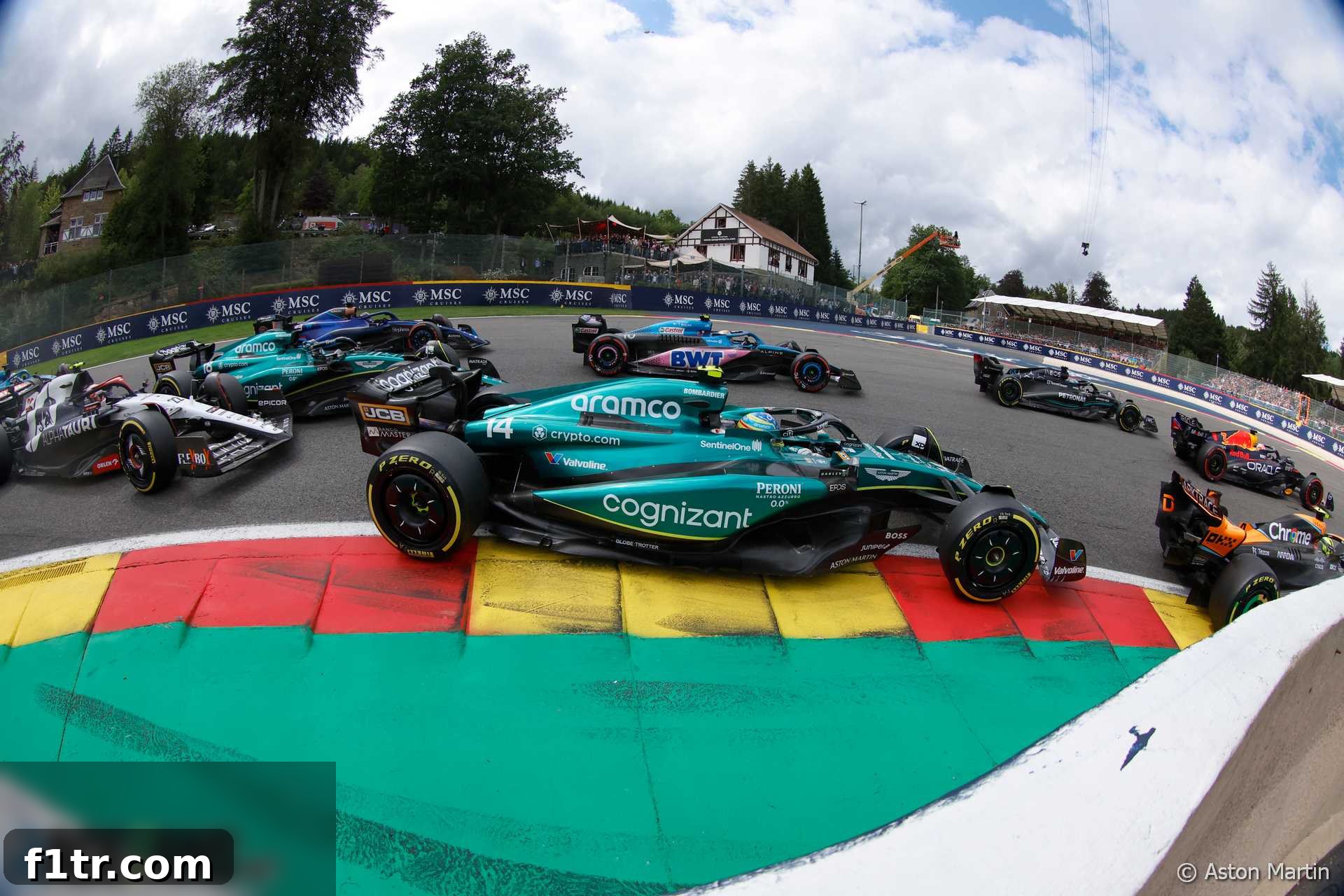
In a crucial turnaround for Aston Martin, two-time Formula 1 world champion Fernando Alonso delivered a standout performance at the Belgian Grand Prix, securing his best result since the Canadian Grand Prix. The Spanish driver finished a commendable fifth after starting ninth, indicating a significant step forward for the Silverstone-based team which has recently faced challenges in maintaining its early-season competitive edge. Alonso’s strong finish signals that the team has successfully identified and begun to address some of the underlying issues plaguing their AMR23 challenger in recent races.
Aston Martin’s Resurgence: A Crucial Fifth Place at Spa
Speaking to media, including RaceFans, following his impressive drive at Spa-Francorchamps, Alonso expressed palpable relief and renewed confidence. “I felt definitely more competitive than the last few events,” he stated, highlighting the team’s concerted efforts to understand and rectify their car’s performance inconsistencies. This sentiment marks a welcome change after a period where Aston Martin appeared to lose ground to key rivals such as Mercedes and McLaren.
Alonso’s race was not without its moments of fortune and strategic brilliance. He capitalised on early race incidents, gaining several positions after Oscar Piastri and Carlos Sainz Jnr tangled at the start. Reflecting on this pivotal moment, Alonso admitted, “I was lucky at the start before Eau Rouge, I made a few places there.” Despite the initial gains, an underlying concern about the car’s long-run pace lingered. “I was a little bit worried we would fall back and the pace would not be good enough to keep that position,” he confessed.
However, these fears proved unfounded. The AMR23 demonstrated a marked improvement in race trim, allowing Alonso to not only maintain but also consolidate his position against formidable competitors. “But it was good, today the car felt fast. We kept one Mercedes behind, one McLaren behind, so we were in the mix and that’s good news before the summer break,” he proudly shared. This ability to contend directly with top-tier cars from rival teams underscores the effectiveness of the changes implemented by Aston Martin, providing a much-needed morale boost as the championship heads into its traditional mid-season hiatus.
Navigating the Treacherous Conditions of Spa-Francorchamps
The 2023 Belgian Grand Prix weekend presented a unique set of challenges, particularly due to the mixed and constantly evolving weather conditions. The rain-affected sprint race format meant that teams had limited dry running, making optimal setup choices for the main grand prix, which was expected to remain dry, a particularly arduous task. Alonso elaborated on the difficulties, noting, “It was not an easy weekend to go into the rhythm and the wet qualifying and the track changing all the time. So not much experience on dry.”
The variable conditions at Spa are notoriously tricky, even for the most experienced teams and drivers. The lack of consistent running in any single condition made it a true test of adaptability and engineering prowess. Alonso emphasised that this unpredictability, rather than the specific wet or dry setup, was the paramount challenge. “More than the wet or dry set-up [it] was the changeable conditions. We never did two laps with the same conditions all through the weekend,” he explained. This meant teams were constantly having to make educated guesses and compromises, hoping their predictions for Sunday’s dry race would pay off. For Aston Martin, the fact that their setup proved effective despite these handicaps speaks volumes about their improved understanding of the AMR23.
The Breakthrough: Understanding the AMR23’s Set-Up Challenges
The strong performance at Spa represents a significant psychological and technical breakthrough for Aston Martin. Following the Hungarian Grand Prix, the team candidly admitted they had lost valuable ground to their rivals. This regression was attributed to specific set-up decisions made with the AMR23, which had an adverse impact on the car’s balance and overall performance, particularly evident in qualifying and during longer race stints. The complexities of modern F1 cars mean that even minor setup changes can have cascading effects on tyre degradation, aerodynamic efficiency, and driver confidence.
Alonso’s comments after the Belgian Grand Prix provide clear evidence that the team’s intensive analysis and subsequent adjustments have begun to pay dividends. “The car felt fast today. The guys did an incredible job again on the strategy, also on the pit stops. We made a few places also yesterday even if we didn’t finish the race,” he remarked, underscoring the collective effort that goes into every successful race weekend.
The relief within the team was palpable, as Alonso articulated, “I think today the car felt more normal. We had a few faults after Hungary, after Silverstone, so the team was making a few set-up changes also to the car and I think it paid off today. The car felt much more normal, more competitive, so happy and a good boost for summer.” The term “normal” from a driver’s perspective often implies a predictable, balanced, and responsive car – characteristics that were seemingly lacking in the preceding races. This return to a more familiar and competitive feel for the AMR23 is vital for the team’s continued development path and championship aspirations.
Lance Stroll’s Perspective: A Step Forward, But More to Do
Joining Alonso on the fifth row of the grid and finishing four places behind him in ninth, Lance Stroll echoed his teammate’s sentiments regarding the progress made with the car. His points finish further cemented Aston Martin’s improved showing at Spa. “We made some little mods to the car which definitely helped,” Stroll confirmed, acknowledging the positive impact of the team’s recent adjustments.
However, Stroll’s assessment also tempered the enthusiasm with a dose of realistic caution, indicating that the team remains committed to continuous improvement. “But I think we still really have to keep pushing because we’re still not as quick as we want to be,” he added. This perspective is crucial for an F1 team, as complacency can quickly lead to stagnation. While the Belgian Grand Prix offered a significant upturn in form, the ever-evolving nature of Formula 1 demands relentless development to challenge at the very front of the grid consistently.
The positive results from Spa-Francorchamps are a strong indication that Aston Martin is back on the right track. The ability to quickly diagnose and address technical issues, coupled with strong execution during the race, has given the team a much-needed confidence injection heading into the summer break. This period will be vital for further analysis and development, ensuring that the AMR23 continues its upward trajectory and maintains its position as a leading contender in the constructor’s championship as the second half of the season approaches.
2023 Belgian Grand Prix Related Articles
- Haas drivers fear losing battle for seventh after “grim weekend” in Spa
- Mercedes optimistic they’re “in the right place for winter” with development plan
- Ferrari not convinced by call to equalise engines: ‘Renault is not so far away’
- Ferrari staying “calm” amid swings in performance from race to race
- Pirelli proposes new “super-intermediate” to address wet weather tyre problems
Browse all 2023 Belgian Grand Prix articles