Red Bull’s Grid Interference: Unpacking the €50,000 Fine and the Nuances of F1 Start Procedures
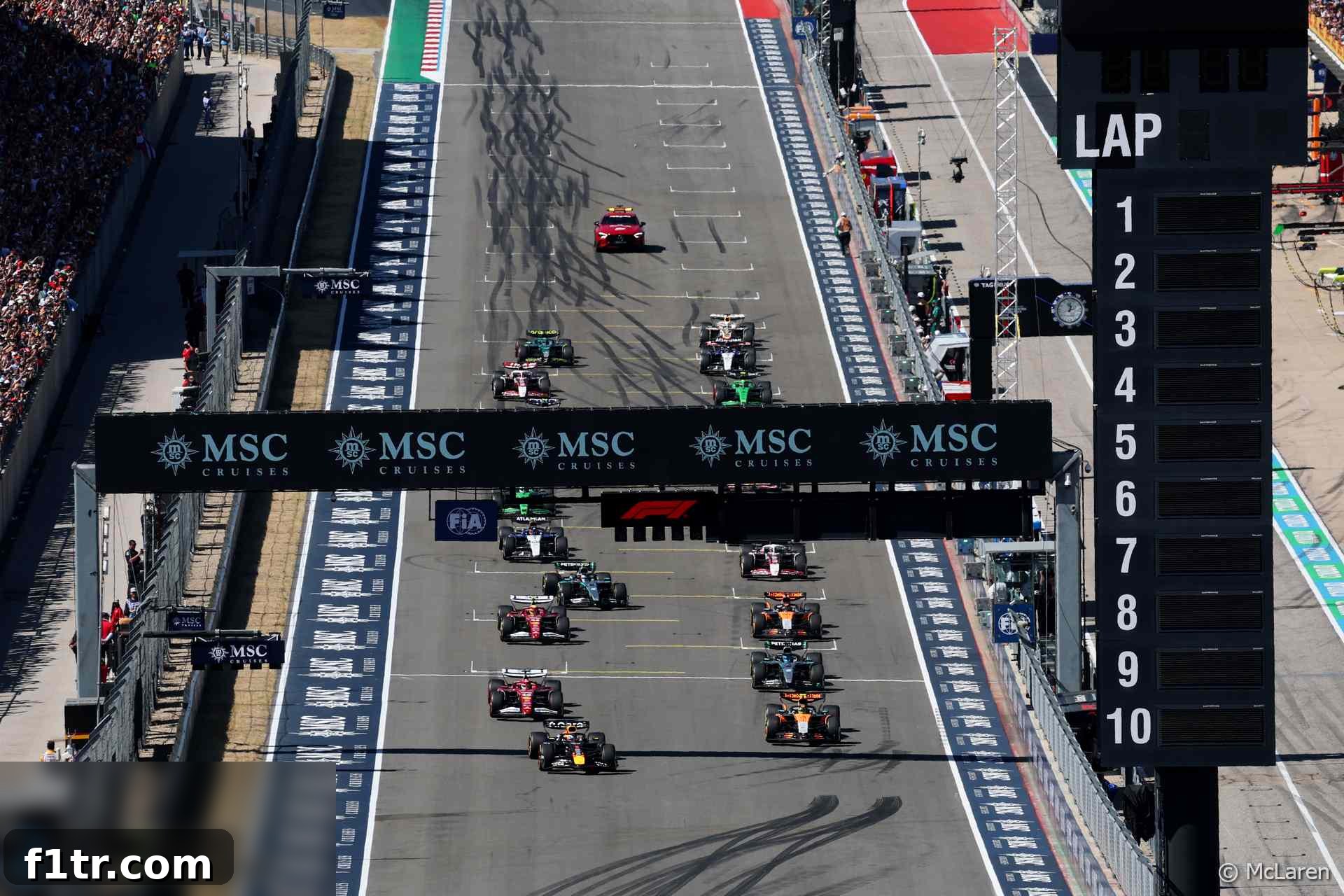
The high-stakes world of Formula 1 often sees teams pushing the boundaries in their relentless pursuit of competitive advantage. This ethos was starkly highlighted at the recent United States Grand Prix, where Red Bull Racing found itself on the wrong side of the regulations, incurring a hefty €50,000 fine for interfering with rival driver Lando Norris’s grid positioning. The incident, which involved a Red Bull team member venturing into a prohibited area during the formation lap, sparked considerable discussion about sportsmanship, rule enforcement, and the intricate details that can sway a race outcome.
Red Bull team principal Laurent Mekies openly admitted that the team had “gone too far” in their efforts, describing the situation as a culmination of “silly games” that had escalated between various teams over several races. This candid admission suggests a potential shift in approach, with Mekies indicating a move towards more controlled conduct moving forward. The financial penalty, split between an immediate payment and a suspended portion contingent on future compliance, underscores the FIA’s commitment to maintaining fair play and adherence to established protocols, even for infractions that might seem minor to an outsider.
The US Grand Prix Incident: A Deep Dive into Competitive Tactics
The core of the controversy at the Circuit of the Americas revolved around a piece of tape. McLaren, Norris’s team, had strategically placed a piece of tape on the wall adjacent to Norris’s grid slot. The purpose was ingenious and entirely within the spirit of gaining a marginal advantage: to provide Lando Norris with an additional visual reference point, helping him to position his car as far forward as possible within his designated grid box without crossing the line. In a sport where fractions of a second can dictate victory or defeat, even a few centimeters gained at the start can prove crucial, allowing for better reaction times and a stronger launch.
However, Red Bull perceived this as an unfair advantage. During the formation lap, a member of the Red Bull crew entered a prohibited area on the grid with the explicit intention of removing this McLaren tape. This action was promptly detected by race stewards, leading to the investigation and subsequent fine. The stewards’ decision to impose a significant penalty reflects the seriousness of violating designated track areas, particularly during a live race procedure like the formation lap. Such areas are off-limits for personnel to ensure safety and prevent any unauthorized interference with competing vehicles or race operations.
The incident wasn’t an isolated attempt by Red Bull. Mekies’ statement implied that similar tactics, albeit perhaps less overt, had been tried on previous occasions. This reveals the constant strategic cat-and-mouse game played by Formula 1 teams, where every potential loophole or advantage is scrutinized and, if deemed beneficial, exploited or countered. It’s a testament to the hyper-competitive environment where even small, seemingly innocuous details like tape on a wall can become points of contention and regulatory action.
The Critical Art and Science of Formula 1 Grid Positioning
To fully appreciate the gravity of Red Bull’s actions and McLaren’s innovative tape, one must understand the inherent challenges F1 drivers face when lining up on the grid. From the cockpit of a modern Formula 1 car, visibility is notoriously limited. The driver is ensconced low in the chassis, with the large front tires, complex aerodynamic elements, and the halo device obstructing their view of the track surface immediately in front of them. This makes precise positioning on a grid slot, which is only marginally larger than the car itself, an incredibly demanding task.
To aid drivers, a distinct yellow reference line is painted across each grid slot. The objective is for the front wheels of the car to be positioned as close to, but not over, this line. Getting it wrong can lead to severe penalties, as a perfect start is often the best opportunity to gain positions, especially in the opening meters of a Grand Prix. A few centimeters too far back can mean losing crucial momentum, while crossing the line prematurely results in a jump start penalty, typically a five-second time penalty or a drive-through, which can devastate a driver’s race.
The pressure on drivers during the grid lineup is immense. With hundreds of millions watching, the tension palpable, and the knowledge that a fraction of a second can alter their race trajectory, every aspect of the start procedure is meticulously practiced. Therefore, any aid, like McLaren’s tape, that can provide even a slight improvement in a driver’s ability to consistently hit their mark perfectly becomes a highly prized asset. It eliminates guesswork and allows the driver to focus purely on the reaction to the lights, rather than simultaneously judging their car’s exact position.
Lando Norris: A History with Grid Penalties and Verstappen’s Vigilance
The incident at the US Grand Prix gains further context when considering Lando Norris’s previous experiences with grid positioning. At the Bahrain Grand Prix, Norris had already received a five-second time penalty for failing to line up in his starting position correctly. This earlier transgression underscores the very real consequences of misjudging one’s position on the grid.
Interestingly, it was Red Bull driver Max Verstappen who reported Norris’s error over his team radio during the Bahrain GP, stating: “Lando is over his grid box.” This highlights the acute awareness and competitive vigilance among rival drivers and teams. In Formula 1, competitors are not just racing against each other on track; they are constantly monitoring each other for any slight infraction or advantage, ready to flag it to the race stewards. Verstappen’s quick observation in Bahrain ultimately led to Norris’s penalty, illustrating how crucial every detail is under the intense scrutiny of an F1 weekend.
Norris’s reaction to the Bahrain penalty – “I didn’t think I was that far forward. Nothing more than that.” – perfectly encapsulates the challenge from the driver’s perspective. It’s not always a deliberate act of seeking an unfair advantage, but rather an honest misjudgment due to the limited visibility and the high-pressure environment. This past incident with Norris undoubtedly motivated McLaren to devise a robust solution, such as the tape, to prevent a recurrence, inadvertently setting the stage for the Red Bull interference at Austin.
Regulatory Oversight and the Deterrent Effect of Fines
The penalty handed down to Red Bull was not merely a slap on the wrist. The €50,000 fine, with half immediately payable and the other half suspended until the end of the year, serves as a significant deterrent. The suspended portion specifically targets the prevention of similar offences in the remaining rounds of the championship, effectively placing Red Bull under strict observation. This structured penalty aims to ensure immediate accountability while also encouraging long-term behavioral change.
The FIA (Fédération Internationale de l’Automobile), as the governing body of motorsport, maintains a comprehensive rulebook covering every aspect of a Grand Prix weekend. Rules pertaining to personnel access to designated areas, particularly during critical phases like the formation lap, are stringent for both safety and fair play reasons. Any breach of these rules is taken seriously. The stewards, comprising experienced individuals with a deep understanding of motorsport, are tasked with interpreting and enforcing these regulations consistently and impartially.
This incident reinforces the idea that no team, regardless of its success or stature, is above the rules. It underscores the FIA’s role in upholding the integrity of the sport and ensuring that competition remains fair and within defined boundaries. The transparency in addressing such infractions is vital for maintaining credibility and trust among teams, drivers, and the global fanbase.
The Unseen Battle: Team Rivalry and Marginal Gains in F1
Laurent Mekies’ comment about “silly games” offers a fascinating glimpse into the intense, often unseen, battle waged by Formula 1 teams. Beyond the spectacular racing on track, F1 is an arena of relentless innovation, strategic maneuvering, and the pursuit of “marginal gains” – tiny advantages that, when combined, can create a significant performance delta. McLaren’s tape was a classic example of this: a low-tech solution to a high-tech problem, seeking to optimize a critical phase of the race.
Team rivalry in F1 is legendary. From McLaren vs. Ferrari in the Prost-Senna era to Mercedes vs. Red Bull in recent years, the competitive spirit often extends beyond the track to psychological warfare and strategic counter-measures. Teams constantly analyze their rivals’ cars, strategies, and even their pre-race rituals for any perceived advantage they might be gaining or any vulnerability they might have. Reporting an opponent’s potential rule breach, as Verstappen did with Norris in Bahrain, is a common and legitimate part of this competitive landscape.
However, there’s a fine line between legitimate competitive tactics and actions that cross into unfair interference or rule-breaking. Red Bull’s attempt to remove the tape clearly crossed that line, leading to the penalty. This incident serves as a reminder that while innovation and strategic thinking are celebrated, they must always operate within the framework of the established rules and spirit of fair competition. The constant tension between pushing boundaries and respecting regulations is a defining characteristic of Formula 1.
Looking Ahead: Implications for Future F1 Starts
The Red Bull fine and Mekies’ subsequent admission will undoubtedly have repercussions. Other teams will be more cautious about similar “silly games,” knowing the FIA is willing to impose substantial penalties. It may also lead to clearer guidelines or increased surveillance around grid areas during the formation lap to prevent such occurrences. Teams might also re-evaluate their own “marginal gain” strategies, ensuring they firmly align with the regulatory framework to avoid similar sanctions.
For McLaren and Lando Norris, the incident highlights the effectiveness of their innovative solution, even if it led to a reactive response from a rival. It might encourage other teams to find their own legal ways to aid drivers in grid positioning, perhaps through enhanced onboard visuals or other permitted methods. The ongoing saga of grid positioning, precise starts, and the constant battle for every advantage continues to be a compelling subplot in the grand narrative of Formula 1. This incident at the US Grand Prix serves as a potent reminder that in F1, every detail matters, and the pursuit of perfection often pushes teams to the very edge of the rules.
Ultimately, the €50,000 fine on Red Bull for interfering with Lando Norris’s start serves as a strong affirmation of the FIA’s commitment to fair play and the integrity of the sport. It underscores the intense scrutiny under which Formula 1 operates, where the smallest details can trigger significant consequences, shaping not just race results but also the very conduct of the teams involved. As the season progresses, it will be interesting to observe how this incident influences future team behavior and the overarching competitive dynamics on the grid.