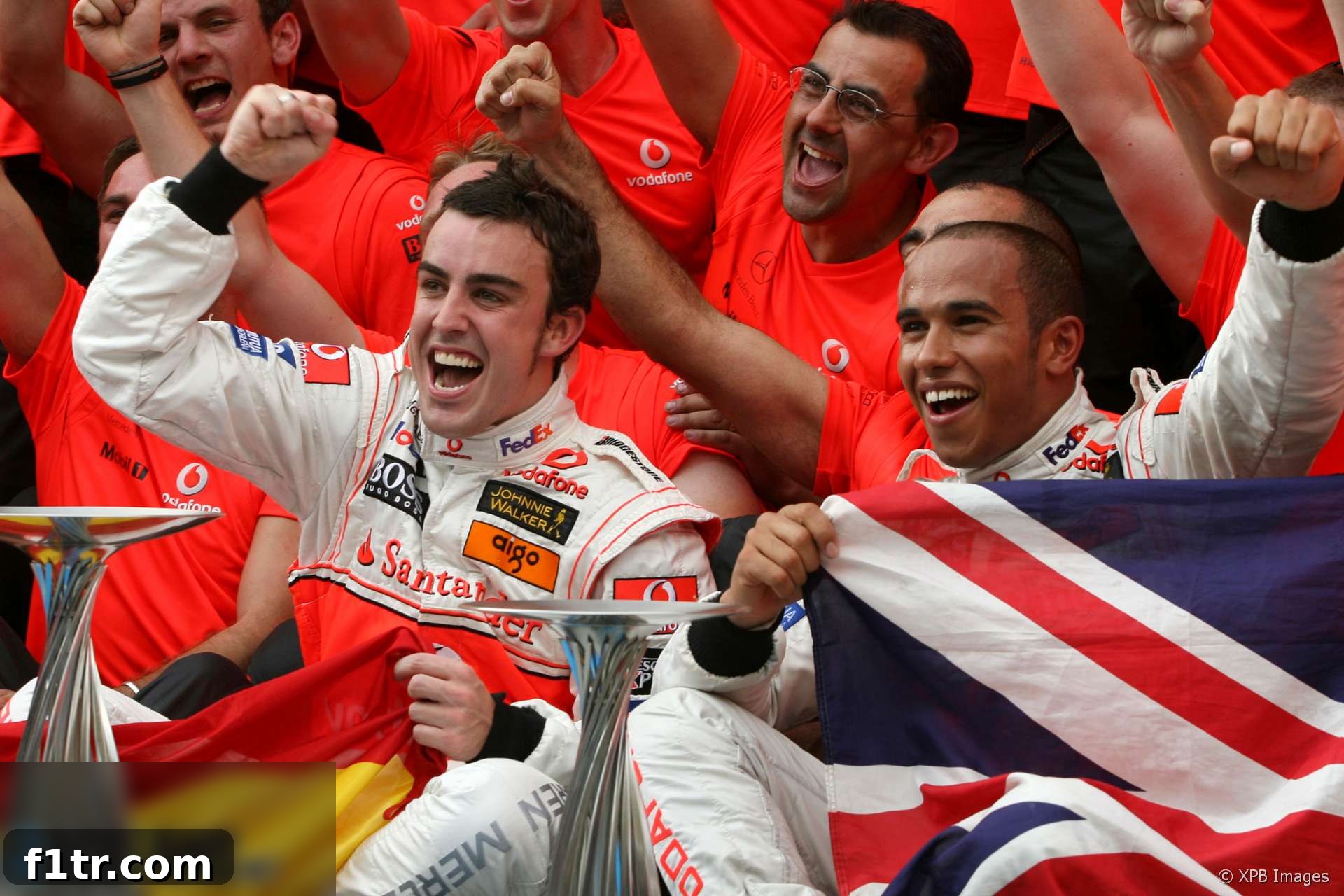
The annals of Formula 1 are replete with legendary driver pairings, duos whose intense rivalry and supreme talent defined eras and captivated millions. Yet, few, if any, command the same level of historical intrigue and sheer raw ability as the 2007 McLaren-Mercedes lineup of Lewis Hamilton and Fernando Alonso. This formidable combination, featuring a reigning double world champion and a prodigious rookie, was unequivocally the “strongest pairing ever” to grace the sport, according to Pedro de la Rosa, who observed their dynamic from the unique vantage point of McLaren’s test driver.
De la Rosa’s assertion, shared with the official F1 website, highlights a season that was as tumultuous as it was spectacular. The 2007 campaign saw Hamilton, then a rookie, and Alonso, a two-time world champion seeking a third consecutive title, engage in an internal battle for supremacy that pushed the boundaries of competition. While the partnership lasted only a single, dramatic season before Alonso’s acrimonious departure, its impact on Formula 1, and the careers of both drivers, was profound and undeniable.
The brilliance of Hamilton and Alonso was evident from the outset. Throughout the season, they consistently demonstrated unparalleled speed, tactical acumen, and a relentless will to win. Each driver secured four victories, culminating in an astonishing tie of 109 points in the drivers’ championship standings. Hamilton, in his debut season, finished ahead on count-back of second-place finishes, a testament to his immediate impact on the sport. However, the internal strife and the infamous ‘Spygate’ scandal ultimately cost McLaren dearly, leading to their disqualification from the constructors’ championship and allowing Kimi Räikkönen to snatch the drivers’ title by a mere single point.
The Unprecedented Talent: Hamilton and Alonso in Focus
Pedro de la Rosa, having spent countless hours analyzing telemetry and working alongside both drivers, possessed an unparalleled insight into their capabilities. His perspective goes beyond mere statistics, delving into the very essence of their driving. “I remember looking at their data and thinking ‘these guys are from a different planet’,” de la Rosa recounted, underscoring the extraordinary skill level that both Hamilton and Alonso brought to the McLaren garage.
Fernando Alonso arrived at McLaren as the reigning world champion, renowned for his clinical precision, strategic brilliance, and relentless consistency. His ability to extract maximum performance from any car, coupled with his unparalleled race craft, made him one of the most formidable drivers on the grid. He was the undisputed leader of the team he had just joined, bringing a wealth of experience and championship-winning pedigree.
Lewis Hamilton, on the other hand, was an unknown quantity in Formula 1 terms, despite his stellar junior career. Stepping into a top team like McLaren for his debut season was an immense challenge, yet he met it with astonishing maturity and blistering speed. Hamilton immediately demonstrated an innate talent, a fearless attacking style, and an uncanny ability to adapt to the pinnacle of motorsport. His raw pace and audacious overtaking maneuvers instantly marked him as a future legend.
The synergy of these two contrasting yet equally potent talents created an electrifying atmosphere. They pushed each other to limits rarely seen, often extracting more from the MP4-22 than seemed humanly possible. This internal competition, while ultimately destabilizing for the team, undoubtedly raised the performance bar for both drivers, forcing them to find reserves of speed and skill they might not have otherwise accessed.
The Unraveling: Spygate and Internal Strife
Despite their individual brilliance and mutual respect on track, the 2007 season was marred by escalating tensions off track. The ‘Spygate’ scandal, involving allegations of McLaren possessing confidential Ferrari technical data, cast a long shadow over the team. This controversy, coupled with the ferocious rivalry between its star drivers, created an unsustainable environment. De la Rosa, who was at the heart of the team, lamented the unfortunate explosion of their relationship. While he acknowledged the public perception, he maintained that Alonso was “wrongly blamed” for certain aspects of the affair, hinting at a more complex internal dynamic.
The rivalry between Hamilton and Alonso was not merely about on-track position; it was a battle for psychological dominance within the team. Incidents such as the Hungarian Grand Prix qualifying, where Alonso was penalized for impeding Hamilton, brought the internal conflict into sharp public focus. These events, combined with the immense pressure of the ‘Spygate’ investigation, ultimately proved too much for the team to manage. Alonso’s decision to terminate his contract early signaled the end of what could have been a dynastic partnership for McLaren.
However, despite the surrounding drama, de la Rosa firmly stressed that the respect between the two drivers on the racetrack remained intact. “They always respected each other massively at the track because they knew how good the other was,” he explained. “Although they never said publicly, they had a lot of respect for each other.” This observation is crucial, highlighting that the core of their competition was purely sporting, driven by an unyielding desire to be the best, rather than malicious intent. “There was nothing wrong ever done at the race track between them. It was always a strong fight, but fair. There was nothing, no pushing or just breaking the front wing, nothing. There was just two gladiators fighting bravely at the race track. So I have no bad memories about that.”
A Cut Above: Comparing Generations of Greatness
De la Rosa’s bold claim that Hamilton and Alonso represent Formula 1’s finest driver pairing places them even above the legendary McLaren duo of Ayrton Senna and Alain Prost from the 1988-89 seasons. This is a significant statement, given the iconic status of Senna and Prost and their own incredibly intense rivalry. De la Rosa, a motorsports veteran, offers a compelling rationale for his view, rooted in the evolution of the sport itself.
“I always think that the new generations are stronger,” he stated. This perspective suggests that as technology advances, training methods improve, and competition becomes ever more refined, each successive generation of drivers tends to push the boundaries of performance further. While acknowledging Senna and Prost as his “heroes, forever heroes,” de la Rosa believes that the sheer technical and physical demands placed on modern drivers, combined with the relentless pursuit of perfection, mean that the current crop of elite drivers operate at an even higher plane.
In this context, the “amazing” level of Fernando and Lewis in 2007, as observed by de la Rosa, was not just about their individual talents but also about how they synergistically elevated each other. Their head-to-head battles were a masterclass in aggressive yet precise driving, showcasing a level of skill that, according to de la Rosa, surpasses even the titans of previous eras.
The Enduring Legacy and the “What Ifs”
The truncated partnership of Hamilton and Alonso remains one of Formula 1’s great “what if” scenarios. De la Rosa articulated this sentiment perfectly: “It was a shame because those two guys they would have brought so many championships to McLaren.” Had the team been able to harness their combined power and navigate the internal and external pressures more effectively, McLaren could have dominated the sport for years to come.
Instead, their departure marked a turning point for both drivers and the team. Alonso sought new challenges, eventually finding success elsewhere, while Hamilton continued his extraordinary journey with McLaren before moving to Mercedes and establishing himself as the most statistically successful driver in F1 history. The 2007 season served as a crucible for Hamilton, forging the steely resolve and competitive fire that would define his career. For Alonso, it was a period of frustration but also a demonstration of his unwavering determination and talent.
The memory of the 2007 McLaren pairing endures not just for the controversies, but for the sheer spectacle of two generational talents operating at their absolute peak, pushing the boundaries of what was thought possible in a Formula 1 car. Pedro de la Rosa’s testimony serves as a powerful reminder of the unparalleled skill, mutual respect (despite the acrimony), and the enduring legacy of a season that, for all its drama, showcased the very best of Formula 1 driving.
Further Exploration of F1 History
- When did F1 last have a mid-season break longer than five weeks? 1990
- Did Norris actually win Formula 1’s closest championship fight of all time?
- Hamilton is Ferrari’s first new driver in 44 years to complete season without a podium
- Ferrari are on course to lose an F1 record they’ve held since 2004
- Red Bull in 2010 or Ferrari in 1979? Past title fights illustrate McLaren’s current dilemma
Browse all history articles