The stage is set for an epic conclusion to the 2024 Formula 1 season. In the sweltering heat of the Abu Dhabi Grand Prix, the final race of a thrilling 24-event calendar, McLaren stands on the precipice of achieving a feat many of their ardent supporters have only dreamed of: clinching the Constructors’ Championship. This coveted title, a testament to the team’s combined efforts in design, engineering, and driving prowess, represents the pinnacle of team success in Formula 1.
The narrative of this season finale is further enriched by the identity of their adversary. For McLaren to seize this ultimate glory, they must overcome their oldest and arguably fiercest traditional rival: Scuderia Ferrari. The clash between these two historic giants of motorsport promises a spectacle steeped in rivalry, prestige, and high-octane drama, making the Yas Marina Circuit the crucible where legacies will be forged or denied.
Qualifying Sets the Stage for High Stakes
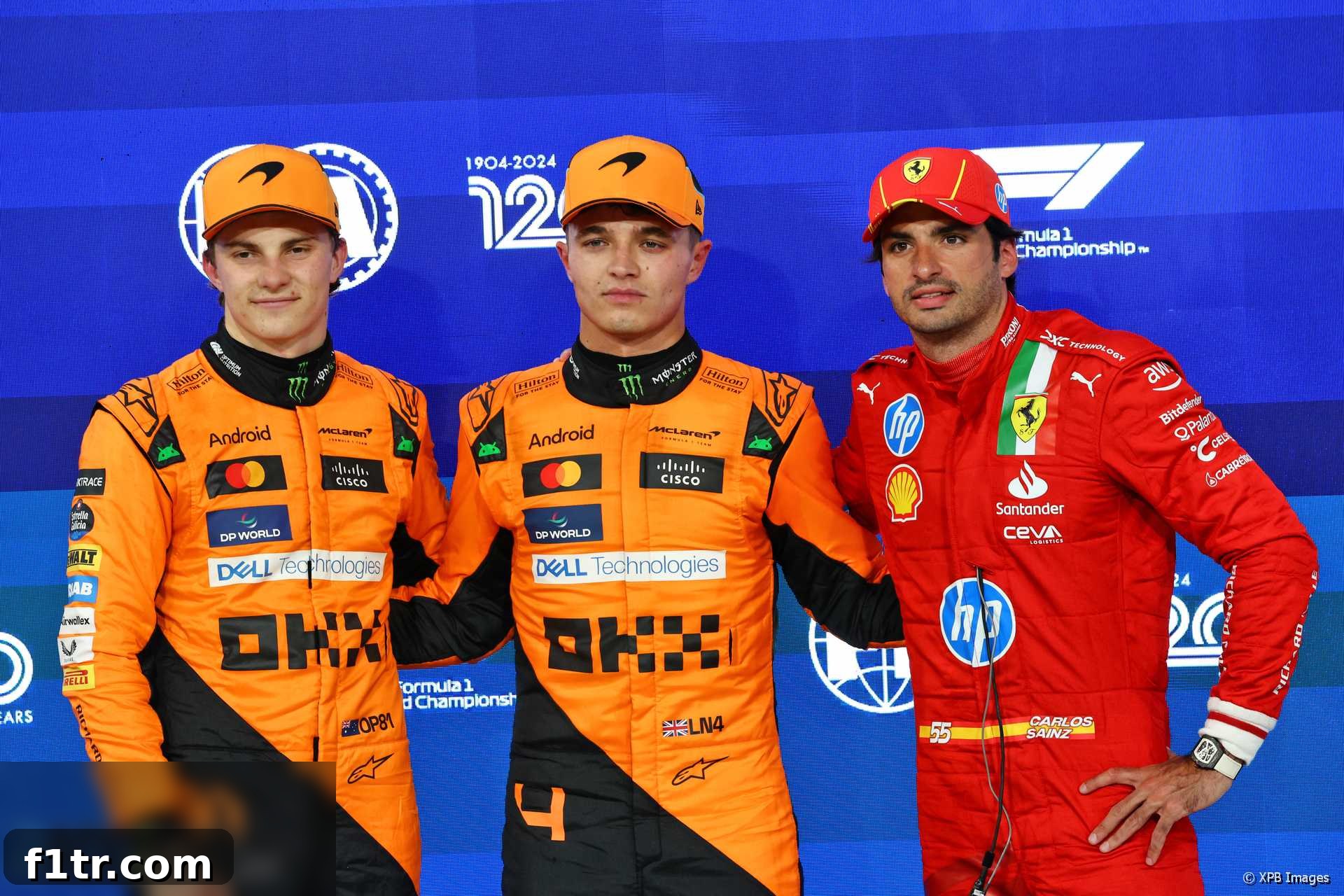
The tone for the championship showdown was decisively set during the qualifying sessions of the Abu Dhabi Grand Prix weekend. McLaren’s drivers, Lando Norris and Oscar Piastri, delivered a performance nothing short of phenomenal. Demonstrating formidable pace throughout Friday and Saturday, they meticulously extracted every ounce of performance from their MCL38 cars. Their efforts culminated in one of the most significant front-row lockouts in McLaren’s recent history, with Lando Norris securing a masterful pole position, his eighth of the 2024 season, and Oscar Piastri bravely planting his car alongside him in second place. This crucial result placed them directly ahead of Ferrari’s Carlos Sainz Jr., who managed a commendable third on the grid.
The palpable tension within the McLaren garage was evident, as Norris articulated after his pole-winning lap: “I think we’ve both been driving well this weekend and we knew the pressure was on, from ourselves. So we’ve both performed well. We’ve both got everything out of the car. But this is a long race, and many things can happen, so we’re definitely not going to get ahead of ourselves.” His words underscored the team’s cautious optimism, acknowledging the substantial advantage gained while remaining acutely aware of the unpredictable nature of Formula 1 racing.
Conversely, Ferrari’s qualifying session was a rollercoaster of emotions, leaning heavily towards the bittersweet. Carlos Sainz Jr., who had notably struggled at the Yas Marina circuit the previous year, delivered a stellar performance, proving that Ferrari’s car was by no means lagging far behind McLaren in raw pace. His qualifying lap, just two-tenths shy of Norris’s pole, highlighted Ferrari’s potential and his own determination. However, the joy of Sainz’s strong showing was overshadowed by a series of misfortunes that plagued his teammate, Charles Leclerc. Leclerc’s weekend began with a debilitating 10-place grid penalty on Friday due to power unit component changes, a severe blow to Ferrari’s championship aspirations before the competitive sessions even began. Adding insult to injury, a brutal Q2 elimination followed after he exceeded track limits, meaning Ferrari’s second car would start an agonizingly distant 19th on the grid. This combination of adverse events amplified McLaren’s advantage, leaving Ferrari with a monumental task for Sunday’s race.
Ferrari’s Uphill Battle: A “Mission Impossible”?
The scale of Ferrari’s challenge was not lost on Carlos Sainz. Reflecting on their situation, he admitted, “I think it was already extremely difficult. It was a bit of a ‘mission impossible’ already before the weekend started.” He further elaborated on the compounding issues: “Then we arrived in FP1 and Charles’ battery died before running and the grid penalty obviously was a huge shock, a huge blow. On top of that, you get the Q2 situation for Charles. It just makes things obviously a lot more difficult.”
Despite the overwhelming odds, Sainz, in what is his final race for the Scuderia before moving on, exuded an unwavering fighting spirit. His determination to push both McLarens to their absolute limit was clear. “Until the chequered flag comes down tomorrow, anything can happen,” he declared. “I’m going to keep fighting for whatever comes. And I’m sure Charles from the back will push flat out to get every single point available and see what happens with the McLarens.” Sainz’s resolve highlights the sheer will to win that permeates the Ferrari camp, even in the face of what appears to be an insurmountable deficit.
Race Day Conditions: Predictably Dry, Strategically Complex
The Abu Dhabi Grand Prix, much like its predecessors, is almost certainly destined to be a dry race. The Yas Marina circuit, nestled in the desert landscape, offers virtually no chance of rain, ensuring that the Constructors’ Championship will be decided under clear skies. This predictability in weather removes one layer of strategic complexity, allowing teams to focus entirely on car performance, tire management, and race execution.
The race itself will unfold in conditions largely consistent with those observed during qualifying and Friday’s second practice session. Ambient temperatures are expected to hover just under 30°C for the 5 PM local race start, gradually falling as the sun dips below the horizon, transforming the day race into a twilight spectacle. Wind, which can often be a disruptive factor, has been minimal throughout the weekend and is projected to remain subdued on Sunday, with speeds lower than the preceding days. This stable environment allows teams to rely heavily on their collected data, reducing the chances of unexpected variables impacting performance.
The Critical Start: A Short Dash to Destiny
The opening moments of the Abu Dhabi Grand Prix will be intensely scrutinized. The run from pole position to the braking point for Turn 1 is a mere 177 meters, one of the shortest on the Formula 1 calendar. This compressed distance significantly limits opportunities for drivers to execute out-braking maneuvers into the first corner, even if the driver starting second on the grid, on the left-hand side, manages a superior launch. The tight confines and rapid approach demand precision and measured aggression from all drivers.
Historically, pole position at Yas Marina has proven to be a considerable advantage. In the last ten Grands Prix held here, the pole-sitter has led the opening lap eight times. Lewis Hamilton is the only driver to have snatched the lead from second on the grid, doing so against Nico Rosberg in 2014 and Max Verstappen in their unforgettable 2021 championship decider. However, this statistical precedent is likely to be overshadowed by McLaren’s immediate team objectives. Oscar Piastri will undoubtedly be under strict instructions to prioritize the team’s championship aspirations over any personal glory in the initial phases of the race. His primary role will be to protect Lando Norris and maintain the lead over Carlos Sainz and the recovering Ferrari, ensuring McLaren’s dominance at the front of the pack.
Strategy and Tire Management: The Path to Victory
Tire strategy will, as always, play a pivotal role in the outcome of the race. Many teams and drivers have already used up a significant number of their soft compound tires over the weekend, a tactical decision indicating a clear preference for other compounds on race day. Indeed, the soft tires are almost certainly not the preferred choice for Sunday’s main event.
Last year, the field largely converged on a two-stop strategy. The top eight finishers all opted for a consistent approach, starting on medium tires before executing two stints on the harder compound. Notable exceptions included Yuki Tsunoda, who managed a single-stop strategy to finish ninth, and Lance Stroll, the only driver within the top ten to run a hard-hard-medium compound sequence. This year, however, Pirelli’s predictions lean towards a one-stop strategy as the optimal route, mirroring the approach seen at the recent Qatar Grand Prix. This involves starting on the medium tires and then switching to the hard compound for the remainder of the race. This revised prediction is attributed to lower levels of tire degradation observed this weekend compared to the same event last season. McLaren, with their front-row advantage, will likely aim for a textbook one-stop race, whereas Ferrari, particularly Charles Leclerc from the back, may need to explore more aggressive or unconventional strategies to make up ground.
Overtaking Opportunities: The Impact of Track Modifications
Yas Marina has historically not been lauded for its abundant overtaking opportunities, often leading to processions rather than thrilling wheel-to-wheel battles. However, significant reprofiling efforts at both ends of the track ahead of the 2021 season have had a demonstrably positive impact on the racing spectacle. These modifications aimed to create faster, more flowing sections conducive to improved overtaking.
The statistics bear this out. The seven races held under the circuit’s old configuration (2014-2020) averaged 25.7 successful on-track overtakes per race, excluding passes made on the first lap. Following the 2021 changes, the subsequent three races have seen a marked increase, averaging 44.3 passes per race. The two most obvious overtaking zones remain at the end of the two DRS (Drag Reduction System) zones, specifically into Turns 6 and 9. While the DRS zone along the back straight approaching Turn 6 has been reduced by 50 meters for this year, it did not appear to significantly hinder passing opportunities in Saturday’s F2 sprint race, where several decisive moves were executed into both turns. This suggests that while overtaking is still challenging, it is certainly not impossible, offering a glimmer of hope for Ferrari’s recovery drive.
Safety Cars: A Rare But Potentially Decisive Element
The Yas Marina circuit, with its extensive asphalt run-off areas and generally high safety standards, is not a track renowned for frequent Safety Car deployments. Over the last ten Grands Prix held here, only three full Safety Car periods have been necessary, complemented by just two Virtual Safety Car periods. The last two Abu Dhabi Grands Prix, in fact, ran entirely free of any Safety Car interventions. This historical trend suggests a relatively clean and uninterrupted race, which would favor McLaren’s strong starting position and straightforward strategy.
However, the most memorable and controversial Safety Car deployment in the sport’s history occurred here, following Nicholas Latifi’s crash at Turn 14 towards the end of the 2021 race. This serves as a potent reminder that even on a seemingly safe circuit, unforeseen incidents can dramatically reshape the race’s dynamics and, in a championship decider, have monumental consequences. A Safety Car could either consolidate McLaren’s lead by bunching up the field, or, conversely, offer a strategic lifeline to Ferrari, allowing them to close the gap and potentially execute an opportunistic pit stop.
One to Watch: Lewis Hamilton’s Final Mercedes Dance
As the curtain falls on the 2024 season, all eyes will be on several key players, but one stands out for a unique reason: Lewis Hamilton. This Abu Dhabi Grand Prix marks his final race for Mercedes-AMG Petronas F1 Team, bringing an end to an era of unprecedented success that yielded eight Constructors’ Championships and six Drivers’ Championships. Starting from a disappointing 16th position on the grid, far lower than both he and his team would have desired, it is widely believed that Hamilton’s raw pace during Q1 suggested he deserved a much higher grid slot, before issues prevented him from progressing further.
Hamilton now faces the challenge of concluding his illustrious tenure with Mercedes on a high note. The parallels to Michael Schumacher’s final race for Ferrari before his initial retirement in 2006, where he produced a stunning fight from the back of the grid in Brazil, are hard to ignore. Hamilton will undoubtedly be desperate to emulate his fellow seven-time world champion, aiming to conjure one final moment of magic, one last unforgettable drive, before embarking on his next chapter with Ferrari in 2025. His performance, while unlikely to directly impact the Constructors’ Championship battle at the very front, could still influence the points distribution further down the order and provide a compelling individual storyline in this monumental season finale.
The Final Verdict: A Championship Decider for the Ages
The 2024 Abu Dhabi Grand Prix presents a captivating blend of strategic warfare, driver skill, and raw emotion. McLaren holds a distinct advantage with their front-row lockout and superior grid positions, giving them the best possible platform to secure their first Constructors’ Championship in years. Ferrari, despite the immense challenges posed by Leclerc’s grid penalty and Q2 elimination, remains a formidable opponent, with Carlos Sainz Jr. leading their charge with unyielding determination.
Every lap, every corner, and every pit stop will be crucial. The stable weather conditions, the unique characteristics of the Yas Marina Circuit, and the looming threat of a rare safety car all add layers of complexity to an already tense situation. As the sun sets over the Arabian Gulf, the world will watch to see if McLaren can hold its nerve and etch its name into the history books, or if Ferrari can mount an improbable comeback to snatch victory from the jaws of defeat. This final race is not merely about points; it is about pride, legacy, and the ultimate triumph in the fiercely competitive world of Formula 1.
Your Thoughts on the Abu Dhabi Grand Prix
Will Carlos Sainz be able to mount a strong challenge against the McLarens for victory on Sunday, or will McLaren convert their dominant qualifying performance into a championship win? Share your views and predictions on this enthralling Abu Dhabi Grand Prix in the comments below.