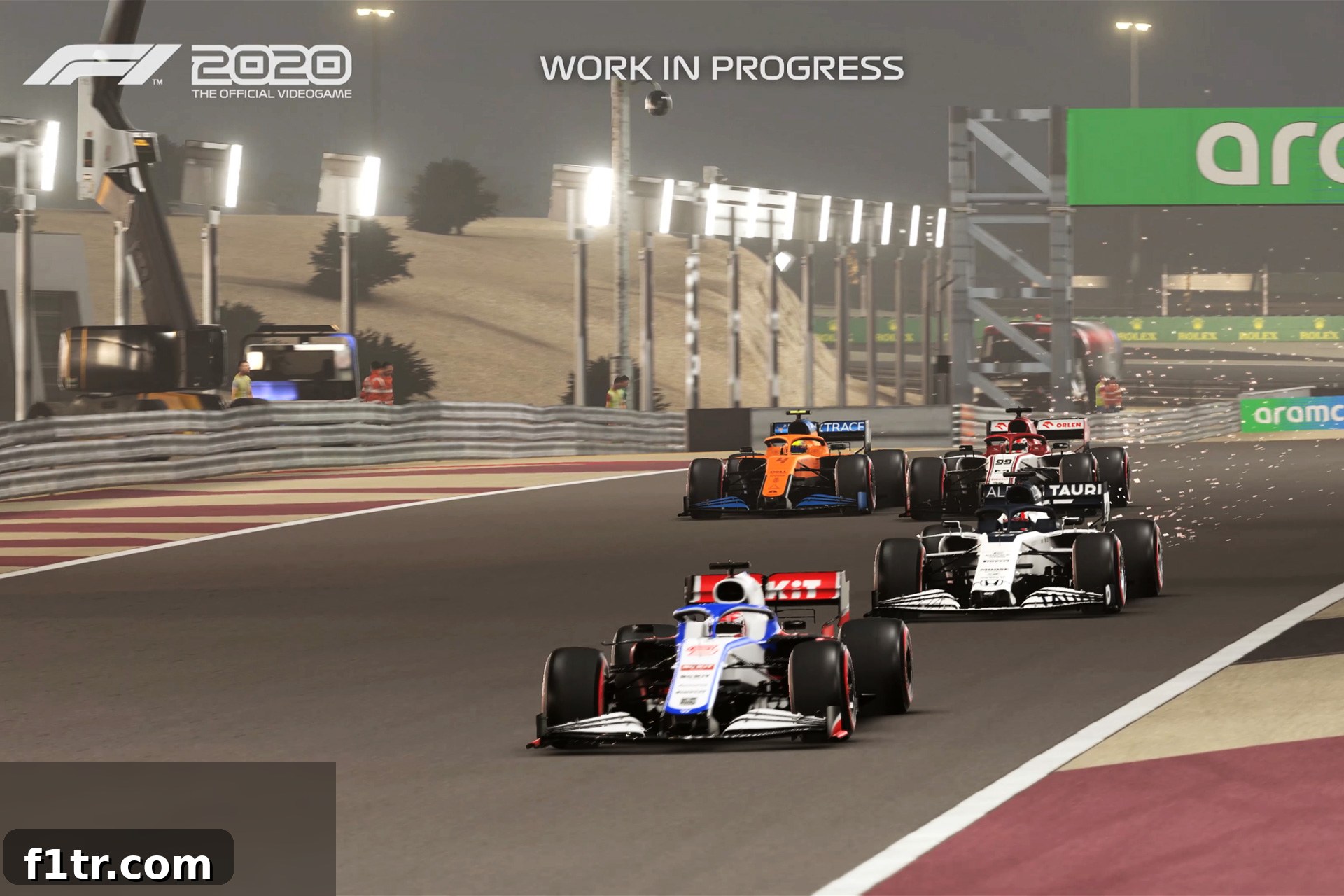
Formula 1 has cultivated a highly successful and enduring partnership with Codemasters, the acclaimed developers behind its official racing game series. This collaboration has thrived for over a decade, consistently delivering immersive motorsport experiences to fans worldwide. The latest iteration, F1 2020, launched to critical acclaim and popular demand, further solidifying Codemasters’ reputation in the racing game genre.
The challenge for any official Formula 1 game lies in its immense appeal to a vast and diverse audience. This demographic spans from seasoned motorsport enthusiasts who have decades of experience with driving games and a deep understanding of F1’s intricacies, to absolute newcomers and first-time players just beginning to grasp the fundamental concepts of racing. Balancing these varied expectations is a delicate art, requiring developers to cater to both the desire for authentic simulation and the need for immediate accessibility.
Codemasters, keenly aware of this dual demand, meticulously crafts each F1 title to satisfy both segments of its player base. F1 2020, for example, introduced significant finely detailed refinements to car physics, which were eagerly embraced by hardcore players seeking an uncompromisingly realistic driving experience. Simultaneously, the game featured a new ‘casual’ driving mode, strategically implemented to lower the barrier to entry for rookies and ensure the game remained approachable for those new to the series or the sport itself. This dual approach aims to expand the game’s reach without alienating its most dedicated fans.
Despite Codemasters’ efforts, a persistent debate echoes within the sim racing community: would Formula 1 be better served by bifurcating its gaming offerings? Many players advocate for two distinct titles: a light, highly accessible ‘arcade’ style game designed for casual gamers and newcomers wielding joypads, focusing on immediate fun and easy mastery. Parallel to this, they envision an uncompromisingly realistic simulation, tailored for dedicated players who invest heavily in high-end sim racing peripherals such as wheels, pedals, and even full-fledged sim rigs. This school of thought suggests that attempting to bridge the gap between these two extremes within a single game inevitably leads to compromises that neither fully satisfies.
These proponents of a dedicated F1 simulator found a glimmer of hope when Formula 1 leadership openly acknowledged the surging popularity of “hardcore simulation” games. F1 confirmed it was actively exploring the feasibility of adding such a highly realistic title to its expanding portfolio of official licensed games. This consideration was almost a necessity, given the undeniable success stories from other motorsport categories. Championships like IndyCar, NASCAR, and Australian Supercars have profoundly demonstrated the immense value of licensing their cars for iRacing, a platform renowned for its unparalleled simulation accuracy and vibrant competitive scene. During periods of real-world racing hiatus, particularly during the global pandemic, a significant number of their actual drivers gravitated towards iRacing, showcasing its credibility and appeal.
The contrast with Formula 1’s own virtual endeavors became stark. While iRacing effortlessly attracted top-tier drivers from other series, F1’s Virtual Grand Prix events, utilizing the official F1 2019 game, struggled to consistently field even a handful of its regular grid members. It often took weeks to gather as few as eight current F1 drivers for a virtual race. Prominent figures such as Max Verstappen and Romain Grosjean publicly stated their preference for iRacing for their sim racing activities, highlighting the perceived gap in realism and competitive integrity. This preference underscored the desire among real-world professionals for a simulator that mirrored their on-track experiences with greater fidelity.
Further emphasizing this sentiment, McLaren driver Lando Norris, who participated in both IndyCar and Supercars virtual series in addition to F1’s Virtual Grands Prix, candidly described F1 2019 as “too much like an arcade game” for real-world drivers. Such comments from actual F1 competitors reinforce the notion that while the official F1 game excels at broader entertainment, it may fall short of the exacting standards required for a true professional simulation. This creates a compelling argument for a more specialized, hyper-realistic F1 simulator that could capture the attention of current drivers and appeal to the most demanding sim racers.
However, a crucial and inherent difference makes the creation of an F1 simulator a far more challenging proposition than for series like IndyCar. The technical specifications and designs of cars in championships such as IndyCar are much more tightly controlled and standardized compared to the fiercely competitive, innovation-driven world of Formula 1. For instance, the core mechanics of IndyCar’s Dallara DW12 chassis have remained largely unchanged for nearly a decade. While occasional aerodynamic updates are introduced, and cars are configured with different trim levels for superspeedways versus road and street courses, the underlying platform provides game developers with the luxury of time to meticulously model and refine a single car design.
In Formula 1, this complexity is multiplied several times over. Firstly, each of the ten teams independently designs and constructs its own unique car, a bespoke machine built to its own philosophies and interpretations of the regulations. Secondly, these cars undergo significant evolutionary changes every single year, necessitating a complete re-modelling process annually. Thirdly, further performance-enhancing modifications and upgrades are introduced throughout the racing seasons, sometimes on a race-by-race basis. Fourthly, certain components and aerodynamic packages are rotated and optimized for specific tracks, adding another layer of variability. This relentless pace of development and inherent individuality of each F1 car presents an almost insurmountable challenge for developers aiming to achieve absolute real-world simulation accuracy.
While none of these factors make creating an F1 simulator an utterly insurmountable challenge, they certainly add layers of complexity and cost. A far more significant obstacle, however, lies in the intense secrecy surrounding Formula 1 car designs. Teams are fiercely protective of their intellectual property and competitive advantage, wanting as little information as possible about their intricate car designs to enter the public domain. Once a design secret is revealed, even inadvertently, it can be meticulously analyzed by rivals, potentially surrendering a hard-won competitive edge. This culture of extreme secrecy directly impedes the level of detail that can be incorporated into a publicly available simulator.
Codemasters, as the official game developer, receives essential details and aggregated data necessary to build their virtual models. However, this is largely limited to public specifications and performance metrics rather than the deep, proprietary design secrets. Teams vigilantly guard their valuable design secrets and intellectual property, employing every measure to keep their innovative solutions under wraps. A perfect illustration of this came with the Dual-Axis Steering (DAS) system. Mercedes technical director James Allison certainly did not complete the design of the W11, put down his pencil, and then immediately call Codemasters’ F1 game director Lee Mather to share the groundbreaking innovation.
Like the rest of the world, Codemasters only discovered the existence and functionality of DAS during pre-season testing, because Mercedes found it impossible to completely conceal such a visible and active system. Mather, in response to a question from RaceFans, recounted the discovery: “We watched the video, you see Lewis [Hamilton] doing his little push and his pull and you think ‘that’s incredible’.” This anecdote perfectly highlights the information asymmetry; developers often learn about cutting-edge F1 technology at the same time as the general public, long after design and implementation. This significantly delays their ability to accurately integrate such features into the game, if at all.
As Mercedes junior driver George Russell aptly observed, DAS was merely the visible tip of a vast iceberg when it came to the innovations hidden within the W11. Countless other aerodynamic devices, suspension geometries, engine mapping strategies, and design secrets remain meticulously hidden beneath the car’s pristine surface. The teams’ extreme sensitivity to exposing these secrets is precisely why media personnel and even paddock pass-clutching fans are strictly prohibited from pointing their cameras into the back of cars or anywhere near an F1 machine when its covers are off during testing or in the garage. This level of protection, while understandable for competitive reasons, creates an inherent barrier to achieving complete simulation fidelity.
This raises a fundamental question about the sport’s expectations: Can Formula 1, a championship that encourages teams to invest hundreds of millions of pounds annually to design and build racing cars bristling with cutting-edge, proprietary technology, realistically expect those very same teams to surrender enough intimate details of their cars’ inner workings to enable them to be authentically simulated in a publicly available game? The contradiction is evident. Further complicating this ethical and practical dilemma is the sport’s own history of confidential dealings. This is the same championship which famously struck a secret agreement with one team because the governing body, the FIA, could not definitively determine whether their power unit complied with the highly complex technical regulations.
Could this dynamic change in the future? Perhaps. The highly anticipated technical regulations overhaul, originally planned for 2021 and subsequently pushed to 2022 (and further evolved for future iterations like 2026/2027), aims to reshape the sport. Many believe these new regulations will, to a greater degree than ever before, strip F1 cars of some of their extreme individuality through more standardized parts, tighter design envelopes, and reduced aerodynamic freedom. Whether this is ultimately beneficial for the sport’s identity and innovation remains a subject of considerable debate among fans and pundits. However, it might potentially pave the way towards making a truly publicly-available, hyper-accurate official F1 simulation game a more achievable reality. Such a development would still hinge, of course, on the sport’s conviction that there are enough potential buyers out there to make the significant investment worthwhile, and that teams become more open with certain design data under future regulations.
Don’t miss anything new from RaceFans
Stay connected with the latest Formula 1 news and updates. Follow RaceFans on social media for instant access to breaking stories, analysis, and exclusive content:
- Join RaceFans on Facebook
- Follow RaceFans on Twitter
- Get daily email updates directly from RaceFans
Video: F1 2020 First Play
Immerse yourself in the world of F1 2020 with our exclusive first play video. Witness the graphics, gameplay, and new features firsthand:
For a comprehensive analysis, read our in-depth first play preview of F1 2020. Discover even more videos of F1 2020 gameplay, features, and insights on the official RaceFans YouTube channel:
- Subscribe to RaceFans on YouTube for all our video content
Note: All images and footage displayed in this article showcase F1 2020 in an unfinished, pre-release state, and may not reflect the final product.
Go ad-free for just £1 per month>> Find out more and sign up
Gaming
Explore a wealth of articles related to motorsport gaming, simulation, and the evolving digital landscape of Formula 1. Whether you’re interested in game reviews, sim racing news, or discussions on realism, you’ll find it here.
Browse all Gaming articles