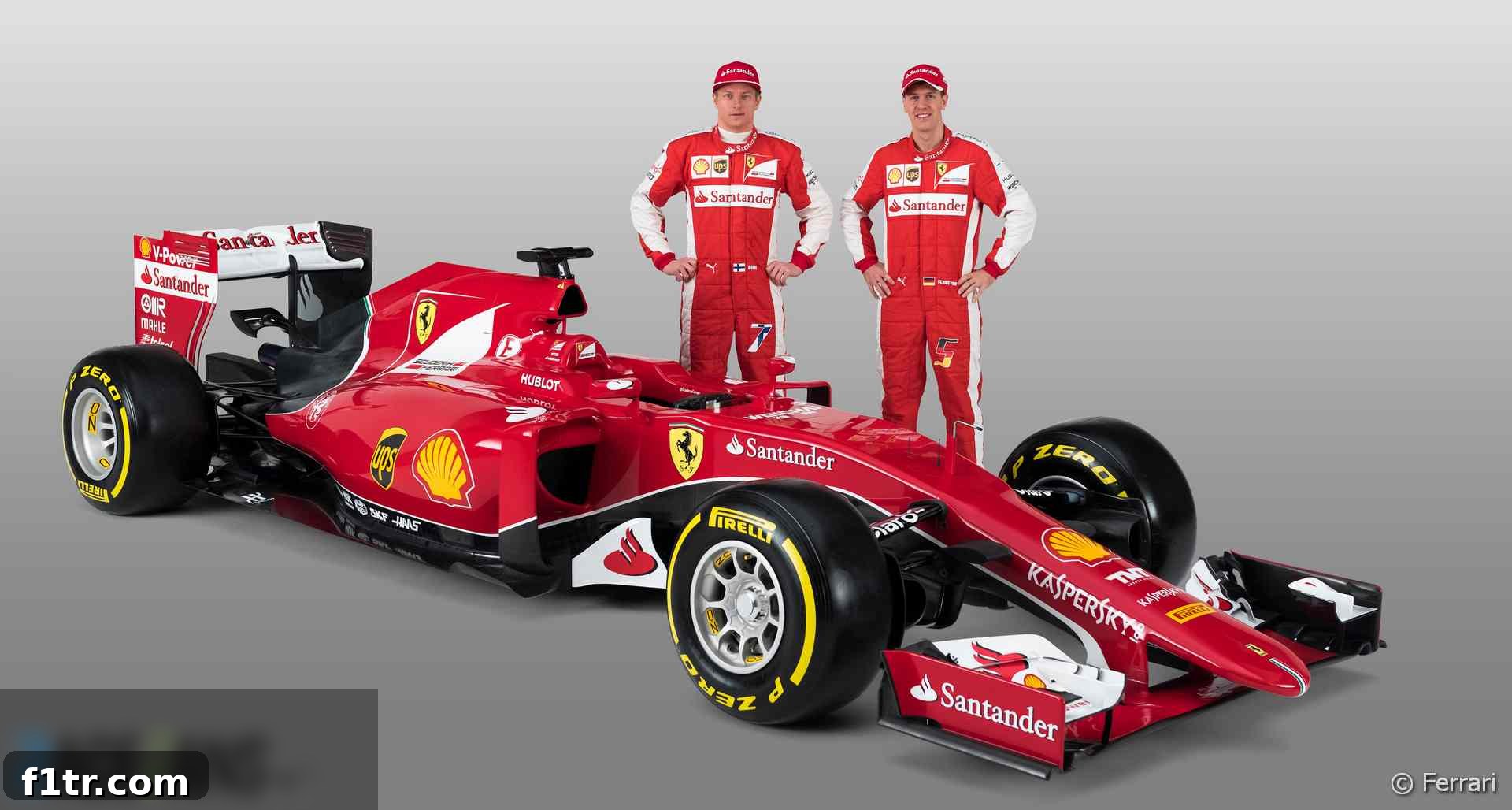
Ferrari SF-15T: A New Dawn for Scuderia in 2015 F1 Season
The unveiling of a new Formula 1 challenger from Maranello is always a moment charged with emotion and expectation. For the 2015 season, the Ferrari SF-15T was not just another racing machine; it represented a profound statement of intent and a symbol of renewed hope for the legendary Scuderia. Following an “unacceptably large gap” in performance during the challenging 2014 season – a year in which Ferrari failed to secure a single Grand Prix victory for the first time since 1993 – the pressure to deliver a competitive car was immense. The first official images of the SF-15T revealed a meticulously re-engineered vehicle, spearheaded by an electrifying driver lineup: four-time world champion Sebastian Vettel joined forces with the returning, popular Finn, Kimi Raikkonen.
This car was designed to mark a significant turning point, a strategic pivot away from the struggles of the past and towards a more dominant future. Technical Director James Allison, a pivotal figure in Ferrari’s engineering department, was candid about the team’s objectives: “We’ve tried to make sure the weaknesses we felt were particularly notable on the ’14 car were put right for the ’15 car.” This mandate underscored a comprehensive commitment to addressing every facet of the car’s performance, from its aerodynamic efficiency and power unit integration to fundamental chassis dynamics, aiming to restore Ferrari’s rightful place at the forefront of Formula 1.
Advert | Become a Supporter & go ad-free
Revitalizing Performance: Tackling the SF-15T’s Predecessor’s Shortcomings
The 2014 season proved to be a harsh reality check for Ferrari, highlighting critical deficiencies across various areas of their F14 T car. The introduction of the complex V6 turbo-hybrid power unit regulations presented a steep learning curve for many teams, but Ferrari struggled particularly with the integration and optimization of their powertrain, which reportedly lacked both power and energy recovery efficiency compared to rivals. Compounding these issues was a chassis that suffered from aerodynamic instability and an inability to generate consistent downforce, leading to a significant performance deficit on track.
Recognizing the depth of these challenges, the development of the SF-15T was approached with a fresh perspective and an aggressive agenda for improvement. The team in Maranello focused on a holistic redesign, ensuring that the chassis and power unit were developed in tandem, rather than as separate entities. This meant a relentless pursuit of greater efficiency, weight reduction, and improved reliability across all systems. The goal was clear: not merely to patch over the old car’s problems, but to engineer a fundamentally stronger and more competitive package, one that could consistently challenge for podiums and victories, fulfilling the high expectations of the Tifosi and the team’s storied heritage.
Aerodynamic Prowess: The Tightly Packaged Rear and Cooling Innovations
A striking aspect of the SF-15T’s design, and a key area of Allison’s focus, was the radical transformation of its rear-end packaging. “The back of the car is something that is noticeably different from the 2014 car where we have been successful in pulling the bodywork much tighter to everything underneath the skin,” Allison explained. This ‘tighter packaging’ is not a mere cosmetic alteration; it’s a crucial aerodynamic strategy. By reducing the overall volume of the car’s rear, the design aims to streamline airflow towards the critical diffuser area, enhancing its efficiency and generating greater downforce while simultaneously minimizing drag. A sleeker rear profile contributes significantly to overall aerodynamic performance, allowing the car to cut through the air with less resistance and improve cornering speeds.
Achieving such compactness is a formidable engineering challenge, especially when dealing with the demanding cooling requirements of a modern hybrid F1 power unit. Ferrari’s solution involved a significant overhaul of its cooling systems. Allison elaborated on the intensive research and development: “That’s been done through a lot of work not just in the wind tunnel but also in the design heart of the company to try and find radiator designs that were fundamentally more efficient. So for every square centimeter of radiator we’re able to extract more cooling this year than last and therefore able to close the car down at the back significantly.” This sophisticated approach meant that instead of simply shrinking components and risking overheating, Ferrari engineered their radiators to be inherently more effective. This allowed for a much tighter bodywork integration without compromising the vital thermal management necessary for optimal engine performance, representing a significant stride in overall car design efficiency.
Aesthetic Appeal Meets Performance: The SF-15T’s Front End
Another area of notable change, and one that garnered widespread approval, was the SF-15T’s front end. The car featured a long, smooth nose, a welcome departure from the often-criticized, ungainly nose designs that had characterized previous F1 seasons due to evolving safety regulations. This cleaner, more elegant aesthetic was a direct consequence of revised regulations governing the front of the car, which aimed to strike a better balance between safety and visual appeal.
Allison expressed genuine enthusiasm for this regulatory shift, noting, “I think all the cars on the grid this year are going to be more appealing around the front because after a few years of trying I think we’ve finally invented a regulation that gets what we wanted from a safety point of view but also doesn’t create the rather unappealing features of the last few years.” This sentiment highlights a common desire within the F1 community for cars that are not only marvels of engineering but also objects of beauty. For Ferrari, a brand deeply intertwined with design and passion, a visually appealing car is intrinsically linked to its identity.
Beyond aesthetics, the nose cone plays a pivotal aerodynamic role, meticulously guiding airflow to the crucial areas beneath the car and towards the front wing. A smooth, integrated nose helps reduce turbulence, ensuring that clean, uninterrupted air reaches other aerodynamic surfaces, thus maximizing downforce and overall stability. The SF-15T’s refined nose suggests a design philosophy that prioritizes harmonious airflow management, a critical factor for achieving competitive lap times.
Strategic Suspension: Ferrari’s Commitment to the Pull-Rod Layout
In a landscape where many Formula 1 teams have converged on push-rod front suspension designs, Ferrari’s decision to steadfastly retain its pull-rod layout for the SF-15T set it apart. This choice wasn’t arbitrary but a calculated engineering decision, deeply rooted in Ferrari’s unique technical philosophy and strategic allocation of development resources. James Allison provided insight into the intricate decision-making process inherent in F1 development: “Every year you set out which areas of the car you think you should put your effort into to try and improve them. These are decisions that need to be taken quite carefully because when you make a choice of working on one part of the car, because you don’t have infinite resources, you’re effectively making a choice not to work on the other part of the car.”
The distinction between pull-rod and push-rod suspension systems is fundamental to a car’s handling and aerodynamic profile. In a pull-rod system, the suspension rod connects to the lower wishbone and pulls upwards towards the chassis to actuate the spring and damper assembly. This arrangement typically allows for a lower center of gravity by positioning heavier components closer to the ground, which can benefit handling. Aerodynamically, a pull-rod setup can offer a cleaner airflow path over the front of the chassis, potentially contributing to more efficient downforce generation.
However, the pull-rod design comes with its own set of challenges, as Allison acknowledged: “Pull-rod is probably harder to get light and stiff but it’s probably a bit easier to get an aerodynamic performance from it. So it’s swings and roundabouts.” Achieving optimal stiffness and minimizing weight are critical for suspension performance, and the pull-rod’s longer linkage can complicate these objectives. Despite these inherent trade-offs, Ferrari’s continued commitment suggested either that they had found effective ways to mitigate the mechanical drawbacks or that the aerodynamic benefits, tailored to their specific chassis design, were too valuable to abandon. Crucially, the front suspension was not identified as a primary performance limitation in the F14 T, allowing Ferrari to focus its finite resources on areas promising greater returns, such as power unit integration and rear aerodynamic packaging, rather than embarking on a costly and time-consuming redesign of a system deemed adequate.
Advert | Become a RaceFans supporter andgo ad-free
The Driver Duo: Sebastian Vettel and Kimi Raikkonen’s Impact
Beyond the impressive technical specifications, the driver lineup for the SF-15T was a significant story in itself. The arrival of Sebastian Vettel at Maranello was nothing short of a landmark event. Having dominated the sport with Red Bull Racing, securing four consecutive world championships, Vettel brought with him not only unparalleled talent but also a formidable winning mentality, extensive development experience, and the ability to inspire a team. His move to Ferrari evoked comparisons to the legendary Michael Schumacher, stirring hopes among the Tifosi for a similar era of dominance.
Paired with Vettel was Kimi Raikkonen, the last driver to win a World Championship for Ferrari back in 2007. Despite a challenging return to Ferrari in 2014, Raikkonen remained a driver of immense natural speed and invaluable experience. The prospect of these two champions, both known for their distinct driving styles and unwavering determination, sharing the garage was tantalizing. Their combined feedback would be instrumental in the ongoing development of the SF-15T, offering a broad spectrum of insights for the engineers. The healthy competition between them was expected to push both drivers to their limits and extract every ounce of performance from the new car, proving vital for Ferrari’s resurgence.
Ferrari SF-15T in pictures
Advert | Become a RaceFans supporter andgo ad-free
The Road Ahead: Ferrari’s Ambitions for the 2015 Season and Beyond
The Ferrari SF-15T was more than just a new chassis and engine; it encapsulated a revitalized spirit within Scuderia Ferrari. The team embarked on the 2015 season with a blend of cautious optimism and fierce determination. While challenging for the World Championship remained the ultimate long-term goal, the immediate focus was on re-establishing consistent performance, narrowing the gap to the dominant front-runners, and regularly securing podium finishes. The meticulous development trajectory orchestrated by James Allison and his engineering team, coupled with the formidable talent and experience of Sebastian Vettel and Kimi Raikkonen, signaled a Ferrari poised for a much stronger competitive presence than in previous years.
The true measure of the SF-15T’s success would unfold during pre-season testing and the opening races of the championship. How effectively the innovative tight rear-end packaging, the aerodynamically refined nose, and the steadfast pull-rod suspension translated into on-track speed and reliability would be under intense scrutiny. For Ferrari, 2015 represented a critical juncture – a season not just about immediate results, but about meticulously laying the groundwork for future triumphs. It was a season dedicated to restoring pride, reaffirming their commitment to innovation, and sending an unequivocal message to the world that the iconic red machines were once again a force to be reckoned with in the thrilling world of Formula 1.
More Formula 1 Pictures and Analysis
- 2026 Japanese Grand Prix in pictures
- 2026 Japanese Grand Prix qualifying day in pictures
- 2026 Japanese Grand Prix practice in pictures
- 2026 Chinese Grand Prix in pictures
- 2026 Chinese Grand Prix qualifying and sprint race day in pictures
View more F1 pictures