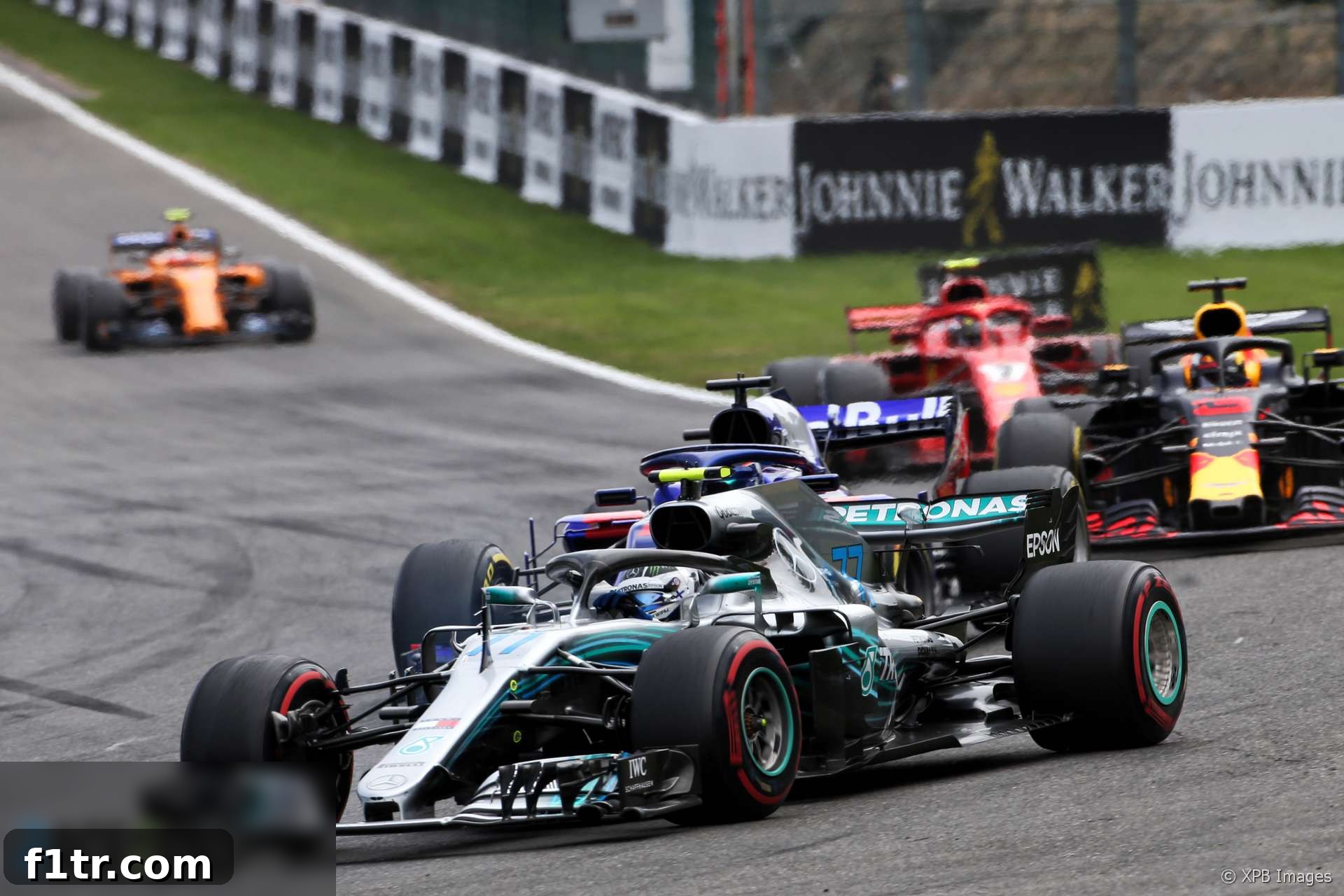
The exhilarating start of the 2018 Belgian Grand Prix at the legendary Spa-Francorchamps circuit was marred by several dramatic incidents, one of which directly involved Mercedes driver Valtteri Bottas. Following a thorough post-race investigation, Bottas was handed a five-second time penalty for causing a collision with Williams’ Sergey Sirotkin during the opening moments of what was ultimately a chaotic race. This incident, while seemingly minor in the grand scheme of Bottas’s race result, sparked discussions about driver judgment, the intricacies of Formula 1 stewarding, and the demanding nature of first-lap racing.
Understanding the Collision: Bottas’s Admission of Fault
The stewards’ official report provided clear insight into the incident and Bottas’s immediate reaction. It stated that Bottas “admitted the collision was his fault, that he had completely misjudged the situation and that the braking of car 35 caught him by surprise and that he should have left more margin.” This candid admission by the Finnish driver highlighted the split-second decisions and extreme pressures faced by Formula 1 competitors. The first corner at Spa, the tight La Source hairpin, is notorious for such incidents, where a slight miscalculation in braking points or car positioning can trigger a chain reaction. Bottas, starting from further down the grid dueah to penalties, was trying to make up positions, a common and aggressive strategy that carries inherent risks, especially into a congested first turn.
The contact with Sergey Sirotkin’s Williams, car number 35, was a direct consequence of Bottas’s perceived misjudgment. While the exact damage or impact on Sirotkin’s race was not detailed in the original report, such collisions, even if minor, can compromise a car’s aerodynamic efficiency or mechanical integrity, severely impacting the affected driver’s performance for the remainder of the race. For Bottas, it was a momentary lapse in judgment, a critical error that, while not dramatically altering his own race, certainly had consequences for his competitor and for his record.
The Immediate Impact: A Five-Second Time Penalty
Despite the penalty, Valtteri Bottas ultimately finished the Belgian Grand Prix in a respectable fourth position. Crucially, the five-second time penalty did not alter his final standing. He crossed the finish line 7.4 seconds ahead of Sergio Perez, who finished fifth. This margin meant that even with the added time, Bottas retained his fourth place, a result that, while not a podium finish, still contributed valuable points to Mercedes’ Constructors’ Championship campaign and his own standings in the Drivers’ Championship. Time penalties are a common form of sanction in Formula 1, typically applied for minor infringements such as speeding in the pit lane, unsafe releases, or causing minor collisions. They are designed to penalize drivers without necessitating a pit-lane drive-through or a harsher grid penalty for a subsequent race, which might be disproportionate to the offense.
The fact that the penalty did not affect his position might lead some to view it as a mere slap on the wrist. However, every second counts in Formula 1, and in a tighter race scenario, a five-second penalty can easily demote a driver several places, potentially costing vital championship points for both the driver and their team. It serves as a stark reminder that even a small error can have significant consequences in the highly competitive environment of elite motorsport. Furthermore, the penalty itself, regardless of its effect on the final classification, officially records the driver’s fault and contributes to their disciplinary record.
Beyond the Race Result: The Significance of Penalty Points
Beyond the five-second time penalty, Valtteri Bottas also received two penalty points on his Super Licence for the collision with the Williams driver. This addition brought his total to four penalty points within the current 12-month period. Formula 1’s penalty points system is a crucial mechanism designed to track driver conduct and deter repeated dangerous driving or infringements. Drivers accumulate points for various offenses, and if a driver reaches 12 penalty points within a 12-month rolling period, they face an automatic one-race ban. This system ensures accountability and promotes safer driving standards across the grid.
For Bottas, reaching four points meant he was a third of the way towards a potential race ban, adding an extra layer of pressure for future races. While four points is not immediately alarming, it underscores the importance of maintaining a clean record. Top drivers, especially those contending for championships, must always be mindful of their penalty point tally, as a race ban could severely jeopardize their title aspirations and their team’s performance. The system acts as a constant reminder for drivers to exercise caution and respect track limits and fellow competitors, even in the heat of battle during a Grand Prix start.
The Driver’s View: “Caught Out by Early Braking”
In his post-race comments, Valtteri Bottas offered his perspective on the incident, attributing the collision to being surprised by the braking behavior of cars ahead. “I got a good start, I was on the inside and just got surprised by how early everyone braked in the inside and I hit the car in front,” he explained. This statement sheds light on the dynamic and unpredictable nature of a Formula 1 race start, especially into a tight corner like La Source at Spa. Drivers are often in a closely packed formation, jostling for position, and braking points can vary significantly based on car performance, tire grip, and individual driver strategies.
The “accordion effect” is a common phenomenon in such situations, where a car braking early at the front of a pack forces subsequent cars to brake even harder, creating a ripple effect. If a driver, like Bottas, is anticipating a later braking point based on their own car’s capabilities or previous laps, being confronted with an unexpected early brake can leave them with insufficient time and space to react, leading to contact. This particular incident serves as a case study in the fine margins that define success and failure in Formula 1, where split-second decisions and accurate judgment are paramount. Even the most experienced drivers can be caught out by the ever-changing variables of a race start.
Stewarding Decisions: Why the Delay in Belgium?
One notable aspect of Bottas’s penalty was the delay in its issuance. The incident occurred on the very first lap of the race, yet the penalty was only handed down after the checkered flag. Race director Charlie Whiting, a highly respected figure in Formula 1 officiating, explained the reasons behind this delay. He admitted, “It was just a bit late being noticed. There was a lot going on that first lap. We sort of didn’t really know why Bottas had come in at the end of the lap. It was just something that was not picked up as an incident.” This explanation highlights the immense complexity faced by race control during the opening lap of a Grand Prix.
Modern Formula 1 races are monitored by an extensive array of cameras, sensors, and telemetry data. However, during a chaotic first lap, race control’s attention is often stretched across multiple developing incidents. Major crashes, such as the one triggered by Nico Hulkenberg at the same event, naturally take precedence, demanding immediate attention to safety and debris clearance. Minor incidents, particularly those that don’t immediately result in a significant retirement or safety car deployment, might be reviewed more thoroughly once the immediate chaos has subsided. Whiting’s comments indicate that Bottas’s incident was initially overlooked amidst the flurry of other events, demonstrating the human element and potential for oversight even with sophisticated monitoring systems.
A Chaotic Start to the 2018 Belgian Grand Prix
The 2018 Belgian Grand Prix began with considerable drama, far beyond Bottas’s contact with Sirotkin. The most significant incident was the terrifying multi-car pile-up triggered by Nico Hulkenberg. The Renault driver misjudged his braking point into La Source, slamming into the back of Fernando Alonso’s McLaren, which was then launched over Charles Leclerc’s Sauber. The severity of this crash, which saw Alonso’s car land on top of Leclerc’s halo-protected cockpit, immediately brought out the safety car and drew the full attention of race control. The sheer scale and potential danger of the Hulkenberg incident meant that lesser collisions, like Bottas’s, understandably took a backseat in the immediate aftermath.
The start of a Formula 1 race, particularly at a circuit like Spa-Francorchamps with its iconic first corner, is always a high-risk, high-reward phase. Drivers push their limits, seeking to gain positions, leading to intense wheel-to-wheel battles. Such crowded conditions heighten the chances of contact, and race stewards must make difficult judgments in real-time or through post-race analysis. The 2018 Belgian Grand Prix serves as a vivid example of how quickly situations can escalate and how multiple incidents can occur almost simultaneously, challenging the capabilities of even the most experienced race officials. The complexity of these opening laps often necessitates comprehensive reviews and can indeed lead to delays in penalty announcements as race control prioritizes immediate safety concerns.
The Anatomy of an F1 Penalty: Time Penalties vs. Grid Penalties
Formula 1 employs a range of penalties to ensure fair play and driver safety, each tailored to the nature and severity of the infringement. Time penalties, like the five-second one issued to Valtteri Bottas, are often applied for in-race transgressions that have a relatively minor impact on safety or the race outcome but still warrant punishment. These can include unsafe pit releases, minor track limit violations, or contact that doesn’t cause significant damage or retirement. Such penalties are either added to a driver’s total race time or served during a pit stop (e.g., a five-second stop/go penalty).
In contrast, grid penalties are typically reserved for more serious offenses or technical breaches, such as exceeding power unit component limits, impeding other drivers during qualifying, or causing a major collision. These penalties affect a driver’s starting position in the subsequent race. The choice between a time penalty and a grid penalty often comes down to the stewards’ judgment of intent, the impact on other competitors, and the overall context of the incident. The consistency and application of these penalties are constantly scrutinized by teams, drivers, and fans, underscoring the delicate balance required to maintain sporting integrity in Formula 1.
Valtteri Bottas’s 2018 Season and Championship Implications
The 2018 Formula 1 season was a challenging one for Valtteri Bottas, especially in comparison to his dominant teammate, Lewis Hamilton, who ultimately secured the drivers’ championship. While Bottas showed flashes of speed and talent, a series of unfortunate incidents, mechanical failures, and strategic challenges often hampered his results. The collision with Sirotkin at Spa, though not race-ending for Bottas, was another instance where his race was complicated by an error. Such incidents, even if minor, collectively contribute to a driver’s season narrative and can impact confidence and championship aspirations.
For Mercedes, every point was crucial in their Constructors’ Championship battle against Ferrari. Bottas’s ability to recover to fourth place, despite the penalty, demonstrated his resilience and the car’s strong performance, ensuring the team maximized their points haul from a difficult weekend. However, these small errors, when accumulated over a season, can make the difference between challenging for a title and playing a supporting role. The 2018 season for Bottas was characterized by moments where he seemed on the cusp of a breakthrough, only for circumstances or minor errors to pull him back, highlighting the immense pressure of driving for a top team in Formula 1.
Looking Ahead: Driver Conduct and the Future of F1 Stewarding
Incidents like the one involving Valtteri Bottas and Sergey Sirotkin at the 2018 Belgian Grand Prix continue to shape discussions around driver conduct, race regulations, and the role of stewarding in Formula 1. The sport is constantly striving for a balance between promoting exciting, aggressive racing and ensuring driver safety and fair competition. The increasing use of onboard cameras, sophisticated telemetry, and real-time data analysis aids stewards in making more informed decisions, yet the human element of judgment remains central to their challenging role.
The penalty points system, the various types of time penalties, and the post-race review processes are all designed to uphold the integrity of the sport. While individual incidents like this one might seem minor in isolation, they contribute to the broader tapestry of F1 racing, influencing driver reputations, team strategies, and the ongoing evolution of the sport’s regulations. As Formula 1 moves forward, the focus on driver responsibility, the clarity of rules, and the efficiency of stewarding will remain paramount in ensuring that the pinnacle of motorsport continues to deliver thrilling yet fair competition for years to come.
Related Articles: 2018 F1 Season Insights
- F1 feared “death knell” for Drive to Survive after Ferrari and Mercedes snub
- McLaren staff told us we were “totally crazy” to take Honda engines in 2018 – Tost
- ‘It doesn’t matter if we start last’: How Red Bull’s junior team aided Honda’s leap forward
- Honda’s jet division helped F1 engineers solve power unit problem
- McLaren Racing losses rise after Honda split
Browse all 2018 F1 season articles