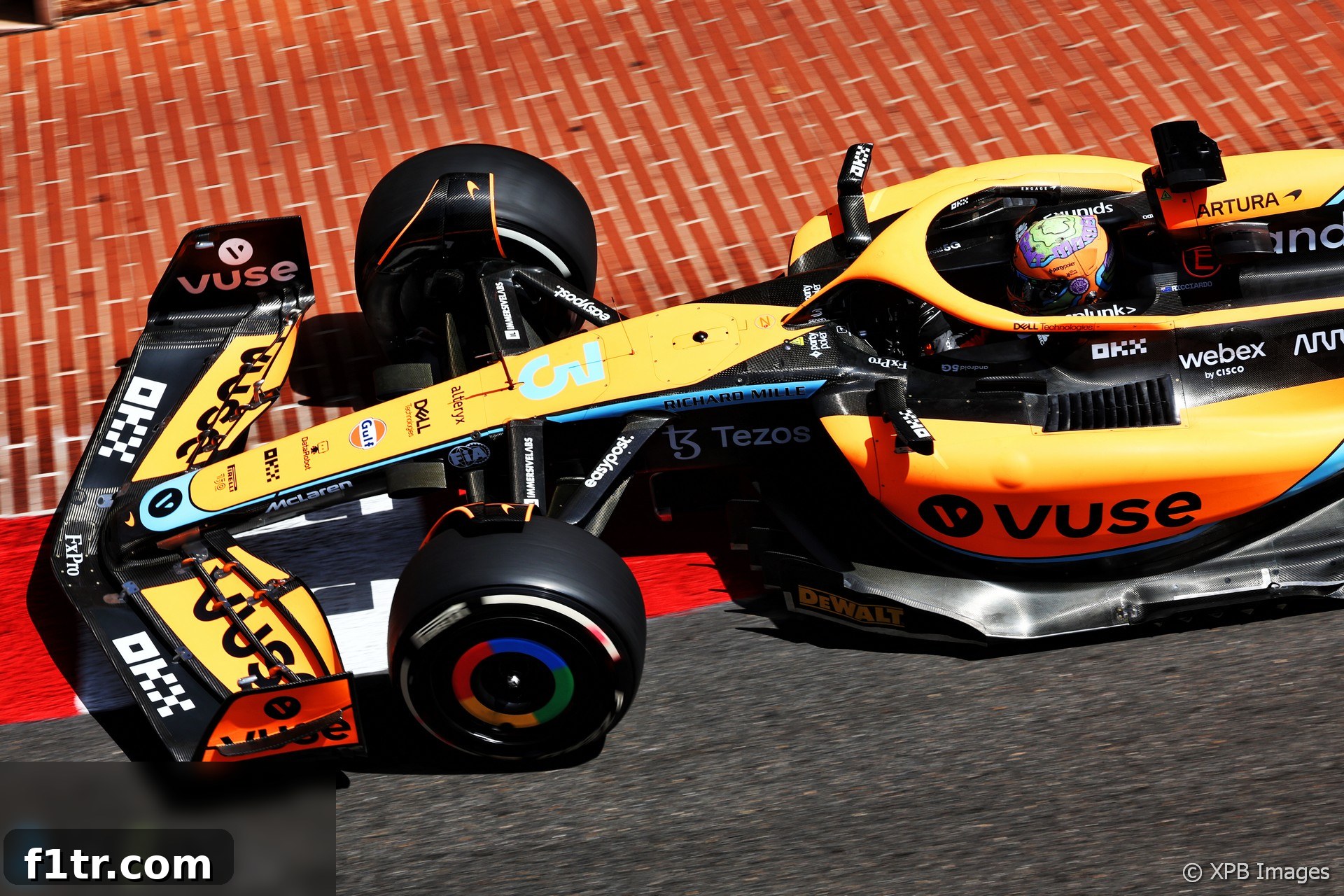
Daniel Ricciardo, the McLaren Formula 1 driver, candidly admitted that his significant crash during the second free practice session for the Monaco Grand Prix was a direct consequence of an overly ambitious approach to his car’s setup. The incident, which unfolded early in the session, saw his MCL36 sustain considerable damage, forcing an premature end to his Friday running and sparking concerns for the remainder of the high-stakes weekend in Monte Carlo. The narrow, unforgiving streets of the Circuit de Monaco offer little room for error, and Ricciardo’s honest assessment underscored the fine margins that define success and failure on this iconic track.
Advert | Become a Supporter & go ad-free
The Australian driver’s dramatic exit from the session occurred within the challenging Swimming Pool complex, a notorious section of the circuit known for its high-speed chicanes and close proximity to the barriers. Ricciardo’s McLaren initially clipped the inside barrier upon entry, a minor touch that proved to be catastrophic. The initial contact compromised the car’s balance, sending it veering towards the exit of the complex, where it ultimately came to a rest against another barrier. The impact, while not appearing outwardly violent at first glance, was enough to cause substantial damage, highlighting the brutal nature of street circuit racing where even the slightest miscalculation can lead to major consequences. This incident underscored the constant battle drivers face to find the absolute limit without overstepping it, especially on a circuit like Monaco where every inch counts.
Recounting the moments leading up to the crash, Ricciardo described a sensation of the car gradually slipping away from his control, despite his best efforts to recover it. “Obviously it happens quickly but it kind of slowed down as well,” he reflected, capturing the paradoxical perception of time during a high-speed incident. “I knew everything that was happening and I tried to save it. But already into Turn 13 I already started losing it, I could feel the car was starting to get away from me.” This detailed account offers a rare glimpse into the intense sensory experience of a Formula 1 driver on the edge, battling their machine as it loses adhesion. He noted that normally, a driver might get away with being “a bit too greedy” on the kerb at Turn 14, implying a typical recovery point that was unavailable to him on this occasion due to the severity of the initial imbalance.
The root cause, according to Ricciardo, lay in an overly aggressive car setup chosen for that particular run. In Formula 1, car setup involves a complex interplay of suspension settings, aerodynamic balance, differential settings, and tire pressures, all meticulously tuned to optimize performance for a specific track. On a circuit like Monaco, where mechanical grip is paramount and aerodynamic downforce is often maximized, finding the perfect balance between stability and agility is a tightrope walk. “I think honestly we just pushed a few things with set-up,” he explained. “Obviously we’re trying but pushed a little too far probably in a couple of areas. I tried my best to save but we couldn’t.” This confession speaks volumes about the continuous pursuit of marginal gains in F1. Teams and drivers are constantly experimenting, trying to unlock every ounce of performance, sometimes at the risk of pushing past the car’s operating window or the driver’s comfort zone. For Ricciardo, who has openly struggled to adapt to the MCL36 compared to his teammate, this “ambitious” setup might have been an attempt to find a breakthrough, albeit one that ended in unfortunate circumstances. The lost track time in FP2, particularly at Monaco, is a significant blow as every lap is crucial for drivers to build confidence and for engineers to gather vital data for qualifying and race strategy.
While Ricciardo grappled with the aftermath of his crash, his McLaren teammate Lando Norris showcased the team’s underlying potential, finishing the second practice session a commendable fifth-fastest. Norris’s performance, positioning him behind only the dominant Ferrari and Red Bull machines, offered a much-needed morale boost for the Woking-based squad. Ricciardo acknowledged this, stating, “I know they’ll fix it. Obviously we missed all the session but I’m okay, we’ll be ready to go tomorrow.” This resilience and team-focused perspective are characteristic of top-tier F1 drivers. He further expressed optimism, adding, “The morning was good, we’ll use that, and Lando had a pretty good [second practice] by the look of it so we can bounce back.” The contrast between the two McLaren drivers’ sessions highlights the fine line between pushing the limits effectively and exceeding them. Norris’s ability to extract pace from the MCL36, even with the inherent challenges of Monaco, served as a tangible target and an encouraging sign for the team’s overall competitiveness.
The incident and subsequent repair work presented a significant challenge for the McLaren mechanics, who would face a race against time to prepare Ricciardo’s car for Saturday’s crucial third practice session and qualifying. On a circuit where grid position is arguably more critical than anywhere else on the calendar due to the difficulty of overtaking, any missed track time or compromise to the car’s setup can severely impact a driver’s weekend. The confidence gained from consecutive laps is invaluable at Monaco, allowing drivers to gradually build up to the limit of the car and the track. Ricciardo’s FP1 session had indeed shown promise, providing a foundational data set for the team to work from, but the loss of FP2 meant missing out on critical long-run data and setup fine-tuning that are typically performed in the afternoon sessions.
Looking ahead, Ricciardo remained pragmatic about McLaren’s prospects in the tight midfield battle. “We kind of never really know how you’re going to go around here in terms of if you’re in that midfield scrap, you’re either in the front end or the back end,” he observed. This statement encapsulates the volatile nature of the midfield in Formula 1, where small performance differences can lead to significant swings in grid position. However, he concluded with a note of confidence regarding their potential: “But I think today at least we showed that we are going to be relatively competitive around here, for our battle.” This suggests that despite his personal setback, the overall performance indicators from both himself in FP1 and Lando Norris in FP2 hinted at a strong package for McLaren on the streets of Monaco. The goal for Saturday would be to translate this perceived competitiveness into a robust qualifying performance, crucial for securing valuable points on Sunday in what is often a chaotic and unpredictable race.
Advert | Become a RaceFans supporter andgo ad-free
2022 Monaco Grand Prix
- Whatever triggered it, Verstappen’s defiance of his own team makes little sense
- Transcript: How Red Bull seized a win that ‘Ferrari looked like they had in the bag’
- Verstappen now has as many poles as Leclerc – but six times as many wins
- Schumacher’s chassis-splitting crash shows effects of rising car weight – Alonso
- Norris still can’t drive McLaren the way he wants to, despite strong results
Browse all 2022 Monaco Grand Prix articles