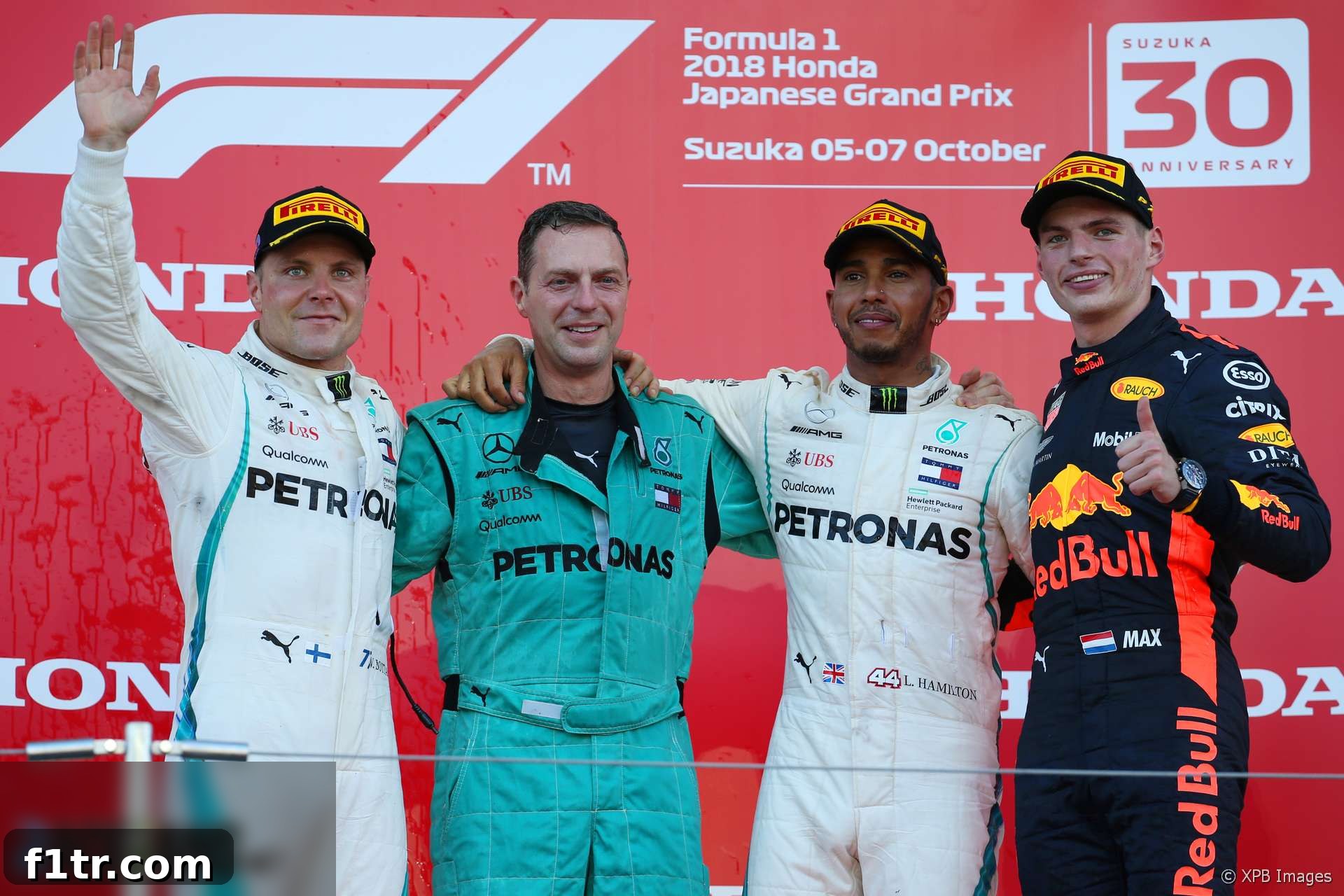
Lewis Hamilton can win his fifth world championship at the next race after scoring his ninth victory of the year in the Japanese Grand Prix.
Advert | Become a Supporter & go ad-free
The 2018 Japanese Grand Prix at the iconic Suzuka Circuit proved to be another pivotal moment in what had been an exhilarating Formula 1 season. For Mercedes-AMG Petronas driver Lewis Hamilton, it was a display of sheer dominance, further solidifying his grip on the drivers’ championship. His ninth victory of the season underscored a remarkable run of form, propelling him ever closer to a historic fifth world title, a feat that would place him alongside legendary figures in the sport’s annals. This triumph at Suzuka was not just a win; it was a commanding statement, delivered with precision and speed, leaving his competitors in his wake. The challenging Suzuka circuit, renowned for its high-speed corners and demanding layout, often separates the good from the great, and Hamilton’s performance left no doubt about his current standing.
Hamilton’s Masterclass: Dominance at Suzuka
From the moment the lights went out, Lewis Hamilton was in a league of his own. Having secured pole position with a stunning qualifying lap, he translated that pace into a flawless race performance. His start was impeccable, immediately pulling away from his teammate Valtteri Bottas, who had locked out the front row for Mercedes. Throughout the 53-lap race, Hamilton controlled the pace, managing his tires effectively and responding to every strategic call from the Mercedes pit wall. He consistently set blistering lap times, maintaining a comfortable gap to Bottas, and never looked threatened. This performance epitomized the synergy between driver and machine, showcasing Mercedes’ technical superiority and Hamilton’s exceptional talent. The Silver Arrows executed their race strategy to perfection, securing a dominant one-two finish that further extended their lead in the Constructors’ Championship, highlighting their engineering prowess and meticulous planning for one of F1’s most demanding circuits.
Vettel’s Championship Hopes Dented by Disaster
While Hamilton cruised to victory, his main championship rival, Sebastian Vettel, endured a catastrophic race that severely hampered his aspirations for a fifth world title. The weekend had already started on a difficult note for Ferrari, with a questionable tyre strategy call in qualifying leaving Vettel starting from eighth position on the grid. This decision proved to be a critical misstep, placing him in the midfield where incidents are far more common. Despite a promising start where he made rapid progress through the field, his charge was abruptly halted. On lap eight, while battling with Max Verstappen for position, Vettel attempted an overtake at the Spoon corner. The move led to contact with Verstappen’s Red Bull, causing Vettel to spin off track and rejoining at the very back of the pack. This incident was a devastating blow to his race, forcing him to fight his way back through the field from an unenviable position. Despite a valiant recovery drive, navigating through slower cars and making numerous overtakes, Vettel could only salvage a sixth-place finish. This result left him a daunting 67 points adrift of Hamilton in the championship standings with just 100 points remaining available across the final four races, making his championship challenge look increasingly insurmountable.
Verstappen’s Controversial Drive and Midfield Mayhem
Max Verstappen was at the center of two significant incidents during the race, showcasing both his aggressive driving style and his raw speed. Early in the Grand Prix, the Red Bull driver ran wide at the chicane while defending his position. As he rejoined the track, he collided with Kimi Raikkonen’s Ferrari, damaging the left side of the SF71-H. The stewards quickly deemed Verstappen at fault for rejoining unsafely and handed him a five-second penalty. Despite serving this penalty during his first pit stop, Verstappen’s pace was such that he emerged from the pits still ahead of Raikkonen, demonstrating the effectiveness of Red Bull’s strategy and his own speed. This initial skirmish set the tone for a race filled with drama for the young Dutchman.
Later, it was Verstappen’s turn to be involved in the crucial incident with Sebastian Vettel at Spoon corner, which saw the Ferrari driver spin out of contention for a podium finish. While the stewards deemed this a racing incident, it highlighted Verstappen’s uncompromising approach on track. Despite these controversies, Verstappen delivered a strong performance, ultimately securing a hard-fought third place. He spent the concluding laps of the race intensely hounding Valtteri Bottas’s Mercedes, pushing for second position. While he was unable to break the formidable hold of the silver cars on the top two spots, his relentless pursuit provided thrilling entertainment and further cemented his reputation as one of F1’s most exciting, albeit sometimes contentious, drivers.
Strategic Moves and Points Scorers in the Midfield
The midfield battles at Suzuka were as intense and unpredictable as ever, with several drivers making strategic gains and others facing misfortune. Sergio Perez delivered a stellar drive for Force India, securing a commendable seventh place. His strategic acumen was on full display as he expertly capitalized on a Virtual Safety Car (VSC) period in the latter half of the race. The VSC was deployed following Charles Leclerc’s retirement, and Perez timed his move perfectly, jumping ahead of Romain Grosjean. The Haas driver, visibly disgruntled by the outcome, eventually finished eighth, just ahead of his compatriot Esteban Ocon. Ocon, driving the other Force India, put in a solid performance to secure ninth place, showcasing the team’s ability to consistently score points.
The unfortunate retirement of Charles Leclerc, who had been struggling with tyre degradation before pulling off track, paved the way for these midfield shuffles. Leclerc’s promising rookie season saw him pushing the limits, but Suzuka proved to be a challenging race for the young Sauber driver. The final championship point, for tenth place, went to Carlos Sainz Jnr of Renault, who benefited from a clean race and consistent pace to add to his team’s tally. These battles underscore the fierce competition that defines the Formula 1 midfield, where every point is hard-earned and strategic decisions can make all the difference.
Retirements and Unfortunate Incidents
The 2018 Japanese Grand Prix saw three retirements, each with its own story of misfortune. The first to exit the race was Kevin Magnussen. His race came to an abrupt end on lap two after a collision with Charles Leclerc. Magnussen had made a late defensive move, and Leclerc, perhaps caught off guard, made contact, causing significant damage to the Haas. The incident was a bitter pill for Magnussen, who had shown promising pace in earlier sessions. The subsequent retirement of Charles Leclerc himself, later in the race due to suspected floor damage from an earlier impact or tyre issues, triggered the Virtual Safety Car that played a crucial role in the midfield strategy.
Adding to the list of retirements was Nico Hulkenberg of Renault. It was a challenging weekend overall for the German driver, who failed to see the chequered flag. His retirement compounded a difficult Grand Prix for the Renault team, which had been hoping for a stronger points haul. These incidents serve as a stark reminder of the unforgiving nature of Formula 1 racing, where a single misjudgment or mechanical issue can bring an end to a driver’s aspirations for points or even a finish.
Advert | Become a RaceFans supporter andgo ad-free
Championship Outlook: Hamilton on the Brink of History
With his commanding victory at the Japanese Grand Prix, Lewis Hamilton stands on the precipice of securing his fifth Formula 1 World Championship. The 67-point advantage he holds over Sebastian Vettel with just 100 points left to contest means that Hamilton could seal the title at the very next race, the United States Grand Prix. For Vettel and Ferrari, the task now appears monumental. They not only need to win every remaining race, but also rely on Hamilton experiencing significant misfortune, a scenario that seems increasingly unlikely given Mercedes’ reliability and Hamilton’s consistent form. The momentum has firmly swung in Hamilton’s favor, and the paddock is buzzing with anticipation of his impending coronation. This potential fifth title would draw him level with Juan Manuel Fangio, placing him second only to Michael Schumacher in the all-time list of F1 world champions, a testament to his enduring skill and the relentless pursuit of excellence by the Mercedes-AMG team.
2018 Japanese Grand Prix Reaction and Analysis
The immediate reaction from the Suzuka paddock was one of admiration for Lewis Hamilton’s dominant display and sympathy for Sebastian Vettel’s continued struggles. Team principals praised Hamilton’s faultless drive, acknowledging the difficulty of extracting such consistent performance from the demanding Suzuka circuit. Ferrari boss Maurizio Arrivabene expressed disappointment with the outcome, emphasizing the need for the team to regroup and minimize errors in the remaining races. Max Verstappen, despite his podium finish, faced scrutiny for his aggressive maneuvers, though his team defended his racing instincts.
- Lewis Hamilton described his victory as “one of my best,” highlighting the incredible feeling of racing at Suzuka.
- Sebastian Vettel admitted his mistake with Verstappen was “my fault,” reflecting on a frustrating weekend.
- Valtteri Bottas expressed satisfaction with the team’s one-two finish, playing a crucial role in Mercedes’ championship push.
- Max Verstappen, while penalised, remained unapologetic about his driving, stating he was “just racing hard.”
- The Japanese Grand Prix once again delivered a mix of strategic brilliance, intense racing, and dramatic incidents, captivating fans worldwide and setting the stage for a thrilling conclusion to the 2018 Formula 1 season.