Struggles and Surprises: An In-Depth Look at Mercedes’ Belgian Grand Prix Qualifying and Midfield Dynamics
The iconic Spa-Francorchamps circuit, renowned for its dramatic elevation changes and high-speed corners, often delivers unexpected results. The 2024 Belgian Grand Prix qualifying sessions proved to be no exception, particularly for the Mercedes-AMG Petronas F1 Team, which found itself grappling with one of its most challenging performances of the season thus far. While the Silver Arrows struggled to find pace, other teams, notably Williams, emerged as standout performers, recalibrating the midfield hierarchy and setting the stage for a captivating race weekend.
Mercedes’ Qualifying Woes and the Shifting Landscape of Team Performance
The qualifying sessions at Spa painted a stark picture of Mercedes’ current form. Their difficulties began early, with both Mercedes drivers failing to advance to the final round of qualifying for the sprint race. This was an early indicator of the uphill battle the team faced on the high-speed Belgian track. While there was a slight improvement in the Grand Prix qualifying, with George Russell managing to reach Q3, young protégé Andrea Kimi Antonelli was unfortunately eliminated in Q1 for the second time during the weekend, highlighting a consistent lack of outright pace.
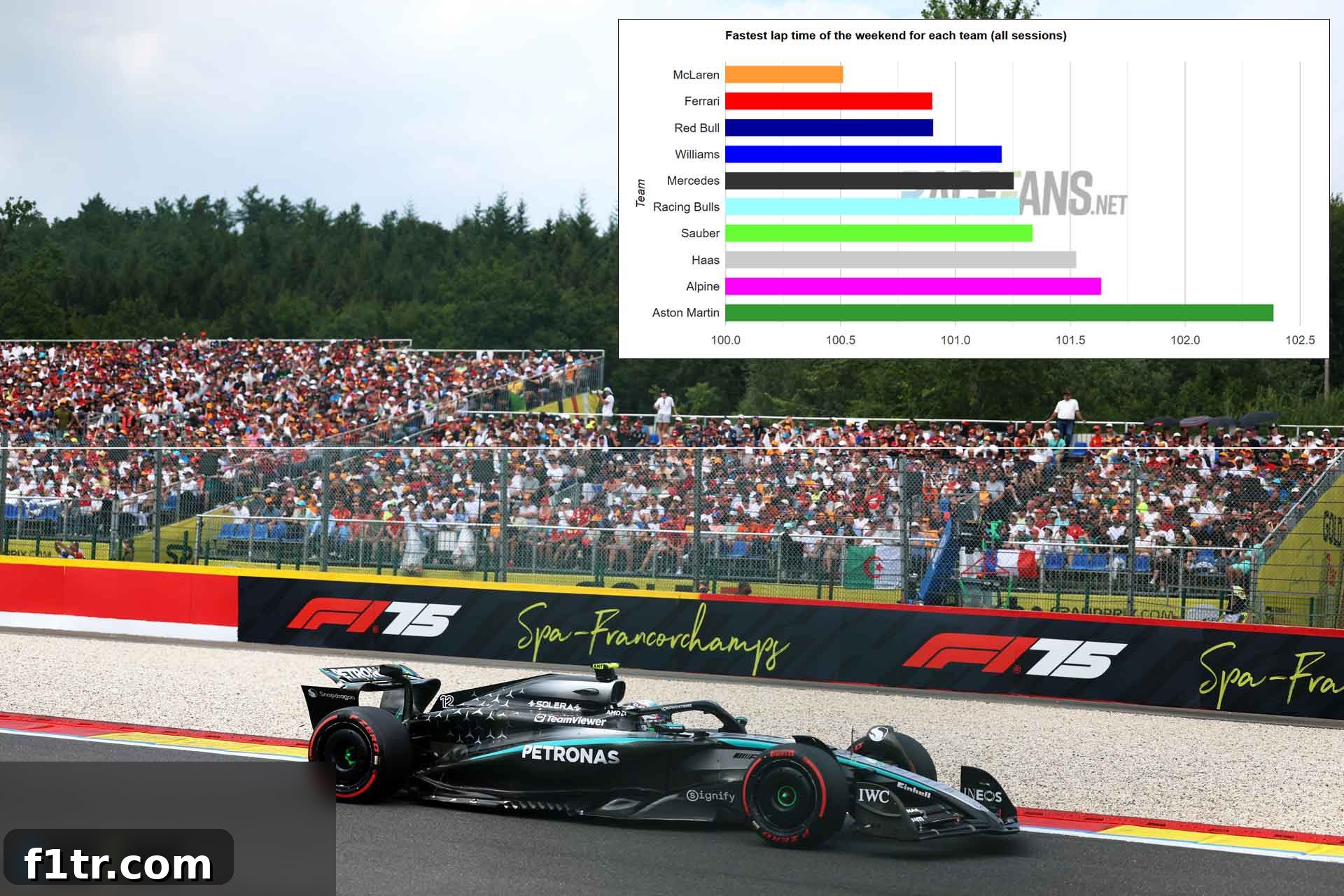
A particularly concerning aspect for Mercedes was Russell being out-qualified for fifth on the grid by Alexander Albon in the Williams. With McLaren drivers locking out the front row, this marked a significant and uncomfortable milestone for Mercedes: it was the first time this year they had been comprehensively outperformed by two of their customer teams in a direct, dry qualifying battle. A similar scenario unfolded in Monaco, though Russell’s car suffered a technical issue there, making the Spa result a more definitive statement on comparative performance. This trend raises pertinent questions about the fundamental competitiveness of the Mercedes chassis and engine package relative to its customer counterparts under specific track conditions.
The Remarkable Resurgence of Williams
In stark contrast to Mercedes’ struggles, Williams showcased a monumental year-on-year improvement at Spa. A mere twelve months prior, the British outfit was widely considered the slowest car over a single lap at this very circuit. Yet, in the 2024 qualifying, they delivered an astonishing performance, with Alexander Albon securing the fourth-quickest time. This dramatic leap in competitiveness underscores the effectiveness of their car development program and their ability to extract maximum performance, particularly on power-sensitive tracks like Spa. This ranking chart, if visualized, would clearly illustrate Williams’ impressive climb relative to their rivals, solidifying their position as a genuine midfield contender capable of challenging established front-runners.
(Chart Placeholder: A visual representation here would typically show the dramatic improvement in Williams’ ranking at Spa compared to the previous season, and the relative positions of all Mercedes-powered teams.)
Advert | Become a RaceFans supporter andgo ad-free
(Advertisement Placeholder)
Aston Martin’s Relative Stagnation
The performance trajectory for the fourth Mercedes-powered team, Aston Martin, moved in an opposite direction to Williams. While Aston Martin’s cars were undeniably over a second per lap faster than their own performance last year, this improvement was overshadowed by their rivals. The softer tyre allocation for the weekend meant that nearly all teams gained significant time year-on-year. However, critically, every one of Aston Martin’s key competitors managed to extract even greater gains, leading to a relative drop in their competitive standing. An improvement chart would visibly demonstrate this, showing Aston Martin’s absolute lap time gains being outmatched by the larger gains of other teams, highlighting their struggle to keep pace with the overall field’s development rate.
(Chart Placeholder: A visual representation here would typically show year-on-year lap time improvements across the grid, highlighting Aston Martin’s gains versus their rivals.)
Field Performance and the Quest for the Ultimate Lap
Beyond the team dynamics, the qualifying sessions at Spa delivered exhilarating individual performances. Oscar Piastri, in a stunning display of skill and pace, set the fastest lap ever recorded on the current layout of the Spa circuit during his pole position run for the sprint race. This remarkable achievement underscored McLaren’s strong form and Piastri’s growing confidence. Despite the intensity of Grand Prix qualifying, no driver managed to better Piastri’s exceptional time, indicating either the perfection of his initial lap or a slight shift in track conditions or grip levels that prevented further improvement. The lap times chart for both qualifying sessions would provide a compelling visual comparison, showing the very fine margins that separated the top contenders.
(Chart Placeholder: A visual representation here would typically compare the fastest lap times across sprint and GP qualifying, showing Piastri’s record-setting pace.)
Advert | Become a RaceFans supporter andgo ad-free
(Advertisement Placeholder)
Mastering Spa’s Sectors: The Precision of Qualifying Laps
The pursuit of a perfect lap at Spa-Francorchamps is a demanding endeavor, requiring absolute precision through its three distinct sectors. Sector 1, featuring the iconic Eau Rouge/Raidillon complex, demands bravery and aerodynamic efficiency. Sector 2 is a technical, flowing section through the Ardennes forest, testing car balance and driver feel. Sector 3, culminating in the Bus Stop chicane, is about power and braking prowess before the long start-finish straight. Even the most talented drivers found it challenging to stitch together an entirely clean lap during qualifying.
Advert | Become a Supporter & go ad-free
(Advertisement Placeholder)
Both McLaren drivers, who ultimately secured the front row, felt they had more time to extract in Q3. Oscar Piastri openly admitted losing crucial tenths at Stavelot on both of his flying laps, a high-speed right-hander that can easily punish even a slight misjudgment. Similarly, Lando Norris, despite his phenomenal pace, couldn’t improve on his final run. He reflected on the fine margins that define competitive Formula 1 qualifying:
“There were a couple of corners that I must have gone slower in, I guess,” Norris explained. “I don’t know why. I don’t see if I’m going quicker or not on my lap. Maybe on turn one [La Source], I hit the kerb a little bit, and it’s a long run after turn one, so probably cost myself a little bit there. And the last corner, a bit too much kerb in both of them, and I probably lost half a tenth, a touch more, and I go slower. We’re talking small margins.”
Norris’s candid assessment highlights the brutal reality of Formula 1 qualifying: fractions of a second can separate pole position from several grid places. An analysis of the McLaren drivers’ sector times clearly reveals that each had untapped potential. However, this wasn’t unique to them. A closer look at the data shows that very few, if any, of the drivers who progressed beyond the first round of qualifying managed to string together a ‘perfect’ theoretical lap by combining their absolute best sector times. Every driver had moments where they could have found more pace, underscoring the formidable challenge of extracting every ounce of performance from both car and driver at a circuit as demanding as Spa.
The “Ultimate Lap” column in the table below, which represents the theoretical fastest possible lap compiled from a driver’s best individual sector times, illustrates this point perfectly. For instance, George Russell had the fastest Sector 1, demonstrating the Mercedes’ straight-line speed and driver bravery, yet his overall lap suffered due to a significantly slower Sector 2. Max Verstappen, known for his relentless consistency, still had a deficit to his ultimate theoretical lap, indicating areas where even the best struggled to optimize every corner.
| P. | # | Driver | S1 | S2 | S3 | Ultimate lap (deficit) |
|---|---|---|---|---|---|---|
| 1 | 4 | Lando Norris | 29.991 (9) | 42.532 (1) | 27.879 (3) | 1’40.402 (+0.160) |
| 2 | 81 | Oscar Piastri | 29.983 (8) | 42.623 (2) | 27.869 (2) | 1’40.475 (+0.151) |
| 3 | 1 | Max Verstappen | 30.055 (14) | 42.785 (3) | 27.926 (5) | 1’40.766 (+0.137) |
| 4 | 16 | Charles Leclerc | 29.819 (2) | 43.049 (5) | 27.947 (8) | 1’40.815 (+0.085) |
| 5 | 63 | George Russell | 29.761 (1) | 43.463 (13) | 27.857 (1) | 1’41.081 (+0.173) |
| 6 | 23 | Alexander Albon | 29.858 (4) | 43.226 (8) | 28.009 (14) | 1’41.093 (+0.108) |
| 7 | 22 | Yuki Tsunoda | 30.019 (11) | 43.081 (6) | 28.077 (16) | 1’41.177 (+0.068) |
| 8 | 6 | Isack Hadjar | 30.032 (12) | 43.172 (7) | 27.991 (13) | 1’41.195 (+0.086) |
| 9 | 30 | Liam Lawson | 29.970 (6) | 43.291 (10) | 27.978 (11) | 1’41.239 (+0.058) |
| 10 | 87 | Oliver Bearman | 30.147 (18) | 42.879 (4) | 28.244 (20) | 1’41.270 (+0.347) |
| 11 | 5 | Gabriel Bortoleto | 30.051 (13) | 43.267 (9) | 27.986 (12) | 1’41.304 (+0.032) |
| 12 | 10 | Pierre Gasly | 29.921 (5) | 43.619 (14) | 27.933 (6) | 1’41.473 (+0.160) |
| 13 | 31 | Esteban Ocon | 29.828 (3) | 43.749 (16) | 27.942 (7) | 1’41.519 (+0.006) |
| 14 | 27 | Nico Hulkenberg | 30.072 (16) | 43.328 (11) | 28.136 (17) | 1’41.536 (+0.171) |
| 15 | 44 | Lewis Hamilton | 29.974 (7) | 43.641 (15) | 27.977 (10) | 1’41.592 (+0.347) |
| 16 | 55 | Carlos Sainz Jnr | 30.122 (17) | 43.462 (12) | 28.055 (15) | 1’41.639 (+0.052) |
| 17 | 43 | Franco Colapinto | 30.007 (10) | 44.049 (19) | 27.966 (9) | 1’42.022 |
| 18 | 12 | Andrea Kimi Antonelli | 30.056 (15) | 44.200 (20) | 27.883 (4) | 1’42.139 |
| 19 | 14 | Fernando Alonso | 30.185 (19) | 43.969 (17) | 28.193 (18) | 1’42.347 (+0.038) |
| 20 | 18 | Lance Stroll”>Lance Stroll | 30.222 (20) | 44.048 (18) | 28.232 (19) | 1’42.502 |
The Belgian Grand Prix qualifying sessions have set the stage for a race filled with intrigue. Mercedes will be keen to bounce back from their challenging performance, while McLaren will aim to convert their front-row lockout into a strong points haul. The significant improvements seen from Williams, and the relative shifts in form among other teams, promise a dynamic and unpredictable battle on race day at the iconic Spa-Francorchamps circuit.
Go ad-free for just £1 per month>> Find out more and sign up
Miss nothing from RaceFans
Get a daily email with all our latest stories – and nothing else. No marketing, no ads. Sign up here:
Related Articles: 2025 Belgian Grand Prix
- Hadjar’s Silverstone crash shows FIA was right to be cautious with Spa rain, say drivers
- “Stay out”: Antonelli told Mercedes track was ready for slicks on same lap as Hamilton
- Antonelli ‘paying the price for wrong steps’ made by Mercedes – Allison
- Verstappen is in his longest run of races without a podium finish for six years
- “I’m down to try”: How Hamilton changed his mind about crucial Spa pit stop
Browse all 2025 Belgian Grand Prix articles