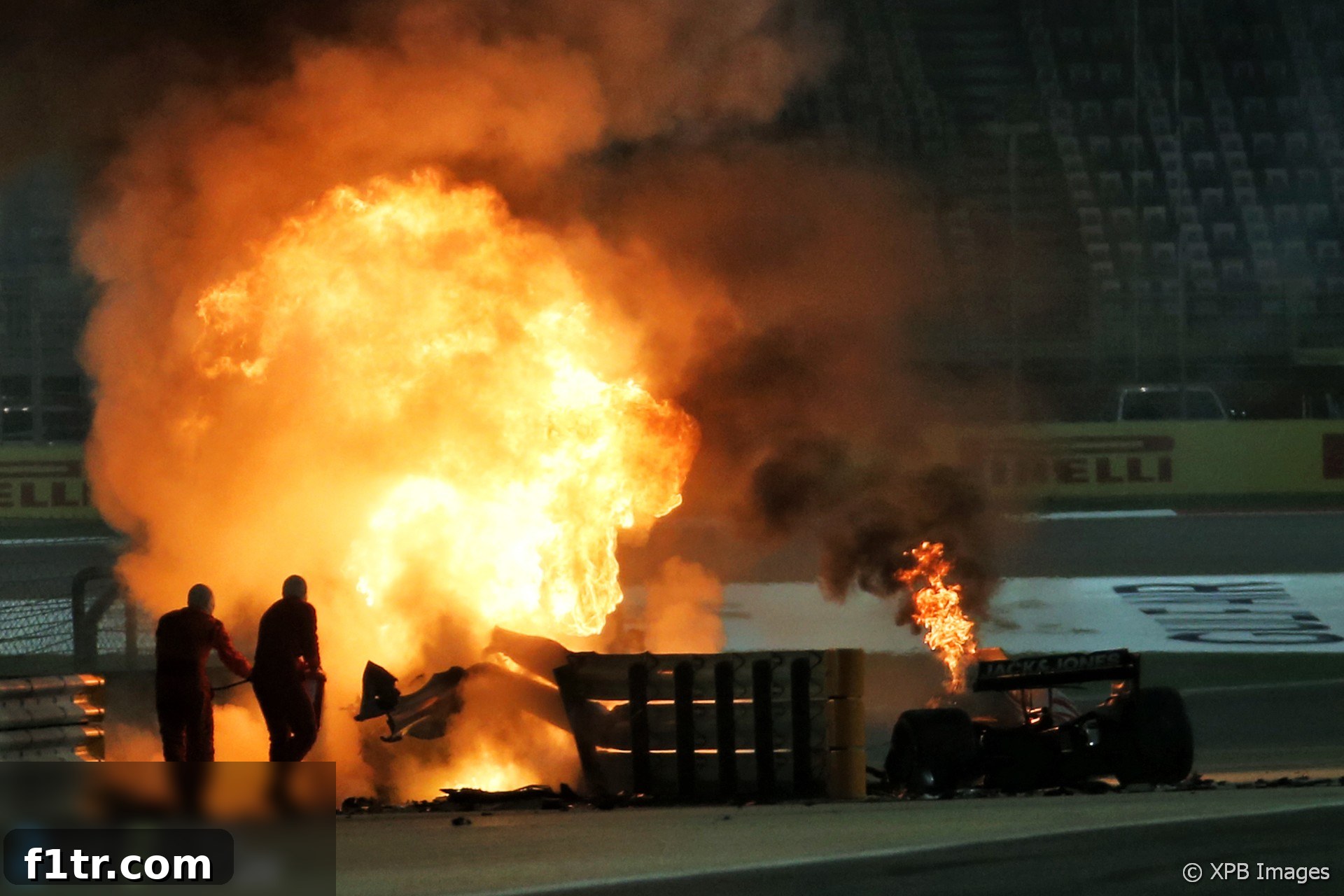
The 2020 Formula 1 Bahrain Grand Prix will forever be etched in motorsport history, not just for the race itself, but for the harrowing and ultimately miraculous crash involving Haas driver Romain Grosjean. What began as a routine opening lap quickly transformed into a terrifying spectacle, leaving spectators, teams, and safety personnel in a state of shock and disbelief. The sheer intensity of the incident, particularly the scale of the fire, profoundly impacted even the most seasoned safety professionals, including the FIA’s Medical Car driver, Alan van der Merwe.
Just moments into the race, Grosjean’s car made contact with Daniil Kvyat’s AlphaTauri, sending him veering sharply to the right and into the barrier at Turn 3. The impact was catastrophic, registering a staggering 53G force. This immense energy instantly ripped the car in two, with the front section, including the driver’s monocoque, piercing through the Armco barrier. Almost simultaneously, a massive fireball erupted, engulfing the wreckage in a blinding inferno. The scene was apocalyptic, prompting immediate red flags and a collective gasp of horror from everyone watching.
A Fiery Impact and Immediate Response
The speed and ferocity of the crash were unprecedented in recent Formula 1 memory. Alan van der Merwe, alongside Dr. Ian Roberts, were at the scene within mere seconds, their response exemplary as dictated by FIA protocols. “We’ve never seen that much fire,” van der Merwe recounted, still visibly shaken by the events. “In 12 years, I’ve never seen that much fire at an impact like that. We just took a little while to process what was going on.” The medical crew’s initial assessment was grim; the inferno was so intense that hope for the driver’s survival seemed perilously thin.
Yet, amidst the chaos and flames, an extraordinary act of self-preservation unfolded. Despite the car being split in half and the monocoque embedded within the barrier, Grosjean, against all odds, managed to free himself. Trapped for what felt like an eternity but was actually around 28 seconds, he miraculously emerged from the still-burning wreckage. This remarkable escape stunned observers, none more so than the approaching medical team. “I’m sure it was only a second or so, but it felt like ages,” said van der Merwe. “Then Romain just actually started to get out of the car himself, which is pretty amazing after an accident like that.” The sight of him climbing over the barrier and being helped by Dr. Roberts and other marshals was a moment of profound relief that reverberated throughout the motorsport world.
The Indispensable Role of Modern F1 Safety
Grosjean’s survival was not merely a stroke of luck; it was a powerful testament to the decades of relentless innovation and commitment to safety by the FIA and Formula 1. Every single safety system, from the cockpit outwards, performed its crucial role in unison. Van der Merwe succinctly captured this sentiment: “It just goes to show all the systems that we’ve developed, everything worked hand in hand: The Halo, the barriers, the seat belts, everything worked how it should. Without just one of those things, it could have been a very different outcome.”
The Halo Device: A Life Saved, Doubts Dispelled
Perhaps the most prominent hero of the day was the Halo device. Introduced in 2018 amid considerable debate and even controversy from some drivers and fans concerned about its aesthetic impact, the Halo proved its worth beyond any shadow of a doubt. In Grosjean’s crash, as the monocoque penetrated the Armco barrier, the Halo acted as a crucial deflector, preventing the barrier from impacting his head and neck. Without this titanium structure, capable of withstanding forces equivalent to a double-decker bus, the outcome for Grosjean would almost certainly have been fatal. His escape, virtually unscathed from such an aggressive intrusion, silenced all remaining critics and cemented the Halo’s status as an indispensable safety feature in open-wheel racing.
Monocoque Integrity and Fire Suppression
The integrity of the carbon fibre monocoque was another critical factor. Despite the car splitting in two, the survival cell remained largely intact, protecting Grosjean’s core. This incredibly strong yet lightweight structure is designed to absorb massive amounts of energy while maintaining its shape around the driver. Furthermore, the advancements in fire suppression technology and the fire-retardant properties of the driver’s overalls, gloves, and balaclava provided precious seconds of protection against the intense flames. The quick action of the medical team, equipped with fire extinguishers, also played a vital role in managing the blaze immediately after Grosjean’s escape.
Safety Barriers, Seatbelts, and Medical Preparedness
While the Armco barrier initially failed to prevent the car’s penetration, its role in decelerating the vehicle was still significant. The accident led to immediate reviews of barrier design and placement, especially concerning such high-speed impacts. Crucially, Grosjean’s advanced six-point harness kept him securely strapped into his seat, preventing him from being thrown around inside the cockpit or out of the car during the violent impact. The HANS (Head and Neck Support) device also contributed to protecting his neck from whiplash. Beyond the car’s inherent safety features, the immediate proximity and exceptional training of the FIA Medical Car team and track marshals ensured that professional help was available within seconds, turning a potential tragedy into a powerful narrative of survival.
Grosjean’s Recovery and the Aftermath
Romain Grosjean suffered relatively minor injuries given the severity of the crash – predominantly burns to his hands and ankles, along with a suspected rib fracture. He was swiftly transported to the Bahrain Defence Force (BDF) Hospital for treatment. His recovery journey was closely followed by the global motorsport community, underscoring the collective relief and admiration for his resilience. While his Formula 1 career effectively ended with this crash, it became a defining moment for him, a symbol of courage and a powerful advocate for motorsport safety.
The incident spurred further scrutiny and improvements in Formula 1 safety regulations. The FIA initiated a thorough investigation into the crash, examining every detail from the barrier construction to the fuel cell’s performance under extreme stress. This continuous cycle of learning and improvement is a hallmark of motorsport safety, driven by a commitment to mitigating risks in an inherently dangerous sport. The Bahrain crash served as a stark reminder of the ever-present dangers but also a profound affirmation of how far safety technology and protocols have come.
A Defining Moment for Formula 1 Safety
The Romain Grosjean crash at the 2020 Bahrain Grand Prix will forever stand as a pivotal moment in the history of Formula 1 safety. It demonstrated, in the most dramatic fashion possible, that the cumulative efforts of engineers, medical professionals, and governing bodies have created an environment where drivers can survive crashes that would have been unimaginable just a few decades ago. It was a terrifying ordeal that ultimately delivered a powerful message of hope and validated years of tireless dedication to driver protection.
The global outpouring of relief and support for Grosjean, coupled with the unanimous praise for the safety systems, solidified the consensus that driver safety must always remain paramount. The incident moved beyond mere sport; it became a global human interest story, showcasing courage, resilience, and the triumph of engineering and human ingenuity in the face of extreme peril. As Formula 1 continues to push the boundaries of speed and technology, the lessons learned from Bahrain will undoubtedly continue to shape its future, ensuring that the sport remains thrilling yet as safe as humanly possible.
Browse all 2020 Bahrain Grand Prix articles