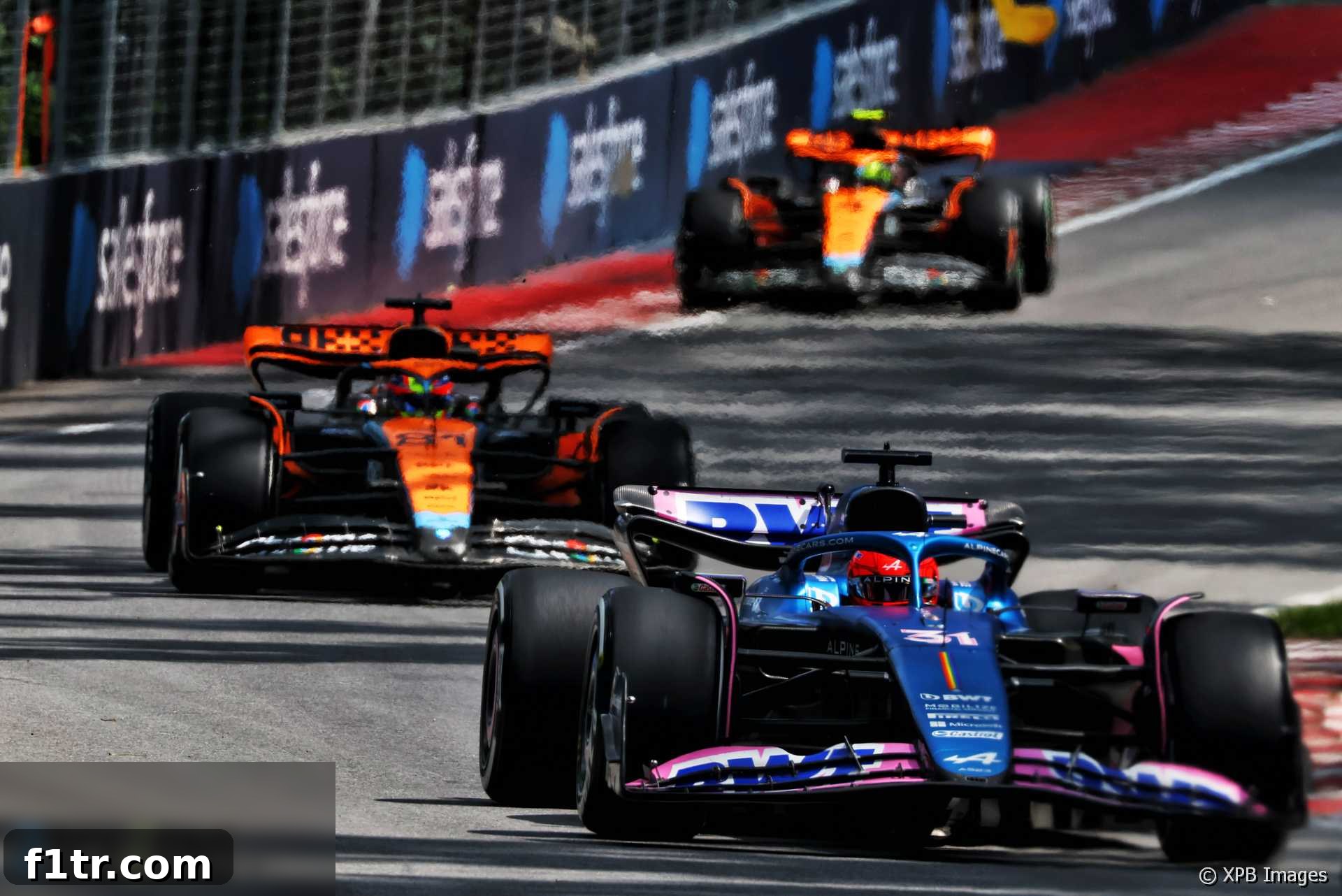
Lando Norris, McLaren’s star driver, has expressed a pragmatic outlook on his team’s chances of overtaking Alpine in the Constructors’ Championship, even as McLaren rolls out a significant upgrade package for their MCL60. This skepticism highlights the fierce competition in Formula 1’s midfield and Norris’s clear-eyed assessment of their rivals’ strengths.
The battle between McLaren and Alpine has been a recurring theme in recent Formula 1 seasons, with both teams vying for the coveted “best of the rest” title behind the top three. Currently, Alpine holds a considerable advantage, leading McLaren by 44 points to 17 in the intense fight for fourth place in the standings. Despite this points gap, Norris believes Alpine’s true performance potential has been understated.
Alpine’s True Pace: A Midfield Powerhouse
Norris contends that Alpine’s current points tally doesn’t fully reflect the raw speed and capability of their A523 challenger. “Alpine have been an extremely quick car this year,” Norris stated, acknowledging the inherent pace of their French rivals. He pinpointed operational issues and strategic missteps as key factors preventing Alpine from scoring even more points. “They’ve just made a lot of mistakes and they’ve had a lot of problems at times,” he elaborated, suggesting that without these setbacks, Alpine’s lead would be far greater.
Indeed, McLaren’s best result this season, a sixth place for Norris in Australia, was partly facilitated by an unfortunate incident involving Alpine drivers Pierre Gasly and Esteban Ocon colliding. Ocon, however, managed to secure Alpine’s standout performance of the season with a remarkable podium finish in Monaco, demonstrating the car’s potential on a demanding street circuit. These incidents underscore Norris’s point: Alpine’s car is consistently quick, even if their execution hasn’t always matched it.
Norris firmly believes that Alpine enjoys a significant pace advantage over McLaren at most circuits. He observed, “They’re fighting Astons, they’re fighting Ferraris through many of the races. It’s just, they crashed in Australia…” This commentary places Alpine not just ahead of McLaren, but often in direct contention with teams that are typically considered higher in the pecking order. “They’ve been extremely good and competitive this season. I think we’re a little bit surprised that we could keep up with them in Montreal. I would say that was one of the weaker weekends of the season. But apart from that, they’ve done a very good job. I would say no one’s complimented what they have been able to do this year.” This statement from Norris is a strong endorsement of Alpine’s engineering prowess and competitive strength in the 2023 season.
The MCL60 Upgrade: A Glimmer of Hope for McLaren
McLaren is introducing the first phase of a substantial upgrade package for their MCL60 specifically on Norris’s car for this weekend’s event. The team hopes these enhancements will close the performance gap to Alpine and other midfield competitors. Norris acknowledges that their ability to challenge Alpine for the remainder of the season hinges directly on the tangible gains these new parts bring.
“I doubt we’ll be able to maybe match [them],” Norris admitted, tempering expectations. “It depends how they are this weekend. But I doubt it, they’ve been doing a very good job. They have one of the best cars, definitely the best of the midfield, by quite a long way. They’re quite a big step ahead, so hopefully we can get close to them, and if they’re not as quick as they normally are, then maybe we can have a race with them too.” This candid assessment from Norris reflects the reality of the task at hand for McLaren: Alpine has set a high bar, and bridging that gap will require more than just incremental improvements.
One of the most significant weaknesses of the MCL60 this season has been its lack of straight-line speed. This deficit has made overtakes challenging and compromised the car’s defensive capabilities on tracks with long straights. Norris is optimistic that the new upgrades will begin to address this critical area. “What has made our life tough is the lack of straight-line speed,” he explained. “I think we’ve been pretty much the slowest in straights almost the whole year.”
He continued, “This is trying to help a bit of that. It’s probably not going to make the biggest difference but it’s the little things sometimes which add up and can start to make a difference.” This highlights the nuanced nature of F1 development, where a series of small, well-integrated improvements can collectively unlock significant performance gains. The upgrade package is not solely focused on straight-line speed; Norris anticipates improvements across various corner types as well, enhancing the car’s overall aerodynamic efficiency and grip.
“It should be slow speed, medium speed, high speed,” Norris elaborated, outlining the comprehensive nature of the intended improvements. “So hopefully I can just be either ahead of cars I should be ahead of or I can maybe follow cars closer and things like that. Or maybe there’s better compromises to make and we can have better race pace and things like that. It’s difficult to know just yet, you kind of have to try it.” This anticipation underscores the hope within the McLaren camp that these upgrades will provide a more versatile and competitive platform, enabling Norris and his teammate to extract more performance in race trim and improve their strategic options.
The Challenge of a Sprint Race Weekend for New Upgrades
The timing of the Austrian Grand Prix, which is a sprint race weekend, presents a unique challenge for McLaren in evaluating and maximizing the potential of their new parts. With only a single practice session before qualifying and the sprint race, teams have extremely limited time to fine-tune car setups and understand the nuances of major new components.
“It’s not the easiest of weekends to put everything on and understand and maximise,” Norris acknowledged. The compressed schedule means that valuable data and feedback, typically gathered over multiple practice sessions, must be acquired in a much shorter window. This heightens the risk of not fully optimizing the setup, potentially leaving performance on the table. “I doubt we’ll maximise everything by tomorrow just in FP1 and understand everything,” he confessed, acknowledging the practical limitations.
The team will undoubtedly face a steep learning curve. “I’m sure there will be a lot of learnings ready for Silverstone, or things that we learned say through qualifying and the sprint race, that we’re like ‘we kind of wish we did this’ but it’s about just doing the best job we can.” This pragmatism is crucial; while the immediate focus is on the Austrian Grand Prix, the insights gained this weekend will be invaluable for subsequent races, particularly the British Grand Prix at Silverstone, a circuit that often provides a clearer picture of a car’s overall performance due to its diverse range of corners.
The Road Ahead: McLaren’s Midfield Ambitions
Lando Norris’s assessment of Alpine’s strength and McLaren’s upgrade potential paints a realistic picture of the ongoing midfield battle in Formula 1. While the new parts offer a crucial opportunity for McLaren to regain ground, Norris’s cautious optimism reflects the significant challenge posed by Alpine’s consistent pace and the demanding nature of F1 development. The outcome of this rivalry will not only define McLaren’s 2023 season but also set the stage for their long-term trajectory in their quest to return to the pinnacle of Formula 1.
The strategic implications for McLaren extend beyond just catching Alpine. Improving the MCL60’s performance, especially in critical areas like straight-line speed and cornering versatility, is fundamental to their broader objective of consistently challenging at the front of the grid. This upgrade represents a crucial step in that journey, providing the engineers with valuable data and the drivers with a potentially more competitive machine. The performance boost, if significant enough, could alter the competitive landscape of the midfield, forcing Alpine to react and intensifying the strategic chess match between the two teams.
Bringing the F1 news from the source
RaceFans strives to bring its readers news directly from the key players in Formula 1. We are able to do this thanks in part to the generous backing of our RaceFans Supporters.
By contributing £1 per month or £12 per year (or the equivalent in other currencies) you can help cover the costs involved in producing original journalism: Travelling, writing, creating, hosting, contacting and developing.
We have been proudly supported by our readers for over 10 years. If you enjoy our independent coverage, please consider becoming a RaceFans Supporter today. As a bonus, all our Supporters can also browse the site ad-free. Sign up or find out more via the links below:
- Become a RaceFans Supporter
- RaceFans Supporter FAQ
2023 Austrian Grand Prix Insights
- Mercedes left scratching heads by lack of performance at Austrian GP
- Verstappen’s determination to grab every point makes him a record-breaker
- Austrian GP track limits farce was avoidable like ‘IndyGate’ and Spa 2021 – Brown
- Alpine now “definitely beatable” for McLaren after upgrade – Brown
- Paddock Diary: 2023 Austrian Grand Prix
Browse all 2023 Austrian Grand Prix articles