Oliver Bearman, the prodigious talent from Haas, faces a crucial start to his second season in Formula 1. The young Briton must navigate the initial races with extreme caution to avoid the dreaded trigger of an automatic race ban, a scenario that Haas’s head of driver development is keenly aware of and actively working to prevent. Bearman concluded his challenging rookie year just two penalty points shy of the 12-point threshold that mandates a suspension from an F1 Grand Prix. This precarious position places immense pressure on him as the 2026 season gets underway, highlighting the stringent regulations governing driver conduct in the pinnacle of motorsport.
Advert | Become a Supporter & go ad-free
Having accumulated his tenth penalty point in the final race of the previous year, Bearman’s licence hangs precariously. The implications of reaching twelve points are severe, leading to an automatic one-race ban. This immediate consequence not only impacts the driver but also creates significant strategic challenges for the team, potentially disrupting their championship aspirations and hampering their development efforts. Haas’s Head of Strategy and Driver Development, Ed Brand, openly acknowledged the team’s heightened vigilance regarding Bearman’s situation. “From our point of view, we have to be a little bit more careful,” Brand stated. “Obviously, we don’t want him to get a race ban. He’s [been] performing really well, and we want to ensure his momentum continues uninterrupted.”
Brand was quick to highlight a critical distinction in the nature of Bearman’s infringements. Unlike many drivers who accrue penalty points due to aggressive racing or incidents involving rivals on track – which typically account for the majority of endorsements – a significant portion of Bearman’s points stemmed from less conventional errors. He received a substantial seven points from two distinct incidents where he failed to respond appropriately to red flags, a clear indicator of rookie mistakes rather than fundamental issues with his racecraft or aggressive driving style.
Reflecting on these incidents, Brand elaborated, “A lot of those points [in 2025] came from silly mistakes, not even in the race. A red flag [incident at the] pit entry in Silverstone and the same in Monaco. Silly mistakes, silly rookie mistakes, which he has learnt from.” This perspective offers a nuanced understanding of Bearman’s situation, suggesting that his penalty woes are largely attributable to inexperience and specific procedural oversights, rather than a pattern of reckless driving. If the points were accumulated through “driving standards” infractions – such as causing collisions or dangerous maneuvers – Brand indicated that the team’s approach might need to be “slightly different.” This emphasis on the type of infringement underscores Haas’s confidence in Bearman’s underlying driving ability and commitment to his long-term development.
The team is not unfamiliar with the harsh reality of the penalty point system. Brand drew a parallel to the previous season, recalling a similar predicament: “But we were in a position [in 2024], which was the same. We had Kevin [Magnussen] who did receive a race ban, which wasn’t the highlight of the season.” Kevin Magnussen’s suspension in a prior season serves as a stark reminder of the system’s impact and reinforces Haas’s determination to guide Bearman through this challenging period without a repeat incident. The experience with Magnussen provides the team with valuable insights into managing a driver on the brink of a ban, allowing them to implement proactive strategies and provide targeted support.
The F1 penalty point system is designed to ensure consistent adherence to sporting regulations and promote safe driving standards across the grid. Points are issued by race stewards for a variety of infringements, ranging from minor procedural errors to dangerous driving incidents. Once accumulated, these points remain on a driver’s licence for a rolling period of 12 months. Should a driver reach 12 points within this period, they automatically incur a one-race ban. This rolling expiry mechanism means that as older points expire, the pressure can ease, but until then, every on-track decision carries significant weight. For Bearman, the initial phase of the 2026 season will be particularly critical. Two penalty points are set to be removed from his licence between the sprint race and the Grand Prix in Montreal, offering a much-needed reprieve. However, until that point, he will remain at high risk of collecting a ban over the first six Grand Prix weekends, demanding immaculate driving and strict adherence to regulations.
Advert | Become a RaceFans supporter andgo ad-free
In preparation for any eventuality, Haas has proactively bolstered its reserve driver line-up for the upcoming season. Former Alpine racer Jack Doohan has joined the team, complementing the existing talent of Ryo Hirakawa. This strategic move ensures that Haas has capable replacements ready to step in should Bearman – or any other driver – become unavailable, providing a crucial safety net for the team’s operational continuity and performance targets. The depth of their reserve pool underscores the team’s commitment to mitigating risks and maintaining competitiveness throughout the demanding F1 calendar.
Despite the penalty point predicament, Bearman’s rookie season showcased his immense potential. He emerged as Haas’s top-scoring driver, remarkably picking up three more points than his highly experienced team-mate, Esteban Ocon. This achievement is a testament to his raw speed, adaptability, and inherent talent, especially considering the competitive nature of Formula 1. Ed Brand emphasized that Bearman’s core speed is undoubtedly his most valuable attribute, a quality that is difficult to teach and forms the bedrock of a successful F1 career. While acknowledging areas for improvement, Brand expressed confidence in the team’s ability to refine Bearman’s approach and address any weaknesses.
“He’s naturally very, very fast,” said Brand, highlighting Bearman’s innate ability to extract performance from the car. The challenge, according to Brand, often lies in “reining that in.” He noted instances where Bearman’s relentless drive to push the limits led to mistakes. “We’ve had it a couple of times where he just keeps pushing, pushing, pushing, and then that’s when the mistakes come.” However, Brand quickly countered that this aggressive tendency is also a sign of a true racer. “But naturally, he’s so fast. You know you put him on a track he doesn’t know and he’s immediately there. It’s the best way to have it, kind of reigning him in slightly. But he is a very good listener. He picks things up very quickly.” This balance between raw speed and controlled aggression is a hallmark of top-tier drivers, and Haas is clearly invested in nurturing this delicate equilibrium in Bearman. His ability to quickly learn and adapt, as noted by Brand, bodes well for his future development and his capacity to internalize the lessons from his rookie errors.
The psychological impact of being on the brink of a race ban cannot be underestimated. Every decision on track, every maneuver, and every interaction with race control will be magnified for Bearman. This added layer of scrutiny could either lead to a more disciplined performance or, conversely, create additional pressure that hinders his natural flair. Haas’s role in providing a supportive environment, clear communication, and strategic guidance will be pivotal in helping Bearman navigate this challenge successfully. The team’s emphasis on his “silly mistakes” rather than fundamental driving flaws aims to build his confidence while instilling a renewed sense of caution.
Oliver Bearman’s Penalty Points Ahead of 2026 Season: A Detailed Overview
To fully understand the precariousness of Oliver Bearman’s situation, a closer look at the specific incidents that led to his accumulation of penalty points is essential. These infractions provide context for Haas’s approach to his development and the types of errors he needs to meticulously avoid in the upcoming season.
| Date | Event | Session | Infringement | Points |
|---|---|---|---|---|
| 23/5/2025 | Monaco Grand Prix | Qualifying | ‘Car 87 overtook car 55 under red flag.’ This incident, occurring during a critical qualifying session in Monaco, resulted in a 10-place grid penalty in addition to the penalty points. Overtaking under red flag conditions is a serious safety breach, as it indicates a lack of immediate response to a dangerous situation on track. | 2 |
| 5/7/2025 | British Grand Prix | Third practice | ‘Failure to comply with a red flag’ This was a more severe incident at his home Grand Prix, leading to a substantial four penalty points and another grid drop. Such a failure typically involves continuing to push or not slowing down sufficiently when the session is neutralized due to an accident or hazard, further emphasizing a need for improved situational awareness and immediate adherence to safety protocols. | 4 |
| 7/9/2025 | Italian Grand Prix | Grand prix | ‘Car 87 collided with car 55 at turn four’ This incident, involving a collision with another competitor during the race at Monza, is more representative of a “driving standards” infringement. While potentially a racing incident, the stewards deemed Bearman at fault, leading to two crucial penalty points and pushing him closer to the ban threshold. | 2 |
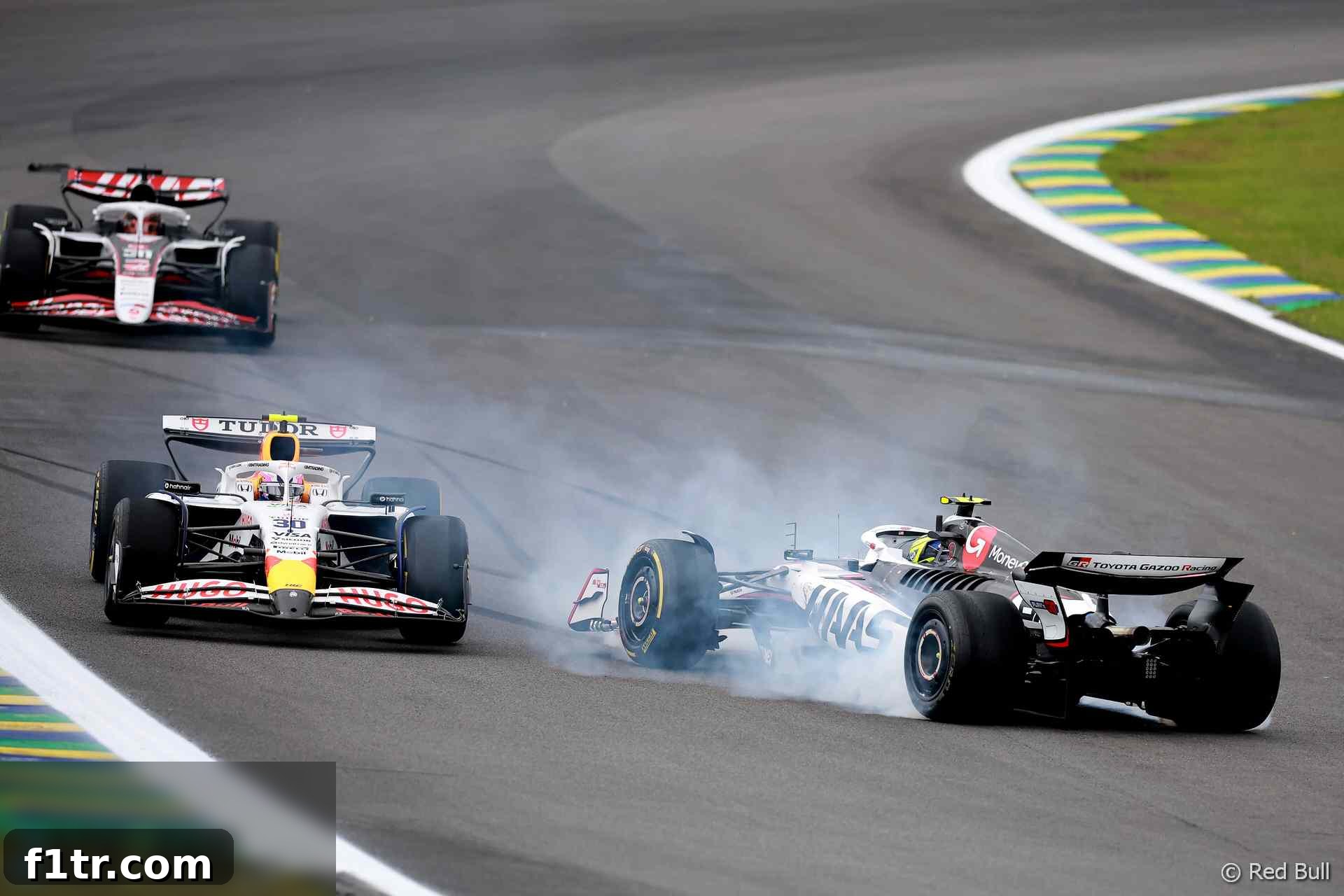
| 8/11/2025 | Brazilian Grand Prix | Sprint race | ‘Driving in a manner deemed potentially dangerous on the straight between turn three and turn four’ Even a single point for “dangerous driving” indicates a maneuver that was perceived as unnecessarily risky or outside the bounds of fair racing, highlighting the tightrope F1 drivers walk between aggression and safety. | 1 |
| 7/12/2025 | Abu Dhabi Grand Prix | Grand prix | ‘Car 87 made more than one change of direction to defend its position’ This final point of the season, for weaving while defending, put him at the 10-point mark. While a common racing tactic, F1 rules strictly limit defensive moves to one change of direction, and exceeding this is a clear breach of sporting conduct. This specific point left him miffed, indicating a learning curve still in progress regarding the finer points of F1 racecraft regulations. | 1 |
The journey through his second Formula 1 season promises to be a rigorous test of Oliver Bearman’s maturity, discipline, and raw talent. With the looming threat of a race ban, every moment on track becomes a learning opportunity and a demonstration of his growth as an elite racing driver. Haas’s unwavering support and strategic guidance will be crucial in helping him navigate this challenging period, ensuring that his exceptional speed is harnessed effectively and his rookie mistakes are firmly left in the past. The focus will undoubtedly be on clean, precise driving, allowing Bearman to fully unleash his potential without the shadow of regulatory consequences, and firmly cement his place as a rising star in Formula 1.
Advert | Become a RaceFans supporter andgo ad-free
More on Formula 1
- F1 returning to India soon after 2027 sounds like wishful thinking
- Verstappen loathes F1’s new generation of cars – but what do his rivals reckon?
- The ‘throwback weekend’ is back in fashion. But it’s a flawed concept – especially for F1
- Is Formula 1’s double race cancellation a blessing in disguise?
- Todt admits Schumacher crashed on purpose – but did it really cost him two titles?
Browse all Formula 1 articles