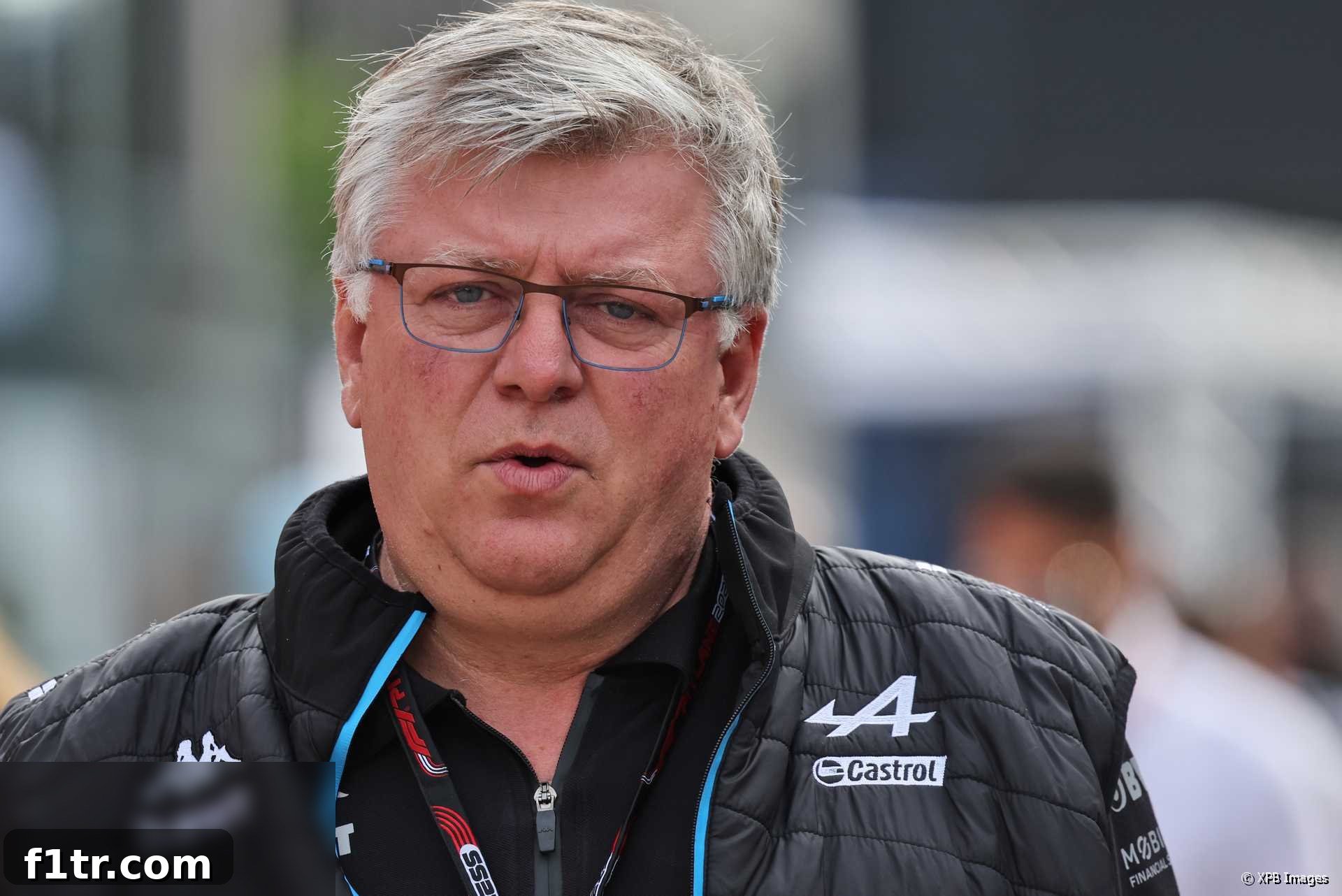
Alpine F1 Team Undergoes Major Leadership Shake-Up: Szafnauer, Permane, Fry Depart
The Alpine Formula 1 team has confirmed a significant overhaul of its top management, with key figures including Team Principal Otmar Szafnauer, Sporting Director Alan Permane, and Chief Technical Officer Pat Fry all departing. This wave of high-profile exits follows closely on the heels of former CEO Laurent Rossi’s departure just two weeks prior, signaling a profound strategic shift within the French-owned racing outfit.
The news, which sent ripples through the Formula 1 paddock, was officially announced by Alpine ahead of the Belgian Grand Prix weekend at Spa-Francorchamps. The immediate impact sees Szafnauer and Permane concluding their tenures with the team after this pivotal race event. Pat Fry, a seasoned engineer, had already transitioned to Williams, where he has taken up the same Chief Technical Officer role, a move that was confirmed by the Grove-based team earlier.
Advert | Become a Supporter & go ad-free
A Sudden Farewell for Key Leaders
Otmar Szafnauer, who assumed the role of Team Principal at the Enstone-based squad at the beginning of the 2022 season, brought with him a wealth of experience from previous roles, notably at Force India and Aston Martin. His tenure was marked by an ambitious “100-race plan” aimed at transforming Alpine into a consistent championship contender. However, his journey with the team has come to an abrupt end. Alongside him, Alan Permane, a venerable figure in the F1 paddock, is also leaving. Permane’s remarkable career at the Enstone factory spans an incredible 35 years, having been a part of the team through its various iterations, including Toleman, Benetton, Renault, and Lotus. Both Szafnauer and Permane’s departures are by “mutual agreement,” a phrase often used in Formula 1 to denote a divergence in strategic vision or a failure to meet performance objectives, despite an amicable split.
The loss of Permane, in particular, represents a significant blow to Alpine’s institutional memory and operational expertise. Having started his journey with the team in 1988, he witnessed numerous championships and structural changes, accumulating an unparalleled depth of knowledge regarding the team’s processes, culture, and technical evolution. His presence was a constant across generations of Formula 1 cars and regulations, making his exit a symbolic end to an era for the Enstone outfit. Szafnauer, though a more recent addition, was tasked with guiding the team through a critical growth phase, and his departure underscores the immense pressure and rapid decision-making characteristic of top-tier motorsport management.
The Context: Strategic Misalignment and High Stakes
This major management reshuffle comes barely a week after the appointment of Philippe Krief as the new CEO, replacing Laurent Rossi. Rossi, known for his direct and often critical assessments of the team’s performance, had been instrumental in setting the aggressive targets for Alpine. The intense scrutiny from the highest echelons of the Renault Group, particularly from CEO Luca de Meo, has consistently highlighted the demand for quick and tangible results.
Interestingly, just prior to the Hungarian Grand Prix, Otmar Szafnauer had publicly expressed confidence in his position and the backing of Luca de Meo. Speaking to media outlets, including RaceFans, Szafnauer articulated his belief that he would be given the necessary time to see Alpine’s ambitious 100-race plan through to fruition, aiming to establish the team as a front-runner capable of fighting for championships. “I have no concern that Luca will be true to his word and give me the 100 race time that’s required,” Szafnauer stated after the event at the Hungaroring. This public assertion of confidence, contrasted with the swift announcement of his departure, paints a clear picture of the dynamic and often unpredictable nature of Formula 1 leadership roles, where perceptions and realities can diverge sharply within a short timeframe.
Interim Leadership Steps In
In the immediate aftermath of these significant changes, Alpine has moved to appoint interim replacements to maintain continuity. Bruno Famin, who serves as Alpine Motorsports Vice-President, will step into the crucial role of interim Team Principal. Famin’s experience and strategic oversight will be vital in navigating the team through this period of transition. Joining him in an interim capacity is Julian Rouse, the esteemed director of the Alpine Academy, who will assume the responsibilities of Sporting Director. Rouse’s background in nurturing young talent and understanding the intricate dynamics of racing operations will be invaluable. These interim appointments suggest that Alpine is taking a measured approach to finding long-term solutions, prioritizing stability while a comprehensive search for permanent leadership is conducted.
Advert | Become a RaceFans supporter andgo ad-free
Performance Fails to Meet Lofty Expectations
The catalyst for these sweeping changes can be traced back to Alpine’s performance trajectory during the 2023 Formula 1 season. Speaking at the Team Principal’s press conference in Spa, Bruno Famin candidly acknowledged that the team’s results had not aligned with their high ambitions. Alpine had set an aggressive target for the year: to consolidate their fourth-place finish in the Constructors’ Championship from 2022 and, crucially, to significantly reduce the performance gap to the sport’s dominant top three teams – Red Bull, Mercedes, and Ferrari.
“The results do not match our expectations, clearly,” Famin stated, his words underscoring the disappointment within the team. He further elaborated on the fundamental disagreement that led to the leadership changes, explaining, “We were not on the same line on the timeline of how to reach the level of performance we are aiming for. We are not where we wanted [to be].” This divergence in strategic timelines and the pace of development proved irreconcilable for the leadership.
Famin reiterated the team’s initial goals: “We were fourth last year. We know that the top three are very strong, but we were aiming to keep that fourth place and maybe to find a little bit more for the third. We are not where we wanted.” Indeed, the 2023 season saw Alpine not only fail to close the gap but also slip down the Constructors’ standings. They were notably overtaken by a resurgent McLaren, who showcased an impressive mid-season turnaround, pushing Alpine to sixth place. The rise of Aston Martin at the beginning of the season also compounded the challenge, intensifying the competition in the upper midfield. This competitive downturn highlighted the urgent need for a fresh approach and a re-evaluation of the team’s development path.
Looking ahead, Famin emphasized the commitment to improvement: “We will work hard with all the teams, with the Enstone guys and with the Viry-Chatillon guys, in order to extract the best possible performance of our car.” This statement underscores the critical synergy required between the chassis development team in Enstone and the engine power unit specialists in Viry-Châtillon to elevate Alpine’s on-track competitiveness.
Acknowledging Contributions Amidst Strategic Differences
Despite the strategic divergence that necessitated the leadership changes, Bruno Famin expressed gratitude for the contributions of the departing personnel. He acknowledged both Otmar Szafnauer and Alan Permane as “great people” who dedicated considerable effort to the team. Famin specifically highlighted Permane’s extraordinary tenure, noting, “We really thank them for all that they’ve brought to the team – for a very long time for Alan, 34 years in Enstone.” He also credited Szafnauer for his role in securing a respectable fourth place in the Constructors’ Championship in 2022, describing it as “a good achievement.”
However, Famin promptly reiterated the core issue: “But we were not on the same line on the timeline to recover the level or to reach the level of performance we were aiming. Mutually, we agreed to split our ways and that’s it.” This clarification underscores that while personal respect and appreciation for their work remain, the professional paths diverged due to fundamental disagreements on the strategic direction and the pace required to achieve Alpine’s ambitious goals. In the cutthroat world of Formula 1, even successful stints can end if the vision for the future is not aligned between key stakeholders and leadership.
The Road Ahead: Searching for Long-Term Solutions
With interim appointments now in place, the Alpine F1 team faces the crucial task of identifying and recruiting long-term replacements for its vacant top leadership positions. Bruno Famin, having recently been appointed Vice-President of Motorsport at Alpine, acknowledged the complexity and time required for this process. “I’ve just been appointed two weeks ago as Vice-President of Motorsport at Alpine,” Famin explained, highlighting his recent elevation within the organization. “Of course, we have been discussing the topic with the top management for weeks, and now I will really assess with the whole team what is the real situation and what will be the plan. I will take the necessary time to do this assessment, and we will decide later on.”
The search for a new Team Principal, Sporting Director, and potentially other key technical roles will be a meticulous process, as Alpine looks to define its future direction. The individuals ultimately chosen will be tasked with revitalizing the team’s performance, ensuring alignment with Renault’s overarching vision, and delivering on the ambitious targets that have been set. This period of transition will be critical for Alpine, impacting everything from car development and strategic planning to driver morale and sponsor confidence. The decisions made in the coming months will undoubtedly shape the trajectory of the Alpine F1 team for years to come, as they strive to reclaim a competitive edge in the highly demanding environment of Formula 1.
Bringing the F1 news from the source
RaceFans strives to bring its readers news directly from the key players in Formula 1. We are able to do this thanks in part to the generous backing of our RaceFans Supporters.
By contributing £1 per month or £12 per year (or the equivalent in other currencies) you can help cover the costs involved in producing original journalism: Travelling, writing, creating, hosting, contacting and developing.
We have been proudly supported by our readers for over 10 years. If you enjoy our independent coverage, please consider becoming a RaceFans Supporter today. As a bonus, all our Supporters can also browse the site ad-free. Sign up or find out more via the links below:
- Become a RaceFans Supporter
- RaceFans Supporter FAQ
Advert | Become a RaceFans supporter andgo ad-free
2023 Belgian Grand Prix
- Haas drivers fear losing battle for seventh after “grim weekend” in Spa
- Mercedes optimistic they’re “in the right place for winter” with development plan
- Ferrari not convinced by call to equalise engines: ‘Renault is not so far away’
- Ferrari staying “calm” amid swings in performance from race to race
- Pirelli proposes new “super-intermediate” to address wet weather tyre problems
Browse all 2023 Belgian Grand Prix articles