McLaren Demands FIA Explanation Over Alpine’s ‘Extremely Loose’ Rear Wing at Canadian Grand Prix
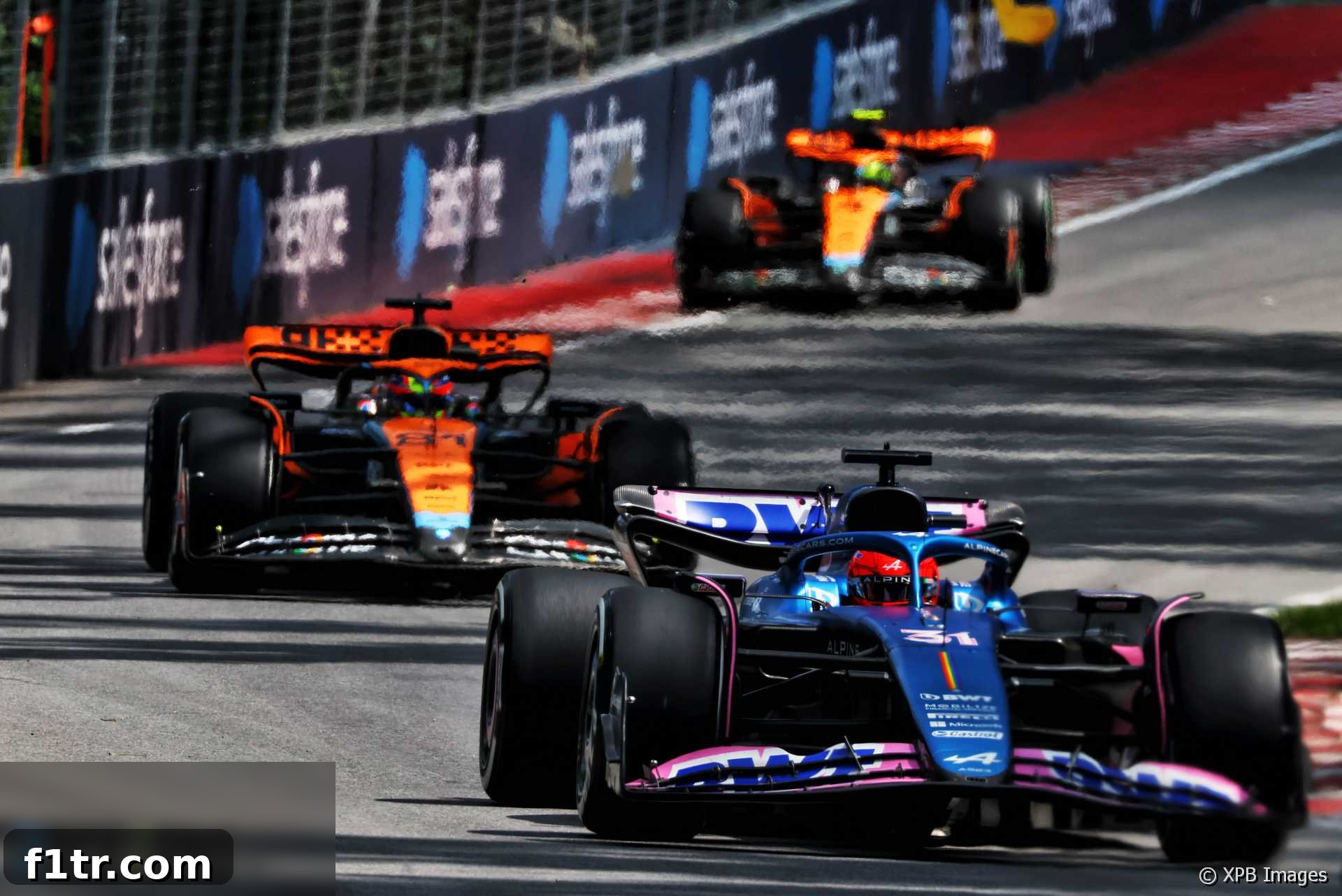
McLaren Racing is formally requesting clarification from the FIA regarding the governing body’s decision not to intervene over the “extreme” and potentially dangerous movement of Alpine’s rear wing during the recent Formula 1 Canadian Grand Prix. The incident, which saw Esteban Ocon’s rear wing exhibit alarming instability in the closing laps, raised significant safety concerns, particularly from McLaren driver Lando Norris.
Norris’s Urgent Warning: A Dangerous Precedent?
The issue became critically apparent when Lando Norris, in pursuit of Ocon’s Alpine during the intense final stages of the race, observed the dramatic oscillations of his rival’s rear wing. His radio communications vividly captured the gravity of the situation, expressing profound concern for both his own safety and that of others on track.
“The rear wing is loose on the Alpine,” Norris urgently warned his race engineer over the team radio. “It’s going to fall off at some point, that thing’s pretty dangerous. It’s very loose.” The McLaren driver’s apprehension intensified as he considered the potential consequences of such a failure. “If this falls off, it could hit someone,” he added, emphasizing, “It’s going to be extremely bad.” High-speed debris, especially from a carbon fibre component like a rear wing, poses a severe threat to drivers and spectators alike, capable of causing catastrophic damage or injury.
FIA Protocols Under Scrutiny: The Black-and-Orange Flag Controversy
The FIA race director holds explicit authority to mandate a car’s return to the pits for inspection or repairs if it is deemed to be in an unsafe condition. This power is typically exercised through the deployment of the black-and-orange flag, a clear signal to the driver that immediate action is required. However, the application of this flag has become a recurring point of contention and debate within the Formula 1 paddock, particularly throughout the previous season.
Haas F1 Team, for instance, faced the black-and-orange flag on three separate occasions in 2022 due to minor damage to their front wing endplates. The team vociferously argued that the damage was superficial and did not compromise safety to an extent requiring a pit stop, which carries a significant competitive penalty. This perceived inconsistency in stewarding was starkly highlighted later in the season at the United States Grand Prix when Fernando Alonso’s Alpine ran for several laps with a visibly loose rear-view mirror. Despite the clear safety risk, the incident inexplicably failed to attract the race director’s attention, leading Haas to formally protest their rival’s car after the race. Such events underscore the challenge of maintaining consistent safety standards while managing the high-pressure environment of competitive racing.
Following these high-profile incidents and subsequent discussions, a revised protocol was introduced. Teams are now ostensibly required to demonstrate to race control that their car remains in a safe condition if any damage becomes apparent during a race. Yet, as McLaren Team Principal Andrea Stella astutely observed, this places teams in an inherent conflict of interest. No team, especially one battling for championship points in the closing laps, wants to voluntarily retire or pit a car that might still be capable of scoring. Ocon’s situation in Canada, where he was on the cusp of points, perfectly illustrated this dilemma.
McLaren’s Stance and Future Debates: A Conflict of Interest
Andrea Stella voiced McLaren’s deep concern and provided insight into the complexities surrounding the FIA’s revised safety protocols. “The race direction now leaves the duty of care to the teams,” Stella explained. “It’s the team’s call to say ‘we should retire the car’ or ‘we should leave the car out’.” He acknowledged the inherent difficulty this presents: “It’s a tricky one because teams, when they are in a competition, you have a conflict of interest in terms of safety of everyone involved and maximising your result.” This moral tightrope walk between competitive drive and paramount safety responsibility forms the crux of McLaren’s grievance.
“I think this is a debate that will deserve more time, and I’m sure that the next Sporting Advisory Committee it will be raised again,” Stella affirmed, indicating that this incident is far from closed. The McLaren principal echoed Lando Norris’s sentiments, highlighting the psychological burden and physical danger for following drivers. “Because Lando said a couple of times that it is not nice when you follow a car with a wobbling rear wing and this may hit you, and kind of nothing happens.” The expectation from drivers and teams is that the FIA should have a clear, non-negotiable protocol for situations that pose such a direct threat, removing the onus from potentially biased teams.
Design Integrity vs. On-Track Reality: Alpine’s New Wing
Alpine had introduced a newly designed rear wing specifically for the Canadian Grand Prix, featuring smaller endplates and a more substantial central supporting pylon compared to its predecessor. However, Andrea Stella was unequivocal in his belief that the “extreme” movement observed at the race’s conclusion was certainly not an intended characteristic of its design. Such a degree of instability would compromise aerodynamic efficiency and structural integrity, factors that are meticulously engineered into every F1 component.
Stella also speculated on the performance implications of the wobbling wing. “Certainly I’m surprised that the Alpine wasn’t in condition to pass Albon because their tyres were much newer,” he noted. “So they must have lost some performance because of the tyre difference.” He continued, “I think if Lando was behind, we should have been able to pass Albon. So maybe that was a contribution to create this little train.” The significant loss of downforce or aerodynamic balance caused by a dramatically flexing wing would undoubtedly hinder a car’s pace and handling, explaining Alpine’s inability to capitalize on fresher tyres.
The McLaren boss further conveyed the escalating nature of their concern, as Ocon’s wing appeared to deteriorate in stability throughout the race. “When Lando was following Ocon, he said that it got worse and worse,” Stella recounted. “This was the kind of concerning element.” The progressive worsening indicated a potential structural failure or increasing fatigue rather than a mere design characteristic.
Stella was adamant that this was abnormal behavior, even for Alpine’s car, which has previously been observed with some minor rear wing flex. “Of course, sometimes we saw already before that the Alpine rear wing wobbles,” he admitted. “You might have noticed as well. But then when Lando reported it, and it started to look like there’s something broken, it can’t wobble like that just out of its normal behaviour. It wouldn’t be accepted by the FIA, it wouldn’t be accepted by the team themselves. I’m sure the thing is not operating within design.” The distinction between minor, acceptable flex and a dangerous, uncontrolled wobble is crucial and, in McLaren’s view, was clearly crossed in Montreal.
Post-Race Scrutiny and McLaren’s Formal Inquiry
Despite the visible and reported issues during the race, Esteban Ocon’s car successfully passed post-race scrutineering. He finished the Grand Prix in eighth position, securing valuable points for Alpine. Lando Norris, who initially crossed the line in ninth, was later demoted to 13th due to a post-race penalty for an unrelated incident. The fact that the car passed scrutineering, which typically checks for compliance with technical regulations regarding dimensions, weight, and safety features in a static state, further fuels McLaren’s inquiry into the dynamic safety assessment during the race.
“We will certainly make a question as to what was their thinking in terms of how safe the situation was today,” confirmed Andrea Stella. This formal query from McLaren is expected to prompt a thorough review by the FIA, not only of this specific incident but potentially of the broader protocols concerning in-race damage assessment and the implementation of the black-and-orange flag. The outcome of these discussions will be vital for ensuring consistent safety standards across Formula 1 and reinforcing driver confidence in the sport’s safety management.
Support Independent F1 Journalism
This content is brought to you by the generous support of readers like you. By contributing to our platform, you help cover the costs of creating, hosting, and developing high-quality, independent Formula 1 coverage. Your support ensures we can continue to bring you the latest news, in-depth analyses, and exclusive insights.
Become a supporter today and enjoy an ad-free browsing experience. Find out more or sign up via the links below:
- Become a Supporter Today
- Supporter FAQ
More from the 2023 Canadian Grand Prix
- Norris ‘even more’ sure Canada penalty was wrong after review request fails
- McLaren seeking more than just downforce gains from major upgrade
- Winning more races won’t necessarily lead to F1 seat – Palou
- Red Bull’s testing restriction will “massively affect” 2024 car development
- Schumacher’s set-up input gives Mercedes a “super advantage” – Wolff
Browse all 2023 Canadian Grand Prix articles