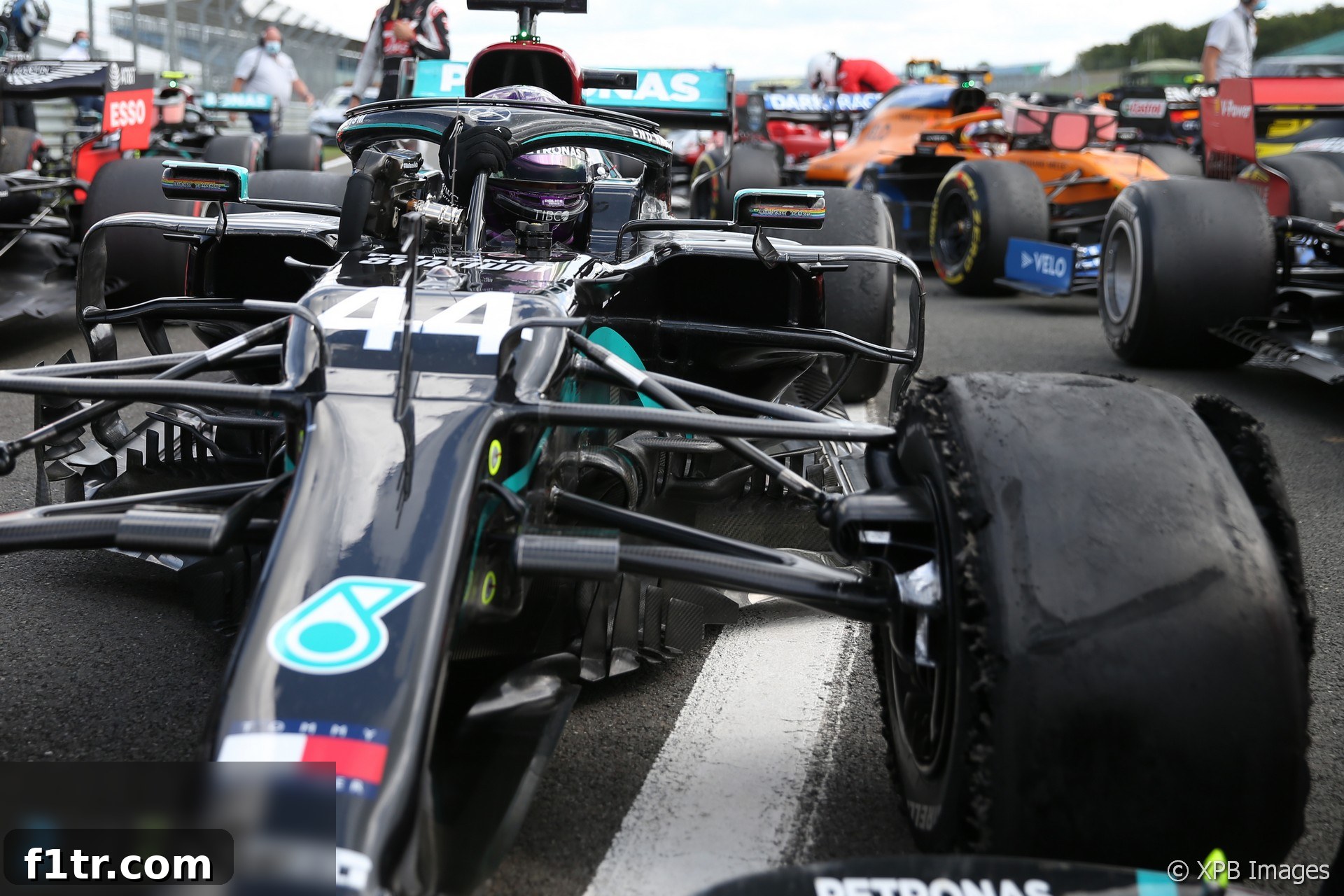
The recent British Grand Prix at Silverstone delivered a heart-stopping finale, marked by an unprecedented series of tyre failures that put drivers, teams, and the sport’s governing body on high alert. Formula 1’s official tyre supplier, Pirelli, has now concluded its thorough investigation into these dramatic punctures, confirming a detailed understanding of the circumstances and announcing crucial adjustments for the upcoming 70th Anniversary Grand Prix, also held at the iconic Silverstone circuit. While the incidents sent ripples of concern through the paddock, Pirelli has committed to moving forward with its pre-planned strategy of introducing softer tyre compounds for the second consecutive race weekend, albeit with significant modifications to operational guidelines.
Advertisement | Support Independent F1 Journalism – Go Ad-Free
Pirelli’s analysis revealed that Sunday’s race subjected the tyres to “the biggest forces ever seen” in Formula 1 history, operating under “the most challenging operating conditions” imaginable. The final four laps of the Grand Prix were particularly fraught, witnessing unexpected tyre failures for three prominent drivers: championship leader Lewis Hamilton, his Mercedes teammate Valtteri Bottas, and McLaren’s Carlos Sainz Jnr. Each incident, while distinct in its immediate outcome, pointed to a common underlying cause related to extreme stress and wear. Hamilton’s last-lap puncture was perhaps the most memorable, forcing him to limp across the finish line on three wheels, narrowly securing victory amidst the chaos.
The tyre manufacturer’s findings pointed to several contributing factors that, when combined, created a perfect storm for tyre integrity. Firstly, the sheer pace of the 2020 Formula 1 cars played a significant role. Lap times at Silverstone had fallen by over one second compared to the previous year, with pole position being 1.2 seconds faster than in 2019. This substantial increase in performance meant that tyres were subjected to greater forces through the circuit’s high-speed corners like Copse, Maggotts, Becketts, and Chapel, which are renowned for their immense lateral load demands.
Secondly, a pivotal early Safety Car period dramatically altered race strategy for nearly the entire field. This unforeseen intervention prompted most teams to anticipate their planned pit stops, resulting in an exceptionally long final stint for the majority of competitors. Drivers were forced to complete approximately 40 laps on a single set of tyres, equating to more than three-quarters of the total race distance on one of the most physically demanding tracks on the Formula 1 calendar. This extended usage, far beyond typical optimal operating windows, pushed the tyre compounds and structures to their absolute limits.
“A set of individual race circumstances led to an extremely long use of the second set of tyres,” Pirelli elaborated in its official statement. “The second Safety Car period prompted nearly all the teams to anticipate their planned pit stop and so carry out a particularly long final stint: around 40 laps, which is more than three-quarters the total race length on one of the most demanding tracks of the calendar.” This strategic domino effect, while seemingly logical in the moment, inadvertently set the stage for the dramatic conclusion.
The convergence of these elements – the inherently faster 2020 cars, the unforgiving nature of the Silverstone circuit, and the abnormally extended tyre stints – created unprecedented stress. “Combined with the notably increased pace of the 2020 Formula 1 cars (pole position was 1.2 seconds faster compared to 2019) this made the final laps of the British Grand Prix especially tough, as a consequence of the biggest forces ever seen on tyres generated by the fastest Formula 1 cars in history,” Pirelli’s statement continued. The cumulative effect was the “most challenging operating conditions for tyres” ever recorded by the supplier. These conditions were particularly harsh on the front-left tyre, which is universally acknowledged as working the hardest at Silverstone due to the circuit’s predominantly right-hand high-speed corners. After an exceptionally high number of laps, the resulting severe wear meant that the tyre’s structural integrity was “less protected from the extreme forces in play,” ultimately leading to the catastrophic failures witnessed.
The incidents highlighted the delicate balance between performance, durability, and safety that Pirelli must continuously manage in its role as the sole tyre supplier. Modern Formula 1 cars generate immense downforce, allowing them to carry incredible speeds through corners. This downforce, combined with powerful engines and sophisticated suspension systems, translates directly into colossal loads on the tyres. As the tyre rubber wears down, its ability to dissipate heat and absorb these forces diminishes, making the internal structure more vulnerable to sudden, acute stress. The failures served as a stark reminder of the limits of even the most advanced motorsport technology when confronted with exceptional circumstances.
Looking ahead to this weekend’s 70th Anniversary Grand Prix at Silverstone, Pirelli is taking proactive steps to mitigate any repeat of the issues while still adhering to its original tyre selection strategy. The company will once again bring the medium (C2) and hard (C3) compounds. However, a significant alteration will see the hardest C1 compound replaced by the second-softest C4 compound, as initially planned for this special commemorative race. This decision to bring a softer range was made long in advance to create a different strategic challenge for teams at the same venue, and Pirelli remains committed to it, aiming to foster exciting racing.
Crucially, in light of Sunday’s failures, Pirelli will implement revised tyre usage guidance for all teams and will significantly increase the minimum tyre pressures. This adjustment is designed to reduce the strain on the tyre constructions, particularly the sidewalls, by making them stiffer and less prone to excessive deflection under load. While higher pressures typically offer enhanced structural integrity, they can also impact grip levels and car handling, presenting a new challenge for engineers to fine-tune their setups. Teams will need to meticulously re-evaluate their strategies, pit stop timings, and driving styles to adapt to these new parameters, ensuring both safety and competitive performance.
The back-to-back races at Silverstone offer a unique opportunity for immediate learning and adaptation within Formula 1. Pirelli’s swift investigation and transparent communication are vital for maintaining confidence in the championship. The forthcoming race will not only be a test of raw speed but also of strategic acumen and the ability of teams to master the updated tyre operating conditions. All eyes will be on the front-left tyres once more, as the sport seeks to deliver another thrilling spectacle, this time with an added layer of tyre management intrigue and enhanced safety measures in place.
Advertisement | Become a RaceFans supporter andgo ad-free
2020 F1 Season Related Articles
- Grosjean to make F1 test return tomorrow for first time since Bahrain horror crash
- Pictures: Wrecked chassis from Grosjean’s Bahrain fireball crash to go on display
- Bottas vs Rosberg: Hamilton’s Mercedes team mates compared after 78 races each
- F1 revenues fell by $877 million in Covid-struck 2020 season
- Hamilton and Mercedes finally announce new deal for 2021 season
Browse all 2020 F1 season articles