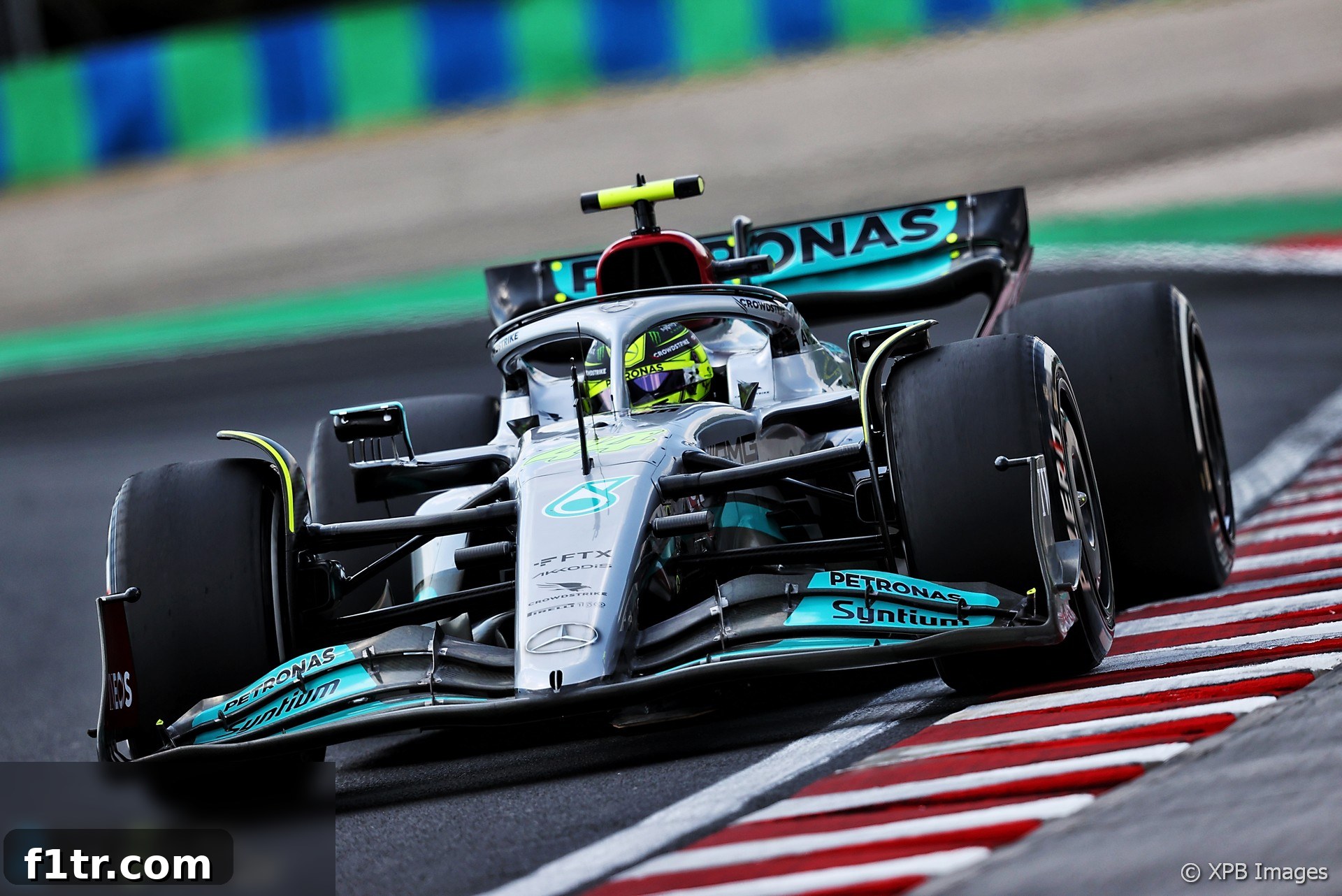
Lewis Hamilton and the Mercedes-AMG Petronas Formula 1 Team are bracing for a formidable challenge this weekend at the Hungarian Grand Prix, after a demanding Friday practice session saw the seven-time world champion cut his race simulation short due to unexpected car damage. The team, fresh from their best result of the season in France, encountered significant hurdles at the twisty Hungaroring, hinting at a potentially arduous few days ahead.
Advert | Become a Supporter & go ad-free
Friday’s practice sessions painted a challenging picture for Mercedes, who concluded the day only the sixth-fastest team on the grid. This position is a stark contrast to their recent performance trajectory, raising questions about the W13’s adaptability to the unique characteristics of the Hungarian circuit. Both drivers, Hamilton and teammate George Russell, expressed their frustrations with the car’s handling and overall balance, setting a cautious tone for the remainder of the race weekend.
A Difficult Start: Hamilton’s Struggles and Car Damage
The day was particularly arduous for Lewis Hamilton. After logging a significant number of laps, his second practice session came to an premature end during his crucial long-run race simulation. The culprit? Damage to his W13’s floor, which severely compromised the car’s aerodynamic performance. “The car’s a bit of a struggle today,” Hamilton candidly admitted in an interview supplied by Mercedes. “It’s crazy how it swings so much from track to track.” This observation underscores the ongoing challenge Mercedes faces in taming their temperamental 2022 contender, which appears to react drastically differently to varying circuit layouts and conditions.
Throughout the session, Hamilton’s radio communications frequently highlighted the car’s “unstable” nature. Such instability is detrimental on a circuit like the Hungaroring, which demands pinpoint precision and consistent grip. The circuit, often dubbed “Monaco without the walls” due to its tight, technical layout and lack of long straights, places a premium on aerodynamic downforce and mechanical grip. Any deficit in these areas, or an unpredictable balance, can severely hamper a driver’s ability to extract performance.
“At the moment it’s a little bit loose and not doing what we want it to do. So a difficult day,” Hamilton elaborated, detailing the challenges the team faced in finding a sweet spot for the W13. The floor damage he sustained was a significant setback, as he explained: “I didn’t get to run at the end because I sustained some damage on my floor so I lost a lot of downforce. After that it was pretty tricky for the long-run pace. It’s going to be a tough weekend but we’ll give it everything, see what we’ve got.” The loss of downforce would have rendered the car incredibly difficult to drive at speed, particularly through the numerous medium and high-speed corners of the Hungaroring, explaining the early curtailment of his practice run.
Hamilton concluded the second session in 11th place, just under two-tenths of a second slower than his teammate. While this gap might seem minimal, in the competitive world of Formula 1, it represents a significant performance delta. The team now faces the daunting task of assessing the damage, understanding its cause, and adjusting the car’s setup for the challenging conditions expected over the weekend.
Russell’s Perspective: Temperature Woes and Strategic Testing
George Russell, who ended FP2 in eighth position, nine-tenths off the pace, also had a far from straightforward day. “It’s definitely not our smoothest Friday so far,” he remarked, reflecting on a session marred by specific technical issues. Russell encountered recurring problems with high power unit temperatures in both practice sessions. Elevated temperatures can force engine manufacturers to reduce power output to prevent reliability issues, thus hindering performance. On a hot, physically demanding circuit like the Hungaroring, with limited opportunities for airflow, managing engine temperatures is critical.
However, Russell’s outlook was tinged with a degree of strategic foresight. The forecast for the remainder of the weekend promises a dramatic shift in conditions, with much cooler temperatures expected and rain heavily predicted for Saturday’s qualifying session. This impending change meant that optimizing the car for Friday’s dry and warm conditions might prove largely irrelevant for the crucial sessions to follow.
“It’s a bit of a strange one because we think it’s going to be wet tomorrow for quali and conditions on Sunday are going to be drastically different,” Russell explained. “So we were trying quite a few things with the car, using it as a bit of a test session because, to be honest, you can try and optimise everything today, but there’s no use of that at all for the rest of the weekend. So even though it’s a very tough day, I think it’s probably being a productive one.” This pragmatic approach by Mercedes suggests they were willing to sacrifice some immediate performance on Friday to gather valuable data on experimental setups, hoping this information might prove beneficial in the unpredictable conditions to come.
Despite this strategic mindset, Russell acknowledged the team’s underlying pace deficit. “Nonetheless,” he stated, “we were definitely a little bit further away than we probably would have expected.” This sentiment highlights the inherent difficulties Mercedes continues to face with the W13, a car that has proven challenging to understand and consistently optimize across different track characteristics.
The W13’s Ongoing Enigma and Hungaroring’s Demands
Mercedes’ 2022 challenger, the W13, has been a source of continuous development and frustration for the team throughout the season. Plagued by persistent porpoising and a narrow operating window, the car has struggled to match the pace of rivals Red Bull and Ferrari. While recent upgrades and a deeper understanding of the car led to a strong showing at the French Grand Prix, the Hungaroring appears to have exposed some of the W13’s inherent sensitivities once again.
The Hungaroring circuit, with its relentless series of corners and minimal straights, punishes any car that lacks a stable platform, strong front-end grip, and efficient downforce. It’s a track that demands exceptional mechanical balance and driver confidence. Mercedes’ struggles with a “loose” and “unstable” car indicate that they are yet to unlock the W13’s full potential in these critical areas for this specific venue. The previous comparison by Hamilton that “the gap’s about the same as last weekend so around a second” suggests that even if they get the car working perfectly, they still anticipate a significant performance deficit to the front-runners in dry conditions.
Looking Ahead: Rain, Recovery, and Resilience
The forecast for a wet qualifying session on Saturday could be a significant game-changer for Mercedes. Rain often acts as an equalizer in Formula 1, reducing the impact of raw car pace and placing a greater emphasis on driver skill and strategic calls. Both Hamilton and Russell are renowned for their prowess in challenging wet conditions, which could present an unexpected opportunity for the Silver Arrows to narrow the performance gap to their rivals.
The cooler temperatures expected alongside the rain should also alleviate the power unit temperature issues Russell encountered, allowing the team to potentially run their engines in a more aggressive mode. This combination of factors could provide Mercedes with a lifeline, allowing them to fight for better grid positions than their Friday pace would suggest.
Concluding his thoughts on Friday, Russell remained cautiously optimistic: “A couple of issues here and there, but I think tomorrow it’s going to be a totally new day and Sunday will also be a very different day. So not all lost yet.” This sentiment reflects the team’s fighting spirit and their historical ability to recover from challenging starts to a weekend. While Friday may have been a stark reminder of the W13’s complexities, the unpredictable nature of the Hungarian Grand Prix weekend, particularly with the ever-present threat of rain, means that the battle is far from over for Lewis Hamilton and Mercedes.
Advert | Become a RaceFans supporter andgo ad-free
2022 Hungarian Grand Prix
- How many victory chances did Hamilton have in his first winless F1 season?
- Aston Martin expect rivals will copy novel rear wing by Singapore GP
- Transcript: Why Ferrari told Leclerc ‘the hard is worse than expected’ but still used it
- What made Verstappen’s 10th-to-first win in Hungary a rare achievement
- Gasly pleased FIA is considering “different options” for track limits policing in 2023
Browse all 2022 Hungarian Grand Prix articles