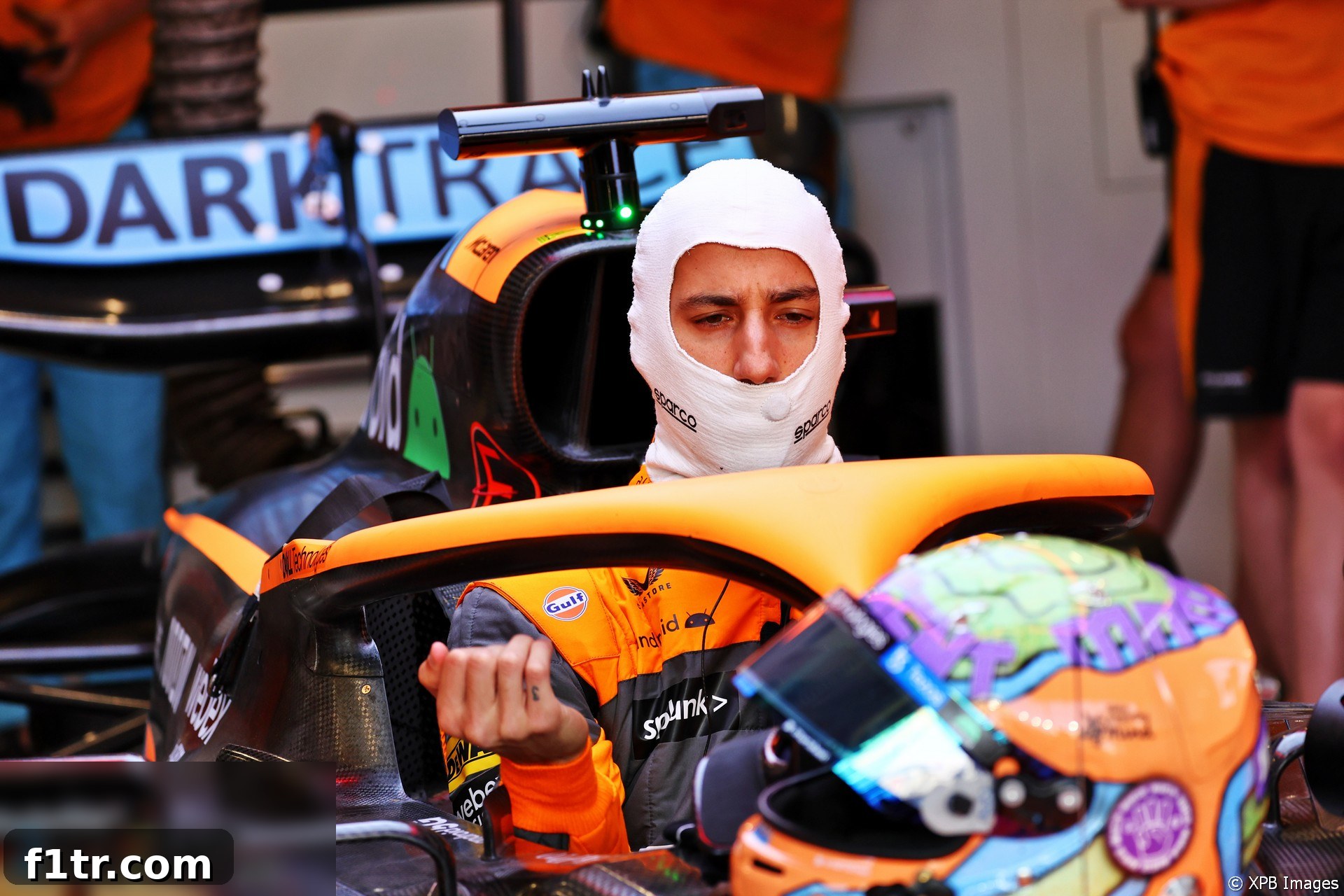
When Formula 1 recently unveiled a captivating social media video showcasing drivers’ dynamic reactions to the highly anticipated Las Vegas Grand Prix announcement, Daniel Ricciardo once again stole the spotlight. His characteristic wit was on full display as he jested about his previous contemplation of retirement, swiftly adding, “but I will no more.” This moment perfectly encapsulated the vibrant, wisecracking personality that has endeared him to millions of fans worldwide. Yet, beneath the ever-present smile, there must lie a profound sense of unease and a growing concern regarding his long-term future in the sport. His career trajectory since departing Red Bull three years ago has, by many measures, failed to deliver the consistent, front-running results that were so widely anticipated for a talent of his caliber. The narrative of Daniel Ricciardo, a charismatic figure often dubbed the “Honey Badger” for his relentless pursuit on track, has become one of intricate strategic decisions, missed opportunities, and a persistent battle to reclaim the formidable form that once placed him among Formula 1’s elite.
The 2022 Formula 1 season has presented McLaren with one of their most challenging starts in recent memory, marking their worst performance since 2017. Both Ricciardo and his young, highly-rated teammate, Lando Norris, struggled significantly, failing to advance beyond Q2 in either of the initial two races. This concerning dip in performance not only highlights McLaren’s struggles but also intensifies the pressure on their drivers. However, the paths of the two McLaren drivers diverge sharply. While Norris, at just 22 years old, has recently solidified his commitment to McLaren with a long-term contract, Ricciardo finds himself closer to the twilight of his F1 career at 32. With a coveted world championship title still elusive and competitive results increasingly sporadic, the stakes for Ricciardo are arguably higher than ever. The juxtaposition of Norris’s burgeoning career with Ricciardo’s veteran status underscores a critical juncture in the Australian driver’s journey, prompting questions about his continued role at the pinnacle of motorsport.
The Formative Years: From HRT Debut to Red Bull Stardom
Daniel Ricciardo’s Formula 1 odyssey began in 2011, a testament to his undeniable talent cultivated through championship victories in Formula Renault and Formula Three. His big break arrived midway through that season, when he was loaned from the formidable Red Bull junior programme to the back-of-the-grid HRT team for his Grand Prix debut. It was a baptism of fire, as Ricciardo himself recently recounted in an interview for McLaren, describing how he felt “thrown to the wolves” due to the sudden nature of the opportunity. “I was only told a week beforehand that I’d be racing,” he explained, shedding light on the immense pressure and rapid acclimatization required. This abrupt entry into the demanding world of Formula 1 meant he had minimal preparation time. “I wore myself out trying to do too much,” Ricciardo admitted. “It wasn’t the perfect preparation. You’ve only got so many hours in a day and I was trying to take in as much information as I could in a short space of time. I was trying to be a hero when, really, the key was to just get the basics right.” This candid reflection reveals the raw challenges faced by a young driver thrust into the global spotlight, eager to prove his worth but perhaps overwhelmed by the sheer scale of the task.
Despite this baptism of fire, Ricciardo’s infectious energy and vibrant personality were instantly recognizable and infallible. The ‘Honey Badger’ quickly carved out a niche for himself as a fan favourite, earning affection not just for his audacious overtakes but also for his genuine warmth and distinctive smile. His journey through the Red Bull pipeline saw him progress from Toro Rosso, Red Bull’s junior team, to the main Red Bull Racing squad in 2014. This move proved to be a pivotal moment in his career, marking his true breakthrough in Formula 1. The 2014 season became a defining chapter for Ricciardo, as he not only secured his maiden F1 victory in Canada but followed it up with two more triumphs in Hungary and Belgium. His stellar performance saw him finish an impressive third in the drivers’ standings, notably ahead of his highly decorated, four-time world champion teammate, Sebastian Vettel. This triumph over a reigning champion underscored Ricciardo’s immense potential and exceptional race craft. At that point, with a handful of remarkable wins under his belt and the confidence of having convincingly beaten a driver of Vettel’s caliber, it felt almost inevitable that Daniel Ricciardo would, in due course, ascend to become a Formula 1 world champion. The expectation was not if, but when.
The Verstappen Era and a Difficult Departure from Red Bull
The season following Ricciardo’s stellar 2014 campaign, 2015, proved to be a significant challenge for Red Bull. The team grappled with substantial engine woes and a pervasive streak of bad luck, which severely hampered Ricciardo’s performance and prospects. However, he showcased his resilience by bouncing back strongly in 2016, achieving his best-ever finish in the standings by securing third place once again. In a season that saw him outscore his new, sensationally talented teammate, Max Verstappen, the narrative appeared complex. While Ricciardo officially finished ahead, Verstappen, who was famously promoted to Red Bull after just five races with Toro Rosso, sensationally won on his debut for the senior team. He concluded the season a mere 52 points behind Ricciardo, signaling the undeniable rise of a new star. The dynamic within Red Bull began to subtly but fundamentally shift. Even though Ricciardo managed to outscore his prodigious young teammate again in 2017, the ascendancy of Verstappen was palpable, laying the groundwork for future tensions.
By 2018, the internal battle at Red Bull reached a crescendo, with Ricciardo finding himself comfortably outpaced by Verstappen. This on-track disparity was further exacerbated by a visibly tense partnership, famously exemplified by their dramatic, race-ending collision at the Azerbaijan Grand Prix. The incident served as a stark public display of the growing friction. Facing what he perceived as a changing internal dynamic and seeking a fresh environment, Ricciardo made the monumental decision to leave the Red Bull fold and embark on a new chapter with Renault, articulating his desire for a fresh challenge. Unsurprisingly, rumors quickly began to circulate, suggesting that intricate intra-team politics had played a significant role in his decision to depart Red Bull. Regardless of the precise motivations behind his exit, a golden opportunity—the chance to potentially contend for a world championship with a top-tier team—had seemingly slipped through his grasp.
Red Bull team principal Christian Horner later offered his perspective on Ricciardo’s departure, revealing the strategic considerations at play. In an interview with Australia’s Daily Telegraph, Horner candidly stated, “We put offers in front of him that were stratospheric.” He continued, explaining the core reason for Ricciardo’s choice: “But Daniel could see Max in the ascendancy and he didn’t want to become the second driver.” This insight underscores Ricciardo’s competitive spirit and his refusal to play a supporting role. However, Horner also highlighted a critical misjudgment, asserting, “His timing was spectacularly bad because, obviously, he had doubts about the Honda engine and then [Honda] went on to prove there it was a competitive power unit and a race-winning package.” Indeed, in the years following Ricciardo’s departure, Red Bull made remarkable strides with the Honda power unit, ultimately propelling Max Verstappen to the world championship title in 2021, in one of the most memorable and fiercely contested seasons in F1 history. This dramatic turn of events solidified the perception that Ricciardo’s career-defining move was, in hindsight, unfortunately timed.
The Renault Years and the McLaren Move: A Continuous Search
Ricciardo’s decision to choose Renault over McLaren at the close of the 2018 season, a move driven by the promise of a fresh start and a leading role, backfired almost immediately. The 2019 season saw McLaren, powered by Renault engines, actually finish ahead of their engine suppliers in the constructors’ standings, a clear indicator that Ricciardo’s strategic gamble had not paid off as intended. The landscape of Formula 1 is unforgiving, and when results fail to materialize, drivers often seek new avenues. Thus, even before the pandemic-hit 2020 season belatedly commenced, Ricciardo had already made the definitive choice to switch camps yet again, signing with McLaren for the following season. This move marked another significant career crossroads, a hope that a change of environment would reignite his championship ambitions.
However, his tenure at McLaren, much like his time at Renault, has not unfolded entirely according to plan. The 2021 season, in particular, presented considerable challenges. Lando Norris, his exceptionally talented and rapidly developing teammate, quickly found his stride with the McLaren car, securing three podium finishes and amassing more than double Ricciardo’s points total heading into the summer break. This clear performance gap generated intense scrutiny and raised questions about Ricciardo’s adaptation to the team and the car. The pressure on the popular Australian was immense, with many in the paddock and among fans wondering if his best years were behind him.
The Monza Redemption: “I Never Left”
Yet, Daniel Ricciardo’s story is defined by resilience, and he emphatically demonstrated this in the second half of the 2021 season. In a moment that resonated deeply across the Formula 1 world, Ricciardo spearheaded McLaren’s first victory in nearly a decade at the iconic Italian Grand Prix in Monza. In a stunning display of skill and determination, he clinched the win, with Lando Norris securing a magnificent second place, delivering a dream 1-2 finish for the Woking-based team. The jubilation was palpable, and Ricciardo’s emotional radio message after taking the chequered flag quickly became legendary: “Deep down I knew this was going to come, so thanks for having my back. And for anyone who thought I left, I never left. I just moved aside for a while.” This powerful declaration not only reaffirmed his belief in himself but also sent a clear, defiant message to any doubters.
Following the race, Ricciardo elaborated on the profound meaning behind his heartfelt comments. “I appreciate that message was going to be directed at I guess people who did maybe think that I’d checked out and that I was on my way out or a little bit washed up or whatever,” he explained, acknowledging the public perception during his challenging periods. However, he emphasized a deeper, more personal significance: “But still, first and foremost, that message was for me because there were times where I did lose a little bit of faith and I did second-guess myself like, why am I struggling so much? Do I have now a little bit of fear that I’m not pushing the car as much?” His candid admission revealed the intense psychological toll that underperformance takes on an elite athlete, even one as outwardly cheerful as Ricciardo. “I knew I didn’t, but still when things aren’t going well, some of these questions pop up. So the ‘I never left’ was also for me to be like, I can still do it, I still belong here. And anyone that forgot, then forget no more.” The Monza victory was more than just a race win; it was a profound personal and professional redemption, a reaffirmation of his enduring talent and rightful place at the pinnacle of motorsport.
Current Challenges and an Uncertain Future
Beyond the professional struggles, Ricciardo has openly acknowledged that homesickness occasionally weighed heavily on his mind, particularly during the trying moments of the 2021 season. The prolonged separation from family and friends in Australia, exacerbated by the global pandemic, added another layer of emotional complexity to his already challenging career phase. His eventual return home to Australia during the off-season, the first since the pandemic began, offered much-needed solace and reconnection. At 32 years old, Daniel Ricciardo still possesses the skill and experience to contend for a championship, theoretically having several good years left in his Formula 1 career. However, McLaren’s concerning lapse in form and persistent reliability issues at the outset of the 2022 season, coupled with Lando Norris’s newly cemented long-term commitment to the team, places Ricciardo in an increasingly precarious and uncertain position. The relentless demands of Formula 1 mean that sustained performance is non-negotiable, and the clock is ticking for the Australian veteran.
His return to his home race in Australia this weekend, a venue where his record has historically been less than stellar – due in part to his infamous 2014 disqualification over a technical infringement that cost him a podium finish – added another layer of emotional significance. Ricciardo was undoubtedly keen to deliver a standout performance in front of his adoring home crowd, seeking to rewrite past narratives and build momentum. The last time he raced at his home circuit, back in 2019, it was his inaugural race after his high-profile departure from Red Bull and his debut with Renault. That race began inauspiciously, with Ricciardo destroying his front wing mere meters from the start after running off-track – a symbolic, if unfortunate, beginning to his new chapter. This incident, in many ways, foreshadowed the turbulent years that followed, during which Ricciardo’s career has often veered on and off course. The perma-smiling fan favorite, a beacon of positivity in the paddock, at times became an unfamiliar, dejected figure, grappling with challenges that tested his renowned optimism. By his own admission, Ricciardo questioned if he had “lost faith” during 2021, a rare moment of vulnerability from a driver known for his unwavering confidence. Now, in his fourth year since leaving Red Bull, he faces yet another trying season, navigating the complexities of an underperforming car and an uncertain future, all while striving to demonstrate that the Honey Badger still has plenty of fight left.
News Focus
- No happy ending for Ricciardo’s made-for-Netflix redemption arc
- No ‘two alphas’ for Red Bull as team forms its longest-running driver line-up
- Will Mercedes come to the rescue of Ocon’s career a third time?
- How the midfield’s hottest team mate rivalry boiled over
- Petty officialdom or deserved decisions? Five drivers stripped of wins in 2024
Browse all News Focus articles