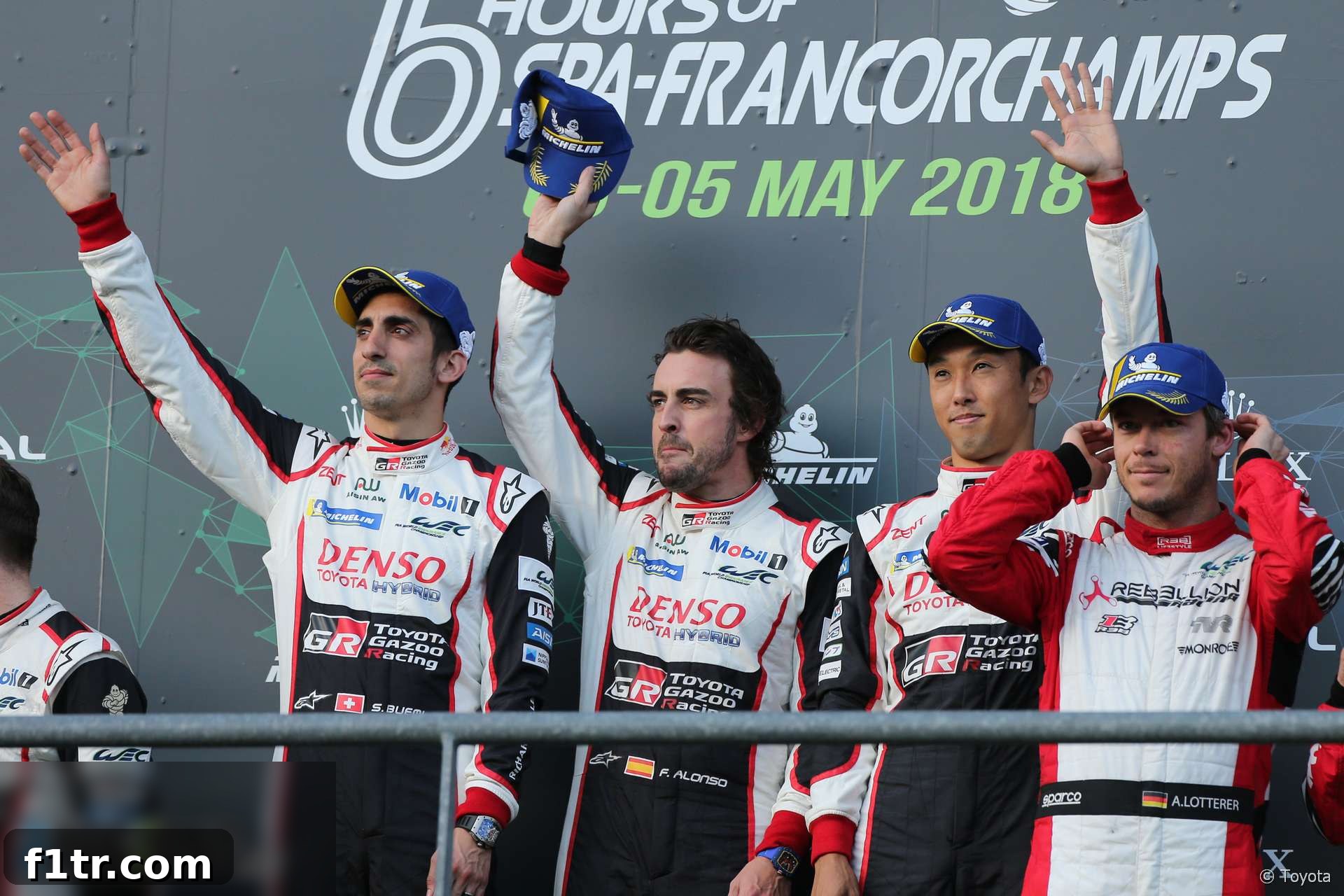
In a resounding display of skill, strategy, and sheer dominance, Fernando Alonso, alongside his seasoned teammates Sebastien Buemi and Kazuki Nakajima, spearheaded Toyota Gazoo Racing to a commanding one-two finish at the Spa Six Hours. This spectacular victory, achieved in the opening round of the highly anticipated 2018-19 World Endurance Championship (WEC) ‘super-season,’ has sent a clear, emphatic message: Toyota is not just participating; they are poised and ready for the ultimate test of endurance racing, the iconic Le Mans 24 Hours.
The Spa-Francorchamps circuit, with its legendary turns and unpredictable Ardennes weather, served as the perfect proving ground. For Alonso, a two-time Formula 1 world champion, and his crew in the No. 8 Toyota TS050 Hybrid, this triumph was far more than just a race win. It was a crucial dress rehearsal, a high-stakes test under genuine racing conditions, laying down a formidable marker for what promises to be an unforgettable season. The atmosphere at Spa was charged with anticipation, not only for the start of the WEC season but also for the critical insights it would offer ahead of motorsport’s most gruelling 24-hour event.
Advert | Become a Supporter & go ad-free
Reflecting on the team’s performance, Alonso encapsulated the sentiment perfectly: “Definitely this is a warm-up for Le Mans. Like a test but with points at the end of the chequered flag.” This statement highlights the dual nature of the Spa event – an opportunity to fine-tune operations and strategies while simultaneously vying for championship points. The pressure on drivers, mechanics, and engineers was immense, simulating the intense environment of Le Mans. Every pit stop, every driver change, every strategic call was scrutinised, pushed to its limit in the crucible of competition. The fact that Toyota delivered a flawless one-two finish under such conditions speaks volumes about their preparation and resolve.
“We wanted to test ourselves in proper race conditions with other teams, the drivers under stress, the mechanics under stress, everyone in racing conditions. And we delivered a one-two, so I think we are ready for Le Mans,” Alonso further elaborated. His words underscore the comprehensive nature of their Spa campaign. It wasn’t just about raw speed, but about the intricate dance of endurance racing: managing fuel, tyres, traffic, and adapting to unforeseen circumstances. The confidence radiating from the Spanish ace was palpable, a stark contrast to the often-tense expressions seen in other high-stakes motorsport endeavours.
Looking ahead to the ultimate challenge, Le Mans, Alonso acknowledged its unique demands. “Definitely the race is a lot tougher, 24 hours, a lot of issues may appear but we are as prepared as possible so I think we will go with confidence into the race.” The Le Mans 24 Hours is notorious for its unpredictability. Mechanical failures, driver errors due to fatigue, and sudden weather shifts can all derail even the most meticulously planned campaigns. Toyota, in particular, has a history of heart-wrenching near-misses at Le Mans, making their pursuit of victory even more poignant. This consistent preparedness, demonstrated by the flawless execution at Spa, is a vital psychological boost as they confront the demons of past Le Mans disappointments.
Tactical Mastery Amidst Early Challenges
The Spa Six Hours race began with an unexpected twist for Toyota. The No. 8 Alonso/Buemi/Nakajima Toyota inherited pole position after their sister car, the No. 7, was hit with a one-lap penalty and excluded from qualifying, forcing it to start from the back of the grid. This initial advantage influenced the No. 8 garage’s tactical approach, which initially leaned towards a more conservative strategy to protect their lead. However, endurance racing, especially at Spa, rarely follows a predictable script.
Alonso explained the evolving race dynamics: “We took quite a safe approach in the race knowing that we were in a good advantage. But then with the Safety Car probably that advantage went, so our safe approach was not the quickest and we had to fight until the end.” The deployment of the Safety Car, a common occurrence in multi-class endurance races with varied speeds, effectively neutralised their hard-earned lead, bringing the field back together and forcing the No. 8 crew to re-evaluate and push harder than anticipated. This scenario proved to be another invaluable test, simulating the kind of pressure and adaptability required at Le Mans.
Despite the challenges, Toyota’s LMP1 contenders showcased blistering pace from the outset. While other LMP1 teams demonstrated initial speed, Toyota’s strategy and execution ultimately proved superior. “Six Hours race, it seems easy, but I think the other LMP1s were quick at the beginning of the race. We stopped before them in the first stop so they were a risk there,” Alonso remarked. The early pit stop strategy was a calculated risk that paid off, allowing them to gain track position and manage the race from the front. The constant threat of traffic from slower GT and LMP2 cars added another layer of complexity, demanding exceptional situational awareness and precise overtakes from all drivers.
“Anything can happen in six hours. A lot of traffic, a lot of risky moments. I think we executed the race to perfection and we got the one-two so it’s good for the team.” This statement perfectly encapsulates the essence of endurance racing – it’s not just about speed, but about meticulous planning, seamless teamwork, and the ability to adapt to a constantly changing environment. The synergy between Alonso, Buemi, and Nakajima was evident throughout the race, with each driver delivering consistent, faultless stints, contributing to a truly dominant performance by Toyota Gazoo Racing.
Fernando Alonso’s Triumphant Return to the Top Step
For Fernando Alonso personally, this victory carried significant weight. It marked his first win in international competition in almost five years, a testament to his unwavering determination and his relentless pursuit of new challenges beyond Formula 1. The taste of victory, a sensation he had long savoured in F1, was clearly intoxicating. His post-race comments were laced with pure joy and a touch of humorous exhaustion.
“I was telling Kazuki and Sebastien it is so nice to be on the podium and I will be here all night long, so pick me up tomorrow morning because I will try to sleep here,” he quipped. This light-hearted remark underscored the profound satisfaction of standing on the top step, a feeling cherished by every competitive athlete. For a driver of Alonso’s calibre, known for his fierce competitiveness, this win was not just a career milestone but a deeply personal achievement that reinvigorated his passion for top-tier motorsport, moving him closer to his ambition of securing motorsport’s coveted Triple Crown.
His integration into the Toyota WEC team has been seamless, his vast experience and analytical mind proving invaluable. The partnership with endurance racing stalwarts like Buemi and Nakajima has clearly elevated the team’s performance, creating a formidable trio that combines raw speed with strategic intelligence and unwavering consistency. Alonso’s enthusiasm and dedication have injected a new level of media attention and excitement into the WEC, drawing new audiences to the thrilling world of prototype racing.
Le Mans: The Ultimate Test Awaits
With the Spa Six Hours firmly in the rearview mirror, all eyes now turn to the Circuit de la Sarthe for the Le Mans 24 Hours. The WEC ‘super-season’ format, which includes two Le Mans races, provides an unprecedented opportunity for teams to contend for the most prestigious endurance title twice within the championship cycle. For Toyota, this presents a unique chance to finally conquer a race that has eluded them with agonizing regularity.
Their Spa performance served as an exhaustive examination of their complete package: the reliability and performance of the TS050 Hybrid, the efficiency of their pit crew, the strategic acumen of their engineers, and the sheer talent and endurance of their driver lineups. Every element passed with flying colours, instilling a profound sense of belief within the team. The meticulous data gathered from Spa will be scrutinised and applied to the specific demands of Le Mans, from optimal aerodynamic configurations for the long Mulsanne straight to managing tyre wear over extended stints.
The Le Mans 24 Hours is not just a race; it is a legend, a trial by fire that pushes human and mechanical limits to their absolute breaking point. The challenge of racing through the night, battling fatigue, navigating multi-class traffic, and contending with the unpredictable elements makes it arguably the most demanding race in the world. Toyota’s unwavering commitment to this event, coupled with their dominant form at Spa, positions them as the undeniable favourites. However, as history has repeatedly shown, Le Mans holds its own unique power, and nothing is guaranteed until the chequered flag falls after 24 hours of relentless racing.
Advert | Become a RaceFans supporter andgo ad-free
World Endurance Championship Insights
- WEC cancels its Qatar season-opener due to US-Iran war
- Porsche to end WEC Hypercar programme after just three seasons
- Mercedes won’t return to Le Mans because “we don’t like Balance of Performance” – Wolff
- “Luck” needed to win Le Mans because of Balance of Performance – Verstappen
- McLaren finally confirms it will enter the World Endurance Championship in 2027
Browse all World Endurance Championship articles