Lewis Hamilton’s Century of Speed: A Deep Dive into His 100 F1 Pole Positions
In the annals of Formula 1, certain achievements transcend mere statistics, carving a permanent mark in the sport’s rich history. Lewis Hamilton, a name synonymous with breaking records, achieved one such monumental feat by becoming the first driver to secure 100 pole positions. This unprecedented milestone, reached on a memorable Saturday, solidified his status not only as a racing legend but as the undisputed king of qualifying.
No other Formula 1 driver has ever reached a century of Grand Prix wins or fastest laps, let alone pole positions. This accomplishment underscores Hamilton’s unparalleled ability to extract every ounce of performance from a Formula 1 car during the crucible of a single flying lap. It is a benchmark that speaks volumes about his precision, courage, and consistent mastery over the most advanced machinery in motorsport.
The Unrivaled Significance of 100 Pole Positions
A pole position in Formula 1 is more than just starting at the front; it’s a testament to raw speed and nerve. It signifies a driver’s capacity to deliver under immense pressure, navigating the treacherous limits of a Grand Prix circuit with absolute perfection. To do this 100 times over a career spanning more than a decade is an extraordinary display of sustained excellence.
Each pole position is earned in a high-stakes qualifying contest, where fractions of a second separate triumph from disappointment. Hamilton’s century of poles highlights not only his intrinsic talent but also his remarkable consistency across different car regulations, tyre manufacturers, and competitive eras. This enduring dominance sets him apart in a sport where even the greatest drivers often experience peaks and troughs in their qualifying performance.
The Evolving Landscape of Pole Position: The Advent of Sprint Qualifying
While Hamilton’s 100th pole was secured through the traditional qualifying format, the very definition of ‘pole position’ in Formula 1 was on the cusp of a significant change. Shortly after this landmark, F1 introduced Sprint Qualifying races, altering how the starting grid for certain Grand Prix events would be determined. This innovation marks a pivotal shift, introducing an additional layer of racing to decide the ultimate pole-sitter.
Historically, “winning pole position” and “being fastest in qualifying” were often interchangeable terms. However, instances like drivers losing pole due to grid penalties already created slight distinctions. With Sprint Qualifying, the separation became more pronounced. The driver fastest in the Friday qualifying session would technically secure ‘pole position’ for the Sprint Race, but the winner of the Sprint Race would then be awarded ‘pole position’ for Sunday’s Grand Prix. This new format sparked debates among fans and pundits about how future records would be tallied and how this modern approach would impact the legacy of traditional qualifying specialists like Lewis Hamilton.
This evolution underscores the dynamic nature of Formula 1, constantly seeking to innovate and enhance the spectacle. However, it also casts Hamilton’s achievement in an even brighter light, marking it as a historical pinnacle achieved under the traditional, universally understood qualifying rules that have defined the sport for decades. His 100 poles stand as a pure measure of single-lap speed, untainted by the complexities of race performance in a shorter format.
Surpassing a Legend: Hamilton’s Trajectory Beyond Schumacher
The journey to 100 pole positions involved surpassing previous benchmarks, most notably the record set by the legendary Michael Schumacher. Hamilton initially broke Schumacher’s pole position record back in 2017. What is truly remarkable is how far he has pushed that record since then. With his 100th pole, Hamilton effectively raised the bar by an incredible 50% beyond the level Schumacher left it at.
This statistical ascendancy is a testament to Hamilton’s extraordinary longevity and consistent performance at the absolute pinnacle of motorsport. Schumacher’s seven world championships and myriad records once seemed insurmountable, but Hamilton has systematically conquered many of them. The comparison between these two titans of the sport is inevitable, and Hamilton’s pole position record highlights his unique dominance in the qualifying arena. It reflects a sustained competitive edge that few drivers in any era have ever been able to maintain.
From Rookie Promise to Qualifying King: The First Pole to the Hundredth
Lewis Hamilton’s Formula 1 journey began with a bang. On his Grand Prix debut with McLaren in 2007, he qualified an impressive fourth, just 0.683 seconds off pole position and a mere two-tenths behind his then-teammate, Fernando Alonso. This was in an era where drivers qualified with their race fuel loads, a strategic element that added another layer of complexity to single-lap performance.
Hamilton vividly recalled his 100th pole feeling “very similar” to his first. He recounted the pivotal moment when he pushed McLaren for “equality in terms of fuel load alongside my team mate,” noting that his breakthrough first pole position at the Canadian Grand Prix, the sixth round of the 2007 championship, came “the first time they gave us the equal fuel load.” This early demand for parity, even as a rookie, showcased Hamilton’s unwavering belief in his own abilities and his relentless pursuit of fairness and peak performance. It was a foundational moment, demonstrating the mindset that would eventually lead him to become the most successful qualifier in F1 history.
In the earlier stages of his career, Hamilton often racked up pole positions at a faster rate than his race victories, highlighting his raw, explosive speed. As recently as 2019, his pole tally stood 11 higher than his number of Grand Prix wins. However, facing stiffer competition from Ferrari and Red Bull that year, Hamilton experienced a 10-race spell without a pole position, his longest such drought in eight years. This period underscored the constant evolution of Formula 1 and the ever-present challenge of staying ahead of formidable rivals.
Beyond Raw Numbers: Pole Position Strike Rate and Longevity
While 100 pole positions is an astounding absolute number, examining a driver’s “strike rate” – the percentage of races started from pole – offers another perspective on qualifying prowess. Lewis Hamilton’s strike rate of taking pole position for 37% of the races he has started ranks him fifth-highest among all drivers who have competed in the sport. This figure is impressive, particularly considering the sheer length of his career.
His 270th race start, coinciding with his 100th pole, means he has competed in over 100 more races than the legendary Ayrton Senna and more than 200 races more than Juan Manuel Fangio, both of whom rank higher in terms of strike rate. Drivers like Fangio achieved an extraordinary strike rate of 56.86% by starting more than half of his races from pole position. Senna also boasted an incredibly high percentage, but their careers were significantly shorter, meaning their raw pole counts were much lower.
Pushing Hamilton’s strike rate higher becomes increasingly difficult with each additional race start. To match Fangio’s incredible 56.86% strike rate, Hamilton would hypothetically need to secure pole position for the next 125 consecutive races, a feat that would realistically extend his career well into the latter half of the 2020s. This comparison highlights the difference between an era of shorter careers and absolute, intense dominance, versus an era of incredible longevity and sustained, though not absolute, competitive advantage.
The Spanish Grand Prix: A Glimpse into the 2021 Season Battle
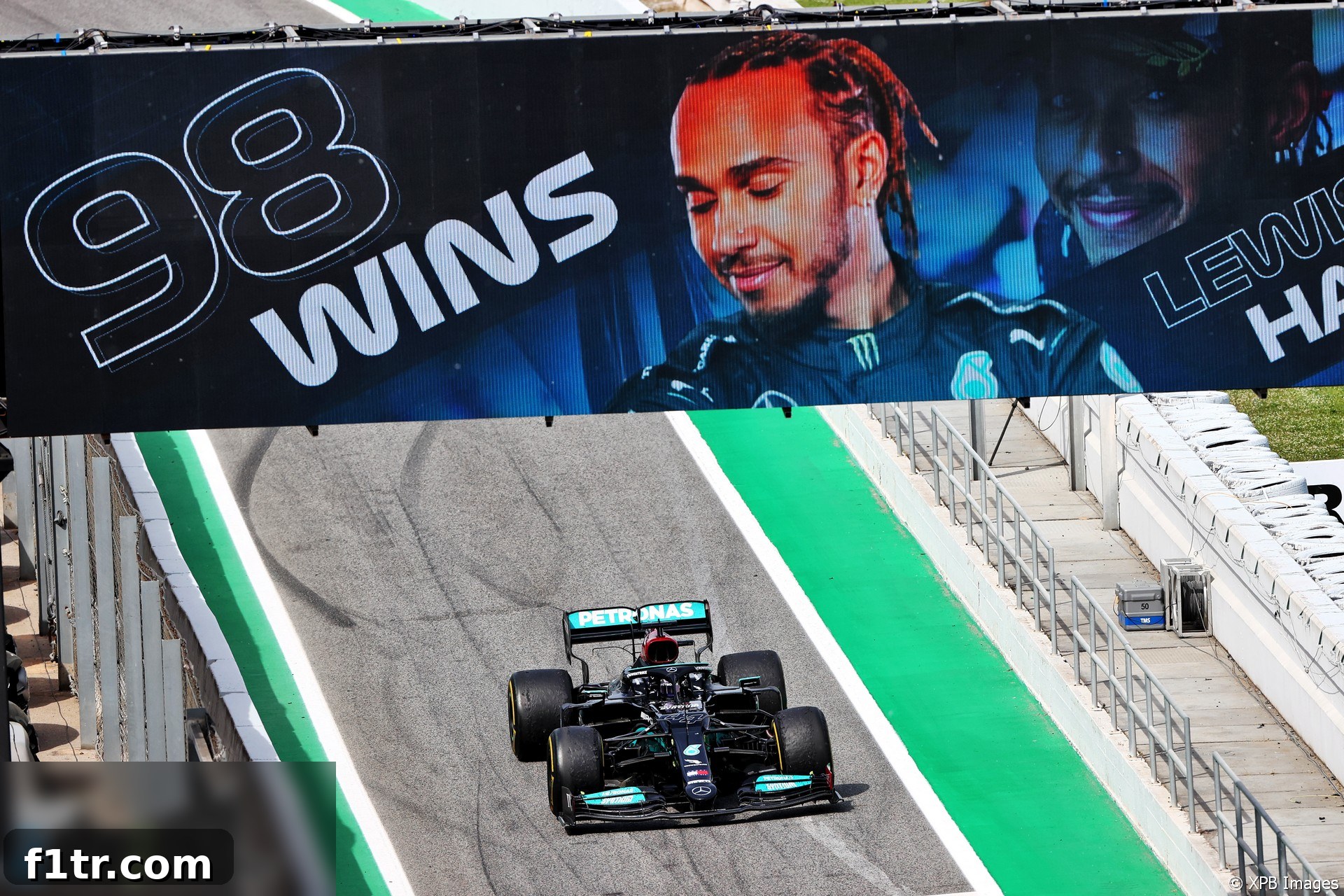
While the focus was heavily on Hamilton’s qualifying prowess, the Spanish Grand Prix itself offered a thrilling snapshot of the fierce championship battle unfolding in the 2021 season. Hamilton secured his 98th career Grand Prix victory, inching ever closer to another unprecedented century mark – 100 race wins. Although he didn’t complete a ‘hat trick’ by taking the fastest lap in Spain, that honor went to Max Verstappen, who secured the 11th fastest lap of his career.
The race in Spain also saw Hamilton match one of his hero Ayrton Senna’s remarkable achievements: his fifth consecutive win at the same Grand Prix. Senna achieved this feat at the Monaco Grand Prix from 1989 to 1993, a testament to consistency and mastery of a particular circuit. Hamilton’s dominant run at the Circuit de Catalunya mirrors this, underscoring his exceptional skill at this challenging venue.
The 2021 season was characterized by an intense rivalry at the very top. At this point in the season, Max Verstappen had led more laps than Hamilton – 144 to Hamilton’s 75 – yet Hamilton had converted his track time into three wins out of four races, showcasing his strategic acumen and race management. Hamilton was the only driver to have led every race of the season up to that point, a testament to Mercedes’ strong start and his relentless driving. He and Verstappen had consistently shared the top two steps of the podium at every race that year.
In Spain, Hamilton led Verstappen and Valtteri Bottas across the finish line, repeating the exact podium order from the previous race and from the Spanish Grand Prix of the previous year. Remarkably, it was the fourth consecutive year that this trio had shared the podium at the Circuit de Catalunya, although in 2018 and 2019, Bottas had finished ahead of Verstappen. This consistent presence at the front highlighted the enduring strength of Mercedes and the rising challenge from Red Bull.
Midfield Dynamics: McLaren vs. Ferrari
Beyond the titanic struggle at the front, the Spanish Grand Prix also saw intense battles in the midfield. McLaren continued their impressive streak of scoring points with both cars in every race of the season, demonstrating strong reliability and consistent performance. However, they were out-scored by Ferrari in Spain, allowing the Scuderia to close to within five points in what was shaping up to be a very close constructors’ title fight for third or fifth place.
For McLaren, Daniel Ricciardo led Lando Norris home for the first time as teammates, a significant moment as Ricciardo adapted to his new car and team. Ricciardo’s points finish marked his 15th consecutive race scoring points, further illustrating his consistent ability to bring the car home in strong positions.
Conclusion: A Legacy Still Being Written
Lewis Hamilton’s 100th pole position is not just a number; it’s a symbol of an unparalleled career dedicated to pushing the boundaries of what is possible in Formula 1. It speaks to his longevity, adaptability, and an insatiable hunger for perfection that has defined his journey. As he continued his relentless pursuit of further records, including the coveted 100th Grand Prix victory, Hamilton was still actively shaping his legacy, cementing his place as perhaps the greatest driver in the sport’s history. His achievements serve as an inspiration, reminding us that with talent, dedication, and unwavering focus, even seemingly impossible milestones can be reached and surpassed.
2021 Spanish Grand Prix Insights
- Two reasons why Catalunya may not predict the championship – at least this year
- McLaren to keep “drip-feeding” updates onto 2021 car
- Working group tackling F1’s track limits problem
- ‘We’ll discuss what went wrong’: Hamilton and Verstappen team radio transcript analysis
- 2021 Spanish Grand Prix Star Performers
Browse all 2021 Spanish Grand Prix articles