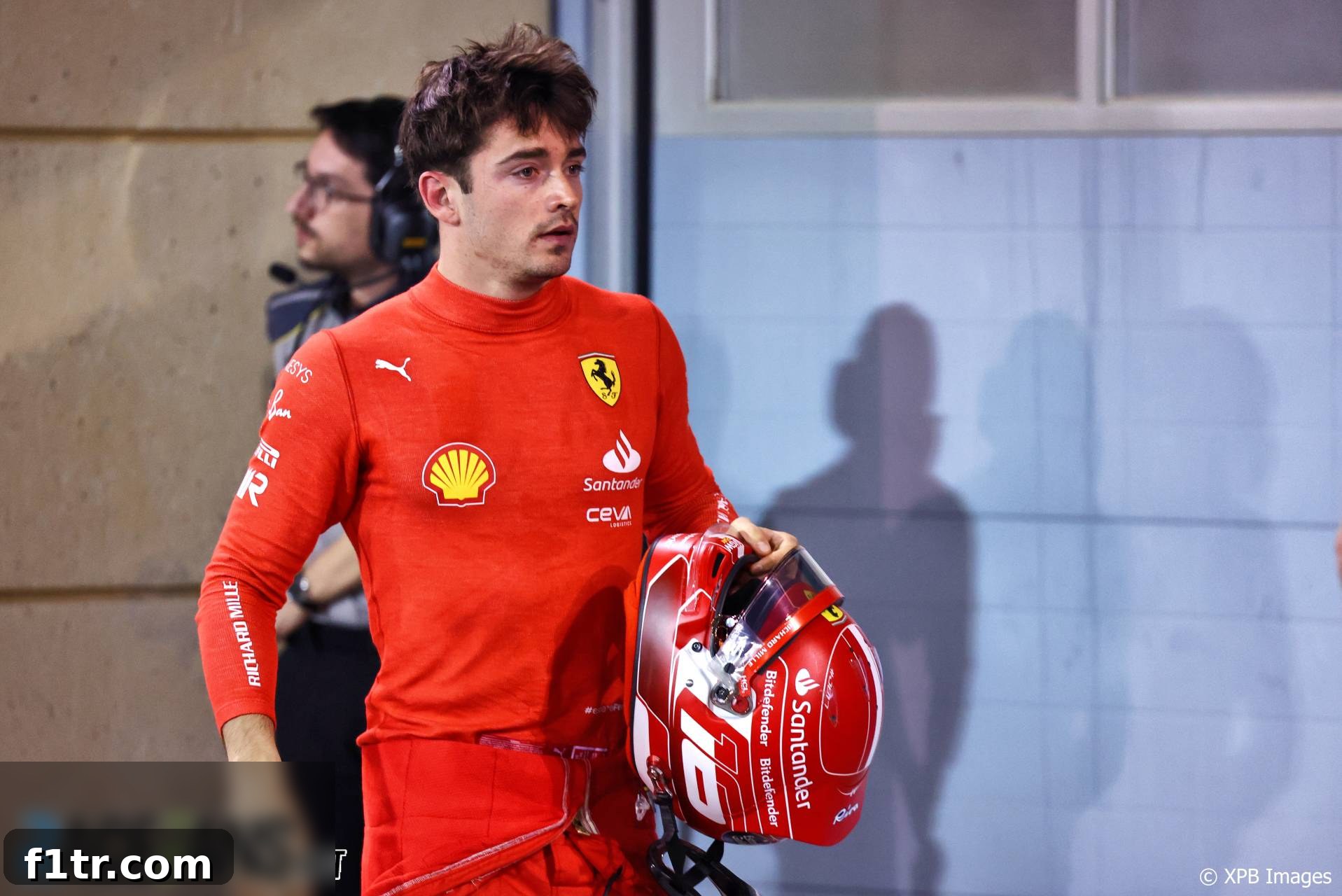
Charles Leclerc’s Strategic Sacrifice: The Logic Behind Ferrari’s Bold Qualifying Call in Bahrain
In the high-stakes world of Formula 1, every decision, from car setup to race strategy, is meticulously calculated. At the opening Grand Prix of the 2023 season in Bahrain, Charles Leclerc and Ferrari made a particularly audacious choice during qualifying, one that saw the Monegasque driver voluntarily forego a final, potentially pole-contending lap in Q3. Despite the immediate consequence of dropping a position on the grid, Leclerc firmly believes the team’s decision to save a fresh set of soft tires was not just warranted, but strategically brilliant for the impending race.
The qualifying session for the Bahrain Grand Prix saw Leclerc demonstrate impressive pace. Following the initial runs in the crucial Q3 segment, he held a provisional second place, trailing only the formidable Max Verstappen. With a fresh set of soft tires readily available in the Ferrari garage, the expectation was for Leclerc to head out for a final attempt, pushing the limits to challenge for pole position. However, to the surprise of many onlookers, Leclerc climbed out of his car, signaling an end to his qualifying efforts prematurely.
This calculated gamble quickly led to a tangible consequence on the grid. As Leclerc remained in the pits, Sergio Perez, his Red Bull rival, significantly improved his lap time during his final run. This improvement nudged the Ferrari driver down to third place on the starting grid, ceding the front-row slot that had momentarily been his.
Ferrari’s Rationale: Prioritizing Race Pace Over Grid Glory
Ferrari confirmed after the session that the decision to keep Leclerc in the garage was a deliberate team strategy aimed at conserving a critical set of fresh tires for Sunday’s Grand Prix. This move underscored a significant shift in thinking, prioritizing long-term race performance over the immediate gratification of a higher qualifying position.
Leclerc himself was unequivocal in his support for this strategy. He articulated that Ferrari’s single-lap qualifying pace, while surprisingly strong, masked a fundamental concern regarding their performance over a full race stint. He candidly admitted that rivals like Red Bull and Aston Martin appeared to possess a significant advantage in race trim. “We need to be realistic,” Leclerc told media, including RaceFans, during the post-qualifying press conference. “Those guys and also Aston Martin seems to be really, really quick in the race.”
This stark assessment of their comparative race pace was the cornerstone of Ferrari’s strategic calculus. The team understood that gaining a front-row start might be pyrrhic if their tire degradation or overall performance during the race meant they would inevitably fall back. Therefore, the sacrifice of a grid position was deemed a worthy trade-off. “Which is why I think we made that choice in Q3 to be willing to lose one or two positions at the start, but having new tyres to put all the chances on our side, which I’m sure is the right choice. But let’s see tomorrow,” Leclerc explained, highlighting the forward-thinking nature of the decision.
The Nuances of Tire Management in Modern F1
The strategic importance of tire management in contemporary Formula 1 cannot be overstated. With Pirelli providing a limited number of tire sets for each race weekend, every decision concerning their usage carries significant weight. A fresh set of soft tires, particularly at a circuit like Bahrain known for high degradation, can offer a crucial performance advantage, especially during critical race moments such as the start or an undercut/overcut strategy during pit stops. By saving a set, Ferrari aimed to equip Leclerc with maximum flexibility and optimal performance when it mattered most – over the 57 laps of the Grand Prix.
The decision also reflects a deeper understanding of the evolving competitive landscape in F1. While securing pole position traditionally offers the best chance of victory, modern aerodynamics and tire characteristics mean that a slight advantage in qualifying might be easily negated by superior race pace or more effective tire management from rivals. The 2023 season, in particular, was anticipated to feature tighter competition, making strategic ingenuity even more vital.
Leclerc’s Candid Thoughts: Surprise Pace and Strategic Confidence
Speaking immediately after exiting his car, Leclerc conveyed a mix of surprise and confidence. He admitted that Ferrari’s qualifying pace had been “a good surprise” for the team, especially considering the challenges they faced during pre-season testing and the initial free practice sessions in Bahrain. “To be honest I did not expect that after testing and after the free practices that were a little bit difficult, we managed to find that pace for the quali lap, which was great,” he remarked.
This unexpected burst of speed in qualifying likely fueled the internal debate about whether to push for pole. Leclerc himself entertained the possibility, suggesting he “might have had a chance to take pole position.” However, the overriding concern for race performance quickly brought the team back to their strategy. He pondered the hypothetical outcome: “I don’t know if we would have got pole or not, but it would have been close.”
Crucially, Leclerc reiterated his belief that the strategic sacrifice was the correct one. He articulated a clear preference for his starting position with the fresh rubber: “However, we need to keep in our mind that in the race run we seem to be a little bit on the back foot compared to Red Bull. I think we are in a better place starting third with new tyres than starting first with old.” This statement powerfully encapsulates the core reasoning behind Ferrari’s calculated risk. Sacrificing a front-row start to gain a significant tire advantage for the race could prove to be a masterstroke, allowing Leclerc to maintain pace, manage degradation more effectively, or even launch a more aggressive strategy against his rivals.
Implications for the Bahrain Grand Prix and Beyond
The decision to save a set of new soft tires sets the stage for a fascinating strategic battle in the Bahrain Grand Prix. With Leclerc starting third, he is still in a strong position to challenge for podium places, and potentially even victory, should the tire advantage materialize as Ferrari hopes. The strategy suggests that Ferrari is playing a longer game, focusing on maximizing their points haul over the course of the season rather than chasing singular qualifying glory at the expense of race performance.
This approach also highlights Ferrari’s evolving understanding of their 2023 car, the SF-23. Early in the season, teams are often still learning the optimal operating windows for their new machinery, particularly concerning tire wear and long-run performance. By opting for a conservative qualifying strategy, Ferrari demonstrated a pragmatic acceptance of their current limitations in race trim, while simultaneously leveraging their unexpected qualifying strengths to position themselves for a stronger Sunday.
Ultimately, the success or failure of this audacious gamble will only be truly known once the checkered flag waves on race day. However, Charles Leclerc and Ferrari have certainly signaled their intent: they are prepared to make difficult, strategic choices in pursuit of championship aspirations, even if it means foregoing immediate accolades for a greater long-term benefit. The Bahrain Grand Prix promises to be a compelling showcase of strategy, tire management, and raw racing talent, with Ferrari’s bold qualifying call adding an intriguing layer to the competitive dynamic.