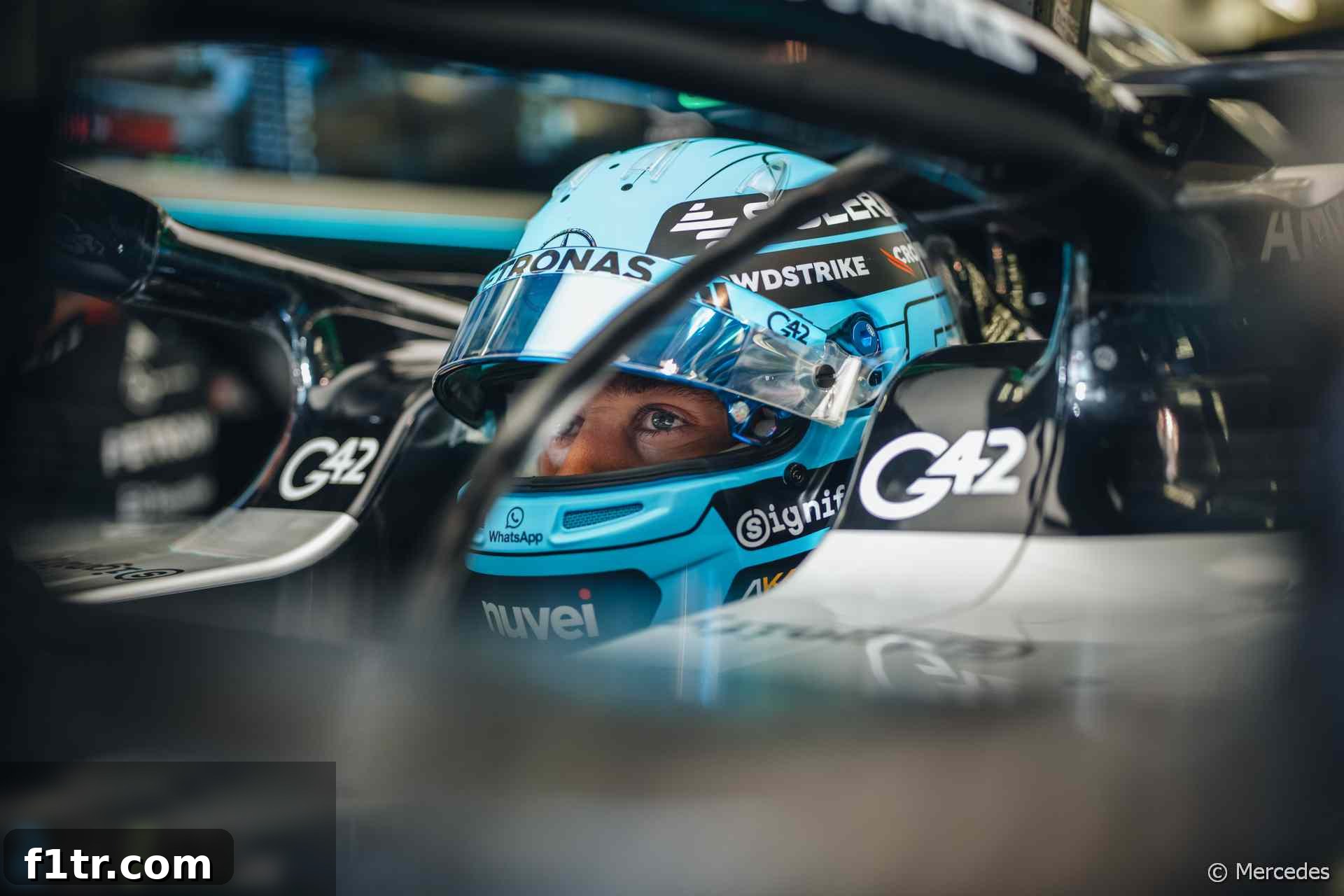
George Russell on the Ruthless Reality of F1 Driver Contracts and the Unpredictable Market
In the high-stakes world of Formula 1, where split-second decisions define careers and multi-million-dollar deals hang in the balance, the driver market operates with a brutal efficiency. Mercedes driver George Russell has offered a candid insight into this often-unforgiving landscape, asserting that while the market can be “ruthless,” unwavering performance remains the ultimate currency that guarantees a future.
Russell, whose current contract with the Mercedes-AMG Petronas F1 Team is set to expire at the close of this year, finds himself at a pivotal juncture. Having consistently demonstrated his calibre throughout his four seasons with the German outfit, his recent performances have been particularly impressive. He has secured a top-five finish in every race contested so far this season, positioning him fourth in the drivers’ championship, a mere 14 points adrift of the current leader. This remarkable consistency underscores his value and strengthens his negotiating position, yet the swirling rumours surrounding the driver market suggest no seat is truly safe.
The Verstappen Factor: A Shadow Over Contract Negotiations?
Despite Russell’s strong showings, his contract extension with Mercedes for the upcoming seasons remains unconfirmed. This delay has fueled rampant speculation, particularly concerning world champion Max Verstappen. Whispers suggest that Verstappen is reportedly unhappy with the internal dynamics and recent performance trajectory at Red Bull Racing, sparking widespread rumours of a potential seismic shift to Mercedes. Team Principal Toto Wolff has openly expressed his admiration for the Dutch prodigy, indicating a keen interest in securing his services. However, Russell remains unfazed by these external factors, maintaining a stoic focus on what he can control.
“There’s always so much excitement around contracts, but the fact is, if you don’t perform, even if you’ve got a contract, you get booted out. And if you do perform, your future sorts itself out,” Russell articulated in an interview with Sky Sports. His words reflect a profound understanding of Formula 1’s meritocratic nature. “So from my side, I’m just excited with my racing, pleased with how I’m performing, enjoying this season with the team. Performance is our strongest currency, so that’s what I’m focused on, and everything will sort itself out.” This pragmatic approach highlights the ingrained belief among elite drivers that their on-track results are their most potent bargaining chip, capable of overriding even the most intricate contractual arrangements.
Unpacking Long-Term Deals: More Flexible Than They Appear
Max Verstappen’s situation at Red Bull serves as a prime example of the complexities inherent in modern F1 contracts. Three years ago, he inked a monumental long-term deal designed to keep him with the Austrian squad until 2028. Yet, recent internal turmoil within the team and a perceived dip in competitive advantage have ignited intense speculation about a premature departure. Red Bull’s motorsport consultant, Helmut Marko, recently acknowledged the existence of an exit clause, reportedly allowing Verstappen to leave if he is not within the top three in the championship standings by the summer break in August. This revelation underscores Russell’s point about the inherent fluidity of even seemingly ironclad agreements.
The current Formula 1 grid presents an interesting dichotomy: more than half the drivers have already secured deals for the 2026 season and beyond. This trend towards longer contracts might suggest increased stability, but Russell quickly dismisses such a notion. He points out that these “long-term deals” are often peppered with various exit and performance clauses, rendering them far less binding than they appear on the surface.
“At the end of the day, we’ve never discussed a contract prior to May or June in a season,” Russell clarified, providing context to the usual timeline for negotiations. “I’d say the more abnormal point is how many drivers have these sort of long-term deals. But everyone’s got exit clauses, they’ve all got performance clauses. So a driver who’s on a three-year contract, it doesn’t really mean anything if they’ve got an exit clause or the team has an exit clause if the driver doesn’t perform.”
The Unspoken Rules: Performance Trumps Paperwork
Russell’s observations peel back the veneer of formality often associated with professional sports contracts, revealing the raw, performance-driven reality beneath. A contract, he implies, is merely a framework, subject to the intense pressures and ever-shifting dynamics of Formula 1. If a driver fails to meet expectations, or if a team finds a more promising alternative, contractual obligations can quickly become secondary considerations.
“It doesn’t really mean a lot. If you’ve got a contract with the team, but if the team wants you gone, then the team finds a way to get you gone,” Russell stated matter-offactly. This blunt assessment highlights the power imbalance that can exist between teams and drivers, particularly when significant investments are at stake. Teams, driven by the relentless pursuit of championship glory, are prepared to make difficult decisions to optimize their lineup and maintain a competitive edge. Conversely, drivers also possess their own leverage, often with clauses allowing them to seek greener pastures if a team’s performance or trajectory fails to meet certain benchmarks.
The cut-throat nature of Formula 1 demands constant excellence. There is little room for complacency or underperformance. “That’s how this sport works and how it should work because we’re 20 of the best in the world, and it’s ruthless. There’s no time to mess. All you can do is focus on driving fast,” Russell concluded. His philosophy distills the essence of what it means to be a top-tier F1 driver: an unyielding commitment to speed, precision, and consistency, knowing that any slip can have profound consequences for one’s career trajectory. This environment fosters an incredible competitive spirit but also an ever-present sense of insecurity for those not consistently at the pinnacle of their game.
Navigating the 2025 F1 Driver Market: A Strategic Chess Game
The unfolding driver market for 2025 and 2026 promises to be one of the most intriguing in recent memory. Beyond the Russell-Verstappen narrative, several high-profile seats remain unconfirmed, and numerous talented drivers are vying for opportunities. The strategic decisions made by teams like Mercedes will send ripples across the entire grid, potentially triggering a cascade of movements. For George Russell, his immediate focus on maximizing his performance is not just a personal mantra but a strategic imperative. By consistently delivering strong results, he not only solidifies his position within Mercedes but also enhances his appeal to any potential suitor, should circumstances dictate a change. In a sport where contracts are often fluid and futures are forged on the track, Russell’s message is clear: success is the ultimate negotiator.
Related Articles: 2025 Saudi Arabian Grand Prix
- Red Bull made tactical decision not to avoid a penalty in Jeddah, Horner confirms
- Norris’s starts were far poorer than Verstappen’s but the balance is shifting
- McLaren’s rivals “just one upgrade away from being the lead car” – Brown
- Russell told race control what he thought of Verstappen’s first lap corner cut
- Doohan’s final corner pass on Bortoleto was F1’s closest fight for last place in seven years