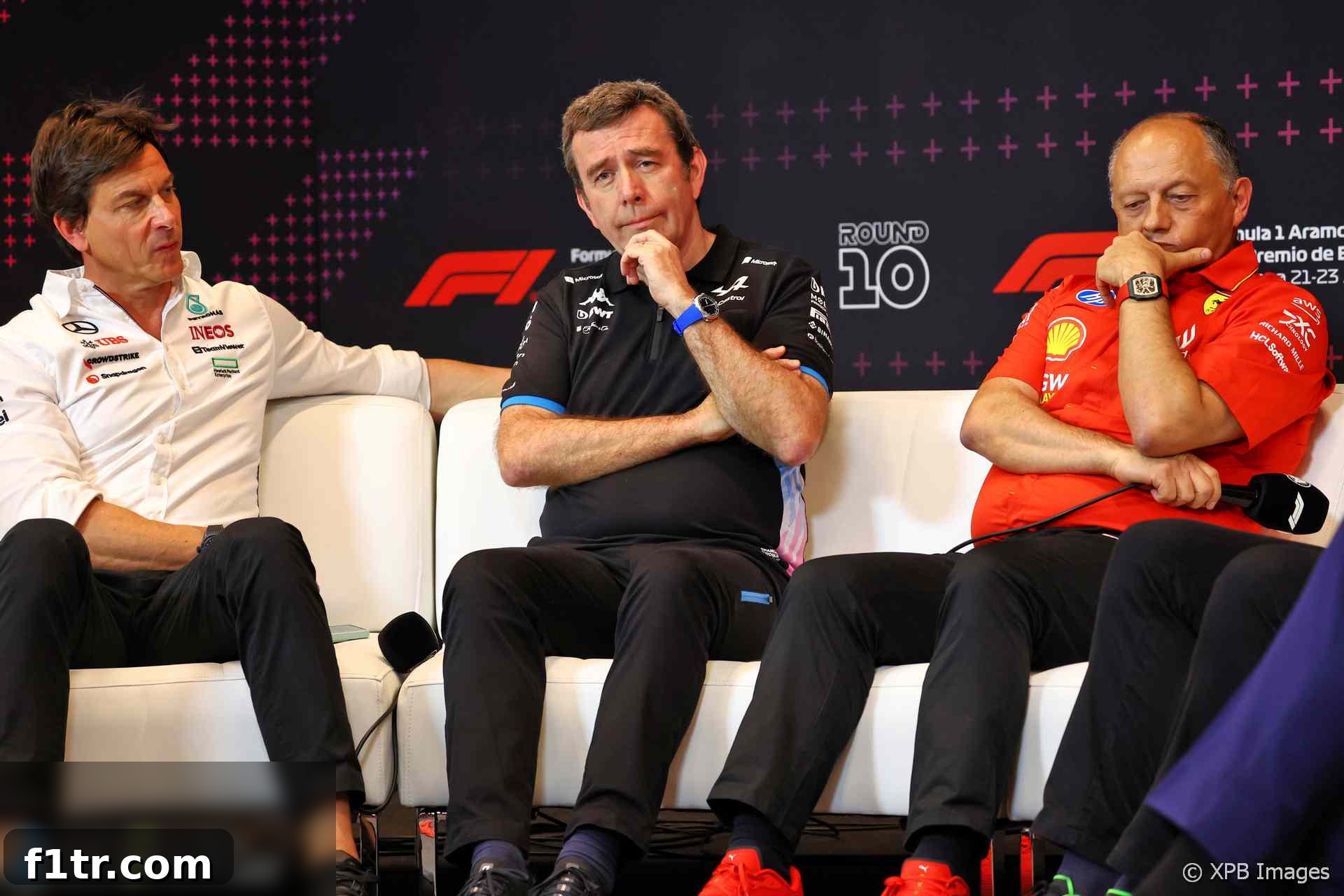
In the high-octane world of Formula 1, where every decision is scrutinized and every performance analyzed, the recent surge of conspiracy theories surrounding Lewis Hamilton’s treatment at Mercedes has ignited a fierce debate. Mercedes team principal Toto Wolff, visibly frustrated, vehemently denounced these claims, labeling the perpetrators as “cowards,” “mad people,” and “lunatics.” His impassioned remarks underscore a broader issue within the sport: the unsettling contrast between the swift condemnation of baseless allegations and the quiet acceptance of individuals with a history of proven misconduct.
The controversy escalated with a barrage of emails making wild accusations about Mercedes intentionally sabotaging Lewis Hamilton, particularly in light of his impending move to Ferrari at the end of the season. While some reports suggested these emails originated from alleged whistleblowers within Mercedes, others, including RaceFans, clarified that the references to ‘team’ likely pertained to ‘Team LH,’ Hamilton’s fervent fanbase, rather than actual Mercedes personnel. Regardless of their origin, the severity of these claims prompted Mercedes to involve the police, highlighting the serious implications and potential reputational damage they posed.
Addressing the Hamilton Sabotage Allegations
The notion that Mercedes would deliberately hinder one of their star drivers, especially one who has been an integral part of their success for over a decade, is, as many pundits and team principals have pointed out, fundamentally irrational. Toto Wolff articulated this sentiment clearly, emphasizing the enduring bond and mutual trust between Hamilton and the team. “Lewis was part of the team for 12 years,” Wolff stated, underscoring their shared history and ambition. “We have a friendship. We trust each other. We want to win this. We want to end this on a high. We want to celebrate the relationship.”
Beyond personal ties, Wolff highlighted the strategic imperative for Mercedes to ensure both cars perform optimally. The Constructors’ World Championship is a fiercely contested title, pivotal for a team’s prestige, financial standing, and technical development. To deliberately compromise one car would be an act of self-sabotage, directly undermining their championship aspirations. “If you don’t believe all of that,” Wolff added, “then you can believe that we want to win the constructors’ world championship. And part of the constructors’ world championship is making both cars win.” This logical appeal aimed to dismantle the baseless theories by pointing to the clear, tangible objectives that drive any competitive F1 team.
Ferrari team principal Frederic Vasseur, Hamilton’s future boss, echoed Wolff’s sentiments with equal vehemence. He questioned the very logic behind such accusations: “How you could imagine that a company with 1,500 people, working night and day, pushing like hell to bring upgrades… each race, we could kill one of our cars or damage one of our cars? This is completely irrational and nobody in the paddock could do something like this.” Vasseur’s remarks underscored the immense human and financial investment in Formula 1, where every fraction of a second and every championship point is meticulously fought for. The idea of intentionally squandering points from a driver, regardless of their future plans, is antithetical to the sport’s competitive spirit and the fundamental goals of any team. “We are fighting for the championship. Each weekend we are trying to score one point more than the other one. How you could imagine that we say ‘okay, that Lewis, we don’t want to score points anymore with him’,” Vasseur concluded, perfectly deconstructing the illogic of the conspiracists’ claims.
The Echoes of a Real Conspiracy: Crashgate’s Lingering Shadow
Despite the current outrage over fabricated conspiracies, Formula 1 has a history marred by actual, documented acts of manipulation. This brings us to a glaring double standard that has recently resurfaced with the return of Flavio Briatore to the sport. Briatore, a figure synonymous with the infamous “Crashgate” scandal, has rejoined Alpine, the team that was formerly Renault F1. Crashgate, arguably one of F1’s most scandalous episodes, involved the deliberate crashing of Nelson Piquet Jr.’s car during the 2008 Singapore Grand Prix to trigger a safety car, thereby benefiting his teammate Fernando Alonso, who subsequently won the race. This calculated act of sporting fraud sent shockwaves through the F1 world, prompting an extensive investigation by the FIA.
The scandal led to severe penalties for the Renault team and lifetime bans for its key figures, including team principal Flavio Briatore and technical director Pat Symonds. While Symonds eventually returned to the sport in a different capacity after serving his ban, Briatore’s “lifetime ban” was later overturned, allowing for his potential re-entry. Despite the passage of time and the team’s evolution through ownership changes (from Renault to Alpine, though still under the same manufacturer), the historical stain of Crashgate remains. Briatore has consistently denied any role in the conspiracy and, crucially, has never offered an apology for the incident, which not only compromised the integrity of the sport but also cost Renault significant sponsorship and left them facing the threat of a permanent ban for two years.
The Unsettling Welcome: Flavio Briatore’s Return to F1
The stark contrast between the treatment of those spreading anonymous, evidence-free conspiracy theories and the welcoming reception given to Flavio Briatore upon his return to the F1 paddock is deeply troubling. While Wolff lambasted the “cowards” behind the Hamilton allegations, he adopted a decidedly different tone when discussing Briatore’s re-entry. “I think we need to give the chance to recover from these situations,” Wolff remarked, defending the decision. He acknowledged Briatore’s business acumen and extensive experience in Formula 1, suggesting that his input could be beneficial. “I have known Flavio as an extremely smart businessman. He has a lot of know-how in Formula 1. Every input that I got over the last 10-plus years that I’ve been in much more contact – and I have a friendly relationship with him – was in a way helpful.”
Alpine team principal Bruno Famin also expressed no reservations about Briatore’s return, even though Briatore has never admitted guilt or apologized for Crashgate. This lack of contrition, a critical element often expected for rehabilitation, was seemingly overlooked. Wolff further reinforced this view, stating, “There is a lot of experience and expertise that, like Bruno said, 40 years of Formula 1 do. And I think everybody deserves the opportunity to come back.” He went on to emphasize the perceived benefits for Alpine: “For me, for sure, having another clever mind in Alpine, someone that is able to simplify things and apply common sense in any case, where Alpine is today, is a benefit.”
Even Frederic Vasseur, whose Ferrari team and its driver Felipe Massa arguably suffered a significant championship loss as a direct consequence of Renault’s tactics in 2008 (leading Massa to seek recompense over a lost championship), offered no objections. Vasseur framed Briatore’s return as a positive step for Alpine and, by extension, for F1 as a whole. “Overall, I think it’s probably, as Bruno said, a step forward for Alpine,” Vasseur commented. “And it’s good for F1 at the end if Alpine is coming back into the fight. We know the story and I think he paid the price of this and if now he’s allowed to come back, he can come back.” This consensus among leading team figures highlights a collective willingness to prioritize perceived benefits—such as experience and potential team improvement—over past ethical transgressions, particularly when a public apology or admission of wrongdoing is conspicuously absent.
The Double Standard and F1’s Ethical Dilemma
The juxtaposition of these two narratives—the fierce condemnation of fantastical sabotage theories and the seemingly uncritical welcome of a figure implicated in a genuine, proven act of sporting fraud—reveals a significant ethical conundrum for Formula 1. It is logically challenging to reconcile the argument that those who imagine conspiracies should be “pilloried” while an individual found responsible for orchestrating one is granted “full latitude” with seemingly zero remorse. This double standard undermines the sport’s credibility and its purported commitment to fairness and integrity.
While it would be naive to suggest that without Crashgate, there would be no conspiracy theories in F1, this breathtaking act of manipulation undoubtedly provided a ready-made justification for any wild speculation that followers might conjure. When a precedent for deliberate interference with race outcomes is set by those at the highest levels of team management, it inevitably fuels skepticism and mistrust among fans. The very act of a real conspiracy empowers the “flat-earthers” of the F1 world, providing a historical blueprint for their often baseless accusations.
Toto Wolff and other team principals are understandably weary of the unjust criticisms leveled against their teams’ efforts to field two fully competitive cars. The accusations of favoritism or sabotage are corrosive and detract from the incredible effort and dedication involved in Formula 1. However, they, and indeed the entire F1 paddock, would do well to reflect on the historical context that has contributed to this environment of mistrust. The ghosts of past misdeeds, particularly significant ones like Crashgate, cast long shadows. Until the sport unequivocally demonstrates a consistent and uncompromising stance against all forms of manipulation—real or imagined, past or present—it will continue to battle the specter of conspiracy theories, many of which find their genesis in its own complicated history.