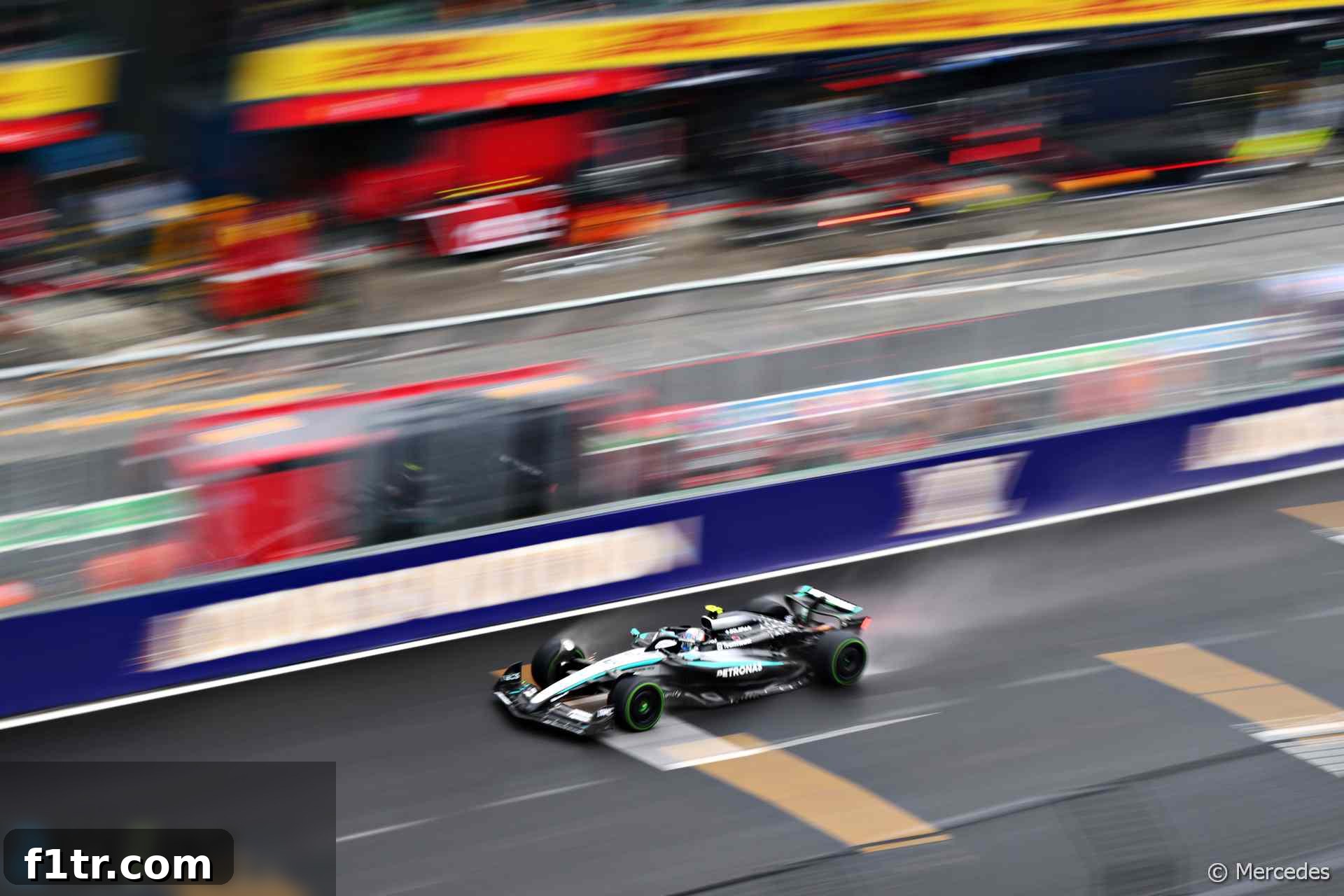
Andrea Kimi Antonelli’s Thrilling F1 Debut: A Story of Near Misses and Remarkable Recovery in Australia
In a sport where every fraction of a second and every inch of track can dictate destiny, the Australian Grand Prix served as a dramatic stage for Andrea Kimi Antonelli’s Formula 1 debut. The young Mercedes driver, thrust into the unforgiving world of top-tier motorsport, experienced the full spectrum of emotions, from a terrifying near-crash on the opening lap to an astonishing recovery that saw him climb an impressive 12 places to finish fourth.
Antonelli candidly admitted his alarm when he found himself fighting for control of his car amidst treacherous wet conditions during the critical opening moments of the race. The incident occurred at the challenging exit of Turn Five, a corner that proved particularly problematic under the challenging circumstances. As the lights went out and the grid surged forward, his car developed a sudden, violent snap of oversteer, threatening to send his F1 machine spiraling out of contention just as his career was beginning.
The Alarming Moment: A Rookie’s Baptism by Fire
The conditions on track were far from ideal for a Formula 1 debut. A wet surface, slick from recent rain, presented a formidable challenge, especially for a rookie still acclimatizing to the immense power and nuanced handling of an F1 car. Antonelli’s Mercedes, pushing hard through the corner, lost rear-end grip, leading to a sudden and significant oversteer moment. This critical loss of traction could easily have culminated in an early exit from the Grand Prix.
The severity of the situation was underscored by the fate of another promising rookie, Jack Doohan. Doohan, driving for a rival team, encountered similar difficulties at precisely the same point on the track during the chaotic first lap. Tragically for him, he was unable to recover, his car succumbing to the conditions and ending his race prematurely in a dramatic crash. Antonelli, however, demonstrated extraordinary composure and lightning-fast reflexes, managing to wrestle his car back under control from the brink of disaster.
“I got really scared,” Antonelli confessed to the official F1 channel after the race, his words hinting at the intense pressure and the split-second decisions that define a top-tier racing driver. “I cannot really say what I thought in the moment because it would have been… but definitely, it was a big save. Not bad to start lap one.” His understated assessment belied the remarkable skill involved in preventing what could have been a career-defining mistake, showcasing an innate talent for car control that bodes well for his future.
This near-miss served as a stark reminder of the fine margins in Formula 1 and the immense challenge faced by young drivers stepping up to the pinnacle of motorsport. It was a baptism by fire, one that tested not only his physical abilities but also his mental fortitude under immense pressure.
Mastering the Treacherous Track: Adaptation and Confidence
What followed this dramatic opening was an equally impressive display of adaptation and perseverance. Despite the early scare and the initially challenging track conditions, Antonelli embarked on a remarkable comeback drive. Starting from 16th position on the grid – a consequence of damaging his car during a tense qualifying session – he meticulously picked his way through the field, ultimately crossing the finish line in a sensational fourth place. This achievement was particularly noteworthy given the fluid and unpredictable nature of the race.
“The whole race was really enjoyable,” he remarked, a sentiment that might surprise many given the initial drama. Antonelli explained his approach to the unfolding challenge: “In stint one I was really trying to understand the conditions because the grip was really tricky, very low at the start of the race. Especially with those white [painted] lines, it was very, very tricky.” These painted lines, innocuous in dry conditions, become incredibly slick and treacherous when wet, demanding an extra layer of precision and caution from the drivers.
His debut also marked his first experience racing on intermediate tires in a competitive F1 setting. “The first thing I was really trying to understand was the grip; the track was evolving. It was the first time trying the intermediate so I was trying to understand how the tyre was working.” Intermediate tires are designed for damp, but not fully wet, conditions, offering a crucial balance between grip and water dispersion. Mastering their characteristics in real-time, under race pressure, is a testament to a driver’s raw talent and adaptability. As the race progressed and the track gradually dried, Antonelli’s confidence grew exponentially.
“But then when I jumped for the last stint on inters, I definitely felt much more confident with the car and the conditions. It was a very enjoyable race,” he added. This evolution from tentative exploration to confident mastery highlights a key attribute of elite athletes: the ability to learn and adapt rapidly within a high-stakes environment. His growing comfort with the intermediates, combined with a track that was slowly coming to him, allowed him to unlock more pace and make decisive overtakes.
A Race That Flew By: The Flow State of a Racer
For Antonelli, the intensity and enjoyment of the race created a unique perception of time. He noted that the Grand Prix “felt quite short” to him, a common experience for athletes deeply immersed in a “flow state,” where concentration is so absolute that external awareness diminishes. “During the Safety Car when we switched to slicks, I remember looking at the board and we were already on lap 40. I was like, ‘we’re at the end of the race’. It was really enjoyable out there.”
The deployment of the Safety Car provided a brief respite and an opportunity for teams to switch to slick tires as the track conditions improved significantly. Antonelli’s ability to maintain focus and enjoy the pure act of driving, even after such a demanding start, speaks volumes about his passion for the sport and his mental resilience. This deep enjoyment, despite the inherent dangers and pressures of F1, is often a hallmark of the sport’s greatest talents.
Building Confidence and Looking Ahead: A Promising Trajectory
Antonelli’s impressive performance in his first Grand Prix has undoubtedly provided a significant psychological boost. Starting from 16th after a qualifying incident, where he admitted to damaging his car, made his climb to fourth even more commendable. The pressure on a young driver making their F1 debut, especially one linked to a prestigious team like Mercedes, is immense, and it’s natural for nerves to play a part.
“I think in Melbourne I was a little bit too tense as well, especially when it was time for qualifying,” he reflected, offering insight into the mental game of Formula 1. This self-awareness and willingness to acknowledge areas for improvement are vital for growth. His remarkable race performance, however, seemed to alleviate much of that tension.
“Now definitely I feel a lot more relaxed and a lot more in control of the situation,” Antonelli affirmed, expressing a newfound comfort and confidence that will be invaluable in future races. While acknowledging that there is “still lots to learn,” his forward-looking statement – “really looking forward to this weekend” – encapsulated an eagerness to continue his development and build upon this sensational debut.
The Future of a Rising Star: Implications for Antonelli’s Career
Andrea Kimi Antonelli’s debut in Australia was far more than just another race; it was a powerful statement of intent. For a rookie to navigate such a challenging, rain-affected race, recover from a near-crash, and make such significant progress through the field to secure a fourth-place finish, speaks volumes about his potential. This performance has not only cemented his reputation as a formidable talent within the motorsport world but has also offered Mercedes a tantalizing glimpse into their future.
His ability to adapt to changing track conditions, manage tire degradation, and maintain composure under extreme pressure are all hallmarks of a future champion. The experience gained, from the harrowing snap of oversteer to the satisfaction of a strong finish, will serve as a crucial foundation for his ongoing development. As he continues his journey in Formula 1, all eyes will be on Antonelli, watching how he harnesses this early success and transforms it into consistent top-tier performances.
The Australian Grand Prix might have started with a moment of alarm for Andrea Kimi Antonelli, but it concluded with an exhilarating display of raw talent, mental resilience, and undeniable promise. It was a debut that has undoubtedly set the stage for an exciting career, marking him as one of the most compelling young drivers to watch in Formula 1.