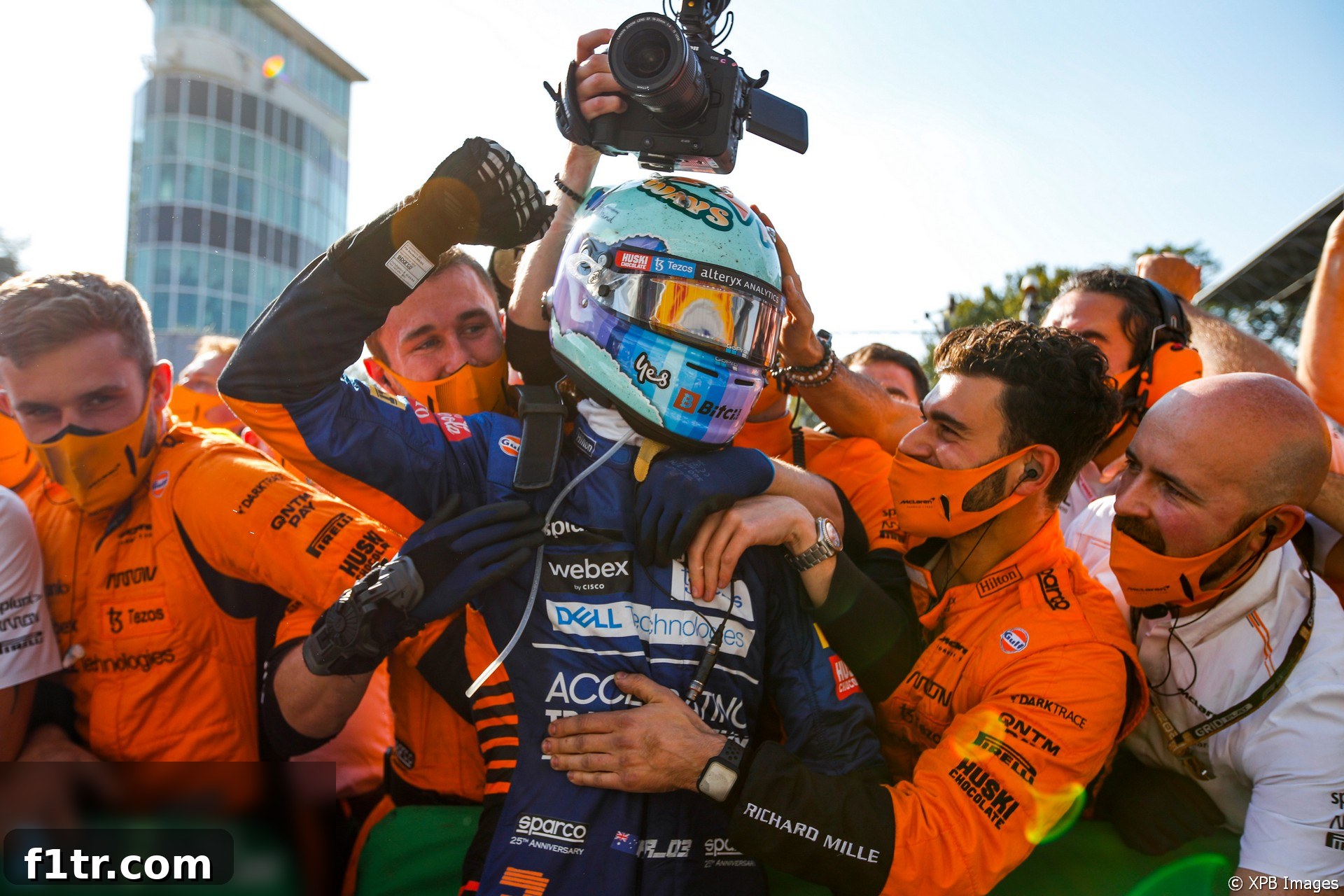
In a sport defined by relentless pressure and fleeting triumphs, Daniel Ricciardo’s victory at the Italian Grand Prix in Monza was more than just a win; it was a profound declaration of resilience, a testament to unyielding faith, and a pivotal moment that redefined his narrative at McLaren. After a challenging initiation period with the Woking-based team, where his trademark smile often masked underlying frustration, Ricciardo credits the crucial summer break for enabling him to reset, recalibrate, and ultimately ascend from the “lows” to seize a victory that “means everything.”
Ricciardo’s journey to McLaren was itself a narrative of bold choices. Following a decorated but ultimately unfulfilling stint at Red Bull, which he departed at the close of 2018, he embarked on a two-year spell with Renault. His decision to leave a race-winning Red Bull car was met with widespread skepticism, and the speed of his subsequent move from Renault to McLaren further fueled speculation about his career trajectory. Upon his arrival at McLaren, the highly anticipated partnership began with considerable hurdles. The charismatic Australian struggled to adapt to the unique characteristics of the McLaren MCL35M, finding himself consistently unable to match the pace and consistency of his younger, highly-rated teammate, Lando Norris. This disparity was a source of palpable frustration for Ricciardo, who, prior to the summer break, often found himself at a loss to articulate the reasons behind his comparative lack of performance.
The mental and emotional toll of such a demanding environment can be immense. For a driver of Ricciardo’s caliber, accustomed to podiums and victories, the struggle to perform at his peak was undoubtedly a significant challenge. The media scrutiny, the internal pressure, and the relentless comparison to his teammate all contributed to a period of intense personal reflection. It was within this context that the August summer break emerged as an unexpected catalyst for change. Away from the glare of the Formula 1 paddock, Ricciardo found the space to physically and mentally disengage. This respite allowed him to step back, re-evaluate, and perhaps most importantly, reaffirm his intrinsic belief in his own abilities. “There have been lows this year,” Ricciardo admitted, reflecting on the challenging first half of the season, “but, deep down, I never lost faith or the belief. I think I just also needed to step back. And I think that’s where having some time off in August helped. I actually think that helped this weekend get to this position.” This period of introspection and detachment proved to be the pivotal turning point, allowing him to return with a refreshed perspective and a renewed sense of purpose.
Basking in the warm glow of victory on that memorable Sunday evening in Monza, Ricciardo eloquently articulated the profound satisfaction that such moments bring, making all the preceding struggles worthwhile. “I think that’s why we love the sport – it makes all those crappy days worth it. It’s simple as that.” He described the intoxicating high derived from a victory, a sensation so potent it verged on the surreal. “There’s a high that you get from this moment right now that I’ll probably watch this interview in a few days time and I’ll be like, ‘oh, I actually said that?’. I’m still kind of floating right now, to be honest. And that’s what it does. So that’s what draws you back in.” This raw, unadulterated joy was a powerful reminder of why he endures the relentless demands of Formula 1, underscoring the intrinsic reward that transcends the mere act of winning.
Crucially, Ricciardo’s triumph also offered a moment to reflect on his broader philosophy regarding happiness and sport. He steadfastly maintains a healthy separation between his personal well-being and his professional outcomes. “I definitely try not to dictate my life happiness around the sport, because it’s been three and a half years since I won, so I’d be pretty miserable most of the time if I just based on my happiness on winning races,” he explained. This mature perspective highlights a crucial coping mechanism for elite athletes, preventing their self-worth from becoming solely defined by results. While the elation of victory is undeniable, his ability to compartmentalize and find contentment outside the racing circuit speaks volumes about his character and mental fortitude. Despite the long wait since his last win at Monaco in 2018, his underlying optimism and resilience never wavered, a quality that ultimately bore fruit in Italy.
The Monza victory also provided Ricciardo with a unique opportunity to connect with two of his motorsport heroes in a deeply personal way. The first is seven-time NASCAR champion Dale Earnhardt, an icon whose fearless driving style and competitive spirit deeply resonate with Ricciardo. McLaren Racing CEO Zak Brown, known for his enterprising spirit and close relationship with his drivers, had previously promised Ricciardo a test drive in his prized possession: Earnhardt’s iconic 1984 Chevrolet Monte Carlo. This extraordinary prize was initially dangled as an incentive for Ricciardo’s first podium finish with the team. “It was always ‘the podium, you get to drive it’,” Ricciardo recounted with a grin, adding, “We’ve never talked about a win!” The victory, however, undoubtedly elevated the stakes. With a playful jab, Ricciardo remarked, “I gave him my shoe that he drank out of, so maybe he gives me the car. It’s a good trade!” The prospect of getting behind the wheel of Earnhardt’s legendary car is more than just a thrill; it’s a “pinch me” moment, a surreal intersection of his personal admiration and professional achievement. This unique reward underscores the personal stakes and the cherished connections within the McLaren family.
Beyond the allure of NASCAR, Ricciardo’s triumph at Monza held even deeper significance, linking him to the profound legacy of one of Formula 1’s most revered figures: Ayrton Senna. McLaren is indelibly associated with the Brazilian legend, whose iconic victories in the red and white cars are woven into the very fabric of the sport’s history. For Ricciardo, the connection is visceral. “When I think ‘McLaren’, I think of Senna,” he stated, recalling his earliest memories of the sport. “That’s the early memories.” The tangible presence of Senna’s achievements at the McLaren Technology Centre (MTC) through the numerous trophies in the cabinet serves as a constant reminder of the team’s illustrious past. To now have his own winning trophy, bearing his name and destined for “pretty much the same cabinet,” is an almost unbelievable honor. “It’s crazy,” he mused, reflecting on the weight of the moment. These “two little things today,” the prospect of driving Earnhardt’s car and the shared legacy with Senna, represent profound, “surreal moments” that underscore the magnitude of his achievement and its place within the rich tapestry of motorsport history.
Daniel Ricciardo’s Monza victory was not merely a singular race win; it was a powerful narrative arc, encompassing struggle, resilience, a crucial reset, and ultimately, redemption. It provided vital validation for his career choices, silenced critics, and demonstrated his enduring capability to perform at the absolute pinnacle of motorsport. This win will undoubtedly serve as a significant confidence booster for both Ricciardo and the McLaren team, injecting a renewed sense of belief and momentum into their campaign. It proves that even after navigating difficult passages, unwavering faith, combined with the right support and a timely reset, can lead to the most extraordinary of comebacks. For fans of Formula 1, it was a reminder of the sport’s dramatic highs and lows, and for Ricciardo, a moment that will forever shine as a beacon of his enduring spirit and talent.