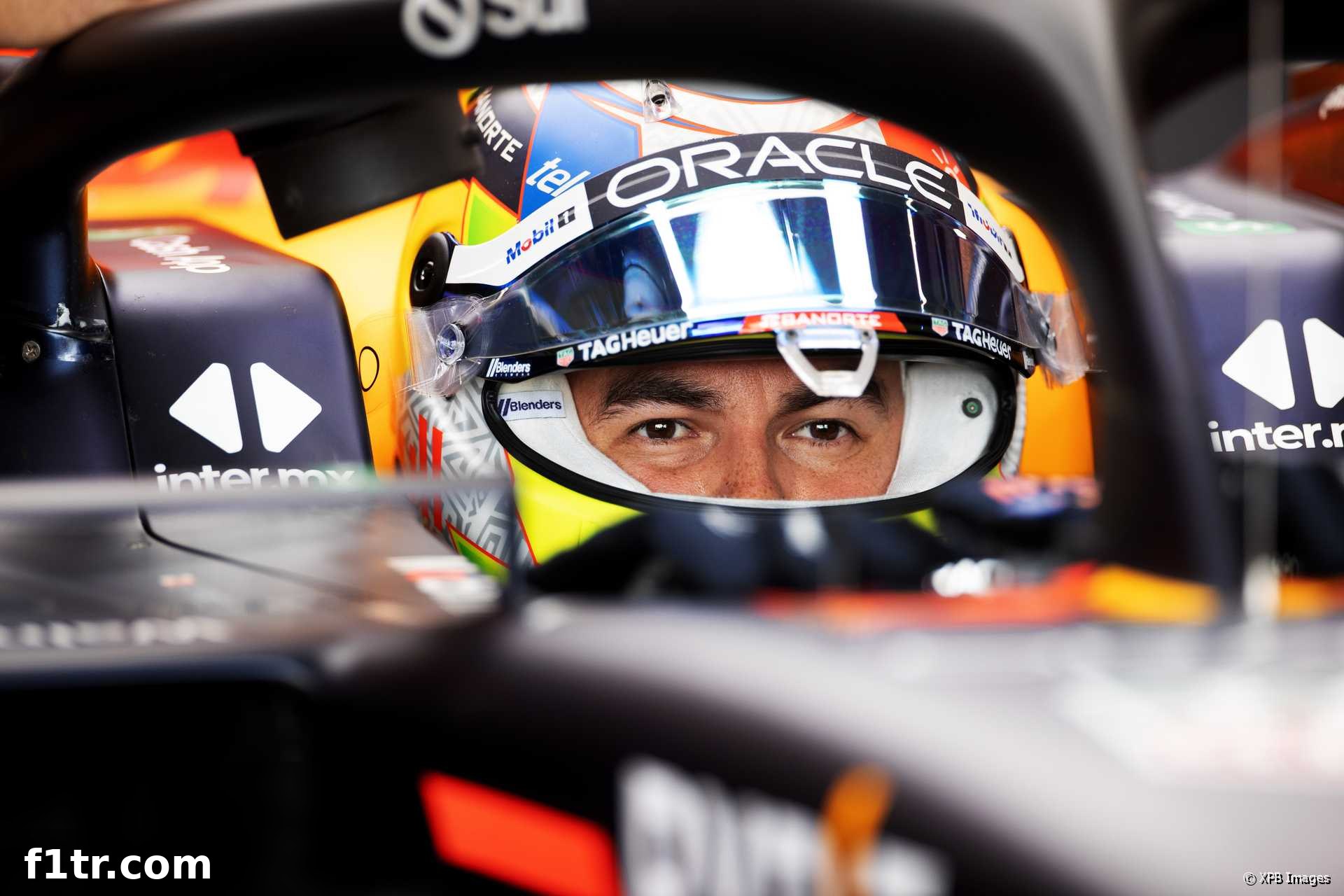
Sergio Perez’s qualifying struggles continued at the 2023 British Grand Prix, where the Red Bull driver was unexpectedly eliminated in Q1. The Mexican driver attributed his early exit to being caught off guard by the extended duration of a red flag period, which severely compromised his tyre temperatures and, ultimately, his final flying lap at Silverstone. This marks a disheartening fifth consecutive race weekend where Perez has failed to reach the crucial Q3 session, putting significant pressure on his championship aspirations and reinforcing a concerning pattern within his season.
Perez’s Q1 Exit: A Red Flag Miscalculation at Silverstone
The first qualifying session at the iconic Silverstone circuit was briefly suspended after Kevin Magnussen’s Haas came to a halt at the exit of Stowe corner, experiencing a loss of oil pressure. This incident triggered a red flag, bringing the session to a temporary halt. During this pause, Sergio Perez positioned himself at the pit lane exit, eagerly awaiting the restart. However, the wait proved to be longer than anticipated by the Red Bull Racing team.
Speaking to media outlets, including RaceFans, Perez elaborated on the critical impact of this unforeseen delay. “I think the red flag lasted longer than we predicted initially,” he stated. “That didn’t help for the temperature of the tyre.” In Formula 1, tyre temperature is a meticulously managed variable, pivotal for generating optimal grip and extracting peak performance from the car. When tyres drop below their ideal operating window, they lose their ability to “switch on,” leading to a significant reduction in grip and lap time. For Perez, sitting static for an extended period meant his tyres cooled down too much, rendering them ineffective for his final attempt to set a competitive lap time once the session resumed.
The importance of perfectly prepped tyres cannot be overstated in qualifying, particularly in changeable conditions. A slight deviation in temperature can mean the difference between a place in Q2 and an early exit. For a driver of Perez’s caliber, and especially for a team as dominant as Red Bull, such a miscalculation of a red flag’s length is a costly error, underscoring the razor-thin margins that define success and failure in the pinnacle of motorsport. Starting from the eighth row of the grid at the British Grand Prix, Perez now faces a monumental task to recover positions on a track known for its high-speed corners and limited overtaking opportunities, making a strong qualifying performance all the more crucial.
A Troubling Pattern: Five Consecutive Q3 Misses
Sergio Perez’s Q1 elimination at Silverstone wasn’t an isolated incident; rather, it was the latest in a worrying sequence of underperformances during qualifying. This marks the fifth consecutive Grand Prix weekend – following Monaco, Spain, Canada, and Austria – where the Red Bull driver has failed to advance beyond the second qualifying session (Q2), let alone reach the final shootout for pole position (Q3). This statistic is particularly glaring when contrasted with the consistent front-row performances of his teammate, Max Verstappen, who has been in commanding form throughout the season.
For a driver in a car as dominant as the RB19, engineered by Adrian Newey and consistently outperforming the rest of the field, a string of qualifying failures is highly unusual and raises serious questions. While Perez has shown glimpses of brilliant race pace, often demonstrating impressive recovery drives, these qualifying woes are actively undermining his championship challenge. Starting from deep in the pack consistently means he has to expend valuable tyre life and engine mileage battling through traffic, rather than focusing on direct competition with the front-runners, particularly Verstappen.
The psychological impact of such a streak cannot be underestimated. Each poor qualifying session adds to the pressure, potentially leading to a spiral of decreased confidence and increased errors. While Perez possesses undeniable talent and resilience, demonstrated by his climb from 15th to third in the preceding Austrian Grand Prix, the continuous uphill battles are unsustainable for a title contender. The Red Bull hierarchy will undoubtedly be scrutinizing these performances closely, expecting their second driver to be consistently in contention at the sharp end of the grid to support the team’s Constructors’ Championship efforts and maintain a strategic advantage over rivals.
Race Pace Potential vs. Qualifying Handicap
Despite the frustrating qualifying performance, Sergio Perez remains optimistic about his prospects for the British Grand Prix, largely banking on the inherent strength of the Red Bull RB19 and his proven ability to recover positions during the race. “It’s a shame to lose out because we had a great Friday, the race pace was looking really good,” he commented. This sentiment reflects a recurring theme in Perez’s recent outings: while he struggles to unlock the car’s full potential over a single lap, his race craft and the car’s long-run performance often allow him to make significant progress through the field.
The previous race in Austria serves as a prime example of this resilience. Starting from 15th on the grid, Perez meticulously carved his way through the field to secure a commendable third-place finish, showcasing his formidable race pace and strategic acumen. However, Silverstone presents a different challenge. While Austria’s Red Bull Ring offers ample overtaking zones, Silverstone’s high-speed nature makes it more difficult to pass without significant pace advantage or strategic brilliance. Overtaking typically requires precise timing and brave maneuvers through corners like Maggotts, Becketts, and Stowe, placing an even greater emphasis on track position.
Consequently, Perez acknowledges that the British Grand Prix will likely be another “damage limitation” exercise. For a Red Bull driver, “minimizing the damage” entails securing as many points as possible, ideally pushing for a podium finish, even if a victory seems out of reach from his starting position. This strategy is critical not only for his individual championship standing but also for Red Bull Racing’s dominance in the Constructors’ Championship. Every point counts, and failure to consistently deliver top results puts undue pressure on the team’s overall objectives. The goal will be to utilize the RB19’s superior performance, manage tyre degradation effectively, and exploit any opportunities that arise, potentially through safety cars or strategic pit stops, to climb as high as possible.
The RB19 and Challenges in Mixed Conditions
Adding another layer to Sergio Perez’s recent qualifying woes is his candid admission about struggling with the Red Bull RB19 in mixed weather conditions. Following a qualifying session that saw intermittent rain, Perez stated, “In these conditions, it’s where I struggle the most with the car. My issues with the car become more apparent in changeable conditions. So I think it’s something that as a group we need to get on top of and understand what we are able to do better.”
Mixed conditions, characterized by varying grip levels as the track transitions from wet to dry or vice versa, are notoriously challenging for Formula 1 drivers. They demand exceptional sensitivity to the car’s feedback, precise throttle control, and rapid adaptation to evolving circumstances. For Perez, his struggles suggest a potential disconnect or lack of confidence in the RB19’s behavior under these specific scenarios. While the car is undoubtedly fast in optimal conditions, it might possess certain characteristics – perhaps related to its delicate aerodynamic balance, front-end responsiveness, or rear stability – that make it less forgiving when grip levels are unpredictable.
This difficulty in adapting could stem from a variety of factors: a specific setup philosophy that favors dry conditions, a driving style that thrives on consistent grip, or indeed, inherent traits of the RB19 that do not align perfectly with Perez’s preferences when conditions are not straightforward. Compared to his teammate Max Verstappen, who is often hailed for his exceptional car control and adaptability in challenging weather, Perez’s vulnerability in mixed conditions becomes more pronounced. This disparity highlights an area where the team, as a collective, needs to focus its efforts. Understanding what aspects of the car or setup are exacerbating these issues for Perez, and then finding solutions, will be crucial not only for his individual performance but also for ensuring Red Bull’s continued dominance across all race conditions. Addressing this challenge effectively could unlock a significant performance boost for Perez, allowing him to contend at the front irrespective of the weather.
The Broader Implications for Perez’s Championship Hopes
Sergio Perez’s ongoing qualifying struggles, epitomized by his Q1 exit at the British Grand Prix and the preceding four Q3 misses, cast a significant shadow over his championship aspirations. While he began the season with strong performances and even challenged Max Verstappen for the championship lead in the early races, this recent downturn has seen the points gap widen dramatically. The ability to consistently qualify at the front is non-negotiable for a driver aiming for a Formula 1 World Championship, especially when competing against a teammate of Verstappen’s caliber. Each qualifying setback not only costs valuable points but also depletes strategic options for the race, forcing reactive rather than proactive strategies.
The pressure on Perez from within Red Bull Racing is undoubtedly mounting. Team principal Christian Horner and advisor Helmut Marko are known for their high expectations, and while Perez’s race day recoveries are impressive, consistent qualifying underperformance cannot be overlooked. The team needs both its drivers to be performing optimally to secure maximum points and to keep rivals like Mercedes, Aston Martin, and Ferrari at bay. A lack of a strong second car at the front can expose Red Bull to strategic vulnerabilities during a race, potentially allowing competitors to split strategies or gain an advantage.
Looking ahead, Perez needs to find a rapid and sustainable solution to his qualifying and mixed-condition issues. The season is long, but the opportunities to claw back the points deficit are diminishing with each passing race. His ability to perform on Sunday, as seen in Austria, offers a glimmer of hope, but relying solely on recovery drives is a precarious path for a championship contender. The team’s collective effort to understand and adapt the RB19 to his specific needs in changeable conditions, as he himself suggested, will be paramount. Without a significant turnaround in his single-lap performance, the dream of a maiden World Championship might slip further out of reach for Sergio Perez. The British Grand Prix is not just another race; it’s a crucial test of his resilience and ability to turn the tide.
2023 British Grand Prix News & Analysis
- Norris is “growing” closer to the champion who inspired him to race
- Second supplier part failure ‘a frustrating issue we must solve’ – Alpine
- Albon ‘surprised’ to be quicker than Alonso at end of British GP
- Bottas admits Alfa Romeo ‘were expecting to be better than this’ in 2023
- McLaren now “finding performance quicker” after emulating Red Bull’s design
Browse all 2023 British Grand Prix articles