Chequered Flag Confusion Reigns Supreme at Chaotic 2022 Japanese Grand Prix
The 2022 Japanese Grand Prix at Suzuka will long be remembered not just for Max Verstappen securing his second world championship, but for the profound confusion that engulfed the race’s premature conclusion. A heavily rain-disrupted event, shortened dramatically by an expiring three-hour time limit, left many Formula 1 drivers and their teams in a state of bewilderment, leading several to continue racing at full competitive speed long after the chequered flag had officially been waved.
Advert | Become a Supporter & Go Ad-Free
Originally scheduled for 53 laps, the race at the iconic Suzuka Circuit saw only 28 laps completed due to the maximum three-hour race time limit being reached. According to the intricate F1 sporting regulations, time-limited races are designed to conclude “at the end of the lap following the lap during which the two-hour period ended.” However, the application of this rule at Suzuka created an unprecedented scenario. Race winner Max Verstappen commenced what became his final, 28th lap with mere seconds ticking away on the race clock. Yet, upon completing this lap, he was unexpectedly greeted by the chequered flag, rather than being allowed to embark on what many anticipated would be a final, conclusive lap.
The Unexpected End: A Regulatory Labyrinth
The sudden and early termination of the race caught numerous teams completely off guard, highlighting the complex nature of F1’s regulatory framework, especially under challenging conditions. Red Bull Racing, Verstappen’s own team, initially informed their star driver that he had just begun his final lap after he crossed the finish line. It wasn’t until halfway through his cool-down lap that the reigning champion was finally told the race was definitively over, a testament to the real-time confusion that permeated the paddock.
Ferrari faced a similar predicament. They mistakenly informed Charles Leclerc that he had started his final lap, even though he had, in fact, just completed the race. Fortunately for the Scuderia, a recently-implemented automated radio message system triggered its “chequered flag” announcement as Leclerc crossed the line. This timely, if somewhat accidental, intervention proved crucial in helping the team swiftly recognize their error and relay the correct information to their driver.
Dangerous Delays: Drivers Still Pushing Hard
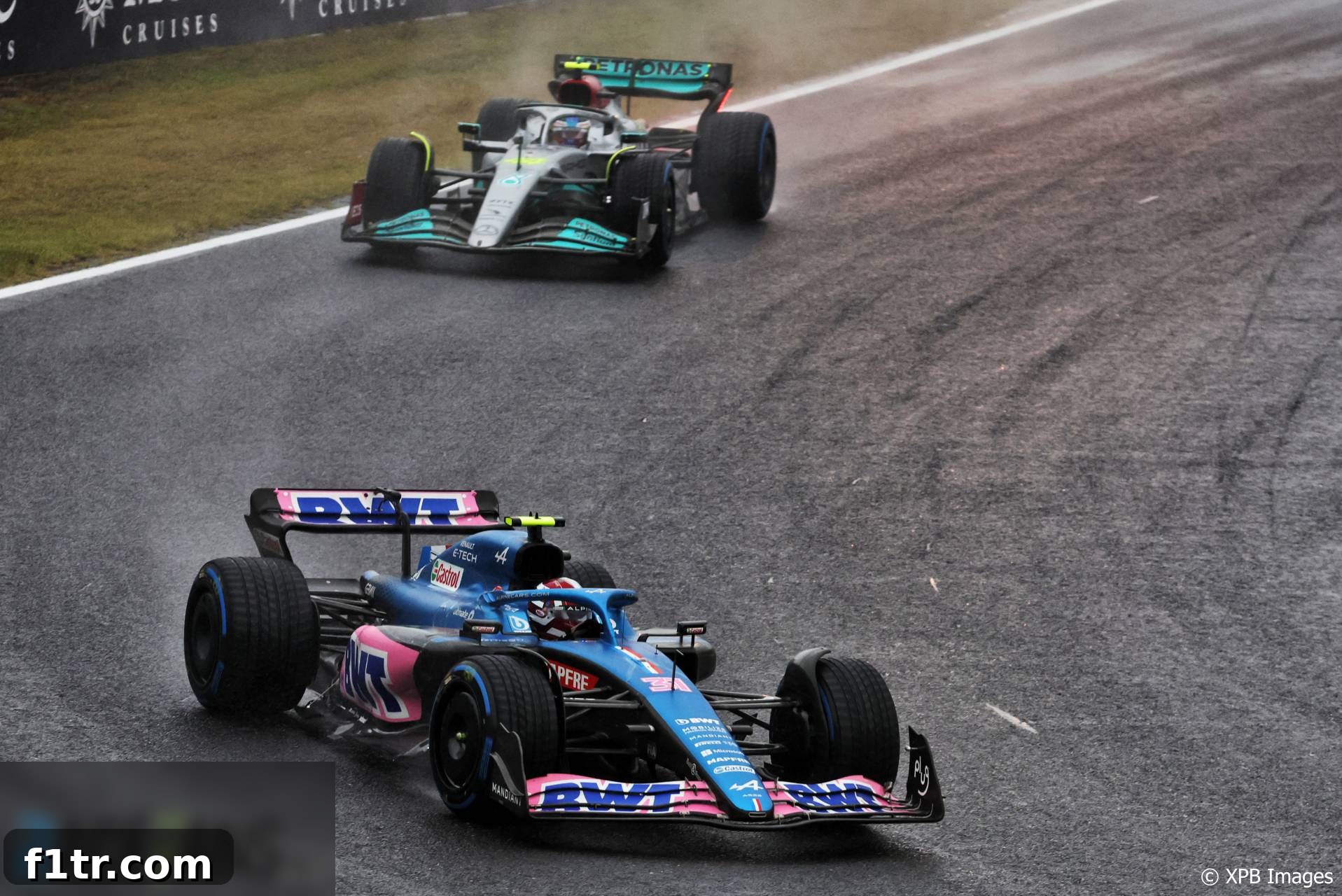
As the front-runners, now aware of the race’s end, began to slow down on their cool-down laps, a potentially dangerous situation unfolded behind them. Uninformed drivers continued to race at full speed, believing they were still locked in fierce competition for vital championship points and positions. This led to several alarming encounters on track. Sergio Perez, who had crossed the line in third position, significantly backed off. However, he was quickly caught by Esteban Ocon and Lewis Hamilton, both of whom were still pushing hard after receiving the chequered flag. The sight of Perez slowing down came as a genuine surprise to Ocon and Hamilton, who were still in full racing mode, having completed their race some 12 seconds after the Red Bull driver.
Adding to the drama, veteran driver Fernando Alonso was embroiled in an intense battle for sixth position with Sebastian Vettel. The pair delivered a thrilling side-by-side finish, with Vettel narrowly claiming the spot by a mere hundredth of a second. Despite crossing the finish line, Alonso, unaware the race was over, continued to push. He completed two full sectors of what should have been a cool-down lap at racing speed before his team finally instructed him to back off and return to the pits, underscoring the widespread nature of the confusion.
“It was very chaotic for everyone,” Alonso reflected after the race, perfectly encapsulating the mood in the paddock. “Even the last lap, we didn’t know if it was the last lap or not, so it was very difficult for everybody.” His comments highlighted the palpable uncertainty that plagued not just the drivers, but also the strategists and engineers in the pit lane.
McLaren team principal Andrea Seidl voiced his team’s astonishment at the sight of other drivers maintaining racing speeds even after the chequered flag was clearly displayed on the timing screens. “From our side, it was pretty clear what had to happen there,” Seidl stated in response to a query from RaceFans. “I think also the chequered flag was out at the right time. But we saw that Max, for example, was still going flat out after crossing the chequered flag, so I’m not exactly sure what happened there or which communications happened there. For us it’s clear – we saw the chequered flag and if it’s out, then you respect it. But we saw that Max kept pushing, so we went on the safe side until we had clarity.” Seidl’s remarks underscore the dilemma faced by teams: adhere to clear signaling or react to the unexpected actions of competitors.
Radio Silence and Mixed Messages: A Deep Dive into Team Communications
The confusion was perhaps most vividly illustrated through the frantic and sometimes contradictory radio messages exchanged between drivers and their race engineers. These transcripts offer a unique window into the real-time chaos and the struggle to convey vital information under immense pressure.
Ocon and Hamilton’s Radio Messages After Chequered Flag
Esteban Ocon and Lewis Hamilton crossed the finish line in fourth and fifth positions respectively. Yet, the Alpine driver continued to race, prompting a series of urgent communications:
| Speaker | To | Message |
|---|---|---|
| Josh Peckett (Engineer) | Esteban Ocon | Esteban, that is the chequered flag. Chequered flag. Well done mate, you did it! |
| Esteban Ocon | Josh Peckett | Ocon is still racing with Hamilton You sure? Are you sure? |
| Josh Peckett | Esteban Ocon | Yes. |
| Esteban Ocon | Josh Peckett | Ocon continues to race Hamilton He’s still pushing behind… |
| Josh Peckett | Esteban Ocon | Keep pushing, please. Keep pushing. |
| Josh Peckett | Esteban Ocon | Esteban, the cars in front have backed off. |
This exchange clearly shows Ocon’s initial disbelief and the conflicting signals. His engineer confirms the chequered flag, but Ocon’s observation that Hamilton is still pushing leads his engineer to, perhaps cautiously, tell him to “Keep pushing.” This highlights the reactive nature of communication in such a fluid and uncertain situation, where even team engineers struggled to fully grasp the on-track reality.
Behind Ocon, Lewis Hamilton faced similar uncertainty, as evidenced by his radio traffic:
| Speaker | To | Message |
|---|---|---|
| Peter Bonnington (Engineer) | Lewis Hamilton | So we have taken the flag, so let’s go strat mode one. So you’ve got cars ahead going slow… |
| Lewis Hamilton | Peter Bonnington | What’s that? He’s taken the flag? |
| Peter Bonnington | Lewis Hamilton | Yeah affirm! |
| Lewis Hamilton | Peter Bonnington | Backing off Aww shit, man… |
| Peter Bonnington | Lewis Hamilton | Yeah, copy. Felt like that came out one lap early according to our timing. |
| Peter Bonnington | Lewis Hamilton | So we’re going strat mode one. And that’s P5 Lewis. |
Hamilton’s “Aww shit, man…” perfectly captures the frustration and surprise. His engineer, Bono, then explicitly states that “it felt like that came out one lap early according to our timing,” pinpointing the root cause of the widespread confusion – the discrepancy between the official flag and teams’ pre-calculated lap counts based on the regulations.
The situation escalated when Ocon and Hamilton, after briefly backing off, encountered Perez and Leclerc who had already begun their cool-down procedures. Both Ocon and Hamilton, still processing the information, decided to push again, illustrating the competitive instinct overriding initial instructions when doubt persisted:
| Speaker | To | Message |
|---|---|---|
| Josh Peckett | Esteban Ocon | Ocon has passed Perez and Leclerc Okay, the chequered flag was out, Esteban. That’s it. |
| Esteban Ocon | Josh Peckett | Backing off Okay, okay… You’re sure, yeah? |
| Josh Peckett | Esteban Ocon | As sure as I can be. |
| Esteban Ocon | Josh Peckett | Both drivers return to racing speed Okay, well, I’m passing everyone and then you tell me. |
| Lewis Hamilton | Peter Bonnington | Are you sure the race is over? These guys are still pushing. |
| Peter Bonnington | Lewis Hamilton | Yep. Yep they have shown the flag. We’re seeing it on the timing page. |
| Josh Peckett | Esteban Ocon | Okay Esteban, we are going to come in the pit lane at the end of this lap please. Instruction from race control. So the chequered flag was out, we’re coming in the pit lane this lap please. Scenario 12, please. Scenario 12. We are not racing now. We are not racing – the race is over. You finished P4. Well done. Box now. Let’s just try and cool those brakes on the way in. |
| Esteban Ocon | Josh Peckett | Yeah, sorry. Just hasn’t happened a lot of times… |
| Josh Peckett | Esteban Ocon | Yeah, so the confusion has happened because the flag came out a few seconds earlier than we think it should’ve done., so we did a lap less than we thought we were going to. Sorry for the confusion at the end. |
| Esteban Ocon | Josh Peckett | That’s okay |
The final radio message from Josh Peckett to Ocon offers the clearest explanation of the unfolding situation, citing “instruction from race control” and admitting the flag came out “a few seconds earlier than we think it should’ve done.” This detailed breakdown of the communication reveals the layered confusion, starting from the ambiguity of the regulations, propagating through team calculations, and manifesting in the hesitant and sometimes conflicting instructions given to drivers who were operating at the absolute limit of human performance.
The Aftermath and Lessons Learned from Suzuka
The chaotic conclusion of the 2022 Japanese Grand Prix served as a stark reminder of the complexities inherent in Formula 1’s regulations, particularly when unforeseen circumstances like extreme weather and time limits converge. While Max Verstappen’s championship celebration was undeniably well-deserved, the moments immediately following the chequered flag underscored critical areas for review in F1’s communication protocols and race-ending procedures. The incident prompted discussions within the FIA and among teams about the need for clearer, more instantaneous, and universally understood signals for race termination, especially in shortened events. Ensuring driver safety remains paramount, and drivers continuing to race at high speeds when others have slowed down presents an unacceptable risk. The 2022 Suzuka race will forever be a case study in how critical clarity is at the very highest echelons of motorsport.
More from the 2022 Japanese Grand Prix
- From F1 to Formula Ford, 2022 was the year of the championship anti-climax
- Suzuka points confusion didn’t take shine off title win – Verstappen
- FIA to publish findings of inquiry into use of crane during Japanese GP
- Does F1 only need slicks and wets? The case for dropping intermediate tyres
- Hamilton’s work ethic “has not changed at all” in face of difficult 2022 campaign
Browse all 2022 Japanese Grand Prix articles