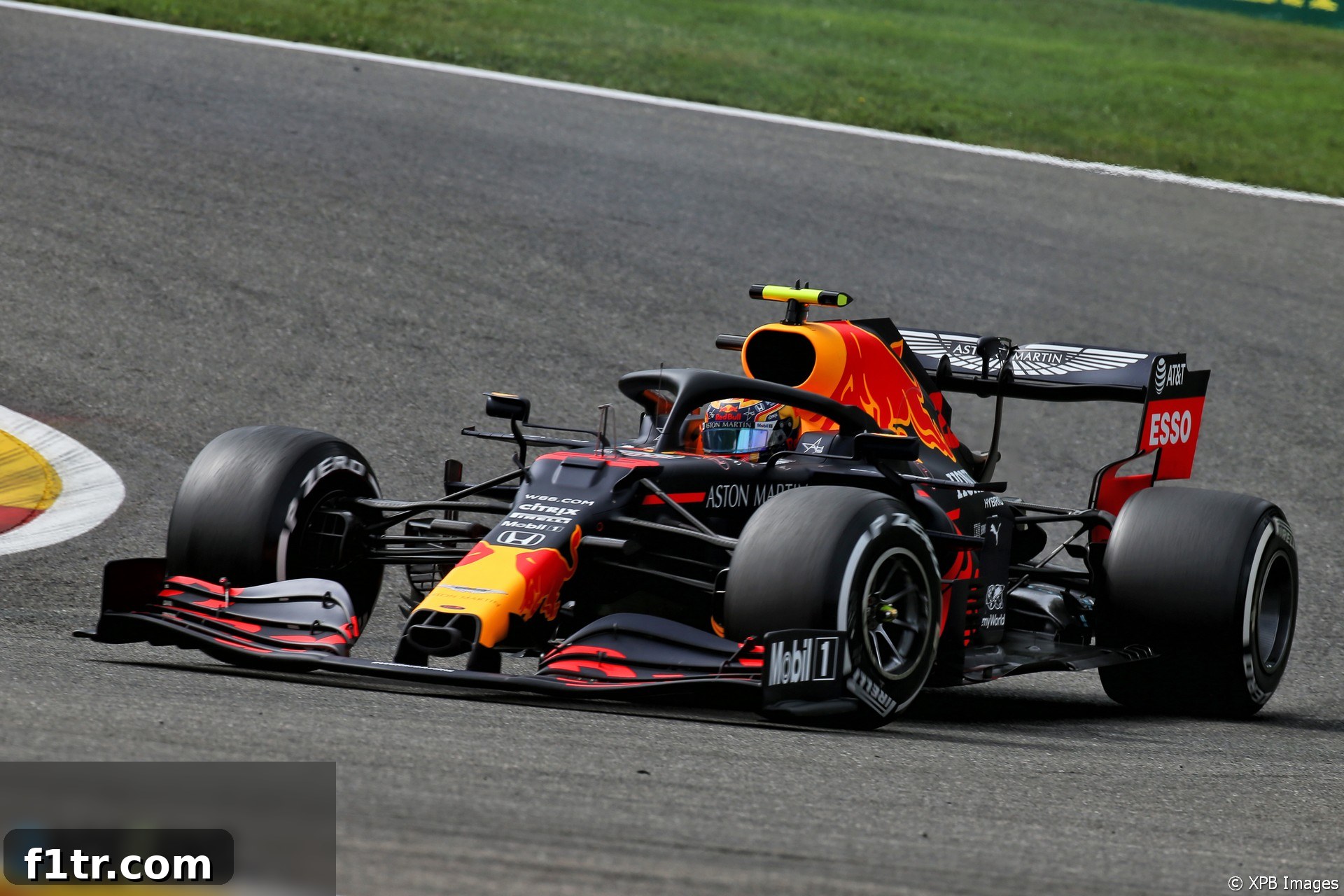
Red Bull’s RB16 Poses Unique Challenges: Horner Explains Driver Performance Gap
Red Bull Racing’s team principal, Christian Horner, has offered a deeper insight into the complexities faced by his drivers, particularly highlighting how the RB16’s inherent characteristics, especially in low-fuel qualifying trim, contribute to exaggerating the performance difference between Max Verstappen and Alexander Albon. This candid assessment sheds light on the intricacies of Formula 1 car design and its impact on driver dynamics and development.
Throughout the current Formula 1 season, Alexander Albon has consistently found himself approximately half a second adrift of his illustrious teammate, Max Verstappen, during crucial qualifying sessions. While this gap often sparks debate and speculation among fans and pundits, Horner emphasizes that Albon’s robust race performances and his valuable contributions to the car’s ongoing development trajectory paint a far more comprehensive picture of his potential and worth to the Milton Keynes outfit. The disparity, according to Horner, is not simply a reflection of pure driver speed but a consequence of how the car behaves under specific conditions.
The RB16’s Demanding Nature: A Deeper Dive
In an exclusive interview, Horner underlined Albon’s crucial role in the team, stating, “Alex’s feedback is actually very, very strong. His work ethic is very high and he’s talking about all the stuff the Max is.” This indicates a strong alignment in their understanding of the car’s strengths and weaknesses, a critical factor for effective car development. The challenge, however, stems from the RB16’s nuanced handling characteristics, which appear to disproportionately affect Albon, particularly during low-fuel runs—the very scenario found in qualifying.
Horner elaborated on this point, explaining, “So I think as we improve the car for Alex it will naturally improve for Max as well. The car is actually very difficult to drive particularly on low fuel at the moment. And that’s where the difference is exaggerated between the two drivers.” This suggests that the RB16, in its current guise, demands a very specific and perhaps aggressive driving style to extract maximum performance, especially when fuel loads are minimal. Such a car might exhibit a highly sensitive rear end or an unpredictable front axle, requiring drivers to constantly make micro-corrections and possess an innate feel for its limits.
The inherent instability of the RB16 on low fuel forces drivers into a delicate balancing act, where overdriving can lead to costly errors and underdriving means losing crucial tenths. Max Verstappen, known for his exceptional car control and ability to adapt to challenging machinery, seems more adept at taming the RB16’s wilder tendencies. For Albon, who is still gaining experience at the pinnacle of motorsport, this demanding characteristic presents a steeper learning curve and a more pronounced challenge during the high-pressure environment of qualifying laps. The pursuit of marginal gains in qualifying, where every millisecond counts, becomes exceptionally difficult when the car itself is inherently temperamental.
Alexander Albon: Race Pace and Progress
Despite the qualifying discrepancies, Horner remains confident in Albon’s capabilities, pointing to his strong race performances as a testament to his talent. “On race pace obviously Alex is quite a bit closer and he’s driven some great races this year. So I think hopefully as we improve the car the drivers will also converge,” Horner affirmed. This distinction between qualifying pace and race pace is a common theme in Formula 1, often influenced by tire management, fuel conservation, and the car’s behavior with higher fuel loads and older tires.
In race trim, with more fuel in the tank and the emphasis shifting from ultimate single-lap pace to consistent performance over many laps, Albon demonstrates a much stronger command of the RB16. His ability to manage tires, execute overtakes, and deliver strategic drives under race conditions underscores his potential as a formidable F1 driver. The additional experience gained with each Grand Prix is expected to further narrow the gap to Verstappen, as Albon continues to refine his understanding of the car and adapt his driving style. Horner underscored this developmental aspect, reminding observers that “You’ve got to remember Alex has only done a year and a half of Formula 1 racing, not even that. So I’m confident that there’s a lot more to come from him.” This perspective is vital, as the learning curve in Formula 1 is notoriously steep, and true potential often only fully blossoms after several seasons.
The pressure on a Red Bull driver, especially one paired with a generational talent like Verstappen, is immense. However, Albon’s resilience, his consistent feedback, and his commitment to development are clearly valued within the team. The hope is that as Red Bull’s engineers continue to iron out the RB16’s low-fuel quirks, the car will become more forgiving, allowing Albon to unlock more of his qualifying pace and consistently challenge at the sharp end of the grid. This continuous improvement process is a cornerstone of Formula 1, where incremental gains throughout a season can dramatically alter performance dynamics.
Red Bull Junior Team’s Rising Star: Yuki Tsunoda
Beyond the immediate challenges within the senior team, Christian Horner also took the opportunity to commend the performance of Red Bull Junior Team member Yuki Tsunoda. The young Japanese driver, who recently secured a commanding victory in a Formula 2 feature race, is making a compelling case for a promotion to Formula 1. Tsunoda’s impressive showings throughout the F2 season have caught the eye of Red Bull management, who are always on the lookout for the next generation of talent to feed their senior teams, Red Bull Racing and AlphaTauri.
“He’s doing a great job,” said Horner. “He’s driving well, he races very well. So he’s an exciting young talent regardless of his nationality or that he’s a Honda youngster or a Red Bull youngster. He’s doing all he should do to deserve a seat in Formula 1.” This strong endorsement highlights Tsunoda’s raw speed, race craft, and consistent performance, qualities that are essential for success in F1. The fact that he is a Honda-backed driver also adds an interesting dimension, given Honda’s partnership with Red Bull and AlphaTauri, potentially making him a strategic choice for a future seat.
Tsunoda is slated to participate in a test for AlphaTauri at the end of the year, a traditional stepping stone for Red Bull-backed drivers eyeing an F1 debut. This test will provide him with invaluable experience in a Formula 1 car and offer the team a direct assessment of his readiness for the top tier. The Red Bull Junior Team has a storied history of nurturing future F1 stars, including Sebastian Vettel, Max Verstappen, and Daniel Ricciardo, among many others. Tsunoda’s ascent through the ranks of junior formulae, culminating in strong F2 performances, places him firmly in contention for a spot on the 2021 grid. His rapid adaptation to different categories and his aggressive yet controlled driving style position him as one of the most exciting prospects outside of Formula 1, embodying the very spirit of the Red Bull talent development program.
As Red Bull Racing navigates the remainder of the season, the focus remains on refining the RB16, maximizing Alexander Albon’s potential, and closely monitoring the progress of emerging talents like Yuki Tsunoda. These efforts are crucial not only for their immediate competitive goals but also for securing the long-term success and sustainability of the Red Bull Formula 1 project.
2020 F1 Season & Beyond
- Grosjean to make F1 test return tomorrow for first time since Bahrain horror crash
- Pictures: Wrecked chassis from Grosjean’s Bahrain fireball crash to go on display
- Bottas vs Rosberg: Hamilton’s Mercedes team mates compared after 78 races each
- F1 revenues fell by $877 million in Covid-struck 2020 season
- Hamilton and Mercedes finally announce new deal for 2021 season
Browse all 2020 F1 season articles