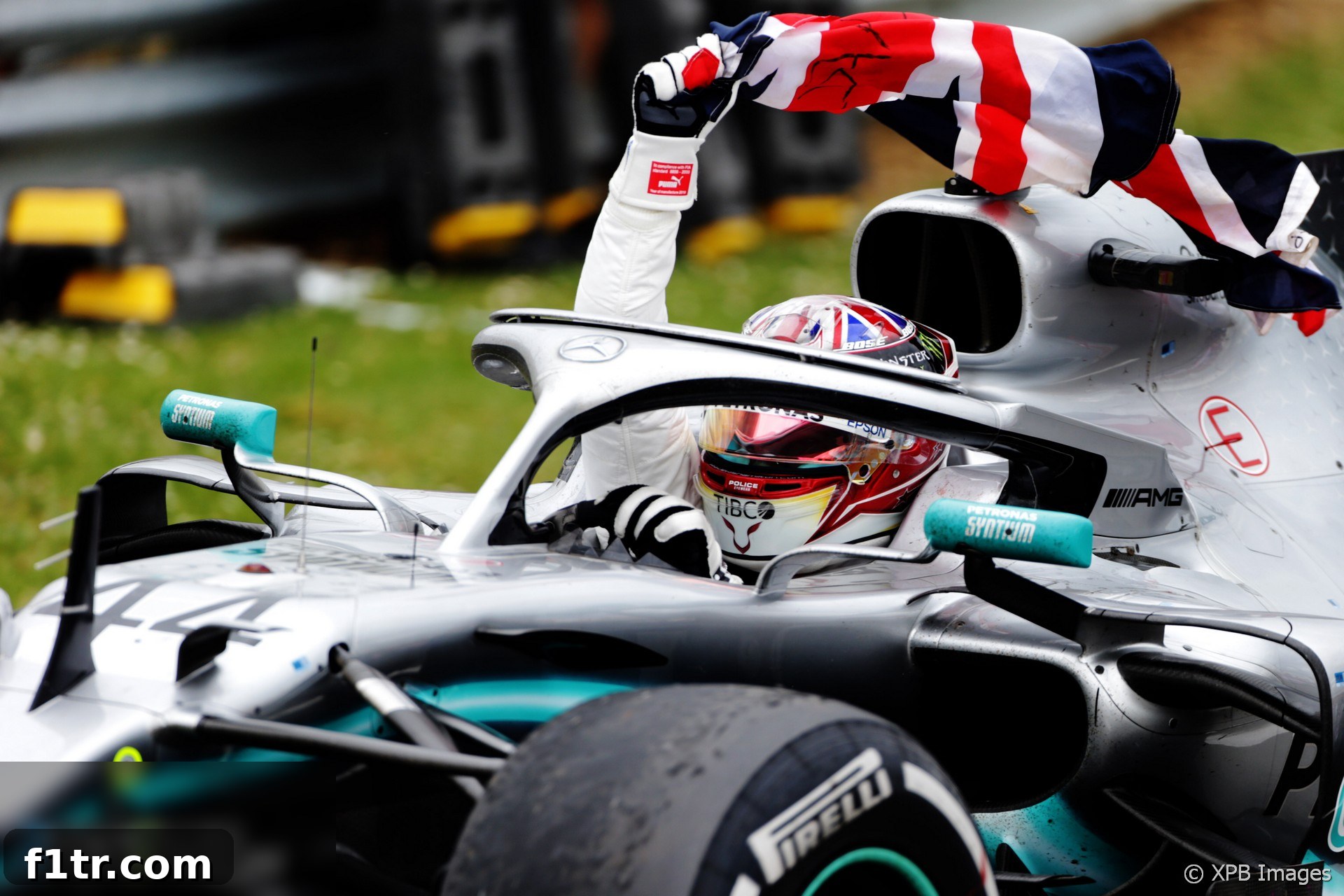
The 2019 British Grand Prix transcended a mere race; it was a captivating spectacle that demanded full appreciation before any deep dive into data analytics. More than just a series of pit stops and safety car interventions, it represented the pinnacle of motorsport: the world’s elite drivers pushing the fastest cars to their absolute limits on one of the planet’s most iconic asphalt canvases. The thrilling announcement of a five-year extension for Formula 1 at its spiritual home, Silverstone, provided the perfect celebratory backdrop to an already unforgettable weekend.
Hamilton Outmanoeuvres Bottas in a Strategic Masterclass
As the lights went out, Charles Leclerc, starting on soft tyres, struggled to find the necessary grip to challenge the dominant Mercedes duo. Instead, the two silver arrows engaged in their own intense internal battle, leaving Leclerc to lead a chasing pack that included both Ferrari and Red Bull machines. Lewis Hamilton, having narrowly missed out on a fifth consecutive pole position at his home circuit by a mere six-thousandths of a second, immediately latched onto his teammate’s rear wing. The reigning world champion had expressed confidence in his race setup after qualifying, a setup he was reluctant to alter significantly, and his performance on Sunday vividly demonstrated why.
Silverstone’s fast-flowing layout, recently re-laid with a custom Tarmac mix, provided the perfect stage for the 2019 cars to unleash their full potential. Drivers attacked every corner with breathtaking commitment, but none more so than Hamilton, whose relentless pursuit of Valtteri Bottas defined the opening laps. On the Wellington Straight, Hamilton used his DRS advantage to launch an audacious lunge down the inside into Brooklands. It appeared he had completed the move, but Bottas, demonstrating exceptional car control and finding crucial grip on the outside, held his ground, forcing Hamilton wide at Luffield. Emerging from the corner, Hamilton was momentarily ahead, only for Bottas to tuck back under his rear wing. Approaching the notoriously fast Copse corner, Bottas shrewdly swung to the inside. Hamilton, perhaps showing an abundance of respect for his teammate, conceded the racing line. Bottas capitalised, using the short straight to reclaim the corner and oblige Hamilton to settle for second. However, the sheer pace and aggressive intent displayed by Hamilton suggested that a reversal of fortunes was an inevitable outcome.
Advert | Become a Supporter & go ad-free
That reversal was ultimately facilitated by the opportune deployment of the Safety Car, which emerged precisely between Hamilton’s and Bottas’s first pit stops. Bottas, lacking comprehensive data on the hard compound tyres, made a crucial strategic decision on lap 16, opting for a second set of medium tyres. This committed him to a two-stop strategy. Other teams had shown more willingness to gamble earlier; Pierre Gasly had initiated a rush to the pits by swapping his mediums for hards four laps prior, demonstrating the potential for an alternative approach. With Bottas’s strategy now transparent, Hamilton judiciously extended his first stint. He would have likely continued beyond lap 20 had Antonio Giovinazzi not spun into the Vale gravel trap. As a recovery tractor needed to traverse the pit lane entrance to retrieve Giovinazzi’s car, the Safety Car was deployed, inadvertently paving Hamilton’s path to the lead. Yet, as Hamilton himself later asserted, even without the Safety Car, he would have simply switched to hard tyres and patiently waited for his teammate’s inevitable second pit stop. While the Safety Car deprived fans of a direct wheel-to-wheel showdown between the two Mercedes drivers in the later stages, it injected an electrifying new dynamic into what was undoubtedly the race’s most thrilling duel: Max Verstappen versus Charles Leclerc, a highly anticipated Round Two.
Advert | Become a RaceFans supporter andgo ad-free
Vettel’s Costly Error Propels Leclerc to Podium Glory
“I think he was a little bit sore still from Austria so he was defending really hard,” quipped Verstappen after the race, offering a light-hearted explanation for the fierce intensity. “But it’s fine, I’m all for that.” Indeed, Leclerc’s driving displayed a noticeably harder edge as he and Verstappen delivered a truly no-holds-barred battle for track position, captivating the Silverstone crowd. Leclerc not only defended with immense aggression but also executed opportunistic moves that would have made his Dutch rival proud.
Leclerc’s soft tyres quickly began to degrade, preventing him from ever truly breaking away from Verstappen’s DRS range in the early phase of the race. However, on lap 10, the gloves truly came off. The Red Bull gained a significant run on the Hangar Straight, but Leclerc moved late and decisively to cut him off – a tactical response that seemed straight out of Verstappen’s own playbook. This set the assertive tone for the enthralling battle that was to unfold. Leclerc then deliberately dawdled at the apex of The Loop, skilfully running Verstappen wide, a move perhaps executed with a knowing smirk as he recalled their previous encounter at the Red Bull Ring. This manoeuvre brought Sebastian Vettel, in the second Ferrari, into the mix. Verstappen responded by closing down hard, covering the inside line approaching Brooklands and turning in early to repel one Ferrari before immediately turning his attention back to the other.
Vettel subsequently fell back into the clutches of Gasly, who executed a surprisingly easy pass into Village. It was a toothless display from Vettel at that moment, yet he was keenly aware that his best chance of advancing was to preserve his soft tyres for as long as possible. Gasly’s pit stop at the end of that lap triggered a flurry of activity in the pit lane for the leaders. Leclerc followed suit on the next lap, and, unusually, Verstappen immediately mirrored his rival’s move. If this was a vote of confidence in his pit crew, they responded with exceptional efficiency, getting Verstappen out of the box a critical nose ahead of Leclerc.
However, Leclerc was in no mood to yield. He aggressively reclaimed the racing line at Village and then boldly threw his car down the inside into The Loop. While the move was unlikely to stick cleanly, it successfully spooked Verstappen into running wide, granting Leclerc the inside line and, crucially, the position. His reward for that brilliant, opportunistic pass should have been a well-deserved place on the podium. However, the subsequent Safety Car period complicated matters significantly. Firstly, it handed third place to Vettel, who had successfully nursed his soft tyres until lap 20, and fourth place to Gasly. Furthermore, Ferrari, wary of losing valuable track position, opted to keep Leclerc out on track, a decision that allowed Verstappen to pit for fresh tyres – a strategic ploy both obvious and incredibly difficult to counter.
When the race restarted, Leclerc found himself chasing Verstappen, Gasly, and Vettel. Leclerc drew alongside Verstappen through the Vale chicane and momentarily claimed the position, but Verstappen, running all four wheels wide onto the run-off area, managed to stay ahead. Surprisingly, the stewards ruled Verstappen’s aggressive defence legal, choosing to let the drivers continue their battle. Red Bull swiftly ‘corrected’ the running order of their two drivers, discreetly informing Gasly that the two cars were on “different strategies.” While both drivers were on hard tyres with no further pit stops planned, making this a debatable point, Gasly conceded the position as soon as Christian Horner directly intervened over the radio, ordering him to pull over.
The dramatic final act of this subplot unfolded on lap 37. Verstappen, having probed Vettel’s defences on preceding laps, effortlessly cruised past him with DRS assistance on the Hangar Straight. However, he ran slightly wide at Stowe, allowing Vettel to launch a comeback. Verstappen clung to the inside line at Vale – his only viable option – when Vettel, in a clumsy and inexplicable move, ran into the back of him. After Leclerc had spent lap after lap battling Verstappen cleanly yet fiercely, this was a dismal display of racecraft from the four-time world champion. Ultimately, Vettel’s blunder meant Leclerc finally prevailed in his protracted fight with Verstappen, a victory achieved despite, and ironically thanks to, the strategic errors and misjudgments within the wider Ferrari team. Vettel was handed a largely symbolic 10-second penalty for his reckless incident, a meagre consequence for such a significant error.
Advert | Become a RaceFans supporter andgo ad-free
Hamilton’s Coup de Grace: A Final Lap of Perfection
The unique circumstances of the race, particularly the Safety Car, had somewhat obscured the true extent of Lewis Hamilton’s superiority. The bonus point for the fastest lap, however, offered a clear opportunity for him to assert his dominance unequivocally. Valtteri Bottas, executing his largely superfluous second pit stop solely to satisfy technical regulations, bolted on a fresh set of soft tyres. He then reeled off a blistering 1’27.406 on lap 47, a time well over a second faster than anyone else had managed, and seemed set to secure a valuable damage-limiting extra point for his championship ambitions.
But Hamilton, who had deliberately declined the option of an additional pit stop for softs to cover Bottas’s attempt, felt exceptionally comfortable on his hard compound tyres. His experience in France earlier in the season had provided him with invaluable insight into what was achievable with a late, determined push on older rubber. As the final lap commenced, he systematically cranked up the performance of his Mercedes, savouring every moment of his last flying lap around the iconic Silverstone circuit. With an awe-inspiring display of precision and raw speed, he delivered a phenomenal 1’27.369 – a scant 0.037 seconds quicker than Bottas’s best. It was the ultimate ‘coup de grace’, capping a perfectly executed drive with the final, coveted extra point on offer, cementing his victory in truly emphatic fashion.
First-Lap Disaster for Haas and Midfield Mayhem
The Safety Car period had widespread consequences that rippled throughout the midfield too. Drivers like Lando Norris (who finished 11th) and Sergio Perez (17th) found themselves with unfortunate stories to tell, as the timing of the Safety Car utterly disrupted their afternoon strategies. A late second pit stop for hard tyres proved to be a critical misjudgment for Norris, costing him dearly. Perez, meanwhile, encountered a problem with his steering wheel after the Safety Car period, leaving him unable to adjust his crucial brake balance. This led to him skidding into Nico Hulkenberg, consequently losing a place to Kimi Raikkonen. Once again, the stewards chose to stay their hand, fostering a distinct impression that they had been instructed to adopt a lenient approach towards driver incidents.
Conversely, the Safety Car proved to be perfectly timed for Carlos Sainz Jnr, who made his sole pit stop during the intervention and shrewdly converted it into an impressive seventh-place finish. He expertly led home a competitive midfield pack comprising Daniel Ricciardo, Kimi Raikkonen, Daniil Kvyat, and Nico Hulkenberg. The latter snatched the final points-scoring position from Alexander Albon with just two laps remaining. The Toro Rosso driver endured an extraordinarily challenging 39-lap stint on medium tyres, an astonishing 10 laps longer than any other competitor. This gruelling endurance run was forced upon him due to an electrical problem with his Honda power unit, which rendered his mechanics unable to touch his car during the pit stop phase. Consequently, Albon heartbreakingly slipped out of the points in the final laps, his despondency undoubtedly compounded by his team’s urgent instruction to jump clear of his ‘live’ car at the race’s conclusion. Norris ultimately took 11th place from him, while Lance Stroll was the leading Racing Point driver at the chequered flag, securing 13th. George Russell delivered a commendable 14th place for Williams – marking the team’s best result of the season so far, a poignant achievement for a team that claimed its maiden Grand Prix victory at this very circuit 40 years prior.
Haas’s already difficult season continued its unfortunate trajectory, finding even more ways to go awry. Before the race weekend even began, they suffered the ignominy of being publicly dropped by their title sponsor, Rich Energy, amidst an escalating internal battle for control of the company. Despite the obvious setback, Haas bravely put on a composed front. However, on the very first lap of the race, Romain Grosjean and Kevin Magnussen clumsily blundered into each other, an incident that inflicted race-ending damage on both cars. Team Principal Guenther Steiner, understandably, was incandescent with fury, not least because Grosjean’s car was running the team’s Australia-specification aerodynamics, which had been generating valuable insights into the persistent underperformance of their upgraded challenger. The collision not only cost them potential points but also crucial data for understanding their car’s complex issues.
Mercedes Returns to Dominant Form at Silverstone
The British Grand Prix emphatically confirmed the widespread impression that Mercedes’ unexpected dip in form at the preceding Austrian Grand Prix was merely a temporary blip. They roared back with a commanding one-two finish, with Hamilton showcasing the same scintillating form that had earned him victory in France. Happily for Formula 1 as a whole, the two races that followed that somewhat lifeless encounter at Paul Ricard proved to be immensely superior sporting spectacles. While this is not to suggest that all is perfectly rosy in the Formula 1 garden, it certainly demonstrates that, given the right set of circumstances and a challenging circuit like Silverstone, we can still be treated to truly great races.
In the championship standings, however, the prospects of any driver not clad in silver overalls getting their hands on the coveted silverware continue to recede. Yet, when the racing is as thrilling and compelling as it was at Silverstone, the fact that the same two cars consistently finish in first and second position matters significantly less. The sheer excitement and drama on track often outweigh the predictable outcome at the very top.
Go ad-free for just £1 per month>> Find out more and sign up
2019 British Grand Prix
- 2019 British Grand Prix Star Performers
- Top ten pictures from the 2019 British Grand Prix
- Hamilton and Formula 1 at their best in Silverstone spectacular
- Hamilton passes Mansell and Clark as top Briton at home
- Paddock Diary: British Grand Prix day four
Browse all 2019 British Grand Prix articles
F1 race reviews
- Antonelli lucks in for second win and becomes youngest F1 championship leader
- Emotional Antonelli grabs first Formula 1 victory in Chinese Grand Prix
- Russell sees off Ferrari threat to lead Mercedes one-two in Melbourne
- Norris clinches F1 title by two points as Verstappen wins finale at Yas Marina
- McLaren strategy blunder in Losail hands Verstappen crucial win and shot at title
Read all F1 race reviews