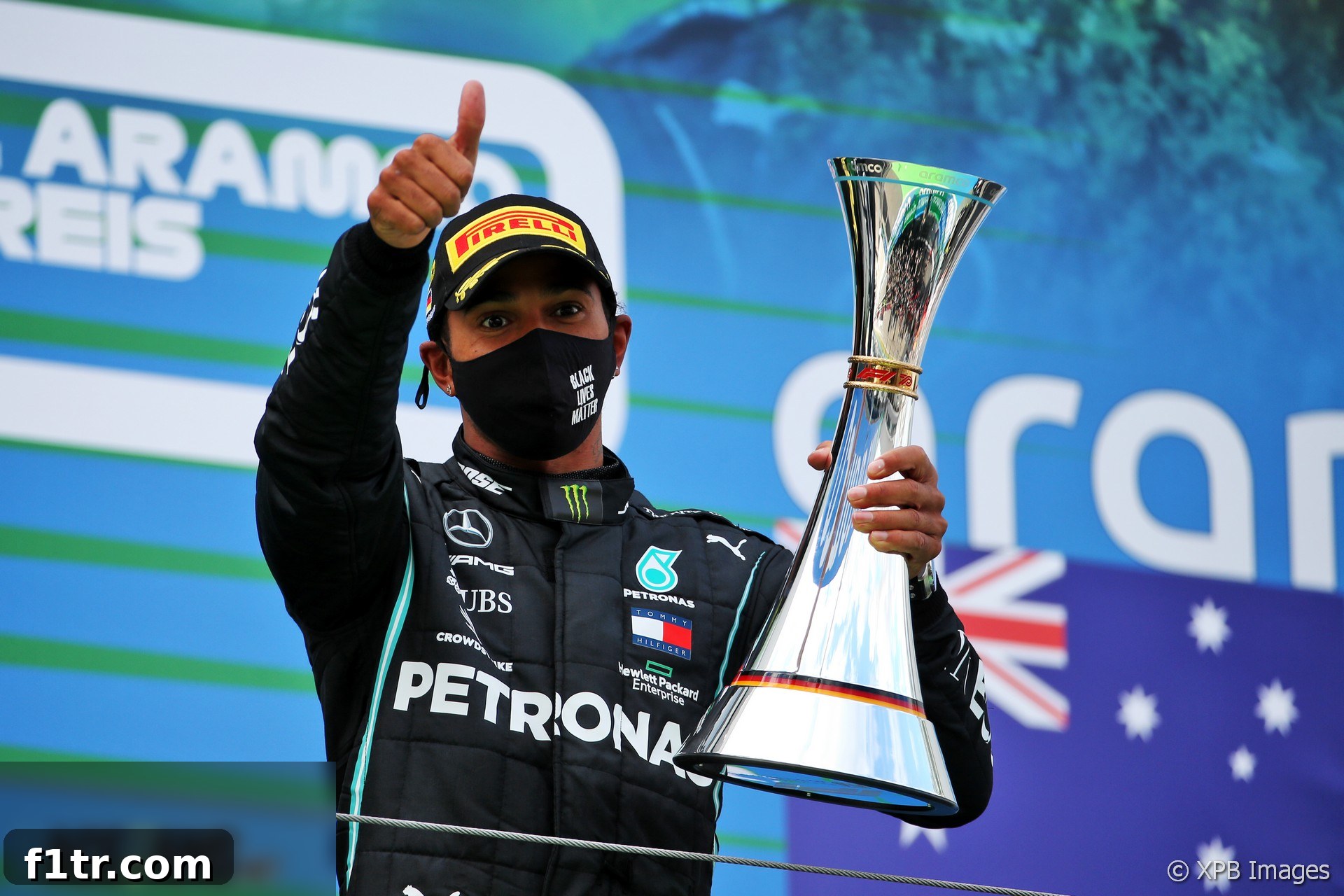
Lewis Hamilton’s Historic Milestone: A Testament to Unparalleled Excellence and Team Synergy
In the thrilling aftermath of the Eifel Grand Prix, Lewis Hamilton etched his name deeper into the annals of Formula 1 history. His monumental victory at the Nürburgring saw him equal Michael Schumacher’s long-standing record of 91 Grand Prix wins – a feat that Mercedes team principal Toto Wolff insists demands respect and acknowledgment, rather than being diminished by external commentary regarding the quality of his equipment.
The achievement, fourteen years in the making since Schumacher set the benchmark, has inevitably reignited debates surrounding the role of a driver versus their machinery in the hyper-competitive world of Formula 1. However, Wolff vehemently rejected the notion that Hamilton’s success is merely a byproduct of Mercedes’ dominant cars over recent seasons, offering a nuanced perspective on the intricate dance between driver talent and engineering prowess.
The Unrivaled Pursuit of Victory: Hamilton’s 91 Wins
Reaching 91 Formula 1 Grand Prix victories is an extraordinary accomplishment that transcends mere statistics. For decades, Michael Schumacher’s tally stood as an almost mythical figure, a testament to an era of unparalleled dominance and relentless pursuit of perfection. Now, Lewis Hamilton has drawn level with this colossal record, marking a pivotal moment in the sport’s rich tapestry.
Hamilton’s journey to this milestone has been defined by a relentless drive, exceptional skill, and an unwavering commitment to pushing boundaries. While he began his career with McLaren, securing his first world title and numerous victories, the vast majority of his triumphs have come since his pivotal move to the Mercedes-AMG Petronas Formula One Team in 2013. This strategic decision, a bold move at the time, has since blossomed into one of the most successful partnerships in motorsport history, yielding multiple world championships and an astonishing win rate.
The significance of matching Schumacher’s record extends beyond the numerical parity. It speaks to Hamilton’s longevity, his consistent ability to perform under immense pressure, and his masterful command of complex machinery. Each of these 91 wins represents countless hours of preparation, meticulous strategy, daring overtakes, and faultless execution. It is a record that places him firmly among the sport’s absolute giants, inspiring future generations and solidifying his status as a living legend.
Toto Wolff’s Resolute Defense: Beyond the Car
Mercedes team principal Toto Wolff, a key architect of the team’s unprecedented success, offered a robust defense of Hamilton’s achievement, directly addressing critics who attribute his success solely to the superiority of the Mercedes car. “In my opinion that’s not quite fair,” Wolff stated unequivocally. He emphasized that winning races and championships in Formula 1 is, at its core, always a collective effort – a symbiotic relationship between a dedicated team and an exceptional driver.
Wolff elaborated on this critical point, highlighting that while a formidable car is essential, it is far from the sole determinant of success. The driver’s role in navigating the labyrinthine decisions of team selection is paramount. “But you need to put yourself in a position that you end up in the best car. There you can see lots of talents and skilled drivers took the wrong decisions, not well-advised decisions,” he explained. This insight underscores the strategic acumen required by top drivers, not just on track, but also in managing their careers and aligning with a team capable of delivering a winning package.
Hamilton’s decision to join Mercedes in 2013, at a time when the team was still building towards its future dominance, is often cited as a testament to his foresight and belief in the project. Wolff underscored this, noting, “And in that respect it was him who joined us in 2013, and it is him that sits in the car and is able to execute on track with a tool that we provide to him. But it’s always the two that are part of this.” This statement perfectly encapsulates the inextricable link between driver and team – a partnership where each component elevates the other.
The Mercedes chief was unyielding in his dismissal of claims that diminish Hamilton’s individual contribution. “We couldn’t achieve the records that we have and he probably couldn’t achieve the records with the right car, full stop. I don’t want to allow these voices that say ‘he drives a Mercedes, it’s obvious that he wins so many races’.” His message was clear: the unparalleled success of the Mercedes-Hamilton pairing is a product of exceptional synergy, not a convenient coincidence. He challenged dissenting voices within the paddock, stating, “The drivers who say that should analyse why they haven’t found their way into a Mercedes.” This pointed remark highlights the competitive landscape of Formula 1, where securing a seat in a top team is itself a validation of a driver’s skill, reputation, and strategic choices.
A Legacy Forged: Hamilton’s Journey with Mercedes
Lewis Hamilton’s tenure at Mercedes has been nothing short of transformative for both driver and team. His arrival marked a new era, coinciding with the sport’s transition to hybrid power units, a domain in which Mercedes would establish unprecedented technical superiority. However, technical advantage alone does not guarantee championship glory. It requires a driver of Hamilton’s caliber to consistently extract every ounce of performance from the machinery, to adapt to evolving regulations, and to maintain an unyielding focus through multiple grueling seasons.
From 2014 onwards, the combination of Mercedes’ engineering brilliance and Hamilton’s driving artistry created a formidable force. His ability to perform under pressure, his tactical intelligence, and his raw speed have enabled him to convert pole positions into victories, execute critical overtakes, and manage challenging race conditions with remarkable consistency. This sustained excellence is a hallmark of true greatness, demonstrating that while the car provides the platform, the driver is the one who dances on the edge of its capabilities, pushing it to its absolute limits week after week.
The partnership has been defined by a shared ambition and a mutual drive for perfection. Hamilton has not merely driven the car; he has been an integral part of its development, providing crucial feedback that has allowed Mercedes to refine and optimize its package. This deep understanding and collaborative spirit are fundamental to their sustained dominance, proving that the relationship between driver and team is far more intricate than simply “driving a fast car.”
Michael Schumacher: The Enduring Icon
Before Lewis Hamilton’s relentless ascent, Michael Schumacher stood alone as the undisputed king of Formula 1 victories. When he set the record of 91 wins in 2006, it was an astonishing 40 more than any other driver at the time, a testament to his sheer dominance and revolutionary approach to the sport. Wolff readily acknowledged Schumacher’s towering legacy, admitting, “It’s unbelievable that Lewis has reached those 91 wins. For me, Michael stands above all. He’s an icon.”
Schumacher’s career, particularly his golden era with Ferrari, was characterized by an unparalleled work ethic, meticulous attention to detail, and a relentless will to win. He transformed Ferrari into a championship-winning juggernaut, crafting a legacy that many believed would forever remain out of reach. His influence extended beyond the track, impacting how teams approached preparation, fitness, and data analysis. He truly redefined what it meant to be a Formula 1 driver.
The sentiment of Wolff, describing Hamilton’s achievement as “almost surreal” in the context of Schumacher’s iconic status, perfectly captures the awe and respect that both figures command within the sport. This moment of equalizing such a monumental record not only celebrates Hamilton’s brilliance but also serves as a profound homage to the standard of excellence set by Schumacher.
Records Are Made to Be Broken: A Continuous Cycle of Greatness
Despite the immense gravity of Hamilton equalling Schumacher’s record, Toto Wolff also embraced the dynamic nature of sport, echoing a sentiment often attributed to Schumacher himself: “But records are here to be broken and I think that’s what Michael said as well. And Lewis is still on his journey.” This philosophical outlook suggests that while records define eras, they also serve as aspirations for future generations, driving the sport forward into new dimensions of performance.
The evolution of Formula 1 is a continuous cycle of innovation, talent, and record-breaking achievements. Each generation produces its own legends, who stand on the shoulders of those who came before them. As Hamilton continues to push his own boundaries, setting new benchmarks for total wins, pole positions, and championships, he simultaneously lays down a formidable challenge for the future. “But maybe there’s somebody in nursery or school that will one day go for the Lewis record. And this is how it should be,” Wolff mused, envisioning a future where new talents emerge to chase these seemingly insurmountable targets.
This perspective underscores the timeless appeal of Formula 1: the ceaseless pursuit of perfection, the breaking of old barriers, and the emergence of new heroes. It is a sport where history is constantly being rewritten, and where the legacy of one great champion inspires the next.
The Symbiotic Relationship Between Driver and Machine
Ultimately, the debate surrounding driver versus equipment in Formula 1 often oversimplifies a profoundly intricate relationship. Success at the pinnacle of motorsport is never solely attributable to the car or the driver in isolation. It is the perfect symbiosis, where an engineering masterpiece is brought to life by a driver of exceptional talent, dedication, and intelligence. The car provides the potential, but the driver unlocks it, pushes its limits, and adapts it to varying conditions.
Lewis Hamilton’s 91 Grand Prix victories, achieved with Mercedes, stand as a powerful testament to this symbiotic connection. They represent not just the triumph of a driver, nor merely the dominance of a car, but the extraordinary synergy of a human and machine operating at the absolute peak of their respective capabilities. This combination has redefined what is possible in Formula 1, setting a new gold standard for competitive excellence.
Conclusion: A Legacy Secured, A Future Inspired
Lewis Hamilton’s achievement of equalling Michael Schumacher’s record of 91 Formula 1 Grand Prix wins is a landmark event that deserves universal acclaim. As Toto Wolff eloquently argues, this milestone is not a mere consequence of a superior car, but the culmination of strategic brilliance, unparalleled driving talent, relentless dedication, and an extraordinary partnership between driver and team. It is a testament to Hamilton’s ability to consistently perform at the highest level, making the most of every opportunity presented to him.
While paying homage to the enduring legacy of Michael Schumacher as an iconic figure in the sport, this moment also signals a new chapter, where Hamilton continues to write his own indelible story. His ongoing journey inspires millions and reinforces the captivating narrative of Formula 1 – a sport where legends are made, records are challenged, and the pursuit of greatness is an eternal flame. Hamilton’s 91 victories serve as a powerful reminder that true champions are forged through an exquisite blend of innate ability, unwavering determination, and the perfect harmony with their chosen machinery.