Italian Grand Prix F1 Practice Session Delayed After Severe F3 Crash at Monza
The highly anticipated final Formula 1 practice session for the Italian Grand Prix at the legendary Autodromo Nazionale Monza was unexpectedly delayed, casting a temporary shadow over the ‘Temple of Speed.’ This unforeseen disruption stemmed from a severe incident during the preceding Formula 3 race, where young driver Alex Peroni was involved in a dramatic crash at the iconic Parabolica corner. The event necessitated urgent track repairs and safety assessments, underscoring the relentless commitment to safety that governs all levels of motorsport, especially on such a demanding circuit.
Monza, renowned for its incredible speeds and rich history within Formula 1, consistently draws a passionate crowd and delivers thrilling wheel-to-wheel action. However, the morning’s events served as a stark reminder of the inherent risks involved in high-speed racing and the meticulous, rapid response protocols required to mitigate them. The delay, though brief, highlighted the intricate balance between pushing automotive engineering to its limits and ensuring the absolute safety of every participant, from drivers to marshals.
The Harrowing F3 Incident: Alex Peroni’s Crash at the Legendary Parabolica
The sequence of events that led to the F1 practice delay began during the hotly contested Formula 3 feature race. Alex Peroni, an aspiring Australian driver competing for Campos Racing, experienced a terrifying accident at the exit of Parabolica, one of Monza’s most challenging and historically significant corners. This sweeping, high-speed bend demands immense courage and precise car control as drivers navigate its long radius before rocketing onto the main straight.
As Peroni navigated the corner, his car reportedly made contact with an aggressive kerb at the exit. This impact proved catastrophic, unsettling the vehicle and sending it airborne with shocking force. The car was launched violently, colliding with the catch fencing and barrier system before eventually coming to a halt on its side. The sheer violence of the impact was visually striking, with significant damage to the car and debris scattered across the run-off area.
Miraculously, and largely due to the extraordinary advancements in driver safety standards and the robust design of modern racing chassis, Alex Peroni was able to extract himself from the wreckage relatively unharmed. This fortunate outcome brought a collective sigh of relief across the paddock and the wider motorsport community, serving as a powerful testament to the ongoing efforts by the FIA and teams to protect drivers in even the most extreme circumstances. The incident, however, immediately raised questions about the track’s immediate safety and required prompt action.
Immediate Aftermath and the Impact on F1 Practice Protocols
Following Peroni’s dramatic accident, race control swiftly initiated an investigation and assessment of the circuit. The primary concern was the structural integrity of the track at the point of impact. Both the kerb that Peroni struck and the barrier system he made contact with required immediate and thorough inspection and repair. It was imperative that the circuit be restored to its uncompromising safety standards before the high-speed, high-downforce Formula 1 cars were permitted to take to the track.
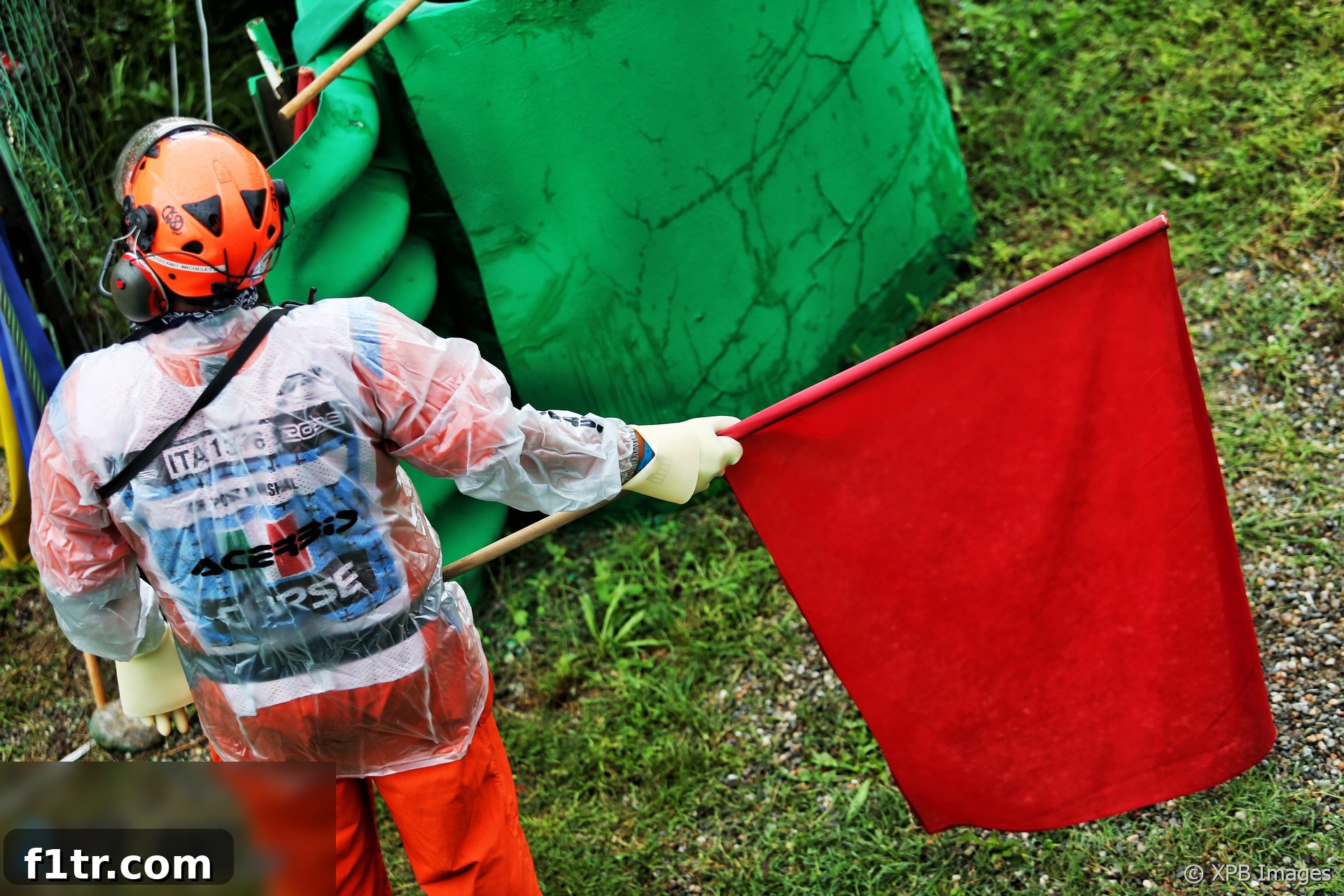
Consequently, despite the official start time for the final F1 practice session, known as Free Practice 3 (FP3), the pit lane exit remained closed. This meant that while the session clock began ticking, no F1 cars were allowed to leave their garages and venture onto the circuit until the essential repair work at Parabolica was completed. This strict adherence to safety protocols is a cornerstone of modern Formula 1 operations, prioritizing driver well-being above all else, even if it meant a delay to crucial track time.
Teams were kept informed by race control, receiving clear communication that a five-minute warning would precede the eventual opening of the pit lane. This allowed them to make last-minute preparations and adjust their session strategies, accommodating the unexpected delay. After dedicated and efficient work by track marshals and specialized repair crews, the all-clear was finally given. Approximately 10 minutes after its scheduled start, the pit lane opened, and the powerful Formula 1 machines roared out onto the Monza circuit, eager to make up for lost time and commence their final preparations for qualifying.
Monza: A Historic Circuit and Its Evolving Safety Standards
The Autodromo Nazionale Monza holds a revered status in the world of motorsport, fondly known as the ‘Temple of Speed.’ Its origins date back to 1922, making it one of the oldest and most historic racing venues globally. Characterized by long, flat-out straights like the Curva Grande and Rettifilo Tribune, interspersed with challenging chicanes and high-speed corners such as Parabolica, Monza consistently tests the limits of engine power, braking efficiency, and aerodynamic setup. Its unique layout inherently pushes the boundaries of speed, making track safety an ever-evolving and paramount concern.
Parabolica, in particular, has undergone various modifications and safety enhancements over the decades. Its original configuration, which featured very little run-off, presented an even greater risk. Over time, significant improvements have been implemented, including the introduction of extensive gravel traps, expanded asphalt run-off areas, and advanced barrier systems. These modifications aim to enhance safety without entirely diminishing the corner’s legendary challenge and character. The incident involving Alex Peroni, while alarming, served to highlight that circuit evolution is a continuous, dynamic process, constantly adapting to the increasing speeds and demands of modern racing machinery across all categories, from Formula 3 to Formula 1.
The Critical Importance of Formula 1 Practice Sessions for Team Performance
While termed ‘practice,’ these sessions are far from casual. For Formula 1 teams, Free Practice 3 (FP3) is arguably the most crucial practice session of a Grand Prix weekend. It represents the final opportunity to fine-tune the car’s intricate setup before the intense pressure of qualifying later in the day and the main Grand Prix race on Sunday. During FP3, teams conduct a series of vital tasks, including crucial aerodynamic evaluations, comprehensive assessments of tire wear and degradation across different compounds, and simulations of both qualifying-style laps and longer race stints.
An unexpected delay, even one as relatively short as 10 minutes, can significantly disrupt meticulously planned testing schedules. Engineers and drivers rely on every minute of track time to gather essential data, implement critical adjustments, and build confidence in the car’s performance. At a unique circuit like Monza, where achieving the optimal balance for high speed and minimal drag is paramount, any reduction in track time can potentially compromise performance during the most important sessions of the weekend. The ability of teams to adapt swiftly to altered schedules and maximize their remaining track time becomes a direct reflection of their operational efficiency, strategic acumen, and the resilience of their personnel.
Motorsport Safety: A Relentless Pursuit of Perfection and Driver Protection
The F3 crash at Monza serves as a stark yet powerful illustration of the profound advancements in motorsport safety over recent decades. In earlier eras, an accident of this magnitude would likely have carried far more tragic consequences. Today, the rigorous safety standards enforced globally by the FIA (Fédération Internationale de l’Automobile), encompassing everything from the cutting-edge design of chassis (including life-saving innovations like the halo device) to stringent circuit design parameters and highly effective emergency response protocols, play an absolutely critical role in protecting drivers.
Incidents like Peroni’s, even when fortunately without serious injury, provide invaluable data and insights for ongoing safety research and development. They trigger immediate reviews of track infrastructure elements such as kerb design, barrier placement, and run-off areas, not only at Monza but potentially across other circuits on the international calendar. This continuous feedback loop—between real-world incidents, in-depth accident analysis, and subsequent safety innovations—ensures that motorsport remains at the very forefront of engineering and human safety. The swift response of the medical and track crews, combined with the fact that the driver walked away unharmed, powerfully underscores the effectiveness and necessity of these multi-layered safety systems.
The Symbiotic Relationship: Formula 1 and its Essential Feeder Series
Formula 3 and its immediate senior category, Formula 2, are indispensable components of the broader Formula 1 ecosystem. These categories serve as crucial proving grounds for the next generation of motorsport talent, providing young drivers with the platform to hone their skills, gain invaluable experience, and ultimately demonstrate their potential to progress to the pinnacle of racing. However, their presence on the same Grand Prix weekend also means that incidents occurring in these junior categories can have a direct and immediate impact on the senior series’ operations.
The shared infrastructure, combined track time, and common safety personnel across the different categories mean that issues arising from F3 or F2 races often create a direct ripple effect on F1 operations. This interconnectedness highlights the unified approach to safety and operational excellence that must govern an entire Grand Prix weekend. The swift and decisive action taken to repair the track after the F3 crash was not just about the F3 event itself; it was fundamentally about ensuring that the F1 drivers could compete in an absolutely safe environment. This demonstrates the integrated and holistic nature of safety management that spans all racing categories operating under the FIA’s umbrella.
The 2019 Italian Grand Prix: A Weekend of High Stakes and Reflection
The 2019 Formula 1 season was already proving to be intensely competitive, with teams locked in fierce battles for championship points. The Italian Grand Prix, with its unique challenges and high-speed demands, was a pivotal race on the calendar, promising thrilling racing and strategic complexities. The delay to FP3, though relatively minor in terms of lost time, introduced an element of tension and served as a stark reminder of the inherent risks that accompany the pursuit of glory at such incredible speeds.
The incident briefly shifted the collective focus from pure performance metrics and championship aspirations to the foundational element of driver safety. It set a reflective tone for the remainder of the weekend, reminding everyone involved that while the spectacle of Formula 1 is exhilarating and captivating, the well-being of its participants remains, and always will be, the highest priority. Despite the early morning drama, the anticipation for the qualifying session and the Grand Prix itself remained undimmed, a testament to the enduring resilience of the sport and the unwavering passion of its global fanbase.
More on the 2019 F1 Season
- Monza Race Report: Ferrari’s Triumphant Home Race
- Driver Performance Analysis from the 2019 Italian Grand Prix
- Key Car Developments and Aerodynamic Upgrades at Monza 2019
- Strategic Battles and Tire Management in the 2019 Season
- Impact of Safety Innovations on the 2019 F1 Championship
Browse all 2019 F1 season articles
Conclusion: Safety Remains the Unwavering Priority in Motorsport
The delay to the final Formula 1 practice session at the Italian Grand Prix was a poignant illustration of the delicate yet crucial balance between breathtaking speed and absolute safety in motorsport. Alex Peroni’s dramatic crash during the Formula 3 race, while thankfully without serious injury, necessitated immediate and critical track repairs at Monza’s iconic Parabolica corner. This incident served as a powerful and timely reminder of the continuous commitment required from circuit operators, race officials, the FIA, and all stakeholders to maintain the highest safety standards across every single racing category.
The swift and decisive action taken to halt the F1 session and promptly address the damaged infrastructure underscored a non-negotiable principle: driver and track safety are paramount. While the brief delay may have impacted the meticulous strategies of the F1 teams, the overarching message was unequivocally clear: no amount of coveted track time is worth compromising the fundamental well-being of any participant. As the race weekend continued, this incident resonated as a powerful testament to the relentless pursuit of perfection in motorsport safety, ensuring that the ‘Temple of Speed’ remains not only a thrilling arena but also an inherently secure one for the world’s fastest racing machines.