The Strategic Saga of the 2022 Japanese Grand Prix: Navigating Suzuka’s Wet Weather Challenge
The 2022 Japanese Grand Prix at the iconic Suzuka Circuit proved to be a race defined by its brevity, its unpredictable conditions, and the critical strategic decisions made under immense pressure. Though the race ran for significantly less than its intended distance due to a series of incidents and delays, it nonetheless served as a testament to driver skill and team foresight, particularly concerning tyre choices on a notoriously demanding track.
A chaotic start, marked by multiple crashes, immediately brought the initial proceedings to a halt. The persistent rain then forced a protracted two-hour suspension, testing the patience of both teams and fans. By the time the race finally resumed under a rolling start, only about 40 minutes remained on the clock, transforming the Grand Prix into a sprint where every decision was magnified. Drivers were initially mandated to restart on full wet tyres, but it quickly became apparent that these would be shed for intermediates as soon as conditions allowed, setting the stage for a high-stakes strategic gamble.
The Intermediate Dilemma: Early Callers Reap Rewards
The decision of when to switch from full wet tyres to intermediates was arguably the most pivotal strategic call of the entire race. The track, initially saturated, began to dry in certain areas, presenting a narrow window for opportunistic teams. Most of the field adopted a cautious approach, waiting for more definitive drying conditions. However, a select few drivers and their teams demonstrated audacious foresight, heading into the pits early to make the crucial tyre change. These bold moves paid significant dividends.
Among the most successful were Sebastian Vettel of Aston Martin and Nicholas Latifi of Williams. Starting from 15th and 16th respectively at the delayed restart, both drivers made early switches to intermediate tyres, a decision that propelled them through the field. Vettel masterfully navigated the challenging conditions to cross the finish line in an impressive sixth position, while Latifi secured a commendable ninth, earning valuable points for his team. Their early pit stops, though seemingly risky given the amount of standing water, were executed perfectly and showcased the profound impact of timely strategic calls.
Suzuka’s Unique Challenge: Tyres Under Pressure
Suzuka is renowned as one of the most punishing circuits for tyres on the Formula 1 calendar, famous for its high-speed corners and abrasive asphalt. This characteristic profoundly influenced the tyre strategy during the Japanese Grand Prix. Unlike the slow-drying, low-grip surface encountered a week prior at Singapore’s Marina Bay Street Circuit, where drivers could nurse their intermediate tyres into a ‘slicktermiediate’ state by wearing them down, Suzuka offered no such luxury. The track’s aggressive nature meant that intermediate tyres would either perform optimally for a short window or degrade rapidly, demanding a different approach from teams.
Drivers were therefore faced with a stark choice: meticulously manage their increasingly worn intermediate tyres to the very end of the shortened race, or risk a second pit stop for fresh rubber. The latter option, while offering potential pace advantages, was a particularly tricky proposition given the notorious difficulty of overtaking at Suzuka. Making up ground after a pit stop required not only superior tyre performance but also exceptional driving to navigate through traffic, a feat that few could realistically achieve.
Individual Battles and Strategic Nuances
Mercedes, like many other teams, grappled with the optimal strategy. “There was only really the one decision point to make in race which was when to come in for inters,” admitted Andrew Shovlin, Mercedes’ head of trackside engineering. He further noted, “It looked like the optimum would have been to follow the Safety Car in when we restarted, which was surprising given the amount of water on the track.” Mercedes opted to bring both Lewis Hamilton and George Russell into the pits together for intermediates. However, the double-stack pit stop proved costly. Hamilton’s lap leading into the pits wasn’t particularly swift, and George Russell, arriving immediately behind him, lost even more precious time waiting for his turn, severely compromising their race.
Fernando Alonso, ever the astute tactician, showcased his strategic brilliance with a late pit stop that nearly paid off spectacularly. Having pitted from behind Sebastian Vettel in the closing stages, Alonso re-emerged on fresh intermediate tyres, rapidly closing the gap to the Aston Martin driver. In a thrilling conclusion, he finished less than a tenth of a second behind Vettel, narrowly missing out on a higher position but demonstrating the sheer potential of fresh rubber in the right hands.
Alonso’s pursuit of Vettel also saw him narrowly miss out on the bonus point for the fastest lap of the race. His first lap out of the pits on fresh tyres, when they were at their absolute optimum, was unfortunately spent negotiating past Nicholas Latifi. This crucial loss of clear track cost him the opportunity to set an uncontested fastest lap. Consequently, he fell short of beating Zhou Guanyu’s fastest lap by an agonizingly thin margin of just one thousandth of a second, highlighting how every millisecond and every track position matters in Formula 1.
2022 Japanese Grand Prix Statistical Insights
The compressed nature of the Japanese Grand Prix and the varied tyre strategies employed by teams provided a rich dataset for post-race analysis. Understanding the nuances of driver positions, lap times, and strategic choices is crucial to fully appreciate the dynamics of such a challenging race.
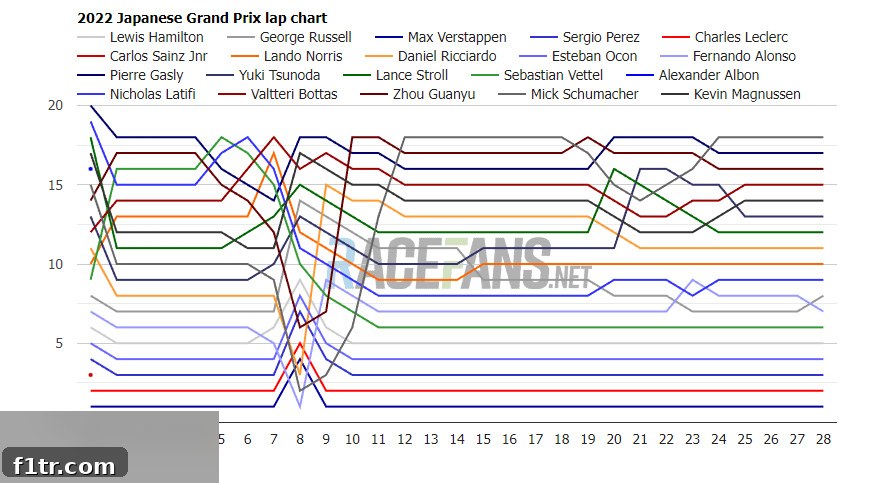
2022 Japanese Grand Prix Lap Chart
The lap chart visually represents the progression of each driver’s position throughout the race. In a chaotic race like Suzuka, such a chart would vividly illustrate the dramatic gains made by early intermediate tyre callers like Vettel and Latifi, contrasting with the struggles of those who delayed their switch. It would also highlight how challenging it was for drivers to recover positions once falling behind, emphasizing the importance of track position on this circuit.
2022 Japanese Grand Prix Race Chart
The race chart typically displays the gaps between each driver relative to the leader’s average lap time. For the 2022 Japanese Grand Prix, this chart would underscore the rapid changes in race pace after the intermediate tyre switch. It would show how quickly the gaps opened or closed, revealing which drivers found pace immediately on their new tyres and which struggled, ultimately reflecting the effectiveness of their strategic timing and tyre management.
2022 Japanese Grand Prix Lap Times
A detailed breakdown of all driver lap times (excluding very slow laps) offers granular insight into individual performance. This data would highlight periods of peak performance on fresh intermediates and also show the degradation curve for those nursing their tyres to the finish. It would be particularly interesting to observe the initial laps after an intermediate pit stop, showcasing the significant pace advantage gained by drivers who executed their strategy well.
2022 Japanese Grand Prix Fastest Laps
Each driver’s fastest lap tells a story of raw speed and optimal track conditions. Zhou Guanyu’s remarkable fastest lap, set on lap 20, stands as a testament to the pace achievable on intermediate tyres when conditions align. Fernando Alonso’s near-miss, just a thousandth of a second behind, further highlights the fine margins in Formula 1. Examining this table reveals not only outright speed but also the different phases of the race where drivers pushed hardest, often on fresher rubber or as the track evolved.
| Rank | No. | Driver | Car | Lap time | Gap | Average speed (kph) | Lap no. |
|---|---|---|---|---|---|---|---|
| 1 | 24 | Zhou Guanyu | Alfa Romeo-Ferrari | 1’44.411 | 200.22 | 20 | |
| 2 | 14 | Fernando Alonso | Alpine-Renault | 1’44.412 | 0.001 | 200.22 | 25 |
| 3 | 16 | Charles Leclerc | Ferrari | 1’44.489 | 0.078 | 200.07 | 10 |
| 4 | 1 | Max Verstappen | Red Bull | 1’44.911 | 0.500 | 199.27 | 10 |
| 5 | 18 | Lance Stroll | Aston Martin-Mercedes | 1’45.205 | 0.794 | 198.71 | 21 |
| 6 | 10 | Pierre Gasly | AlphaTauri-Red Bull | 1’45.387 | 0.976 | 198.37 | 22 |
| 7 | 44 | Lewis Hamilton | Mercedes | 1’45.530 | 1.119 | 198.1 | 11 |
| 8 | 22 | Yuki Tsunoda | AlphaTauri-Red Bull | 1’45.893 | 1.482 | 197.42 | 22 |
| 9 | 11 | Sergio Perez | Red Bull | 1’46.120 | 1.709 | 197 | 11 |
| 10 | 47 | Mick Schumacher | Haas-Ferrari | 1’46.545 | 2.134 | 196.21 | 13 |
| 11 | 31 | Esteban Ocon | Alpine-Renault | 1’46.559 | 2.148 | 196.18 | 11 |
| 12 | 5 | Sebastian Vettel | Aston Martin-Mercedes | 1’46.964 | 2.553 | 195.44 | 13 |
| 13 | 63 | George Russell | Mercedes | 1’47.004 | 2.593 | 195.37 | 21 |
| 14 | 77 | Valtteri Bottas | Alfa Romeo-Ferrari | 1’47.820 | 3.409 | 193.89 | 11 |
| 15 | 3 | Daniel Ricciardo | McLaren-Mercedes | 1’47.843 | 3.432 | 193.85 | 11 |
| 16 | 20 | Kevin Magnussen | Haas-Ferrari | 1’48.072 | 3.661 | 193.44 | 10 |
| 17 | 4 | Lando Norris | McLaren-Mercedes | 1’48.175 | 3.764 | 193.25 | 8 |
| 18 | 6 | Nicholas Latifi | Williams-Mercedes | 1’48.371 | 3.960 | 192.9 | 12 |
2022 Japanese Grand Prix Tyre Strategies
The tyre strategies employed by each driver were perhaps the most defining element of this shortened, rain-affected race. A visual representation of these strategies would highlight the stark contrast between drivers who opted for an early intermediate switch (e.g., Vettel, Latifi) and those who stayed out longer on full wets or were delayed in their change. It would also show any brave secondary pit stops, like Alonso’s, demonstrating the willingness of teams to gamble for an advantage. This chart is crucial for understanding the strategic success or failure of each competitor.
2022 Japanese Grand Prix Pit Stop Times
Pit stops are often called “the third dimension of racing,” and their efficiency can make or break a race, especially in a sprint format. While some teams executed flawless stops, others faced challenges, as evidenced by the complete stop times. George Russell’s unusually long stop, for instance, underlines the complexities and potential pitfalls of pit lane operations under pressure, particularly during double stack scenarios or unexpected issues. Conversely, consistent sub-25-second stops from teams like AlphaTauri and Aston Martin highlight their operational excellence in critical moments.
| Rank | No. | Driver | Team | Complete stop time (s) | Gap to best (s) | Stop no. | Lap no. |
|---|---|---|---|---|---|---|---|
| 1 | 22 | Yuki Tsunoda | AlphaTauri | 23.756 | 23.752 | 3 | 20 |
| 2 | 18 | Lance Stroll | Aston Martin | 23.87 | 23.866 | 3 | 19 |
| 3 | 10 | Pierre Gasly | AlphaTauri | 23.966 | 23.962 | 4 | 19 |
| 4 | 18 | Lance Stroll | Aston Martin | 24.005 | 24.001 | 2 | 7 |
| 5 | 14 | Fernando Alonso | Alpine | 24.106 | 24.102 | 2 | 8 |
| 6 | 14 | Fernando Alonso | Alpine | 24.123 | 24.119 | 3 | 22 |
| 7 | 5 | Sebastian Vettel | Aston Martin | 24.218 | 24.214 | 2 | 5 |
| 8 | 24 | Zhou Guanyu | Alfa Romeo | 24.266 | 24.262 | 3 | 18 |
| 9 | 1 | Max Verstappen | Red Bull | 24.308 | 24.304 | 2 | 7 |
| 10 | 22 | Yuki Tsunoda | AlphaTauri | 24.439 | 24.435 | 2 | 7 |
| 11 | 24 | Zhou Guanyu | Alfa Romeo | 24.563 | 24.559 | 2 | 9 |
| 12 | 4 | Lando Norris | McLaren | 24.595 | 24.591 | 2 | 6 |
| 13 | 47 | Mick Schumacher | Haas | 24.608 | 24.604 | 2 | 11 |
| 14 | 6 | Nicholas Latifi | Williams | 24.785 | 24.781 | 2 | 5 |
| 15 | 77 | Valtteri Bottas | Alfa Romeo | 24.869 | 24.865 | 2 | 6 |
| 16 | 10 | Pierre Gasly | AlphaTauri | 24.966 | 24.962 | 3 | 7 | 17 | 44 | Lewis Hamilton | Mercedes | 25.059 | 25.055 | 2 | 7 | 18 | 31 | Esteban Ocon | Alpine | 25.172 | 25.168 | 2 | 7 |
| 19 | 11 | Sergio Perez | Red Bull | 25.322 | 25.318 | 2 | 7 |
| 20 | 3 | Daniel Ricciardo | McLaren | 25.377 | 25.373 | 2 | 8 |
| 21 | 20 | Kevin Magnussen | Haas | 25.594 | 25.59 | 2 | 7 |
| 22 | 16 | Charles Leclerc | Ferrari | 25.899 | 25.895 | 2 | 7 |
| 23 | 63 | George Russell | Mercedes | 28.728 | 28.724 | 2 | 7 |
| 24 | 10 | Pierre Gasly | AlphaTauri | 41.319 | 41.315 | 1 | 1 |
2022 Japanese Grand Prix
The 2022 Japanese Grand Prix will be remembered as a masterclass in strategic execution under adverse conditions. It highlighted the bravery of teams and drivers willing to take calculated risks, particularly with tyre choices. The race underscored Suzuka’s formidable nature, demanding precision and adaptability from every participant. Ultimately, while shortened, the event delivered compelling drama and significant insights into the art of Formula 1 racing.
- From F1 to Formula Ford, 2022 was the year of the championship anti-climax
- Suzuka points confusion didn’t take shine off title win – Verstappen
- FIA to publish findings of inquiry into use of crane during Japanese GP
- Does F1 only need slicks and wets? The case for dropping intermediate tyres
- Hamilton’s work ethic “has not changed at all” in face of difficult 2022 campaign
Browse all 2022 Japanese Grand Prix articles