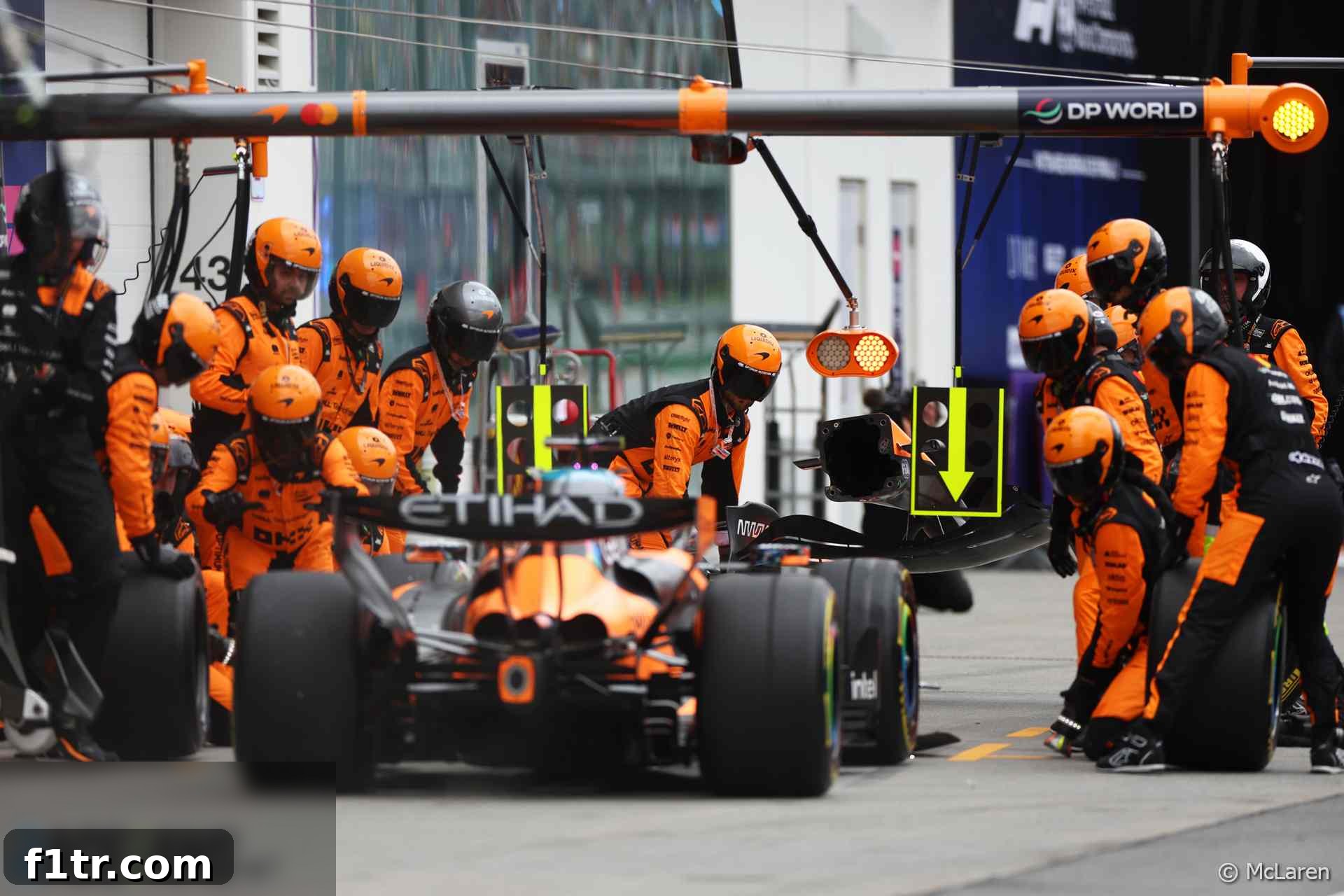
On the face of it, McLaren’s decision to start the Canadian Grand Prix on intermediate tyres looked like a catastrophic mistake on the scale of their missed pit stops in Qatar earlier in the season.
Jump to: Lap chart – Gaps chart – Lap times – Tyre strategies
Oscar Piastri repeatedly urged the team to change their decision before the start. He finished outside the points and Lando Norris retired, leaving McLaren without a score.
Seen purely through the lens of the race result, with both drivers starting from the second row, the call looks disastrous. However, McLaren were not the only team to try this approach and other factors contributed to the outcome. It may still have been a mistake, but understanding why McLaren thought the gamble was worth taking, and in which scenarios it might have paid off, explains their reasoning.
It was an unusually cold day and the track was damp after earlier rain. Many drivers used intermediate tyres on reconnaissance laps roughly 40 minutes before the start — the first time those tyres had been fitted all weekend and in some cases the first time wet-weather tyres had been used on the 2026 cars.
Advert | Become a Supporter & go ad-free
Light drizzle was falling during the national anthem ceremony, about 15 minutes before the start. With the track largely dry, Pirelli’s published tyre choices surprised many. Among the ‘big four’ teams occupying the top eight grid places, three chose soft tyres while McLaren elected to start both cars on intermediates.
McLaren were not alone in that choice. The next-highest intermediate starter was Nico Hulkenberg in 11th, with team mate Gabriel Bortoleto two places further back. Williams split strategies: Carlos Sainz Jnr lined up 15th on intermediates while Alexander Albon, three places behind, was on softs. The two Cadillacs at the back of the grid were also on intermediates. Drivers starting further down the order had more to gain from a risky call, but McLaren clearly saw potential advantage in the move.
With temperatures unusually low, intermmediate tyres would warm up faster than slicks. In normal race conditions drivers worry about keeping tyre temperatures down; in Montreal that concern was reversed, making the treaded intermediates attractive because they could reach operating window sooner.
The immediate warm-up benefit could have been decisive. That advantage, though, was undermined by an unexpected development: two extra formation laps. A single extra formation lap is rare; two in succession is highly unusual. The additional laps delayed the start by six-and-a-half minutes, giving the track more time to dry and increasing the risk for those on intermediates.
Advert | Become a RaceFans supporter andgo ad-free
Piastri was keen to abandon the gamble, but switching to slicks before the lights would have cost the team two things. First, they would have surrendered their starting grid slots and instead had to start from the pit lane. Second, they would have lost the chance to run a single-tyre strategy by beginning on intermediates and, if they secured the lead, changing to slicks later and running to the end without using two dry compounds.
That single-stop or no-stop strategy was the upside McLaren were aiming for. If they’d taken the lead at the start and switched to slicks early, they could have avoided a second set of dry tyres. Although none of the intermediate-starters ultimately completed the race on that plan, the strategy would have worked in a run without the Virtual Safety Car periods that affected the race.
Given that potential, McLaren did not follow Piastri’s calls to swap to softs on the grid. Even drivers with less to lose — for example Valtteri Bottas, starting 21st — stuck with intermediates.
Race control’s decision to order a second formation lap was a close call. Marshals had nearly finished recovering Arvid Lindblad’s stranded car when the order came. Had the race director delayed the start instead of calling two formation laps, teams could have changed tyres on the grid without losing their starting positions, which would have removed much of the gamble’s downside.
Norris’s initial jump to the lead, using the superior grip of intermediates, underlined the logic behind McLaren’s decision. The move offered a clear benefit at the start, but it was a borderline call that left the team exposed if extra formation laps dried the track — precisely what happened.
After the race, Max Verstappen mentioned seeing Lewis Hamilton make a late change to his choice of starting tyre on the grid. That raises the question: was Ferrari close to making the same gamble as McLaren, or was the move intended to deceive rivals? Either way, it highlights how teams use tyre choices not only for performance but also for tactical uncertainty.
Advert | Become a RaceFans supporter andgo ad-free
2026 Canadian Grand Prix lap chart
The positions of each driver on every lap. Click name to highlight, right-click to reset. Toggle drivers using controls below:
Advert | Become a RaceFans supporter & go ad-free
2026 Canadian Grand Prix race chart
The gaps between each driver on every lap compared to the leader’s average lap time. Very large gaps omitted. Scroll to zoom, drag to pan and right-click to reset. Toggle drivers using controls below:
Advert | Become a RaceFans supporter & go ad-free
2026 Canadian Grand Prix lap times
All the lap times by the drivers (in seconds, very slow laps excluded). Scroll to zoom, drag to pan and toggle drivers using the control below:
Advert | Become a RaceFans supporter & go ad-free
2026 Canadian Grand Prix fastest laps
Each driver’s fastest lap:
| Rank | # | Driver | Car | Lap time | Gap | Avg. speed (kph) | Lap no. |
|---|---|---|---|---|---|---|---|
| 1 | 12 | Andrea Kimi Antonelli | Mercedes | 1’14.210 | 211.56 | 68 | |
| 2 | 3 | Max Verstappen | Red Bull-Red Bull-Ford | 1’14.398 | 0.188 | 211.02 | 68 |
| 3 | 44 | Lewis Hamilton | Ferrari | 1’14.573 | 0.363 | 210.53 | 61 |
| 4 | 6 | Isack Hadjar | Red Bull-Red Bull-Ford | 1’14.578 | 0.368 | 210.51 | 67 |
| 5 | 16 | Charles Leclerc | Ferrari | 1’15.297 | 1.087 | 208.5 | 37 |
| 6 | 10 | Pierre Gasly | Alpine-Mercedes | 1’15.390 | 1.180 | 208.25 | 67 |
| 7 | 81 | Oscar Piastri | McLaren-Mercedes | 1’15.456 | 1.246 | 208.06 | 61 |
| 8 | 43 | Franco Colapinto | Alpine-Mercedes | 1’15.462 | 1.252 | 208.05 | 67 |
| 9 | 63 | George Russell | Mercedes | 1’15.477 | 1.267 | 208.01 | 16 |
| 10 | 30 | Liam Lawson | Racing Bulls-Red Bull-Ford | 1’15.604 | 1.394 | 207.66 | 59 |
| 11 | 1 | Lando Norris | McLaren-Mercedes | 1’15.845 | 1.635 | 207 | 36 |
| 12 | 55 | Carlos Sainz Jnr | Williams-Mercedes | 1’15.852 | 1.642 | 206.98 | 65 |
| 13 | 87 | Oliver Bearman | Haas-Ferrari | 1’16.002 | 1.792 | 206.57 | 64 |
| 14 | 5 | Gabriel Bortoleto | Audi | 1’16.221 | 2.011 | 205.97 | 50 |
| 15 | 27 | Nico Hulkenberg | Audi | 1’16.275 | 2.065 | 205.83 | 57 |
| 16 | 31 | Esteban Ocon | Haas-Ferrari | 1’16.577 | 2.367 | 205.02 | 64 |
| 17 | 11 | Sergio Perez | Cadillac-Ferrari | 1’16.915 | 2.705 | 204.12 | 37 |
| 18 | 23 | Alexander Albon | Williams-Mercedes | 1’17.221 | 3.011 | 203.31 | 11 |
| 19 | 77 | Valtteri Bottas | Cadillac-Ferrari | 1’17.725 | 3.515 | 201.99 | 59 |
| 20 | 18 | Lance Stroll | Aston Martin-Honda | 1’18.721 | 4.511 | 199.43 | 39 |
| 21 | 14 | Fernando Alonso | Aston Martin-Honda | 1’19.635 | 5.425 | 197.14 | 10 |
2026 Canadian Grand Prix tyre strategies
The tyre strategies used by each driver:
Advert | Become a RaceFans supporter & go ad-free
2026 Canadian Grand Prix pit stop times
Complete pit stop times for each driver:
| Rank | # | Driver | Team | Complete stop time (s) | Gap to best (s) | Stop no. | Lap no. |
|---|---|---|---|---|---|---|---|
| 1 | 1 | Lando Norris | McLaren | 23.418 | 1 | 2 | |
| 2 | 81 | Oscar Piastri | McLaren | 24.121 | 0.703 | 1 | 1 |
| 3 | 18 | Lance Stroll | Aston Martin | 24.146 | 0.728 | 2 | 49 |
| 4 | 30 | Liam Lawson | Racing Bulls | 24.177 | 0.759 | 1 | 30 |
| 5 | 18 | Lance Stroll | Aston Martin | 24.249 | 0.831 | 1 | 14 |
| 6 | 77 | Valtteri Bottas | Cadillac | 24.413 | 0.995 | 3 | 29 |
| 7 | 14 | Fernando Alonso | Aston Martin | 24.709 | 1.291 | 1 | 20 |
| 8 | 55 | Carlos Sainz Jnr | Williams | 24.751 | 1.333 | 1 | 2 |
| 9 | 5 | Gabriel Bortoleto | Audi | 24.766 | 1.348 | 2 | 18 |
| 10 | 31 | Esteban Ocon | Haas | 24.833 | 1.415 | 1 | 16 |
| 11 | 77 | Valtteri Bottas | Cadillac | 24.847 | 1.429 | 2 | 9 |
| 12 | 6 | Isack Hadjar | Red Bull | 24.902 | 1.484 | 1 | 31 |
| 13 | 27 | Nico Hulkenberg | Audi | 24.952 | 1.534 | 1 | 2 |
| 14 | 11 | Sergio Perez | Cadillac | 24.984 | 1.566 | 3 | 29 |
| 15 | 11 | Sergio Perez | Cadillac | 25.153 | 1.735 | 2 | 15 |
| 16 | 12 | Andrea Kimi Antonelli | Mercedes | 25.153 | 1.735 | 1 | 31 |
| 17 | 3 | Max Verstappen | Red Bull | 25.199 | 1.781 | 1 | 31 |
| 18 | 55 | Carlos Sainz Jnr | Williams | 25.636 | 2.218 | 2 | 30 |
| 19 | 43 | Franco Colapinto | Alpine | 25.64 | 2.222 | 1 | 30 |
| 20 | 10 | Pierre Gasly | Alpine | 25.644 | 2.226 | 1 | 30 |
| 21 | 11 | Sergio Perez | Cadillac | 25.737 | 2.319 | 1 | 2 |
| 22 | 44 | Lewis Hamilton | Ferrari | 25.936 | 2.518 | 1 | 31 |
| 23 | 5 | Gabriel Bortoleto | Audi | 28.178 | 4.76 | 1 | 2 |
| 24 | 77 | Valtteri Bottas | Cadillac | 28.257 | 4.839 | 1 | 3 |
| 25 | 1 | Lando Norris | McLaren | 28.859 | 5.441 | 2 | 15 |
| 26 | 16 | Charles Leclerc | Ferrari | 30.114 | 6.696 | 1 | 31 |
| 27 | 27 | Nico Hulkenberg | Audi | 31.024 | 7.606 | 2 | 20 |
| 28 | 77 | Valtteri Bottas | Cadillac | 31.102 | 7.684 | 4 | 49 |
| 29 | 6 | Isack Hadjar | Red Bull | 34.713 | 11.295 | 2 | 52 |
| 30 | 31 | Esteban Ocon | Haas | 35.351 | 11.933 | 2 | 30 |
| 31 | 81 | Oscar Piastri | McLaren | 36.103 | 12.685 | 3 | 51 |
| 32 | 81 | Oscar Piastri | McLaren | 36.627 | 13.209 | 2 | 12 |
| 33 | 87 | Oliver Bearman | Haas | 44.957 | 21.539 | 1 | 30 |
Advert | Become a RaceFans supporter & go ad-free
2026 Canadian Grand Prix
- Stats: Antonelli has larger points lead than any driver had last year, and more
- Power deficit is keeping Ferrari out of the fight with Mercedes – Hamilton
- ‘Actually an opportunity’: How McLaren answered drivers’ calls to ditch tyre gamble
- “He needs to back up”: How Mercedes managed Russell and Antonelli’s Canadian GP fight
- ‘It doesn’t feel like what motorsport should be’: Podium trio still unhappy with F1’s power units
Browse all 2026 Canadian Grand Prix articles