The Baku Clash: Unraveling the Perez-Sainz Incident at the Azerbaijan Grand Prix
The Azerbaijan Grand Prix, often a crucible of high-stakes drama and unexpected twists, lived up to its reputation in its most recent edition. For 49 of its 51 challenging laps, the race unfolded as a captivating spectacle, building a slow burn of tension that gripped fans worldwide. The unique street circuit of Baku, known for its long straights, tight corners, and propensity for incident, set the stage for a dramatic climax that would leave an indelible mark on the championship narrative.
Initially, the race saw a fierce two-way battle for the lead, featuring the promising talent of Oscar Piastri and the strategic prowess of Charles Leclerc. However, as the laps dwindled, the dynamic shifted. Sergio Perez, driving for Red Bull, masterfully closed the gap, transforming the duel into a high-pressure three-way fight. The Mexican driver’s relentless pursuit put immense pressure on Leclerc, adding another layer of complexity to an already thrilling contest for the top spots on the podium.
Just when the race seemed to settle into this three-way struggle, Carlos Sainz Jnr, Leclerc’s Ferrari teammate, began to demonstrate his formidable pace. Displaying impressive race craft, Sainz steadily reeled in the leading trio. His relentless charge eventually brought him within DRS (Drag Reduction System) range of Perez, who was holding third position. This development injected an extra dimension of excitement and unpredictability into the closing stages, promising a spectacular four-car showdown for the podium places.
Tragically, however, this thrilling build-up culminated in heartbreak for two of the key protagonists. On the penultimate lap, lap 50, both Sergio Perez and Carlos Sainz Jnr found their races abruptly ended in a dramatic collision. The incident, occurring at a critical juncture, took both drivers out of contention, scattering debris and igniting a fierce debate among fans, pundits, and most importantly, the race stewards. While the stewards ultimately decided against taking any action, deeming it a racing incident, the question lingered: were they correct in their assessment, or should blame have been assigned to one driver?
The Critical Moment: How the Collision Unfolded on Lap 50
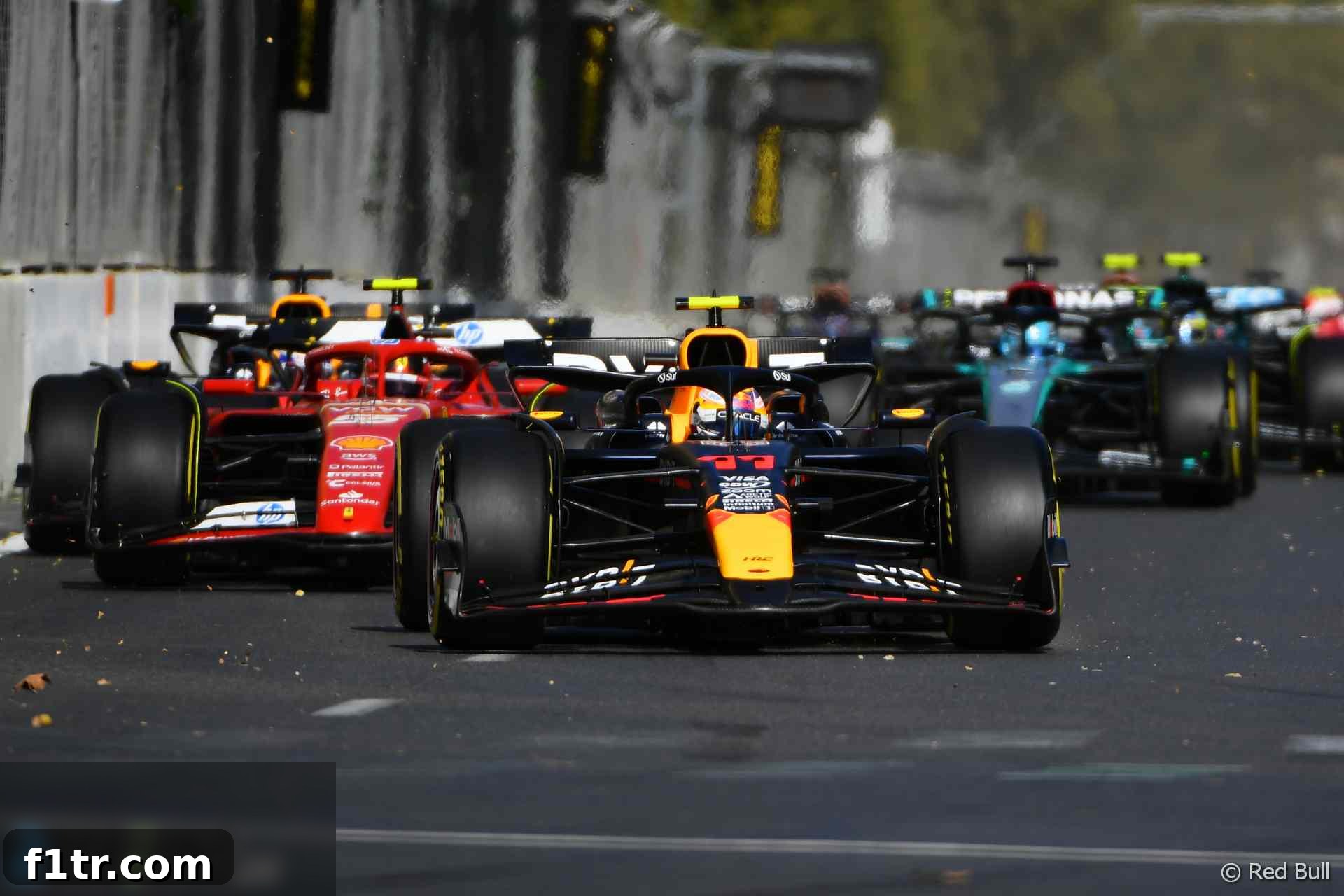
As the Azerbaijan Grand Prix entered its penultimate lap, lap 50, the tension was palpable. Sergio Perez, determined to claim second place, launched an aggressive move on Charles Leclerc into Turn 1. Perez opted for the outside line, a bold choice given Leclerc’s staunch defensive driving. This maneuver, while aiming for an overtake on Leclerc, inadvertently opened a crucial window for Carlos Sainz Jnr. Sainz, capitalising on the unfolding scenario, took a tighter, more advantageous line on the exit of Turn 1, successfully passing the Red Bull of Perez.
With Sainz now ahead of Perez and briefly alongside Leclerc, the battle intensified. As they navigated Turn 2, Sainz momentarily looked to the outside of Leclerc. While this move provided an opportunity against his teammate, it subtly compromised Sainz’s exit onto the crucial straight leading to Turn 3. This slight compromise was all Perez needed. With a powerful burst of acceleration, the Red Bull driver pulled alongside Sainz as they exited Turn 2, setting up a perilous side-by-side confrontation.
The two high-speed machines ran wheel-to-wheel, inches apart, hurtling towards the wall on the left-hand side of the circuit. Perez’s front wing was reportedly halfway alongside the Ferrari when the inevitable contact occurred. The lightest touch between their wheels at such high speeds was enough to send both Perez and Sainz catastrophically into the wall. The impact was violent, immediately terminating their races and scattering significant debris across the straight. Valtteri Bottas, following closely behind, was forced to take evasive action, slowing down and unfortunately running over some of the scattered wreckage. The incident necessitated the deployment of the Virtual Safety Car (VSC), under which conditions the race ultimately concluded at the end of the final lap.
The Immediate Aftermath: Voices from the Cockpit
Raw Emotions on Team Radio
Immediately following the catastrophic collision, the raw emotions of both drivers were broadcast across the world feed via FOM’s playback of their team radio messages. Sergio Perez, clearly incandescent with anger and frustration, communicated with his race engineer, Hugh Bird, in a torrent of expletives (which were subsequently censored). “What the [censored by FOM]? Did you see what he did, man? What the [censored by FOM]? Does he crash or what? [Censored by FOM] idiot,” Perez exclaimed, his voice laced with disbelief and fury. His words painted a clear picture of a driver who felt unjustly taken out of the race and attributed full blame to his rival.
Carlos Sainz, on the other hand, presented a stark contrast in his initial reaction. His radio messages conveyed not anger, but profound confusion and bewilderment. “What happened there?,” he queried his team. “What happened? I don’t get it.” Sainz’s tone suggested a genuine lack of understanding of how the incident had occurred, indicating perhaps a blind spot or a different perspective on the events that led to the collision. This immediate divergence in reactions set the stage for a complex post-race analysis.
Post-Race Reflections: Drivers Offer Their Perspectives
After the initial shock subsided and cooler heads (relatively) prevailed, both drivers offered more measured, yet still distinct, accounts of the incident during their post-race interviews. Sergio Perez, still visibly upset but attempting to articulate his viewpoint, speculated that Sainz might have drifted into him while attempting to gain a slipstream advantage from his teammate, Charles Leclerc, who was ahead.
“I felt that, exiting Turn 2, there was plenty of room between both cars, and within a meter or two we end up making contact,” Perez explained. “It’s very unfortunate. It all happened too quickly. I think Carlos was trying to follow the tow from Charles as he went to the inside and that made things really hard.” Perez’s perspective highlighted his belief that adequate space existed, implying that Sainz’s subsequent movement into that space was the primary cause of the contact.
Carlos Sainz, however, maintained his stance of bewilderment. Despite having reviewed the incident, he remained at a loss to fully comprehend how the collision had unfolded from his vantage point. “When I exited Turn 2, Checo was on my left,” he recounted. “We normally do a slight drift towards the left into that long straight, which I did like every other lap. For some reason, that I don’t understand, Checo and I collided. Which is unfortunate and obviously very disappointing.” Sainz’s explanation emphasized his adherence to his usual racing line, suggesting that if a deviation occurred, it was a standard and predictable part of the circuit’s topography, rather than a deliberate or erratic move that would lead to contact.
The Official Verdict: Stewards’ Impartial Analysis
In the highly regulated world of Formula 1, every significant on-track incident undergoes rigorous scrutiny. Following the Azerbaijan Grand Prix, the race stewards promptly launched an investigation into the collision between Perez and Sainz. They summoned both drivers, heard their testimonies, reviewed telemetry data, and meticulously analyzed all available video angles. After this thorough process, the stewards delivered their official verdict: no further action would be taken against either Sergio Perez or Carlos Sainz. This decision officially categorized the incident as a “racing incident,” implying that neither driver was predominantly at fault.
In their detailed report, the stewards provided a precise breakdown of their reasoning. “Sainz passed Perez after Turn 1 and was completely ahead at the apex of Turn 2,” their decision began, establishing the initial positions. They noted that Sainz then had a “compromised exit,” which allowed Perez to pull to his inside. Sainz confirmed he was aware of Perez’s presence to his left. Crucially, the stewards pointed out that “Perez, being slightly behind, was in a better position to see the relative location of the cars.” As the two cars approached the left-hand wall at the exit of Turn 2, they were approximately one meter apart, a dangerously narrow margin at racing speeds.
A key finding was the drivers’ steering inputs. “From this point and throughout the incident, neither driver steered erratically, and indeed both kept their steering very neutral,” the report stated. This suggests that there was no sudden, aggressive maneuver from either side that directly caused the contact. Instead, it was a gradual closing of space.
To understand the movement leading to the contact, the stewards meticulously checked the drivers’ lines on previous laps. They observed that “Sainz was on or close to his normal racing line, which forms a slight angle away from the right-hand wall. From the exit to the point of contact he moved approximately one car width further away from the wall.” Conversely, “Perez moved approximately half a car width further away from the same wall, being more parallel to the right-hand wall.”
The stewards’ conclusion succinctly encapsulated their findings: “It was thus apparent that while ahead, and having the right to drive his line, Sainz did move slightly towards a car that he had limited vision of. At the same time, there was nothing unusual about Perez’s line, but he could have done more to avoid the car that he had better view of.” This statement highlights the nuanced nature of the incident, distributing responsibility without assigning primary fault. Sainz, while technically ahead and entitled to his line, drifted slightly into Perez’s path with limited visibility. Perez, despite following a normal line, possessed better visibility of Sainz and potentially could have reacted differently to prevent the contact. Therefore, the stewards deemed it a classic racing incident, a byproduct of the intense, high-speed competition inherent in Formula 1.
The Unanswered Question: Your Verdict on the Baku Clash
Despite the official ruling by the race stewards, the incident between Sergio Perez and Carlos Sainz at the Azerbaijan Grand Prix remains a potent topic of debate among Formula 1 enthusiasts. The detailed analysis from the officials, while providing clarity on their decision-making process, often leaves room for fan interpretation and passionate discussion. Was it a straightforward racing incident where two drivers pushed the limits simultaneously? Or did one driver bear more responsibility, even if subtly, for the unfortunate outcome?
The stewards’ explanation highlighted key elements: Sainz’s compromised exit and subsequent slight drift, coupled with his limited visibility, juxtaposed against Perez maintaining a normal line but having a better view and thus a potential opportunity to avoid contact. This delicate balance of contributing factors is precisely what makes such incidents so complex and, at times, controversial. Fans often weigh a multitude of factors, including previous incidents involving the drivers, their reputation for aggressive or cautious racing, and their own understanding of racing dynamics.
Who, in your opinion, was ultimately responsible for this dramatic collision that cost both drivers valuable championship points and podium finishes? Do you agree with the stewards’ decision that it was an unavoidable racing incident, or do you believe a penalty should have been issued to one of the drivers? This incident perfectly encapsulates the fine margins and split-second decisions that define Formula 1 racing, and the ongoing debate is a testament to the sport’s thrilling and often contentious nature.
A poll conducted shortly after the race among fans revealed a diverse range of opinions, reflecting the complexity of the incident. The results showed a significant division:
Fan Verdict: Who was to blame for the collision between Perez and Sainz?
- No opinion (2%)
- Sainz entirely to blame (2%)
- Sainz mostly to blame (9%)
- Both equally to blame (36%)
- Perez mostly to blame (41%)
- Perez entirely to blame (11%)
Total Voters: 152
As the results indicate, a plurality of fans placed the majority of the blame on Perez, closely followed by those who felt both drivers were equally responsible. This outcome underscores the subjective nature of judging racing incidents and the passionate involvement of the F1 fanbase in such controversies. The debate continues to fuel discussions, highlighting the nuanced interpretations of racing rules and driver conduct at the very pinnacle of motorsport.
Further Debates and Polls
For more engaging discussions and to cast your vote on other pressing topics in Formula 1, explore our collection of debates and polls:
- What must Formula 1 fix with its new rules – and what should it leave unchanged?
- ADUO: Do F1 teams who fall behind deserve to get help to catch up?
- F1 is considering doubling its sprint races. Do you want more or fewer?
- Will this be a fight or a rout? 20 questions for the 2026 Formula 1 season
- Which Formula 1 team has the best-looking car – and the worst – for the 2026 season?
Browse all debates and polls