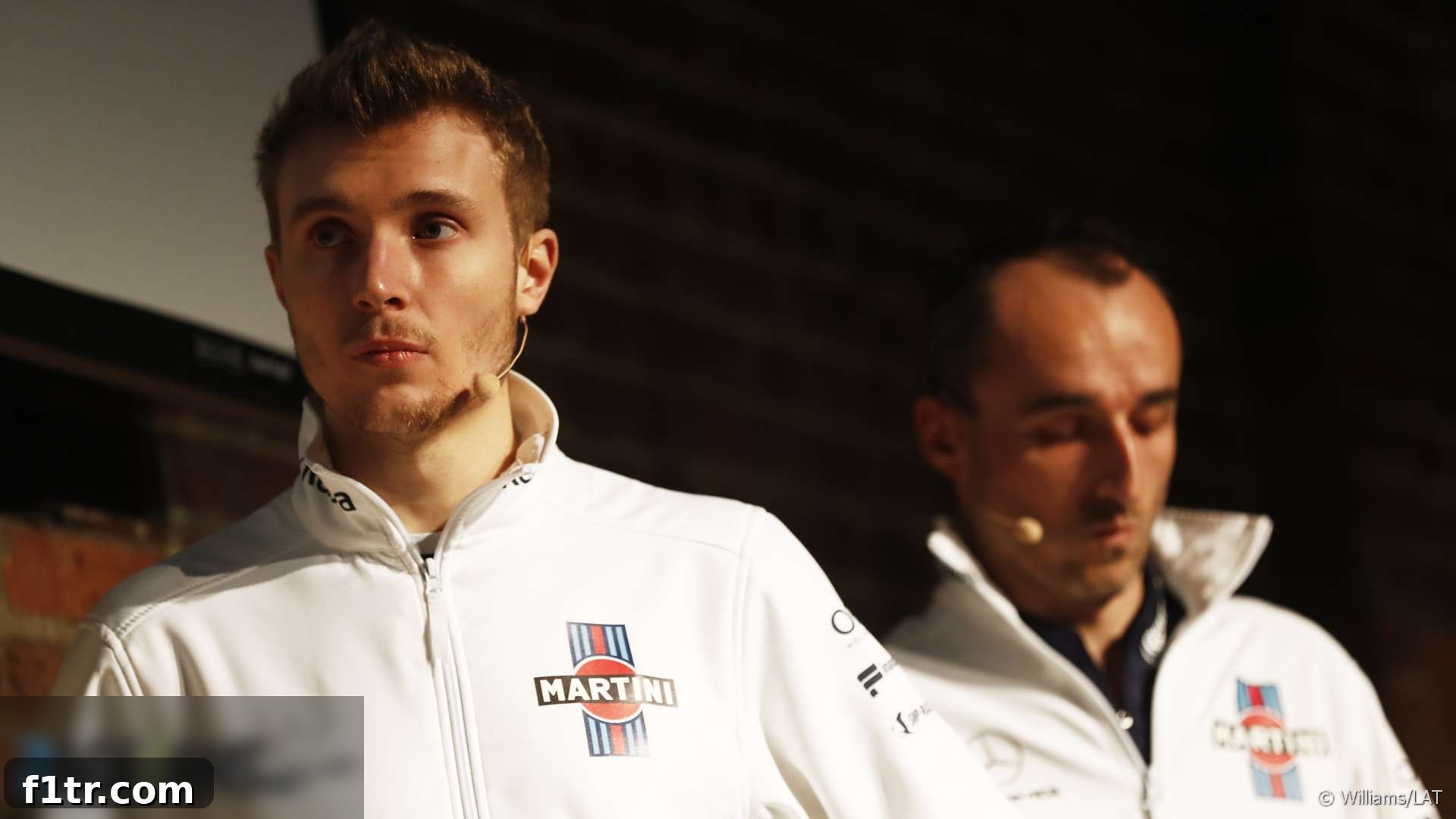
Williams Affirms Sirotkin’s Selection: Merit Prevails in F1 Driver Choice Amidst Financial Realities
In a bold statement that directly addressed persistent speculation surrounding driver appointments in Formula 1, Williams Chief Technical Officer Paddy Lowe unequivocally declared that the team’s new driver, Sergey Sirotkin, was chosen exclusively for his exceptional driving ability and not due to any financial contributions he might bring to the team. This assertion was made during the eagerly anticipated presentation of the team’s new challenger, the FW41, signaling a strong commitment from Williams to pure performance and talent.
Lowe’s remarks highlighted the rigorous and unprecedented nature of the selection process that ultimately led to Sirotkin’s recruitment. Speaking with conviction at yesterday’s FW41 launch event, Lowe described the exhaustive evaluation as “incredibly exhaustive” and “the most exhaustive I’ve ever been involved with,” emphasizing the deep involvement of the technical team in every step. This meticulous approach underscores Williams’ dedication to making data-driven decisions, particularly when it comes to securing the crucial talent behind the wheel.
A Data-Driven Decision: Pure Merit at the Core
“Sergey was selected simply on merit for his driving,” Lowe stated emphatically, leaving no room for ambiguity. He further clarified the independence of the technical evaluation, explaining, “That team know nothing about finances, they’re not involved in it, they weren’t aware of any factors like that. They made the call themselves on the data.” This crucial distinction aims to reassure fans and critics alike that despite the commercial realities of modern Formula 1, the ultimate decision-making process for a driver’s seat at Williams remains firmly rooted in objective performance metrics and technical aptitude.
The emphasis on a purely merit-based selection process is particularly significant for Williams, a team with a rich history and an enduring legacy in Formula 1. In an era where financial backing often plays a visible role in driver placements, Williams’ insistence on separating the technical assessment from commercial considerations reinforces their commitment to sporting integrity. For the technical team, evaluating potential drivers involves meticulous analysis of simulator performance, junior category race data, raw speed, consistency, feedback quality, and adaptation skills – all factors that contribute to a comprehensive profile of a driver’s inherent talent and potential to succeed at the pinnacle of motorsport.
The Unsung Giant: Sergey Sirotkin and the SMP Racing Programme
Sirotkin’s journey to Formula 1, according to Lowe, is a testament to his talent and the efficacy of the extensive SMP Racing program, a driver development scheme from which he emerged. Lowe took the opportunity to shed light on this impressive, yet often understated, initiative. “This is not talked about a lot but Sergey comes out of the SMP racing programme,” Lowe explained. “This is a kind of driver academy and if you look at the scale of it, it covers Russia, Eastern Europe and Scandinavia, drawing drivers from all of that geography.” This broad reach ensures a vast pool of raw talent, identifying and nurturing promising young racers from a very early age.
The scale of the SMP Racing program is truly remarkable and often overlooked in comparison to more publicly known academies. Lowe highlighted its immense size: “They have 1,500 drivers on their books at the moment starting from a very young age in karting. A great programme and much bigger than the likes of the one Red Bull run which is better known.” This comparison serves to underscore the profound depth and rigorous structure of SMP Racing, which systematically guides drivers through the various tiers of motorsport. From the foundational stages of karting, through the intense competition of junior formulas, SMP Racing provides comprehensive support, training, and strategic career progression, ensuring that its graduates are thoroughly prepared for the challenges of professional racing.
A Full Apprenticeship: Sirotkin’s Readiness for Formula 1
Sergey Sirotkin stands as a prime example of SMP Racing’s success, being the first graduate of this monumental program to reach Formula 1. Lowe underscored the completeness of Sirotkin’s preparation: “Sergey is the first graduate of that programme to get to Formula One and he’s done his full apprenticeship in F3, F2.” This extensive background in the feeder series, specifically in the highly competitive F3 and F2 championships, equipped Sirotkin with invaluable experience in high-performance single-seaters, complex race strategies, and high-pressure situations. His progression through these crucial stepping stones means he arrives in F1 not as a novice, but as a seasoned professional who understands the demands of top-tier motorsport.
The thoroughness of his apprenticeship is a critical factor in Williams’ confidence. A driver who has completed the full F3 and F2 journey has developed the race craft, technical understanding, and mental fortitude necessary to adapt quickly to the extreme demands of a Formula 1 car and the unique environment of Grand Prix racing. Lowe expressed profound optimism regarding Sirotkin’s immediate impact: “So I think that he couldn’t be in better shape to hit the ground running as a new driver in Formula One and we have no concerns about how well he’ll perform.” This sentiment reflects the team’s conviction that Sirotkin possesses the inherent talent and comprehensive training required to contribute effectively from his very first race.
Navigating the ‘Pay Driver’ Narrative: Williams’ Perspective
The conversation around “pay drivers” in Formula 1 is a perennial one, often sparking debates among fans and pundits. Williams’ firm stance on Sirotkin’s merit-based selection directly confronts this narrative. While F1 undeniably operates within a commercial ecosystem where financial partnerships are vital for team sustainability, Lowe’s separation of technical assessment from monetary influence is a critical differentiator. It acknowledges that commercial agreements might exist, but stresses that they do not dictate the ultimate choice of who drives the car. For Williams, especially as an independent constructor, securing talent that can consistently deliver performance on track is paramount for both sporting success and long-term viability.
The label of “pay driver” often carries a negative connotation, implying a lack of skill or an undeserved place in the sport. However, many drivers who bring sponsorship also possess immense talent, using commercial backing as a means to achieve their racing dreams rather than a substitute for ability. Williams’ detailed selection process for Sirotkin aims to demonstrate that even if commercial partners are involved, the final decision is underpinned by rigorous, objective performance analysis. Lowe’s assertion that “complaints about ‘pay drivers’ are ‘incredibly naive'” suggests an understanding of the complex financial realities of F1, where external funding can be crucial, but an insistence that talent must always be the ultimate qualifier for a seat in their car.
Williams’ Vision and Sirotkin’s Future Impact
With Sirotkin’s arrival, Williams is clearly signaling its intent to invest in genuine talent identified through systematic evaluation. The team, steeped in a history of champion drivers, aims to nurture his potential and integrate him seamlessly into their technical setup. The launch of the FW41, coupled with Lowe’s statements, marks a pivotal moment for Williams as they look to build a competitive package for the season ahead. The team’s expectation is that Sirotkin’s diligent preparation and natural ability will enable him to quickly adapt to the demands of Formula 1, providing valuable feedback and contributing to the team’s development trajectory.
Ultimately, the performance on track will be the definitive measure of this strategic driver selection. Williams is betting on Sirotkin’s pure talent and comprehensive training to deliver results, validating their “incredibly exhaustive” process. As the 2018 Formula 1 season unfolds, all eyes will be on Sergey Sirotkin to demonstrate the merit that Williams so confidently believes in, cementing his place in the sport and justifying the team’s unwavering commitment to selecting drivers based on skill, not on the size of their sponsorship portfolio.
Go ad-free for just £1 per month>> Find out more and sign up
2018 F1 Season Insights
Explore more articles related to the 2018 Formula 1 season and its key developments:
- F1 feared “death knell” for Drive to Survive after Ferrari and Mercedes snub
- McLaren staff told us we were “totally crazy” to take Honda engines in 2018 – Tost
- ‘It doesn’t matter if we start last’: How Red Bull’s junior team aided Honda’s leap forward
- Honda’s jet division helped F1 engineers solve power unit problem
- McLaren Racing losses rise after Honda split
Browse all 2018 F1 season articles