The 2021 Formula 1 season delivered one of the most dramatic and controversial conclusions in the sport’s history, culminating in a fierce legal battle that extended well beyond the chequered flag of the Abu Dhabi Grand Prix. The destiny of the World Drivers’ Championship hung in the balance as Mercedes-AMG Petronas F1 Team prepared to appeal against the stewards’ decision, which had dismissed their protest aimed at altering the race result. This unprecedented situation cast a long shadow over what should have been a triumphant end to an extraordinary season.
The saga began immediately after the race, where Red Bull Racing’s Max Verstappen claimed a stunning victory, snatching the drivers’ championship from Mercedes’ Lewis Hamilton on the very last lap. This came after a highly contentious Safety Car period and subsequent restart, which ignited a firestorm of debate and prompted Mercedes’ immediate challenge to the official results.
Mercedes lodged two protests with the FIA (Fédération Internationale de l’Automobile) stewards following the race. The primary protest focused on the handling of the last-lap restart, specifically alleging non-compliance with multiple aspects of the Formula 1 Sporting Regulations. They argued that the procedures followed by Race Director Michael Masi regarding lapped cars under Safety Car conditions were not correctly applied. Their request was clear: amend the classification of the race to reflect the standings at the penultimate lap, before the track returned to green and Verstappen made his decisive pass.
This protest, central to the championship’s legitimacy in Mercedes’ eyes, was rejected by the stewards four-and-a-half hours after the race had concluded. However, Mercedes swiftly announced their intent to escalate the matter. A spokesperson confirmed, “We have lodged our intention to appeal document 58, the decision of the stewards to dismiss the team’s protest.” This move signaled that the battle for the championship was far from over and would now proceed through the complex legal channels of international motorsport.
The Epic Season-Long Battle Leading to Abu Dhabi
The 2021 Formula 1 season was a truly captivating spectacle, featuring an intense, season-long rivalry between two titans of the sport: seven-time world champion Lewis Hamilton and the prodigious challenger, Max Verstappen. Their battle for supremacy was relentless, characterized by wheel-to-wheel racing, tactical masterstrokes, and occasional controversial clashes. Entering the final race of the season, the Abu Dhabi Grand Prix, both drivers were tied on an astonishing 369.5 points, setting the stage for a winner-takes-all showdown that promised unparalleled drama. The anticipation was palpable, with fans and pundits alike bracing for a historic conclusion to a truly unforgettable championship year.
Throughout the season, the rivalry between Hamilton and Verstappen transcended mere competition; it became a narrative of generational talent versus established greatness. Each race saw shifts in momentum, with both drivers showcasing incredible skill, resilience, and an unyielding will to win. Mercedes and Red Bull Racing, their respective teams, were equally embroiled in a constructors’ championship fight, adding another layer of strategic depth and pressure. The cumulative tension of 21 preceding races, often punctuated by fiercely debated incidents, all converged on the Yas Marina Circuit, making the final grand prix not just a race, but a definitive battleground for sporting immortality.
The Controversial Climax: Abu Dhabi Grand Prix’s Final Laps
The Abu Dhabi Grand Prix itself was a masterclass from Lewis Hamilton for the majority of its duration. Starting from second on the grid, Hamilton quickly overtook pole-sitter Max Verstappen and maintained a commanding lead for much of the race, seemingly cruising towards a record-breaking eighth world title. Verstappen and Red Bull tried various strategies to close the gap, but Hamilton’s pace and Mercedes’ strategy kept him firmly in control, minimizing any threat.
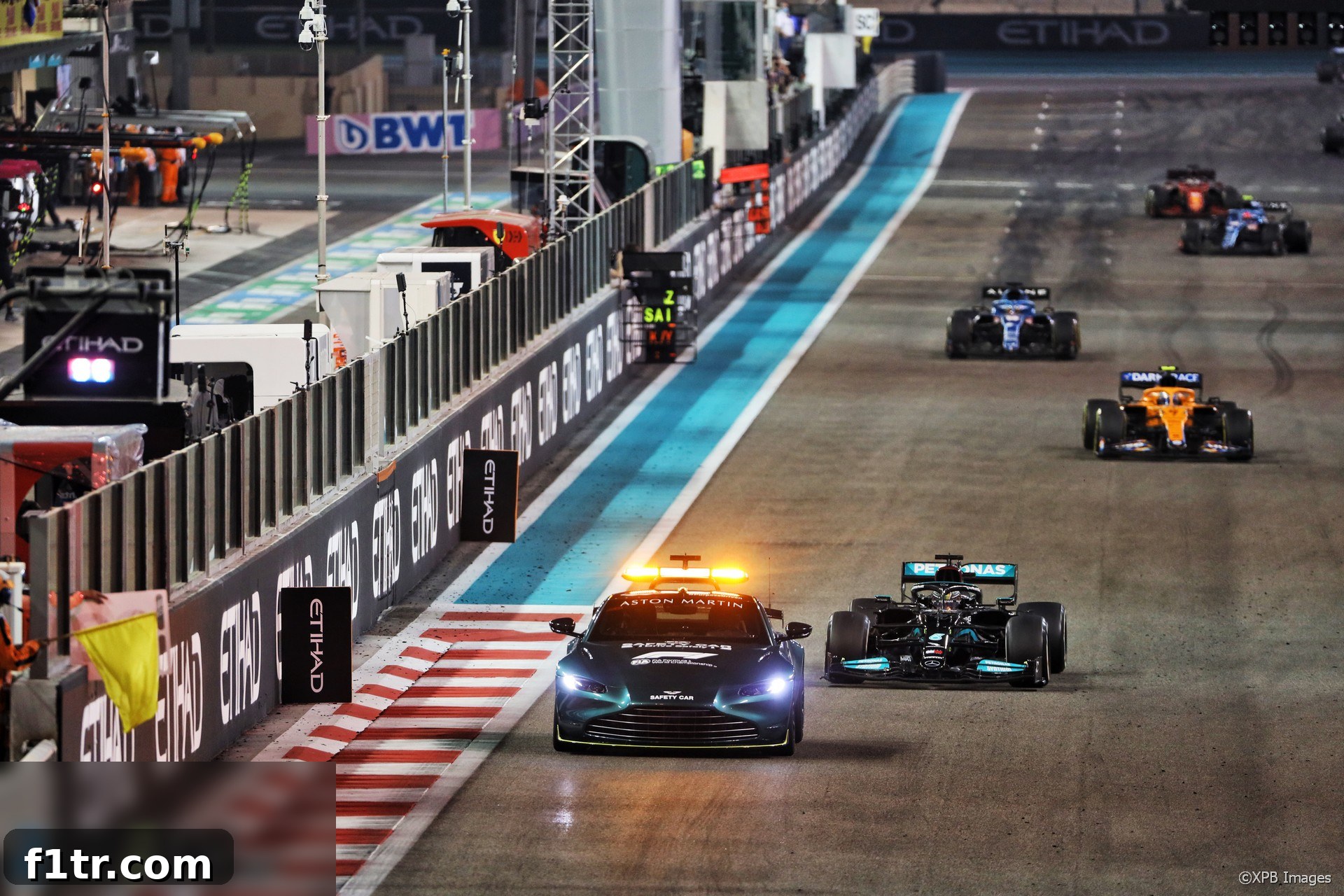
However, the race took a dramatic and unforeseen turn in the closing stages. With just five laps remaining, Nicholas Latifi’s Williams crashed into the barrier, prompting the deployment of the Safety Car. This incident fundamentally reshaped the race, neutralizing Hamilton’s comfortable lead and bringing Verstappen, who had pitted for fresh soft tires, directly onto Hamilton’s gearbox. Hamilton, on much older hard tires, suddenly found himself in a precarious position.
What followed was a sequence of decisions by Race Director Michael Masi that plunged the sport into controversy. Initially, Masi instructed that lapped cars would not be permitted to unlap themselves. This decision would have protected Hamilton’s lead, as several lapped cars separated him from Verstappen. However, moments later, Masi issued a revised instruction, stating that “any” lapped cars between Hamilton and Verstappen would be allowed to unlap themselves. Crucially, this applied only to five specific cars, and not all lapped cars as mandated by Article 48.12 of the Sporting Regulations. The remaining lapped cars, those behind Verstappen, were instructed to stay put.
The decision to selectively allow only certain lapped cars to unlap, combined with the timing of the Safety Car withdrawal, sparked immediate outrage from Mercedes. The Safety Car was then brought in at the end of the penultimate lap, leaving just one racing lap. This put Verstappen, on brand-new soft tires, directly behind Hamilton, who was on worn hard tires, for a single, decisive lap. Verstappen capitalized on his superior grip and momentum, expertly overtaking Hamilton into Turn 5 to clinch the race victory and, with it, his maiden World Drivers’ Championship.
Mercedes’ Protests: The Heart of the Legal Challenge
Following the tumultuous end to the Abu Dhabi Grand Prix, Mercedes immediately launched two formal protests against the race outcome. Their primary and most significant challenge focused on what they perceived as a clear violation of Article 48.12 of the FIA Formula 1 Sporting Regulations. This rule explicitly states that “any cars that have been lapped by the leader will be required to pass the cars on the lead lap and the Safety Car.” Mercedes argued that the Race Director’s decision to allow only a specific subset of lapped cars (those between Hamilton and Verstappen) to unlap themselves, rather than all lapped cars, directly contravened this regulation. Furthermore, they contended that the Safety Car was brought in one lap too early, as the regulations also stipulate that the race should restart at the end of the following lap after lapped cars have unlapped themselves. By deviating from this prescribed procedure, Mercedes claimed the sporting integrity of the final lap was compromised, creating an unfair advantage for Verstappen.
The team’s secondary protest addressed Article 48.8, which prohibits cars from overtaking under Safety Car conditions. Mercedes alleged that Max Verstappen had momentarily pulled ahead of Lewis Hamilton while the Safety Car was still deployed before the restart. While this infraction, if proven, typically results in a time penalty, it was the more minor of the two protests and would not have altered the championship outcome given the circumstances. It primarily aimed to establish a pattern of questionable decisions and highlight the perceived leniency towards Red Bull Racing. Mercedes’ determination to pursue these legal avenues underscored their belief that the race director’s actions had fundamentally manipulated the sporting conclusion of the championship.
The Stewards’ Verdict and Mercedes’ Immediate Appeal Intent
The FIA stewards convened for several hours after the race, meticulously reviewing telemetry, radio communications, and the relevant sporting regulations. Ultimately, they dismissed both of Mercedes’ protests. In their ruling regarding the Article 48.12 protest (concerning the unlapping procedure and Safety Car restart), the stewards acknowledged the complexities of the situation and cited Article 15.3 of the Sporting Regulations. This article grants the Race Director “overriding authority” in matters of Safety Car deployment and removal, suggesting a degree of discretionary power in unusual circumstances. The stewards effectively interpreted Masi’s actions as an exercise of this overriding authority, aimed at ensuring a racing finish rather than ending the championship under a Safety Car. They also noted that while the regulation stated “any cars” that have been lapped, it didn’t explicitly state “all cars,” leaving room for interpretation regarding the selective unlapping.
The second protest, concerning Verstappen’s alleged overtaking under Safety Car conditions (Article 48.8), was also dismissed. The stewards concluded that while Verstappen might have momentarily moved slightly ahead of Hamilton, he immediately corrected his position and did not gain a lasting advantage. This was deemed a minor and unintentional transgression, not warranting a penalty that would impact the outcome.
Despite the stewards’ explanations, Mercedes remained resolute in their conviction that the regulations were not correctly applied. Within an hour of the stewards’ decision, Mercedes confirmed their intention to appeal. This formal notification was lodged under Article 15 of the International Sporting Code, which governs the appeals process within the FIA, and Article 10 of the Judiciary and Disciplinary Rules. This signifies a move to the International Court of Appeal (ICA), a higher tribunal within the FIA’s judicial system, indicating that Mercedes was prepared for a prolonged legal battle to protect what they believed was a rightful championship for Lewis Hamilton.
Implications and the Road Ahead for Formula 1
The decision by Mercedes to appeal the stewards’ ruling had profound implications, extending far beyond the immediate outcome of the 2021 World Drivers’ Championship. It plunged Formula 1 into an unprecedented legal quagmire, challenging the very credibility and sporting integrity of the pinnacle of motorsport. The prospect of the championship being decided in a courtroom rather than on the racetrack ignited a global debate among fans, pundits, and participants about the consistency of officiating, the clarity of regulations, and the discretionary power of the Race Director.
An appeal to the International Court of Appeal (ICA) is a serious undertaking, demanding meticulous legal preparation and presenting compelling arguments to overturn a stewards’ decision. While historically rare for championship results to be altered post-race via appeal, the unique circumstances of the Abu Dhabi Grand Prix, particularly the perceived arbitrary application of Safety Car rules, gave Mercedes grounds for optimism. The potential outcomes were varied: the ICA could uphold the stewards’ decision, dismiss the appeal, or, in a highly unlikely but theoretically possible scenario, overturn the race result, potentially awarding the championship to Hamilton. Even if the championship result remained unchanged, a successful appeal could lead to significant financial penalties for the FIA or, more importantly, a fundamental re-evaluation and clarification of Formula 1’s sporting regulations and officiating protocols.
The aftermath of this controversy also brought Michael Masi’s role as Race Director under intense scrutiny, prompting widespread calls for reforms in race management to ensure greater transparency and consistency. The incident highlighted the immense pressure on individuals making split-second decisions with championship implications and underscored the need for robust, unambiguous rules that leave little room for subjective interpretation. The entire saga served as a stark reminder that even in a sport defined by speed and technology, human judgment and the application of rules remain paramount, dictating not just race outcomes but also the public’s perception of fairness and justice.
Lingering Uncertainty and the Future of Sporting Regulations
As Mercedes pursued its appeal, the shadow of uncertainty lingered over the triumphant celebrations of Max Verstappen and Red Bull Racing. The unprecedented nature of the legal challenge meant that the final resolution could take weeks, prolonging the tension and debate that had characterized the entire season. The case was poised to become a landmark moment for Formula 1, with the outcome having the potential to set new precedents for how regulations are interpreted and enforced in high-stakes sporting competitions.
Regardless of the final verdict, the 2021 Abu Dhabi Grand Prix sparked crucial conversations within the FIA and Formula 1 management about the need for clearer, more robust sporting regulations and enhanced training for race officials. The controversy underscored the importance of ensuring that the rules are applied consistently and transparently, leaving no room for ambiguity that could undermine the integrity of the sport. Moving forward, the focus was firmly on learning from this experience to safeguard Formula 1’s future, ensuring that championship battles are decided purely on merit and sporting prowess, free from the shadow of procedural disputes.
The 2021 season will forever be etched in motorsport history, not just for the exhilarating rivalry between Hamilton and Verstappen, but also for the dramatic and legally contentious conclusion that tested the very fabric of Formula 1’s governance. The appeal by Mercedes sought not only to rectify what they perceived as an injustice but also to instigate a necessary evolution in how the sport is officiated, aiming for a future where such controversies can be avoided, and the focus remains squarely on the thrilling competition on track.
Follow RaceFans for the Latest F1 News and Analysis
- Join RaceFans on Facebook
- Follow RaceFans on Twitter
- Get daily email updates from RaceFans
Explore More on the 2021 Abu Dhabi Grand Prix Controversy
- Masi ‘basically gifted the championship’ to Verstappen says 2021 FIA steward Sullivan
- Norris called out F1 over its farcical 2021 finale. Will it get it right this time?
- Why Mercedes put ‘a reminder of joy and pain’ on display in their factory lobby
- Hamilton would be an eight-time champion if Whiting was still alive – Steiner
- Verdict on error in GT race suggests Mercedes would have lost 2021 Abu Dhabi GP appeal
Browse all 2021 Abu Dhabi Grand Prix articles