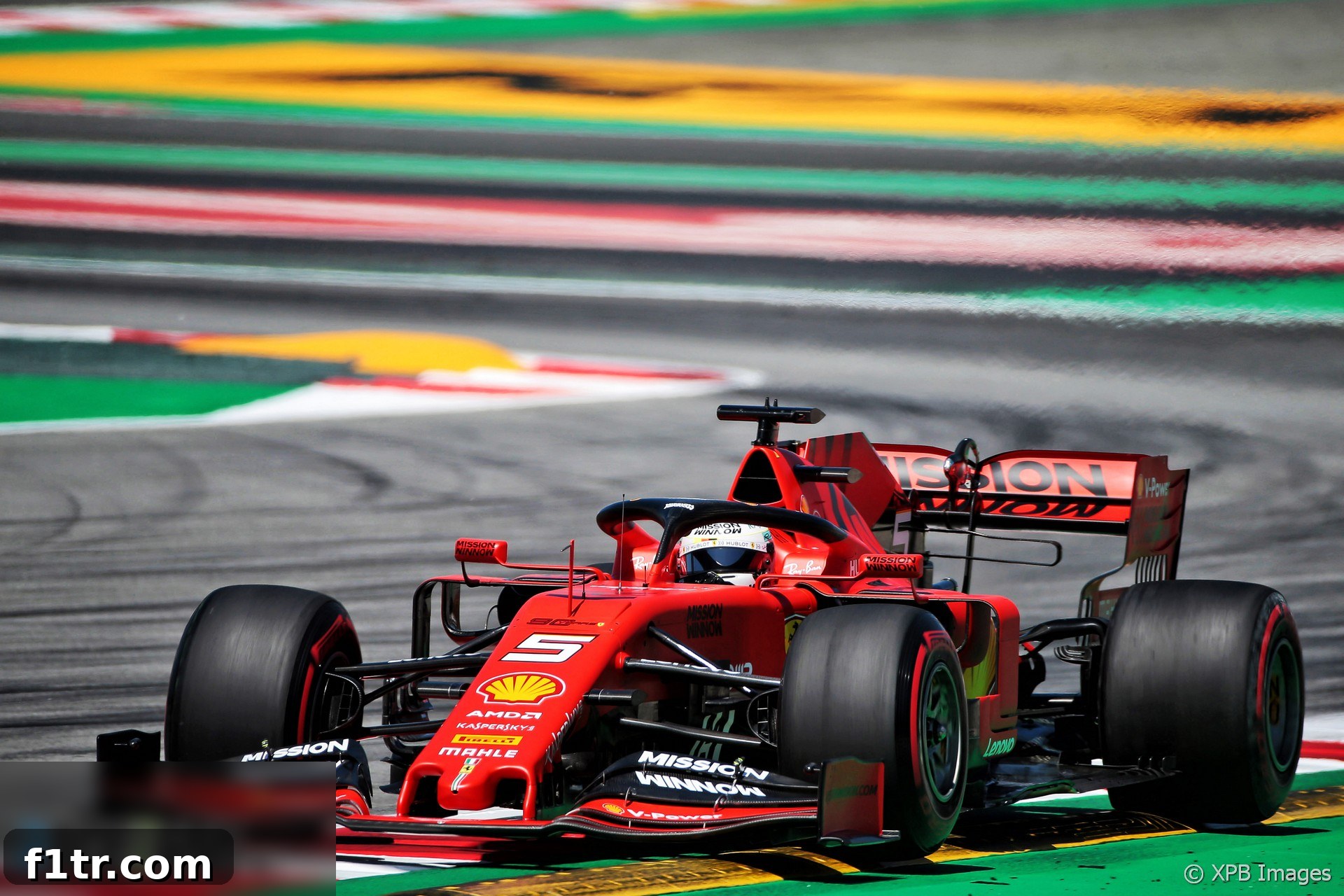
The legendary Scuderia Ferrari, a team synonymous with speed and unparalleled legacy in Formula 1, found itself grappling with a significant challenge during the 2019 season. As the competitive landscape heated up at the Circuit de Catalunya, a critical issue began to emerge: the SF90’s pronounced struggle with performance in slower corners. This vulnerability became particularly glaring in the final sector of the Spanish circuit, a segment characterized by its demanding low-speed chicane. Sebastian Vettel, one of Ferrari’s star drivers, openly acknowledged this deficit, highlighting a recurring problem that hampered the team’s quest for top honors.
During the race weekend at Catalunya, both Ferrari drivers consistently ceded approximately four-tenths of a second to their Mercedes counterparts in the crucial final section of the lap. This seemingly small margin translates to a considerable disadvantage in Formula 1, where milliseconds often define the difference between victory and defeat. The chicane, a sequence of tight, low-speed turns, exposed a fundamental weakness in the SF90’s chassis and aerodynamic package at reduced speeds.
Advert | Become a Supporter & go ad-free
Despite Ferrari introducing a series of upgrades for the Spanish Grand Prix, including a refreshed engine specification and new aerodynamic components, Vettel’s assessment pointed to deeper-seated issues. While the engine improvements were a welcome addition, seemingly boosting the car’s straight-line speed, they couldn’t entirely mask the underlying deficiencies in slow-corner performance. “Engine-wise, I think we’re happy,” Vettel commented, reflecting a sense of optimism regarding the power unit’s progression. However, he quickly tempered this enthusiasm with a pragmatic view of the overall package: “Car-wise, I think we put everything on the car that we expected to put on. Feeling-wise, it’s a different story, and I think it’s a fair picture that we haven’t been the quickest today.” This statement underscored the disconnect between theoretical performance gains and the tactile experience for the driver, a crucial aspect in extracting maximum pace from an F1 machine.
The German four-time world champion articulated the frustration stemming from this persistent flaw. “It’s not the first time this year that we are losing in these sort of corners,” he admitted, acknowledging a pattern of underperformance that had plagued Ferrari throughout the early stages of the 2019 season. The difficulty, he explained, lay in diagnosing and rectifying the issue. “If it was easy, we would just fix it. But currently, we are working very hard and trying still to understand why we are losing out in these type of corners, sometimes more than other times. We’ll see where we will be tomorrow.” His words painted a vivid picture of the relentless analytical work undertaken by F1 teams, emphasizing that not all problems have straightforward solutions.
Delving into the technical specifics, Vettel clarified that the problem wasn’t merely a matter of traction, but a more comprehensive lack of overall grip in slow-speed scenarios. “It’s not really traction; I think it’s just overall grip in slow corners,” he explained. This distinction is critical in Formula 1 engineering. Traction refers primarily to the car’s ability to transfer power to the track without wheelspin, crucial during acceleration out of corners. Grip, however, encompasses the total adhesion between the tires and the track surface, influencing a car’s stability, braking, and cornering speed. A deficiency in overall grip at slow speeds suggests issues with the car’s mechanical setup, low-speed aerodynamic downforce generation, or tire performance under specific loading conditions. As Vettel aptly put it, “Obviously, slow corners can be quite nasty: if you don’t have the grip, then you lose quite a lot of time.” This deficit compounds over a lap, making it exceedingly difficult to challenge rivals who excel in these areas.
Ironically, Vettel’s initial impressions of the SF90 during pre-season testing at the very same Circuit de Catalunya had been overwhelmingly positive. He had expressed significant satisfaction with the car’s handling and potential, a sentiment that contrasted sharply with his mid-season reflections. “Obviously had a very good impression in the first winter testing, not so good after that,” he noted, highlighting the divergent trajectory of his comfort level with the machine. This shift often occurs in F1 as development progresses, and new parts are introduced. While the car had undoubtedly gained performance since testing – with Ferrari having brought “quite some pieces on the car and quite some performance” – this improvement hadn’t translated into a harmonious balance that instilled confidence in the driver. “In terms of feeling, that’s I think what we struggle with, what I struggle with,” Vettel elaborated, pointing to the crucial subjective element of driver feedback and car feel. A car might be objectively faster on paper or in simulations, but if a driver cannot feel confident pushing it to the limit, the ultimate lap time suffers.
The challenge for Ferrari extended beyond mere numbers; it delved into the complex interplay between mechanical grip, aerodynamic efficiency at varying speeds, and the car’s overall dynamic balance. In slow corners, mechanical grip derived from suspension geometry, tire contact patch, and weight distribution becomes paramount, as aerodynamic downforce generated by the wings and floor diminishes significantly at lower velocities. If the car’s chassis is not generating sufficient mechanical grip, or if the suspension setup is too stiff or too soft for these critical sections, the driver will struggle with understeer or oversteer, forcing them to reduce speed and compromise their exit. This not only loses time in the corner itself but also negatively impacts the acceleration onto the subsequent straight, creating a compounding effect on lap time.
Moreover, the subtle art of car balance is key to a driver’s confidence. Vettel’s struggle with the “feeling” of the car indicates that even with performance upgrades, the car was not behaving predictably or responsively enough through these demanding sections. This might involve a lack of front-end bite on turn-in, or an unstable rear-end on exit, forcing the driver to manage the car rather than attack the corner. In an era where marginal gains dictate success, such inconsistencies can be the difference between pole position and a mid-pack grid slot. The Barcelona circuit, with its diverse range of corners, from high-speed sweeps to the notorious final chicane, is often considered a true test of a car’s all-round capability, making Ferrari’s struggle there particularly concerning.
The team’s extensive efforts in the background, encompassing factory simulations, wind tunnel tests, and countless hours of data analysis, were all geared towards unlocking this elusive performance. Yet, the track remained the ultimate arbiter, revealing nuances that weren’t always apparent in the controlled environments of engineering suites. The iterative process of Formula 1 development means that a solution isn’t always immediate; it often requires a fundamental understanding of the root cause, which can be elusive given the myriad variables at play in a complex racing car. Ferrari’s battle with its SF90’s slow-corner performance in 2019 underscored the immense technical challenges inherent in Grand Prix racing and the razor-thin margins that separate the best from the rest. The ongoing pursuit of that perfect balance, that elusive “feeling” for the driver, remains a testament to the relentless innovation and problem-solving at the heart of Formula 1.
Advert | Become a RaceFans supporter andgo ad-free
2019 F1 season
- Crying in the Melbourne car park at 2019 grand prix was my career low – Ocon
- McLaren Racing reports reduced £71 million loss in 2019
- Kvyat: Hockenheim podium last year was “my biggest achievement” so far
- How the FIA’s new encrypted fuel flow meter targets Ferrari’s suspected ‘aliasing’ trick
- “He smashed my office door”: 23 must-see moments from ‘Drive to Survive’ season two
Browse all 2019 F1 season articles