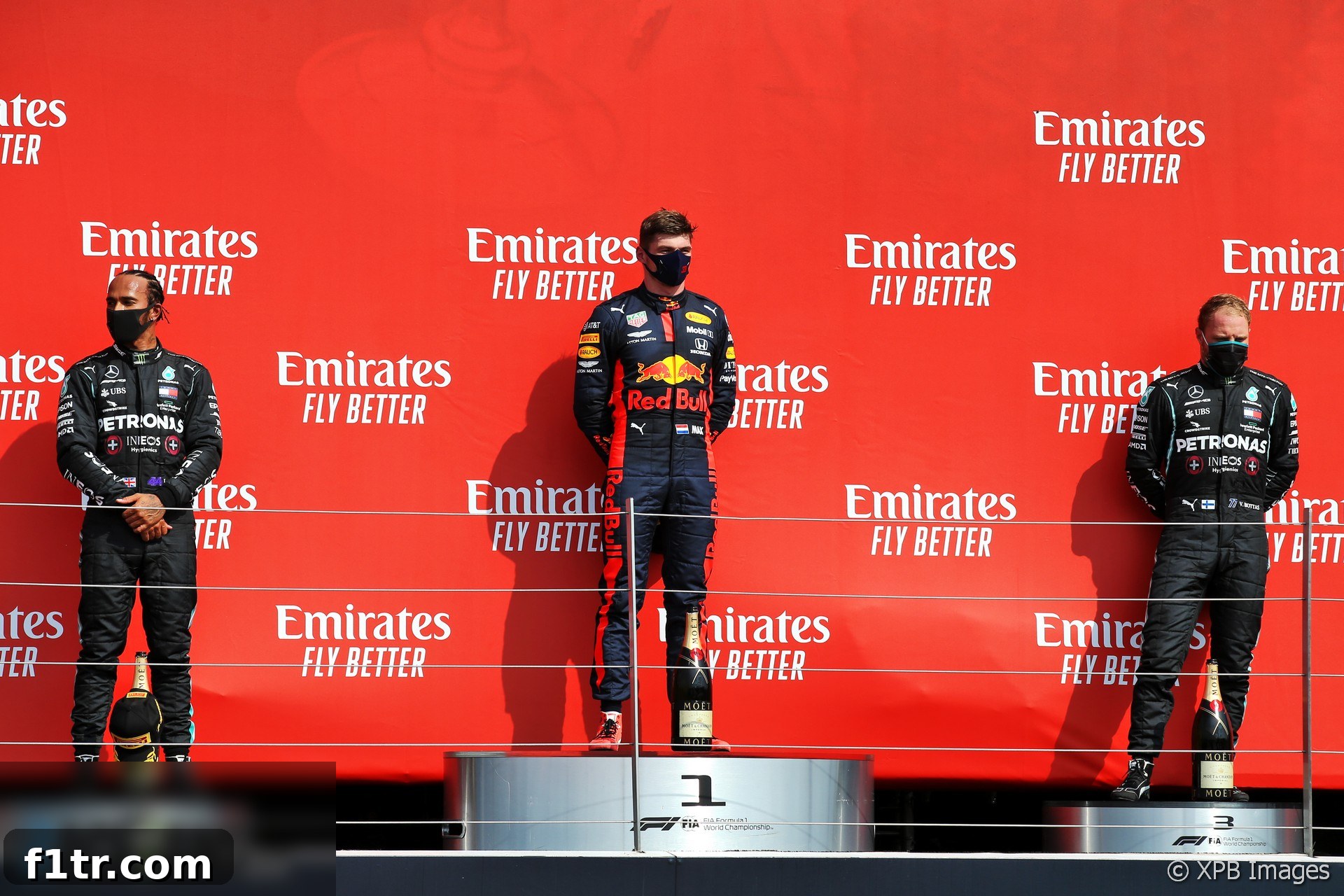
The 70th Anniversary Grand Prix at Silverstone served up a captivating spectacle, breaking Mercedes’ dominant streak and crowning an unexpected victor in Max Verstappen. From a seemingly disadvantageous fourth position on the grid, the Red Bull Racing star executed a masterful performance, blending audacious strategy with formidable driving to seize victory from the reigning champions. This unique race, held a week after the British Grand Prix at the very same iconic circuit, presented a fresh set of challenges, particularly concerning tyre degradation, which ultimately proved to be Mercedes’ Achilles’ heel and Verstappen’s golden opportunity.
Verstappen’s Strategic Masterclass: A Hard Tyre Gamble Pays Off
The foundation of Verstappen’s triumph was laid not on race day, but during Saturday’s qualifying session. In a bold strategic move that raised eyebrows across the paddock, Red Bull opted to send Max Verstappen out on hard compound tyres in Q2. This decision was a calculated risk; while it made qualifying into Q3 more challenging, it allowed Verstappen to start the race on the more durable hard tyres, contrasting sharply with the medium compounds chosen by the Mercedes duo of Valtteri Bottas and Lewis Hamilton, who locked out the front row.
As the lights went out, Verstappen wasted no time, swiftly dispatching the impressive Nico Hulkenberg (who was deputizing for Sergio Pérez at Racing Point) in the opening laps. With Hulkenberg behind him, Verstappen set his sights on the black Mercedes cars ahead. Initial radio calls from his Red Bull pit wall urged caution, advising him not to push too hard or follow the Mercedes too closely to manage his tyres. However, Verstappen, sensing an inherent advantage and showing his characteristic racing instinct, was having none of it. He declared over the radio that he wasn’t “just going to sit behind” them, signaling his intent to challenge for the lead.
This defiance proved prescient. While Valtteri Bottas initially led the race, the Mercedes drivers quickly began to report significant blistering on their medium tyres. The softer compound, subjected to Silverstone’s high-speed corners and the scorching track temperatures, was simply not holding up. Verstappen, meanwhile, on his robust hard tyres, found his pace improving, closing the gap with alarming speed. He was soon breathing down Hamilton’s neck, a sight few had anticipated given Mercedes’ almost unassailable pace throughout the 2020 season. When Bottas made his first pit stop earlier than anticipated to switch to hard tyres, Verstappen found himself momentarily leading the Grand Prix, a testament to his superior tyre management and strategic brilliance.
Mercedes’ Tyre Travails and Hamilton’s Valiant Charge
The tyre blistering issues plaguing the Mercedes team were a stark reminder of Formula 1’s intricate strategic dance. Both Bottas and Hamilton suffered from extreme degradation, forcing them into earlier pit stops and compromising their race pace. Bottas, after his initial stop, found himself locked in a battle for track position, his early lead evaporating. Verstappen, after extending his first stint considerably, finally pitted, taking on medium tyres. Crucially, his extended first stint meant he had built up enough of a lead that when he emerged from the pits, he slotted directly between the two Mercedes cars, immediately passing Bottas to reclaim the lead. This was a pivotal moment, showcasing not only Verstappen’s speed but also the strategic acumen of the Red Bull pit wall.
As the race wore on, the tyre saga continued. Verstappen, having switched to mediums, was soon back in the pits, joined by Bottas, to take on a fresh set of hard tyres for the run to the finish. Hamilton, however, opted for a different approach. Despite visible and worsening blisters on his tyres, the reigning world champion chose to delay his second pit stop, stretching his stint as long as possible. This was a high-stakes gamble, trading immediate pace for potential track position and a late-race attack. When he finally pitted, taking on hard tyres, he rejoined the track with a monumental task ahead of him, needing to make up significant ground.
Hamilton’s charge in the final laps was a masterclass in aggressive driving. He quickly encountered Charles Leclerc, who was performing admirably in the Ferrari on a one-stop strategy. Despite Leclerc’s firm and commendable defensive maneuvers, Hamilton, with the grip advantage of fresh hard tyres, eventually found a way past the Monegasque driver. His next target was his teammate, Valtteri Bottas, who by this point was struggling immensely with his own tyres. The battle between the two Mercedes drivers was swift and decisive. In the DRS zone, Hamilton powered past Bottas with alarming ease on the Wellington straight, leaving his teammate powerless to defend. While Hamilton demonstrated exceptional pace in his pursuit, the gap to Verstappen was simply too large. He ultimately took the chequered flag a full 11 seconds behind the Red Bull, a clear demonstration of Verstappen’s dominance on the day and the strategic advantage his team had carved out.
Midfield Battles and Notable Incidents
Beyond the podium fight, the 70th Anniversary Grand Prix delivered plenty of action in the midfield, with several drivers and teams showcasing impressive performances and enduring moments of misfortune. The Racing Point team, featuring Nico Hulkenberg making his second appearance for the team, initially ran strongly in fourth and fifth positions. However, a differing tyre strategy saw Hulkenberg make an extra stop for soft tyres, which ultimately dropped him behind his teammate Lance Stroll, who secured a solid sixth place, and also Charles Leclerc and Alexander Albon.
Leclerc, in particular, delivered a standout performance for Ferrari. Executing a daring one-stop strategy, he managed his tyres brilliantly to finish an impressive fourth, holding off faster cars for much of the race. Alexander Albon, in the second Red Bull, also had a strong showing, recovering from a difficult qualifying to finish fifth, demonstrating improved race pace and overtaking ability. Hulkenberg, despite his extra stop, still managed a commendable seventh place, a testament to his skill after such a long break from F1.
Esteban Ocon continued his consistent run for Renault, collecting another valuable eighth place. McLaren saw Lando Norris secure ninth, adding to his strong season. However, his teammate Carlos Sainz Jnr experienced a frustrating race. After running well early on, a slow pit stop cost him crucial time and track position, relegating him outside the points. Daniil Kvyat rounded out the top ten for AlphaTauri, securing the final point.
The race was not without its share of drama and spins. Sebastian Vettel, in the other Ferrari, endured a torrid start, spinning at turn one on the very first corner of the race. Despite the setback, the four-time world champion mounted a determined recovery drive, climbing back to 12th position behind Pierre Gasly, showcasing his enduring tenacity. Ocon’s Renault teammate Daniel Ricciardo also had an incident, suffering a mid-race spin at Village, which saw him fall down the order to finish 14th, a disappointing result after a promising start.
Implications and Future Outlook
Max Verstappen’s victory at the 70th Anniversary Grand Prix was more than just another race win; it was a significant statement. It proved that Mercedes, while dominant, were not invincible, especially when faced with extreme conditions and a strategically astute rival. Red Bull Racing showcased that their car, particularly in the hands of Verstappen, had the pace and the strategic flexibility to challenge for victories. For Verstappen, it injected a much-needed shot of confidence and a glimmer of hope in a season largely dominated by Mercedes. While the championship still seemed a distant prospect, this win demonstrated that Red Bull could exploit Mercedes’ weaknesses and keep the pressure on.
For Mercedes, the race served as a crucial learning experience. Their issues with tyre blistering highlighted a vulnerability that other teams would undoubtedly seek to exploit in future races, particularly in hot conditions or on circuits with high energy loads. The contrasting strategies between Bottas and Hamilton also provided valuable data and underscored the fine margins that separate victory from second place, even within the same team. The F1 paddock left Silverstone buzzing with renewed excitement, as Verstappen’s triumph offered the tantalizing prospect of a more competitive and unpredictable season ahead, reminding everyone that in Formula 1, strategy, tyre management, and driver skill can sometimes overcome raw pace.