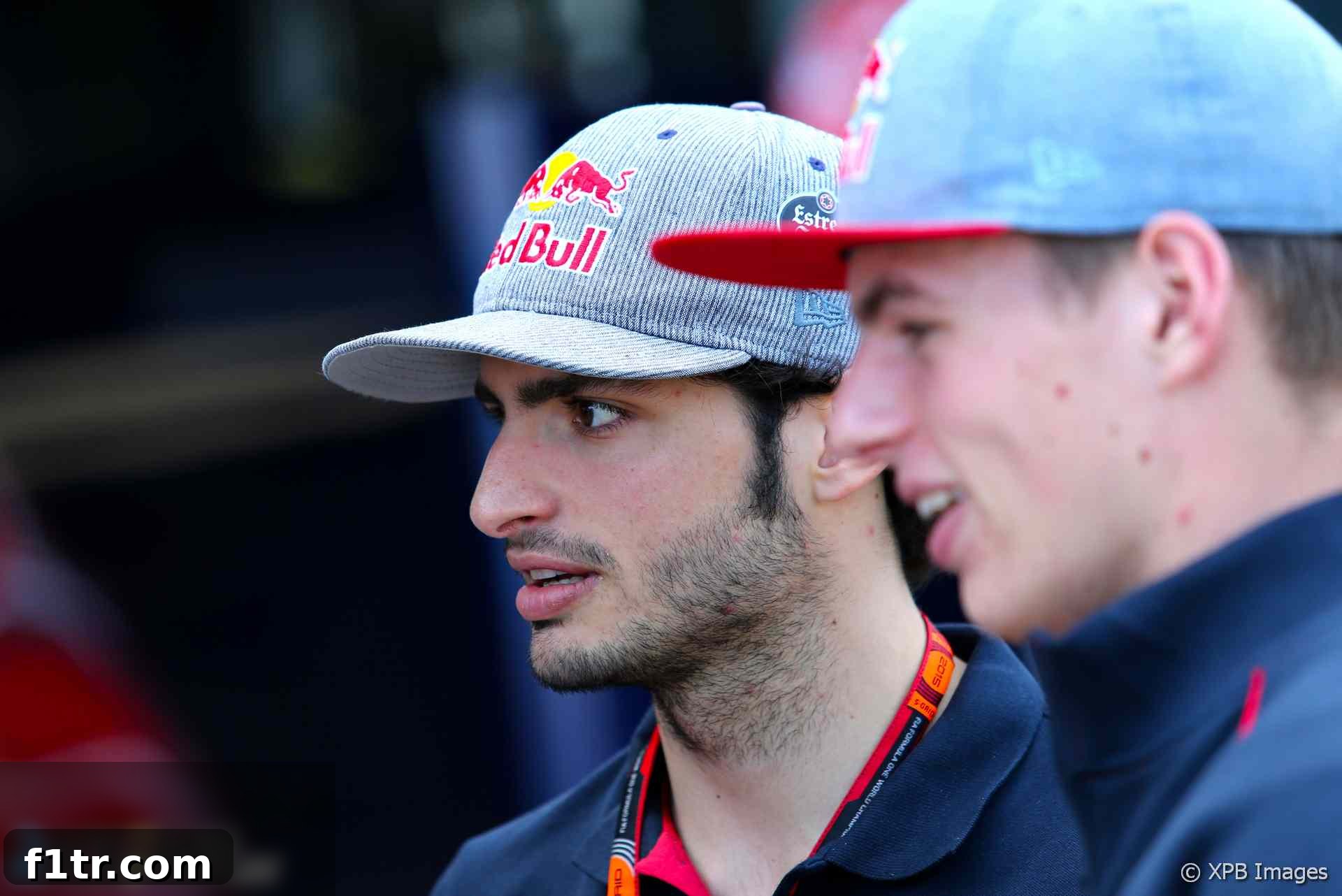
Carlos Sainz Jnr, a seasoned and highly respected driver in Formula 1, has openly expressed his lingering bewilderment regarding why he was never afforded the opportunity to join Red Bull Racing’s senior team, despite being a prominent product of their esteemed junior talent programme. His journey through the ranks of motorsport, marked by both remarkable successes and perplexing snubs, paints a vivid picture of the intense and often unpredictable world of Formula 1.
Advert | Become a Supporter & go ad-free
Advertisement Placeholder
Sainz first stepped onto the Grand Prix stage a decade ago, entering Formula 1 under the wing of Red Bull’s formidable driver development scheme. This programme, renowned for its ruthless efficiency in identifying and nurturing future champions, strategically placed him at their sister team, then known as Toro Rosso. It was there that he was paired with another prodigious talent, Max Verstappen, setting the stage for one of the sport’s most fascinating early rivalries.
The trajectory of the two young drivers, however, diverged significantly. While Verstappen, demonstrating astonishing speed and maturity, was swiftly promoted to the senior Red Bull team during only his second season in the sport, Sainz found himself repeatedly overlooked for the coveted seat. This disparity in career progression has remained a point of contention and discussion, particularly in light of Red Bull motorsport consultant Helmut Marko’s past assertion that the relationship between Sainz and Verstappen at Toro Rosso was “toxic” – a claim Sainz himself vehemently refutes.
Speaking on the High Performance podcast, Sainz offered his perspective, challenging the widely held belief regarding his dynamic with Verstappen. “This is what people have concluded or what people are trying to explain it or to understand it,” Sainz explained, addressing the narrative surrounding their early days. “The only thing I can say is that I genuinely get on well with Max.” His candid remarks highlight a disconnect between external perceptions and the reality of their professional camaraderie.
Sainz elaborated further on their formative years, acknowledging the natural competitive fire that burns between any two ambitious F1 drivers. “This is something people don’t see from the outside. We had a rivalry in our first year in Formula 1 in Toro Rosso, but it was a relatively healthy rivalry in terms of him and me, the way we used to go about racing.” He emphasized that despite the intense on-track battles and the pressure cooker environment of the Red Bull junior programme, their personal relationship remained cordial. “Now we get on really well. So, if that’s the reason [for not being promoted], I don’t understand why they wouldn’t want me next to Max because I think we would actually be a very strong pairing in Formula 1.” This statement underscores Sainz’s unwavering belief in his capabilities and his potential to contribute significantly to a top team alongside a generational talent like Verstappen.
During their time at Toro Rosso, Verstappen, with his raw speed and aggressive style, indeed scored the majority of the team’s points. However, a closer look at their performance metrics revealed that Sainz was often remarkably closely matched with his Dutch teammate – arguably more so than many of Verstappen’s subsequent partners have been against the multiple world champion. This period, competing neck-and-neck with one of the most talented drivers of his generation, instilled in Sainz a profound sense of confidence in his own speed and ability to challenge the very best in the sport. He believes this early experience served as a crucial proving ground, affirming his potential to thrive at the pinnacle of motorsport.
Advert | Become a RaceFans supporter andgo ad-free
Advertisement Placeholder
Sainz acknowledged the immense challenge of being Max Verstappen’s teammate, a role that has tested the mettle of many accomplished drivers. “I think everyone’s having a really tough time being Max’s team mate. I can only say that when I was Max’s team mate, I didn’t have this tough time.” This isn’t a boast but rather a testament to his consistent performance and mental fortitude. He openly expresses admiration for Verstappen’s undeniable talent: “I was obviously incredibly surprised with how quick he was, with how he’s an insane driver. I mean, he’s probably, he’s going to be one of the best ever in history, if he’s not already one.” Yet, Sainz draws a crucial distinction: his direct comparison with Verstappen in their debut year provided him with an invaluable benchmark. “But that first year together since then has given me the confidence to know I can be against anyone.”
This self-assuredness is not merely theoretical; it’s grounded in a career spent competing alongside an elite roster of Formula 1 talents. “I’ve been team mates with Charles [Leclerc], with Lando [Norris], with Nico Hulkenberg. Very quick guys, and probably the best in the sport. Now Alex [Albon], incredibly fast also, and just makes me want to be up against the best, still. I know I can take it, and I know that I’ve been successful in the past.” This impressive list of former teammates, each a formidable competitor in their own right, reinforces Sainz’s credentials as a top-tier driver capable of delivering results under pressure. His tenure at McLaren, where he consistently outperformed expectations, and his race-winning performance with Ferrari further solidify his standing as a highly desirable asset in the driver market.
The complexities of Formula 1’s driver market further amplified Sainz’s frustrations. Red Bull, his former patron, had a clear opportunity to bring him back into the fold last year when considering a replacement for Sergio Perez alongside Verstappen. However, despite Sainz’s proven experience and consistent form, they opted for Liam Lawson, a young talent from their junior pipeline. Lawson’s brief stint, which saw him dropped after only two races due to dissatisfaction with his performance, highlighted a decision-making process that puzzled many observers and further underscored Red Bull’s reluctance to reconsider Sainz.
Similarly, following the unexpected news of his impending departure from Ferrari to make way for Lewis Hamilton, Sainz found himself exploring options with other front-running teams, including Mercedes. “We obviously talked a lot with Toto [Wolff, CEO] at the time and everyone,” Sainz acknowledged, revealing the extent of those discussions. “I was an option for sure, I was considered. How close, I can go and ask Toto, but I think he’s very happy with Kimi [Antonelli].” The decision by Mercedes to potentially favor a rising junior talent like Kimi Antonelli, despite Sainz’s immediate availability and proven race-winning pedigree, illustrates the relentless pursuit of future stars in Formula 1 and the often-unforgiving nature of career opportunities at the very top.
Advert | Become a RaceFans supporter andgo ad-free
Advertisement Placeholder
This series of rejections from the sport’s powerhouse teams inevitably led to a period of significant introspection and disappointment for Sainz. He admitted experiencing a “low point” last year when the reality set in: the coveted opportunity to secure a front-running seat for the 2025 season was unlikely to materialize. This realization forced a pivotal shift in his career outlook and strategy.
“I understood and I told myself, ‘Carlos, that’s not happening: take the decision where you go next and what’s the shortest route to winning again, the route is going to be longer than what you thought.’” This candid reflection reveals the mental resilience required at the elite level of motorsport. Initially, following his Ferrari exit, Sainz harbored hopes of immediately transitioning to another competitive car. “Because when I went, honestly, when Ferrari didn’t renew me, I [thought] I can still be in a competitive car for ’25.” However, as the months progressed, the landscape of the F1 driver market became clearer, and his initial optimism waned. “Then it took three or four months and then there was a point where I said I’m not going to be in a race-winning car for ’25.”
This moment of stark realization, he describes as his “second lowest moment” – a profound disappointment for a driver who consistently demonstrates the talent to compete at the sharp end of the grid. Yet, true to his character, Sainz managed to turn this setback into a positive catalyst. “But then it completely changed my mindset and I managed to see it as a positive.” This shift allowed him to re-evaluate his priorities and embrace a new challenge with a different perspective.
It was Williams team principal James Vowles who ultimately succeeded in persuading Sainz to commit his future to the historic British outfit for the upcoming season. Vowles, known for his strategic vision and ability to inspire, played a crucial role in painting a compelling picture of Williams’s long-term potential and the significant role Sainz could play in their resurgence. “Williams and James were very good at selling that to me and giving me that environment to say, ‘I’m actually really looking forward to be in that environment’ and feeling loved in the right way. That’s what makes me smile now being in Williams.” This heartfelt sentiment speaks volumes about the human element in Formula 1; beyond raw speed and championship aspirations, the feeling of being valued and integrated into a supportive team environment can be a powerful motivator. For Sainz, Williams represents not just a new chapter, but an opportunity to be at the heart of a challenging yet rewarding rebuilding project, a testament to his enduring passion for the sport and his unwavering belief in his own capabilities, regardless of the team’s current standing.
Miss nothing from RaceFans
Get a daily email with all our latest stories – and nothing else. No marketing, no ads. Sign up here:
Advert | Become a RaceFans supporter andgo ad-free
Advertisement Placeholder
Formula 1
- “Overtaking is overtaking”: Domenicali denies F1’s yo-yo racing is “artificial”
- The crashes F1 is trying to prevent may be rare – but the danger is obvious
- F1 returning to India soon after 2027 sounds like wishful thinking
- Verstappen loathes F1’s new generation of cars – but what do his rivals reckon?
- The ‘throwback weekend’ is back in fashion. But it’s a flawed concept – especially for F1
Browse all Formula 1 articles