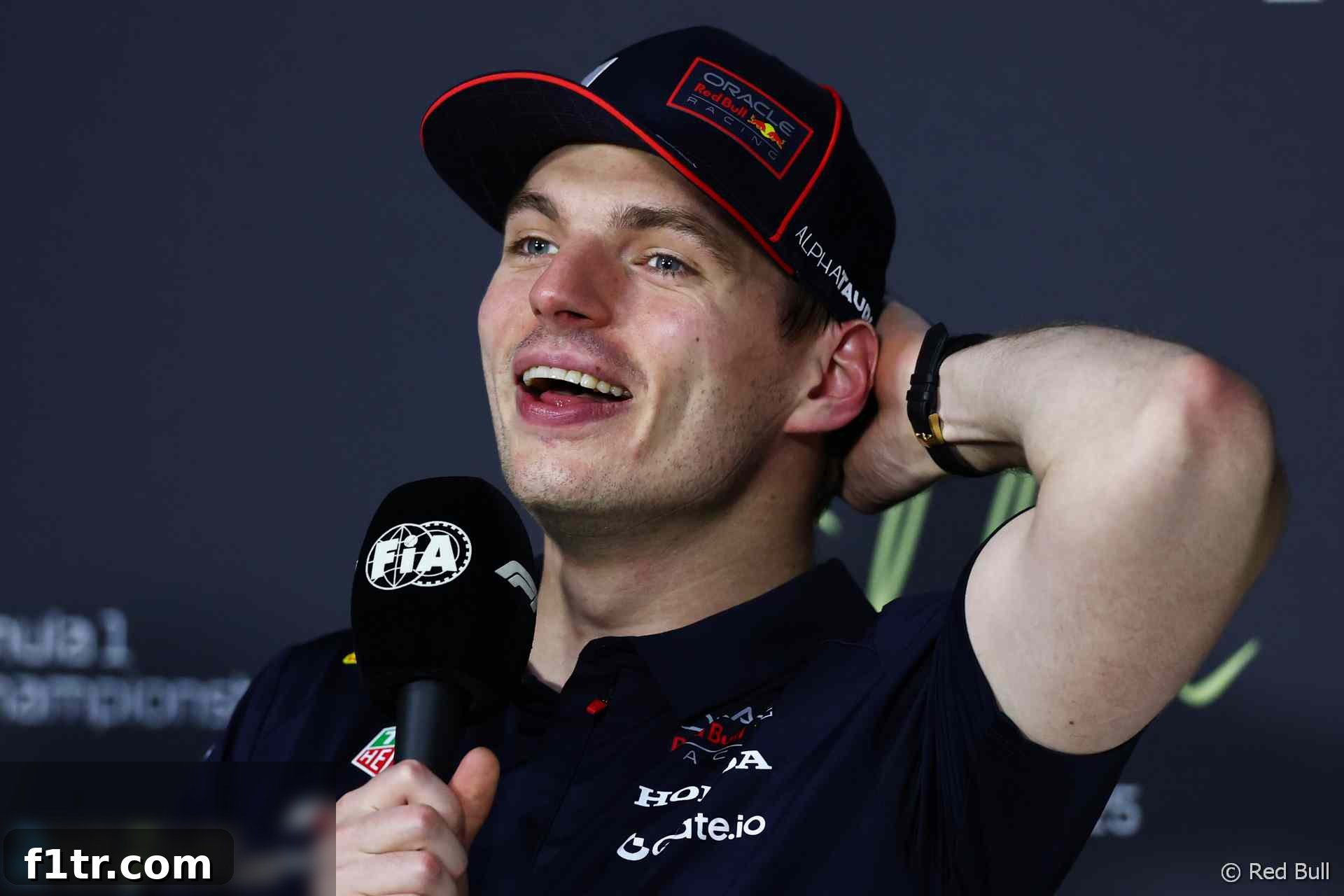
Max Verstappen secured his second pole position of the season at the Saudi Arabian Grand Prix, a performance he attributed to finding the right car setup on a circuit that genuinely suited the Red Bull’s unique characteristics. This narrow victory in qualifying, achieved by a mere one-hundredth of a second over McLaren’s Oscar Piastri, underscores the delicate balance required to unlock the full potential of his machinery and highlights the razor-thin margins at the pinnacle of motorsport.
Advert | Become a Supporter & go ad-free
The journey to pole was far from straightforward for the reigning world champion. Verstappen had trailed McLaren’s pace by two-tenths of a second in Friday’s second practice session, a deficit that unexpectedly widened further in the hotter conditions of final practice. This fluctuation in performance had sparked concerns within the Red Bull garage. However, as the track temperatures began to cool once more, a crucial shift occurred, allowing Verstappen’s Red Bull to unleash a significantly more competitive pace when it mattered most.
Reflecting on this turnaround, Verstappen shared his immediate sense of renewed confidence heading into the crucial qualifying sessions. “I felt immediately more confident when I headed into qualifying,” he stated. He elaborated on the subtle yet impactful adjustments made to the car: “We made some minor changes to the car, but they were clearly big enough to feel.” This comment speaks volumes about the extreme sensitivity of modern Formula 1 cars to even the slightest setup alterations, especially under varying environmental conditions.
Verstappen candidly acknowledged the temperamental nature of his Red Bull chassis. “That’s a bit the story of our car. It can be really hit-and-miss,” he admitted. This inherent characteristic means that when the engineering team hits the optimal setup window, the car becomes a formidable force. However, when they miss that sweet spot, the challenge of extracting performance becomes considerably more difficult. This explains the sometimes inconsistent performance observed, even with a driver of Verstappen’s caliber behind the wheel.
The qualifying session itself unfolded with a demonstration of Verstappen’s clinical precision. He topped Q1, setting an early marker for his competitors. In Q2, he remained remarkably consistent, trailing Lando Norris’s fastest time by a mere four hundredths of a second. The final Q3 session was momentarily disrupted by Norris’s crash, adding an element of unpredictability and pressure. Following the red flag, Verstappen opted for a strategic two-run approach, distinguishing himself from many rivals who settled for a single flying lap. This proved decisive, as he narrowly edged out Piastri, securing pole position with a masterful final effort.
Verstappen expressed his satisfaction with the entirety of the qualifying process. “All of qualifying went well,” he affirmed. He highlighted the importance of rhythm on the demanding Jeddah Corniche Circuit: “Around here, I think it’s always important to have quite a bit of rhythm, so naturally you do quite a lot of laps. The tyres, luckily, hold on to do that.” This ability to maintain consistent performance over multiple laps, especially on a track as unforgiving as Jeddah, is a testament to both driver skill and car balance.
Advert | Become a RaceFans supporter andgo ad-free
Addressing the red flag in Q3, he acknowledged its disruption but emphasized that every team faced the same challenge. “Of course then the red flag in Q3 is not ideal, but everyone has to deal with that.” His choice for the unique two-lap strategy after the restart was deliberate and paid off handsomely. “So we opted for that two-lap strategy, and I’m happy that we did that. It just kept me on top of things, and it felt good.” This strategic decision allowed him to build confidence and extract maximum performance from the tires and car in critical moments, a subtle yet significant advantage over his rivals.
Just a week prior, in Bahrain, Verstappen had been half a second off Piastri’s pole-winning time, a stark contrast to his dominant performance in Jeddah. He explained the reason for this significant shift in competitiveness, pointing to the inherent differences between the two circuits. The Jeddah Corniche Circuit, with its “few more high-speed corners and the Tarmac is completely different, which has a big influence on the tyres as well,” offers a fundamentally different challenge compared to the Bahrain International Circuit. These track-specific variables are crucial in determining a car’s overall suitability and performance.
Verstappen delved deeper into the specific characteristics that challenge the Red Bull in certain conditions. “When you have tracks where you need a lot of rotation mid-corner, and long-duration corners, which you have in Bahrain, that’s a big problem for us,” he revealed. This insight highlights a fundamental design philosophy or perhaps a limitation in the current iteration of the Red Bull car, suggesting it struggles with sustained mid-corner rotation and prolonged G-forces found on circuits like Bahrain. This characteristic can lead to understeer or difficulty in managing tire degradation over longer periods in those specific corner types.
In contrast, Jeddah’s layout appears to mitigate these issues to some extent. “Here, it just seems to be a little bit more competitive,” Verstappen observed. While acknowledging that the underlying problem hasn’t been entirely “solved,” he noted that the track’s nature at least afforded him a better opportunity to “push a bit better and deal with the limitations that we have a bit better.” This suggests that while the car still has areas for improvement, Jeddah’s combination of high-speed sweeps and distinct corner profiles allowed for a more effective workaround or minimization of its inherent weaknesses.
The decision to undertake two laps after the red flag in qualifying, unlike many other drivers who completed only one, proved to be a masterstroke. This additional lap provided Verstappen with a crucial opportunity to gain a deeper feel for the evolving track conditions, allowing him to fine-tune his approach for the ultimate flying lap. In a sport where hundredths of a second separate triumph from disappointment, such an advantage in understanding track grip and car balance can be invaluable, offering the driver the confidence to push the absolute limits.
Despite the strategic advantage, the Jeddah Corniche Circuit remains an immense challenge. Verstappen underscored the formidable task of delivering a perfect lap here: “At the end of the day, you just need to try and have a clean lap, try to be on the limit.” However, he quickly added, “But around here, honestly, it’s super-hard because at some corners you want to try and be super-close to the wall. Sometimes it works out, sometimes it doesn’t.” This constant dance with the unforgiving barriers, characteristic of a street circuit, demands absolute precision and a high degree of bravery, elevating the risk factor significantly.
He specifically pointed out the notorious Turn 22 as an example of Jeddah’s unique difficulties. “Braking into [turn] 22 is very bumpy, so you don’t even see where you’re going when you turn in. So it’s very hard to get everything right,” he explained. This combination of high speed, uneven surfaces, and blind entries makes achieving a perfectly executed lap an extraordinary feat. In Q3, with everything on the line, the stakes are even higher. “But clearly, it was good enough – and of course in Q3 you risk everything a bit more,” he concluded, perfectly encapsulating the high-risk, high-reward nature of qualifying for pole at Jeddah.
Advert | Become a RaceFans supporter andgo ad-free
Verstappen’s pole position at Jeddah is more than just a single achievement; it’s a critical insight into the evolving dynamic of the Formula 1 season. It suggests that while Red Bull may still grapple with specific car characteristics on certain layouts, their ability to adapt and optimize for unique track demands remains formidable. This victory also highlights the depth of competition, with McLaren demonstrating a clear step forward in performance, posing a significant threat to Red Bull’s long-standing dominance. As the season progresses, the battle for supremacy will likely hinge on each team’s capacity to understand and fine-tune their machines for the diverse challenges presented by the global calendar of F1 circuits. The Saudi Arabian Grand Prix qualifying has set a thrilling precedent, promising an exciting race ahead and a captivating championship fight for the months to come.
Miss nothing from RaceFans
Get a daily email with all our latest stories – and nothing else. No marketing, no ads. Sign up here:
2025 Saudi Arabian Grand Prix
- Red Bull made tactical decision not to avoid a penalty in Jeddah, Horner confirms
- Norris’s starts were far poorer than Verstappen’s but the balance is shifting
- McLaren’s rivals “just one upgrade away from being the lead car” – Brown
- Russell told race control what he thought of Verstappen’s first lap corner cut
- Doohan’s final corner pass on Bortoleto was F1’s closest fight for last place in seven years
Browse all 2025 Saudi Arabian Grand Prix articles