McLaren’s Strategic Clarity: Norris and Piastri Defend Monza Team Orders
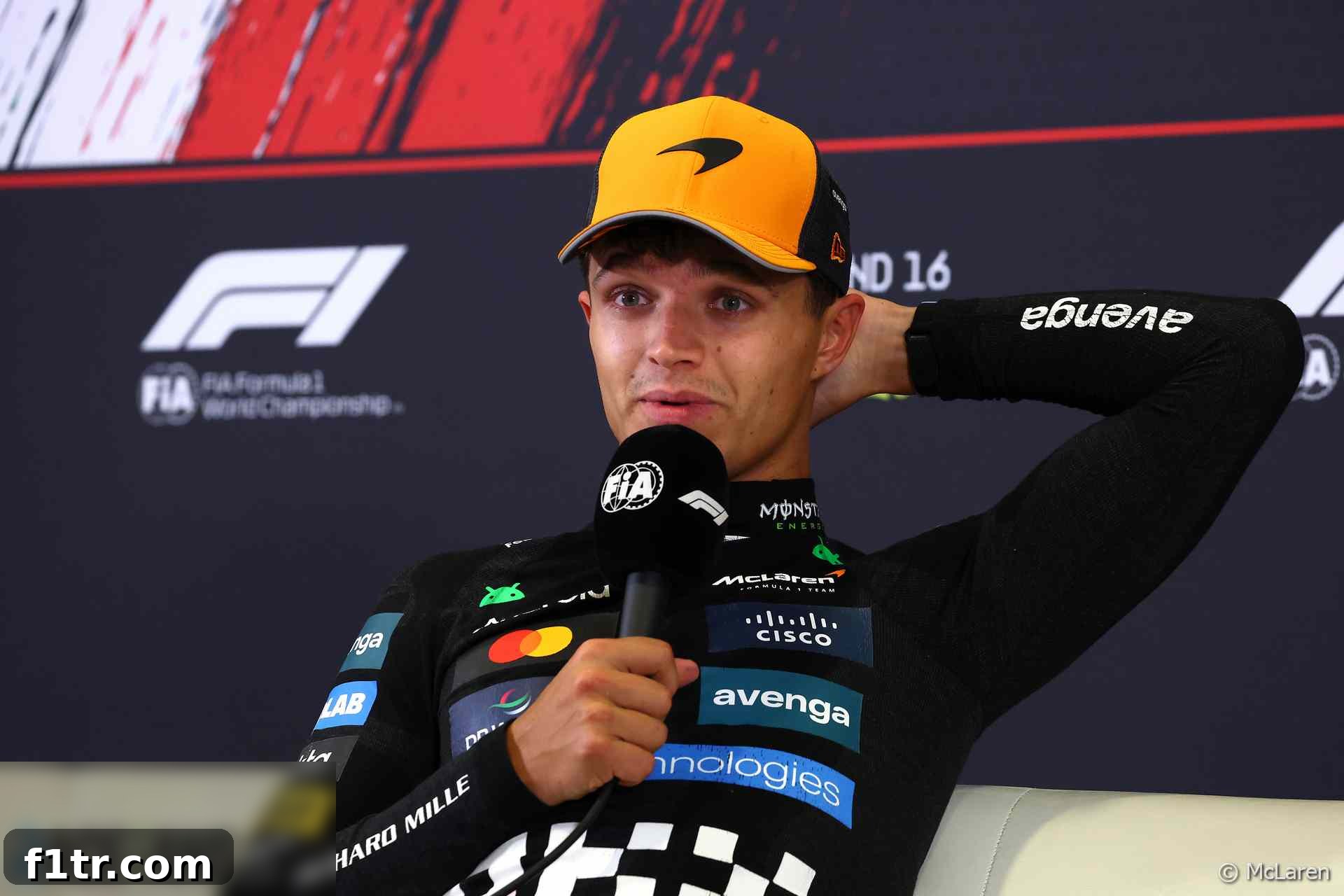
The intricate world of Formula 1 is perpetually abuzz with discussions surrounding strategy, team dynamics, and the delicate balance of driver competition. Following the recent Italian Grand Prix at Monza, McLaren found itself under the spotlight after implementing a team order that saw its star drivers, Lando Norris and Oscar Piastri, swap positions on track. This manoeuvre, executed in the race’s latter stages, ignited debate across the F1 community regarding its implications and whether it set a new, potentially “damaging precedent” for the Woking-based outfit. However, Lando Norris, with his characteristic candour, has unequivocally dismissed such suggestions, firmly asserting that the team’s decision was a meticulously considered response to a unique set of circumstances, rather than a blueprint for future actions.
The genesis of the incident lay in a crucial moment during the race when Norris, who had been running ahead of his teammate, endured a protracted pit stop. This unforeseen delay inadvertently dropped him behind Piastri, despite McLaren’s prior intention to pit Piastri first and their assurance to Norris that his track position relative to his teammate would be maintained. The subsequent decision to reverse the running order was a swift and calculated move, aimed at rectifying an internal operational misstep rather than penalising a driver for a performance lapse. While Oscar Piastri initially expressed some reservations during the intensity of the race, both drivers subsequently voiced their full backing for the team’s decision, presenting a united front that underscored the cohesion within the McLaren garage.
Deciphering McLaren’s Justification: Beyond a Simple Swap
When pressed on the likelihood of McLaren replicating such a team order in future scenarios, particularly if a slow pit stop were to cause a driver to fall behind rival cars, Norris offered a direct and unambiguous reply. “Every situation is different, so it’s pretty stupid just to assume that kind of thing and say that’s the precedent you set,” he declared, dismantling speculative claims with precision. He continued, asserting the team’s logical approach: “We’re not idiots and we have plans for different things. If there were four cars in between me and Oscar, of course he’s not going to let me back past, and I don’t think it’s correct that he let me back past [in that scenario].”
Norris’s comments illuminate a pivotal distinction within McLaren’s strategic framework. The decision to execute the position swap at Monza was fundamentally contingent on the absence of any other competitors directly positioned between the two McLaren cars. This crucial factor allowed the team to restore the drivers to their rightful, pre-pit stop running order without incurring the costly penalty of conceding valuable points or track position to rival constructors. It was, at its core, an act of internal fairness and a direct rectification of a disadvantage caused by a team-induced error, rather than a competitive compromise that would impact their standing against other teams on the highly competitive Formula 1 grid.
Fairness, Accountability, and Team Ethos at McLaren
The highly-rated British driver further elaborated on the foundational principle guiding the team’s actions. “In a situation where we weren’t racing [other cars], in a situation where we can just be fair, then you’d expect to be fair, as a team,” Norris articulated. “They don’t want to be the reason to upset one driver or another through no fault of their own.” This steadfast commitment to fairness underlines McLaren’s deep-rooted dedication to supporting its drivers, especially when circumstances beyond their direct control adversely affect their race performance. The slow pit stop was unequivocally deemed “not my fault” by Norris, a critical determinant in the team’s decision-making process. Had the error been attributable to the driver, the strategic outcome would have, by his own admission, been distinctly different.
Norris vividly illustrated this crucial distinction: “If I came flat-out into my box and I hit all my mechanics out the way, I also don’t expect to get the position back,” he asserted emphatically. “But [it] was out of my control.” This robust explanation underscores McLaren’s meticulously nuanced approach to team orders, where accountability plays a paramount role. The team’s overarching philosophy is not about arbitrarily assigning positions but rather about meticulously correcting an injustice caused by their own operational shortfall. It stands as a powerful testament to the inherent trust and mutual respect cultivated within the team, where both drivers demonstrate a profound understanding and acceptance of the underlying principles guiding their collective efforts.
He further articulated a sentiment shared unanimously between himself and Piastri regarding their preferred method of achieving success. “In the end, I don’t want to win this way through getting given positions or anything like that. And the same thing with Oscar – we don’t want to lose or win like that. But we do what we think is correct as a team, no matter what [others] say or what [their] opinions are, and we stick to doing it our way.” This resolute statement reinforces McLaren’s independent stance, showcasing their unwavering commitment to their internal values, impervious to external commentary or the pressures of public opinion. It signals a team utterly confident in its strategic decisions and resolute in its application of fairness and integrity.
Oscar Piastri’s Endorsement: A Unified Front
Echoing Norris’s sentiments with commendable maturity, Oscar Piastri also provided his perspective on the team’s decision. He unequivocally confirmed that the team would never sanction a position swap if such a move meant compromising their standing against rival cars. “If it’s within your control and there’s no other cars involved, it’s quite simple. But if there’s other cars involved, we’re not going to give away all of those points to other teams for a mistake,” Piastri elucidated. His words underscore the pragmatic essence of McLaren’s strategy: while internal fairness remains a paramount consideration, it is never pursued at the expense of the team’s broader championship objectives. The distinction is crystal clear: rectifying an internal operational error is one thing; sacrificing competitive advantage against other teams on the world stage is an entirely different proposition.
“When there’s no cars in between, it’s much easier to rectify it,” Piastri continued, offering further valuable insight into the operational simplicity and justification behind the Monza swap. “So if there had been more cars in between, then no, we wouldn’t have swapped back because at that point it does just become very unfortunate.” This candid assessment from Piastri solidifies the understanding that the Monza incident was a highly specific case, directly contingent on the precise race conditions prevalent at that moment. It was not intended as a universal precedent, but rather a meticulously tailored solution to a contained internal problem, vividly demonstrating the drivers’ deep comprehension of the team’s comprehensive strategic framework.
Andrea Stella’s Unwavering Stance on McLaren’s Principles
The consistent application of McLaren’s underlying philosophy permeates throughout the highest echelons of the team, a fact emphatically affirmed by Team Principal Andrea Stella. Despite McLaren’s commanding and virtually unassailable lead in the constructors’ championship – a lead that makes a title victory almost a foregone conclusion – Stella steadfastly insisted that their operational principles would remain entirely unchanged. “Winning the constructors’ championship is not a trigger for anything,” he stated unequivocally to the official F1 channel. “There’s no triggering that has to do with winning the world championship. The only guidance, the only beacon we have is the application of our principles.”
Stella’s statement serves as a powerful and resonant declaration of McLaren’s unwavering commitment to its core values, irrespective of championship standings, external pressures, or the pursuit of silverware. It signifies that the team operates on a bedrock foundation of established principles concerning fairness, meticulous driver management, and unyielding strategic integrity. This consistent, principled approach is meticulously designed to foster a stable, predictable, and highly supportive environment for both drivers, ensuring they feel unequivocally supported and that all critical decisions are made based on clear, pre-defined guidelines. It is a philosophy that demonstrably prioritises long-term team cohesion and ethical conduct over short-term expediency or the ephemeral thrill of a momentary championship victory.
Team Orders in F1: A Broader Context of Sportsmanship
The discourse surrounding team orders in Formula 1 is as venerable as the sport itself, frequently igniting impassioned debates among dedicated fans and seasoned pundits alike. Historically, team orders have spanned a wide spectrum, from highly controversial instructions that directly swayed championship outcomes to more subtle, yet equally impactful, strategic directives. McLaren’s unique situation at Monza offers a refreshing and nuanced perspective, showcasing a scenario where an internal team order was meticulously implemented not to arbitrarily favour one driver over another for purely competitive gain, but rather to diligently correct a procedural error that had unfairly disadvantaged a driver. This critical distinction is paramount and serves to conspicuously set McLaren’s approach apart from some of the more contentious examples witnessed throughout F1’s rich and complex history.
By openly defending their decision and clearly articulating the specific conditions under which such a position swap would be sanctioned, McLaren is effectively and transparently managing expectations while simultaneously reinforcing invaluable driver trust. This admirable degree of openness and clarity can prove to be an indispensable asset, particularly in a sport where driver loyalty, morale, and psychological well-being are absolutely critical for sustained success. The notable alignment between Norris and Piastri with the team’s overarching principles strongly suggests the existence of a robust and healthy internal culture, one where strategic decisions, even those involving immediate on-track position changes, are deeply understood and readily accepted as integral components of a larger, coherent, and mutually agreed-upon strategic plan.
The Road Ahead: McLaren’s Consistent Trajectory
As McLaren continues its formidable charge towards ultimately securing the constructors’ championship, the astute handling of the Monza team order incident stands as a profound testament to their increasingly refined operational strategy and exceptionally robust team management. Far from inadvertently establishing a “damaging precedent,” as initially speculated by some observers, the incident appears to have undeniably reinforced McLaren’s unwavering commitment to fairness, accountability, and ethical conduct. The clear, consistent, and confident communication emanating from Lando Norris, Oscar Piastri, and Team Principal Andrea Stella paints a vivid picture of a team that is not only performing at an exceptionally high level on the racetrack but is also operating with an unshakeable moral and strategic compass off it.
Furthermore, this significant incident provides invaluable insight into the evolving dynamic between Norris and Piastri, two immensely talented and highly competitive drivers who nonetheless exhibit a commendable and mature understanding of overarching team objectives. Their collective willingness to wholeheartedly back the team’s strategic decision, even when it directly involved personal on-track position changes, speaks volumes about their professionalism, mutual respect, and the profound bond cultivated within the McLaren garage. As the current Formula 1 season progresses and McLaren diligently aims to consolidate its commanding championship lead, this principled and consistent approach to strategic decisions will undoubtedly serve as a fundamental cornerstone of their continued success, meticulously fostering an environment where both drivers can not only thrive individually but also collectively contribute to the team’s ambitious overarching goals.