The highly anticipated Formula 1 2021 season roared to life with its first two practice sessions at the Bahrain Grand Prix, setting the stage for what promises to be an enthralling championship battle. Red Bull Racing’s Max Verstappen immediately signaled his intent, topping both Friday sessions and looking supremely confident behind the wheel of his Honda-powered machine. His blistering pace and seamless integration with the RB16B suggested a formidable challenge to the reigning champions. Beyond Verstappen’s dominant performance, the initial day of track action at the Bahrain International Circuit offered a wealth of intriguing insights and potential storylines for the season ahead.
The opening Free Practice 1 session was held under challenging conditions, with the Sakhir desert sun beating down relentlessly. Air temperatures soared above 33°C for much of the hour-long session, while the track surface reached a scorching 48°C. Such extreme heat places immense strain on both the cars and the drivers, making it difficult to extract representative performance data. Crucially, the Bahrain Grand Prix is a night race, meaning these daytime conditions were far from indicative of the cooler temperatures expected during qualifying and the race. This meant teams focused more on basic system checks and understanding their car’s behavior in different scenarios, rather than pure pace. The session’s shortened 60-minute duration, a new regulation for all Friday sessions in 2021, added another layer of complexity, pushing teams to maximize every precious minute of track time.
While Verstappen’s Red Bull set the benchmark, Mercedes’ Valtteri Bottas followed closely in the timesheets. Early observations suggested that Mercedes-powered teams, including McLaren and Aston Martin, might possess a straight-line speed advantage this year. Top speeds recorded around the lap frequently featured drivers using the Mercedes power unit, hinting at impressive engine performance. However, Charles Leclerc of Ferrari provided a crucial caveat, reminding everyone of the traditional pre-season ritual known as “sandbagging.” Speaking at the end of the day, Leclerc revealed, “We haven’t run [our power unit] flat out yet, but I don’t think it’s the case for anybody in the paddock today. So we don’t know how much they are sandbagging.” This practice, where teams deliberately underperform or run conservative engine modes to hide their true potential, makes it incredibly challenging to gauge the pecking order from practice times alone. Furthermore, the sheer volume of cars on track during the second practice session often meant drivers encountered traffic, further masking their true lap times and complicating any definitive performance analysis.
The evening session also brought into sharp focus the ever-present issue of track limits, specifically at Turn 4. The race director had issued new instructions regarding permissible boundaries, and Valtteri Bottas seemed particularly prone to exceeding them. On no fewer than five occasions, the Finn had his lap times deleted for running wide over the white lines at the exit of the corner. In stark contrast, the other 19 drivers on the grid collectively accumulated only four such infringements. This pattern of penalties for Bottas highlighted either a difficulty with adapting to the new guidelines or an inherent instability in his Mercedes W12 when pushing to the absolute limit. These deleted times not only affected his position on the leaderboard but also limited the data Mercedes could gather on crucial long runs and performance tests, adding an unexpected hurdle to their race preparations.
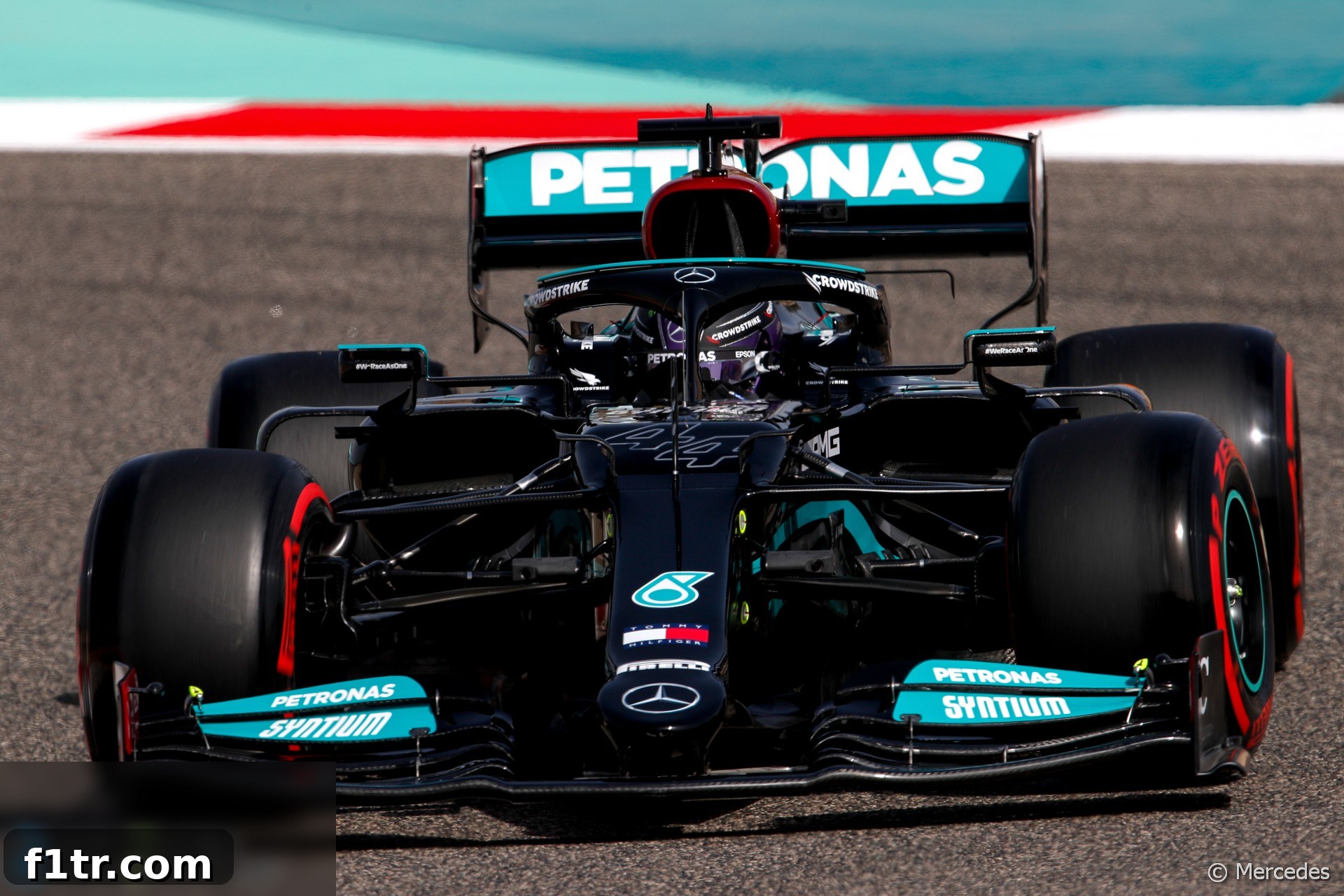
Both Mercedes drivers, Bottas and Lewis Hamilton, attributed their struggles at Turn 4 to a combination of factors: the persistent 15kph winds across the circuit and an unstable rear end of the car, an issue that had also plagued them during pre-season testing. Hamilton, who finished the day third fastest behind Verstappen and McLaren’s Lando Norris, also pointed to “performance we’ve lost on tyres this year” as a contributing factor. The root of Mercedes’ rear-end instability appears to be the significant aerodynamic changes introduced for the 2021 regulations, specifically alterations to the rear floor, brake ducts, and diffusers, all aimed at cutting downforce. Mercedes team principal Toto Wolff articulated his belief that cars designed with a ‘high rake’ concept, like the Red Bull, have been less severely impacted by these changes than their own ‘low rake’ design. The rake angle refers to the upward tilt of the car’s body from front to back. A higher rake generally allows for a larger diffuser volume, which can generate more downforce.
Wolff elaborated on this perceived disadvantage, stating, “We probably suffered more with the change of regulations than the cars with higher rake, and the Red Bull has followed that concept for many years.” He continued, acknowledging the uphill battle, “So it makes it more difficult for us to recover some of the lost downforce. But so far, what I’ve seen and what I hope is that we can really have a really tough fight, it’s what the fans want to see and what we would like to have.” This technical challenge underscores the complexity of F1 aerodynamics and the constant dance teams play with regulations. Aston Martin, a team that emulated Mercedes’ low-rake approach last year, also appeared to struggle in the initial sessions of the season, further supporting Wolff’s assessment of the regulatory impact.
Beyond headline lap times, teams focused heavily on gathering crucial long-run data to prepare for the Grand Prix. Williams demonstrated a strong emphasis on this, with both Nicholas Latifi and George Russell completing unrivaled 14-lap stints on the medium compound tyres during the evening session. These extended runs are vital for understanding tyre degradation and simulating race pace, providing invaluable information for strategists. Alpine also showed promising long-run performance, with F1 returnee Fernando Alonso covering 13 laps in his longest stint and Esteban Ocon racking up 12. Both Aston Martin drivers, Lance Stroll and Sebastian Vettel, also managed to hit the 10-lap mark on their long runs, as did Alfa Romeo’s Antonio Giovinazzi and McLaren’s Lando Norris. This focus on race simulations suggests teams are meticulously dissecting tyre performance under race conditions, a critical aspect given the abrasive nature of the Bahrain track.
At the opposite end of the spectrum, Haas rookies Nikita Mazepin and Mick Schumacher endured a challenging introduction to their first Formula 1 race weekend. Despite their inexperience, they completed fewer laps than many competitors, often finding themselves at the bottom of the timesheets. Mazepin described his debut practice sessions as “quite challenging” from a technical perspective but also “very special” as a dream come true. Schumacher admitted that Practice 1 marked his inaugural experience driving an F1 car in truly hot conditions, a significant learning curve. Despite the difficulties, Schumacher expressed a sense of comfort in the car, stating, “I feel really comfortable in the car, which is obviously a very good sign. It shows that we’ve done the right work to prepare myself and to get into the car and just be comfortable.” Their journey will be one of steep learning and adaptation as the season progresses.
Tyre strategy emerged as another critical element from Friday’s running. Pirelli, the official tyre supplier, indicated that the soft compound, typically expected to suffer significant degradation on the highly abrasive Bahrain track, performed better than anticipated. Pirelli’s head of F1 and motorsport, Mario Isola, revealed that the soft tyre was, on average, 0.9 seconds quicker per lap than the medium compound – approximately double the predicted performance gap. This surprising durability and pace of the soft tyre could open up more aggressive strategy options for teams during the race. Conversely, the performance gap between the medium and hard compounds – which were frequently used by Alfa Romeo’s Antonio Giovinazzi and the two Alpine drivers – was, as expected, around 0.4 seconds. Understanding these nuances will be pivotal for teams as they finalize their race strategies, balancing outright pace with tyre longevity.
One final puzzle piece for teams to decipher was the comparatively slower lap times across the board, even accounting for the windy conditions that mirrored pre-season testing. Ferrari, despite showing signs of improvement, were still almost two seconds away from their 2020 pace. Mario Isola observed, “The track was not quick today but it’s still difficult to understand why the track was not quick.” This observation, coupled with a remarkably tight midfield – where just one second separated the top 16 drivers, and eight of the ten teams demonstrated similar pace – lends further credence to the theory of widespread “sandbagging.” It suggests that many teams are yet to unleash their full potential, holding back their true pace for qualifying and the race. The intense competition promised by these close lap times across the grid sets up an exhilarating first qualifying session, which will provide the initial, more reliable indication of the season’s true pecking order, though race tactics will undoubtedly continue to evolve and surprise.
Quotes: Dieter Rencken
Maximum speeds
Here’s a breakdown of the maximum speeds recorded by drivers during the practice sessions, highlighting the raw power and aerodynamic efficiency of their respective machines.
| # | Driver | Car | Engine | Max speed (kph) | Gap | |
| 1 | 10 | Pierre Gasly | AlphaTauri | Honda | 326 | |
| 2 | 22 | Yuki Tsunoda | AlphaTauri | Honda | 324.6 | 1.4 |
| 3 | 6 | Nicholas Latifi | Williams | Mercedes | 320.3 | 5.7 |
| 4 | 63 | George Russell | Williams | Mercedes | 319.9 | 6.1 |
| 5 | 16 | Charles Leclerc | Ferrari | Ferrari | 317.9 | 8.1 |
| 6 | 99 | Antonio Giovinazzi | Alfa Romeo | Ferrari | 317.7 | 8.3 |
| 7 | 18 | Lance Stroll | Aston Martin | Mercedes | 315.9 | 10.1 |
| 8 | 11 | Sergio Perez | Red Bull | Honda | 315.8 | 10.2 |
| 9 | 55 | Carlos Sainz Jnr | Ferrari | Ferrari | 315.7 | 10.3 |
| 10 | 4 | Lando Norris | McLaren | Mercedes | 315.4 | 10.6 |
| 11 | 3 | Daniel Ricciardo | McLaren | Mercedes | 315 | 11 |
| 12 | 7 | Kimi Raikkonen | Alfa Romeo | Ferrari | 314.8 | 11.2 |
| 13 | 77 | Valtteri Bottas | Mercedes | Mercedes | 314.8 | 11.2 |
| 14 | 5 | Sebastian Vettel | Aston Martin | Mercedes | 314.5 | 11.5 |
| 15 | 31 | Esteban Ocon | Alpine | Renault | 314.5 | 11.5 |
| 16 | 47 | Mick Schumacher | Haas | Ferrari | 313.6 | 12.4 |
| 17 | 44 | Lewis Hamilton | Mercedes | Mercedes | 313.4 | 12.6 |
| 18 | 9 | Nikita Mazepin | Haas | Ferrari | 313.4 | 12.6 |
| 19 | 14 | Fernando Alonso | Alpine | Renault | 313.3 | 12.7 |
| 20 | 33 | Max Verstappen | Red Bull | Honda | 311.5 | 14.5 |
Combined practice times
This table compiles the best lap times from both Free Practice 1 and Free Practice 2 sessions, offering a comprehensive look at driver performance across the day.
| Pos | Driver | Car | FP1 | FP2 | Total laps |
|---|---|---|---|---|---|
| 1 | Max Verstappen | Red Bull-Honda | 1’31.394 | 1’30.847 | 35 |
| 2 | Lando Norris | McLaren-Mercedes | 1’31.897 | 1’30.942 | 45 |
| 3 | Lewis Hamilton | Mercedes | 1’31.921 | 1’31.082 | 39 |
| 4 | Carlos Sainz Jnr | Ferrari | 1’32.366 | 1’31.127 | 41 |
| 5 | Valtteri Bottas | Mercedes | 1’31.692 | 1’31.218 | 40 |
| 6 | Daniel Ricciardo | McLaren-Mercedes | 1’32.434 | 1’31.230 | 42 |
| 7 | Yuki Tsunoda | AlphaTauri-Honda | 1’33.329 | 1’31.294 | 44 |
| 8 | Lance Stroll | Aston Martin-Mercedes | 1’33.233 | 1’31.393 | 44 |
| 9 | Pierre Gasly | AlphaTauri-Honda | 1’32.195 | 1’31.483 | 50 |
| 10 | Sergio Perez | Red Bull-Honda | 1’32.071 | 1’31.503 | 38 |
| 11 | Esteban Ocon | Alpine-Renault | 1’33.528 | 1’31.601 | 44 |
| 12 | Charles Leclerc | Ferrari | 1’31.993 | 1’31.612 | 40 |
| 13 | Antonio Giovinazzi | Alfa Romeo-Ferrari | 1’32.786 | 1’31.740 | 43 |
| 14 | Sebastian Vettel | Aston Martin-Mercedes | 1’33.157 | 1’31.769 | 47 |
| 15 | Fernando Alonso | Alpine-Renault | 1’33.872 | 1’31.770 | 42 |
| 16 | Kimi Raikkonen | Alfa Romeo-Ferrari | 1’33.134 | 1’31.862 | 33 |
| 17 | George Russell | Williams-Mercedes | 1’34.127 | 1’32.331 | 50 |
| 18 | Mick Schumacher | Haas-Ferrari | 1’34.501 | 1’33.297 | 40 |
| 19 | Nicholas Latifi | Williams-Mercedes | 1’34.340 | 1’33.400 | 50 |
| 20 | Nikita Mazepin | Haas-Ferrari | 1’34.975 | 1’33.449 | 35 |
2021 Bahrain Grand Prix Insights
Further analysis and discussions related to the 2021 Bahrain Grand Prix:
- Why one driver says there’s no easy solution to F1’s ‘messy’ track limits problem
- Verstappen: Lost win in Bahrain “is not going to matter” if we have fastest car
- The classic rivalry for ‘best of the rest’ and six more Imola talking points
- Ocon: We need to extract the maximum from the car to score points
- Vettel feeling “not at home in the car yet” after tough weekend
Browse all 2021 Bahrain Grand Prix articles