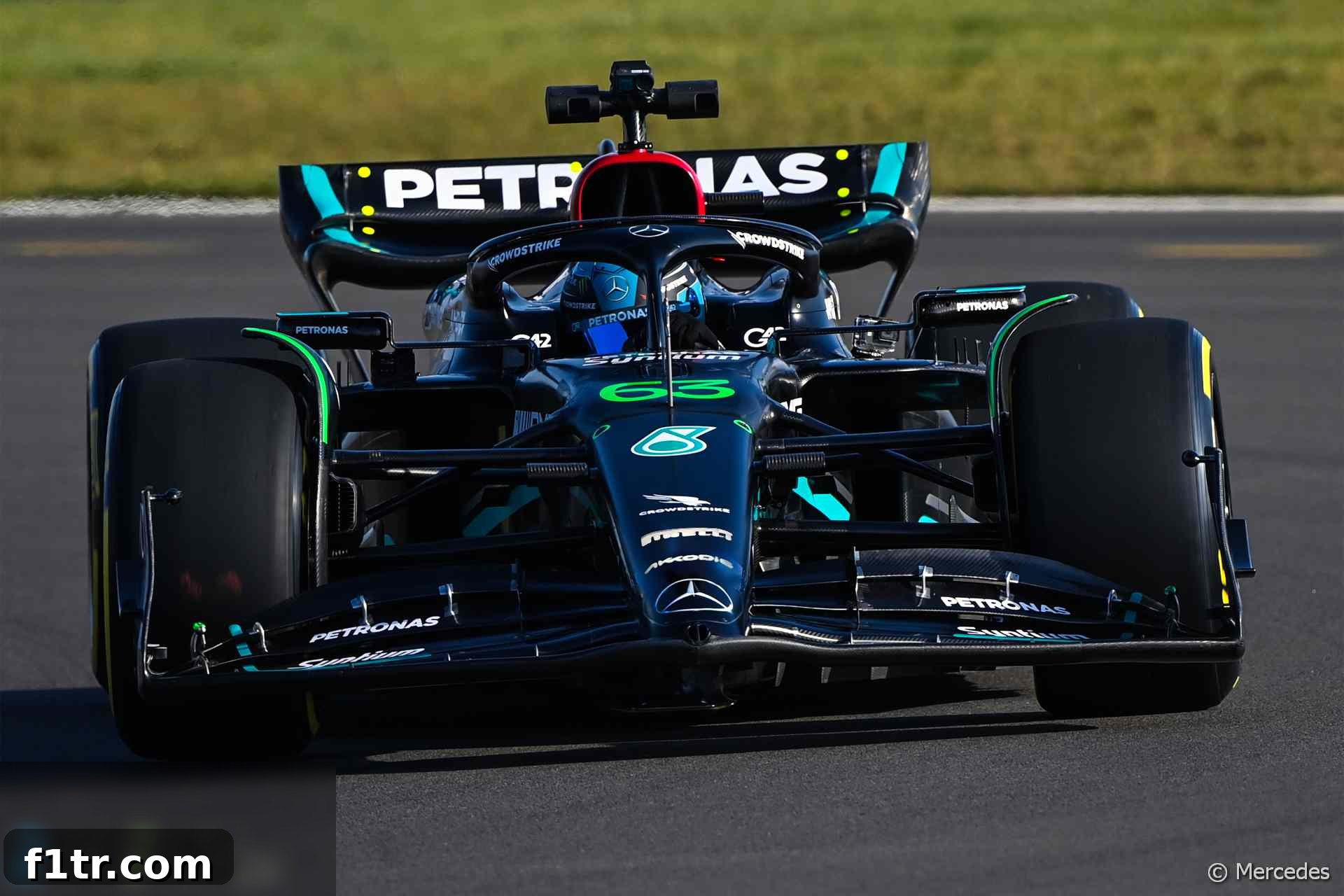
Formula 1 is a sport perpetually in motion, not just on the track, but behind the scenes with its ever-evolving technical regulations. For Mercedes-AMG Petronas F1 Team, these shifts have had profound consequences. After a period of unprecedented dominance that saw them clinch eight consecutive constructors’ championships during the V6 hybrid turbo era, the team has faced significant challenges since the sweeping technical overhaul introduced at the beginning of the 2022 season. With a mere single Grand Prix victory in the last two years, the pressure is mounting for the upcoming season’s car to be an unequivocal success, a sentiment openly acknowledged by the team’s leadership.
This critical juncture is acutely felt by all within the team, perhaps none more so than seven-time world champion Lewis Hamilton, who has endured an uncharacteristic winless streak since the 2022 regulations came into effect. Hamilton recently underscored the immense importance of the period leading up to the start of the next season, signaling a make-or-break moment for the Silver Arrows. Echoing this sentiment, James Allison, who resumed his pivotal role as technical director after the team grappled with limited progress on its challenger last winter, emphasized the absolute necessity of finally mastering the current set of regulations with their next iteration of the car.
The Post-Dominance Era: Mercedes’s Struggle Since 2022 Regulations
The 2022 technical regulations marked a seismic shift in Formula 1 design philosophy, reintroducing ground effect aerodynamics and aiming to promote closer racing by reducing the disruptive “dirty air” experienced by following cars. For Mercedes, a team renowned for its meticulous engineering and ability to exploit the nuances of technical rules, these changes proved to be an unexpected stumbling block. Their W13 and W14 challengers struggled with inherent design flaws, most notably the severe “porpoising” phenomenon in 2022 and a narrow operating window that made consistent performance elusive. The team, once synonymous with innovation and track supremacy, found itself playing catch-up, a stark contrast to their previous mastery of the complex hybrid era.
From 2014 to 2021, Mercedes redefined what was possible in Formula 1, crafting cars that were not only dominant but also incredibly robust and adaptable across various circuit types. This era of unwavering success established a benchmark, both for the sport and for the team itself. The shift to a single victory since the start of 2022 is therefore not merely a dip in form but represents a fundamental challenge to their engineering philosophy and competitive identity. The new regulations demanded a fresh approach to aerodynamics, chassis rigidity, and suspension characteristics, areas where Mercedes, surprisingly, initially lagged behind rivals like Red Bull Racing. Their inability to quickly unlock the potential within the new ground effect rules has underscored the difficulty of staying at the pinnacle of such a technologically demanding sport, highlighting how even the most dominant teams can be unsettled by significant regulatory changes.
Lewis Hamilton’s Imperative: The Critical 2024 Season
For Lewis Hamilton, the current period represents one of the most challenging chapters of his illustrious career. Having been denied an unprecedented eighth world championship in dramatic fashion in 2021, the subsequent two winless seasons have only intensified his resolve. His comments regarding the “critically important” period before the next season are not just an observation; they are a clear call to action, reflecting his immense personal stake in the team’s recovery. Hamilton’s legacy is intertwined with Mercedes’s success, and his desire to return to championship contention, and potentially secure that elusive eighth title, is palpable. He relies heavily on the team’s ability to provide him with a car capable of challenging at the front, and the prolonged struggle tests the patience and trust built over years of shared triumphs.
The absence of wins and the persistent struggle with an unpredictable car have undoubtedly been a source of frustration for Hamilton, a driver accustomed to fighting for victories every weekend. His faith in Mercedes’s engineering prowess, however, remains a cornerstone of his commitment. The upcoming season’s car, therefore, carries not just the weight of the team’s reputation, but also the hopes of its most decorated driver to reclaim his competitive edge and challenge for the ultimate prize in Formula 1. The strategic importance of the 2024 car for Hamilton extends beyond immediate performance; it’s about validating his continued presence at the team and his belief in their collective ability to overcome adversity and return to the summit of the sport.
James Allison’s Strategic Vision: Building the Foundation for Future Success
James Allison’s return to the technical director role following the team’s struggles in developing the W14 was a clear signal of Mercedes’s determination to rectify their course. His deep understanding of Formula 1 car design and his previous instrumental role in Mercedes’s championship-winning machines make him a pivotal figure in this recovery effort. Allison’s analysis of Hamilton’s comments highlights a layered strategic imperative. He stated, “It’ll be a new season and it’s important that we get off the new season on the front foot.” This immediate goal is compounded by a longer-term consideration: the looming 2026 regulations.
Allison further elaborated, “More than average-ly so because with 2026 bearing down on us, [for] the car that will need to be engineered in 2025, it’s highly likely that the 2025 car’s going to be close cousins of the 2024 cars. So it’s doubly important to get the 2024 car good.” This insight into F1 development cycles is crucial. The conceptual groundwork, aerodynamic philosophy, and mechanical design decisions made for the 2024 car (often referred to as the W15) will inevitably inform, and often dictate, the direction for its 2025 successor. Therefore, a successful 2024 platform provides a robust foundation for iterative improvements in 2025, rather than requiring a costly and time-consuming conceptual reset. Conversely, another suboptimal car in 2024 would not only hinder immediate performance but could also create a cascading effect, forcing significant design revisions for 2025 while diverting crucial resources that would ideally be earmarked for the vastly different 2026 regulations. Allison’s experienced perspective underscores the interconnectedness of F1 car development and the strategic foresight required to navigate consecutive regulatory periods.
The Looming Specter of 2026: A Balancing Act for All Teams
The 2026 Formula 1 season is set to introduce another monumental change with entirely new power unit regulations, and soon-to-be-defined chassis rules. The power unit changes are significant: they will feature a greater emphasis on electrical power, a move towards 100% sustainable fuels, and the removal of the costly and complex MGU-H component. While the power unit rules are largely agreed upon, the specific chassis regulations are still being finalized, promising a distinct aerodynamic concept that will likely complement the new power unit architecture. This future overhaul casts a long shadow over current development cycles.
Teams across the grid face a delicate balancing act. While immediate performance in 2024 and 2025 is vital for constructors’ championship standings and prize money, the potential for a significant competitive advantage under the new 2026 rules means that resources will inevitably begin to shift towards future car development. Investment in 2026 offers a greater potential return on investment in the long term, making it a strategic priority. This allocation of resources is further complicated by Formula 1’s budget cap, which limits overall spending. Teams must strategically decide how much of their budget to dedicate to current car development versus early conceptual work for 2026. Prioritizing 2026 too early might compromise current performance, while focusing too heavily on the short-term risks falling behind rivals who make a more aggressive shift to the new era. As Allison noted, this calculation is not unique to Mercedes but “does sharpen your focus wanting to make sure that we have a car that gives us a good run into 2026 as well as good championships and the fun that brings.” The impending 2026 regulations are thus a pervasive factor influencing every major development decision made in the preceding seasons, creating a complex strategic chess match across the paddock.
Identifying a “Well-Born” Car: The Driver’s Instinct
There’s an oft-repeated adage in Formula 1 that a truly great car reveals its potential almost immediately. James Allison touched upon this driver intuition, stating, “Over the years, most of the good cars that I’ve been lucky enough to be around while they’ve happened, the driver gets in and doesn’t exactly say ‘spend your bonus’, but they more or less do. Unlocking potential is not really something that takes very long if the car is well-born and that would be the aim of this one.” This speaks to the innate feel a driver has for a car that is fundamentally sound, one that possesses inherent balance, predictability, and a wide operating window. A “well-born” car is one that responds consistently to driver inputs, inspires confidence, and allows the driver to push to the absolute limit without fear of sudden, unpredictable behavior.
In contrast, Mercedes’s recent cars have often been described by their drivers as temperamental, difficult to drive on the limit, and having a narrow operating window where they perform optimally. This has been particularly evident with issues like a challenging rear end or a car that only performs well within a specific setup range, making it hard to extract consistent performance across different tracks and conditions. The aim for the W15, therefore, is not just to be fast in simulations but to translate that speed into a car that feels intuitive and rewarding from the moment the drivers complete their first laps. If the car has strong foundations, unlocking its ultimate performance becomes a process of fine-tuning rather than fundamental problem-solving. This early validation from the drivers would be the most encouraging sign that Mercedes has indeed “cracked” the current regulations and returned to a path of competitive resurgence.
Mercedes’s Path Forward: Unlocking Potential and Reclaiming the Top Spot
Mercedes’s journey to reclaim its top spot involves overcoming several critical challenges. The team has openly discussed issues with aero correlation – the discrepancy between wind tunnel data and actual on-track performance – which has plagued their recent development cycles. Ensuring the W15 accurately reflects its simulator and wind tunnel projections is paramount. Beyond data, a conceptual shift might be necessary, moving away from past design philosophies that proved less effective under the new ground effect rules. This involves a comprehensive re-evaluation of chassis stiffness, suspension kinematics, and the entire aerodynamic concept, particularly around the floor and diffuser, which are now the primary sources of downforce.
The hope for the W15 is that it will represent a clean break from the compromises and inherent issues of its predecessors. By learning from the past two years of struggle, the technical team aims to deliver a car that is not only faster but crucially, more stable, predictable, and easier for both Lewis Hamilton and George Russell to drive at the limit. This stability would allow the drivers to confidently explore the car’s potential, rather than battling its inherent quirks. Unlocking true potential means creating a robust platform that can be consistently developed throughout the season, rather than being constantly fundamental re-works. The meticulous analysis of what went wrong, coupled with the proven expertise of their engineering talent, forms the basis of their belief that the 2024 car can be the “silver bullet” that returns them to regular contention for race victories and championships.
Conclusion: High Stakes for the Silver Arrows
The 2024 Formula 1 season stands as a pivotal moment for Mercedes. The admission from the team that their next car “must be a success” underscores the immense pressure and the high stakes involved. Following two seasons that have fallen far short of their own lofty standards, the W15 represents an opportunity for redemption. It is a chance to reassert their engineering prowess, to vindicate Lewis Hamilton’s unwavering commitment, and to lay a strong foundation for the challenging transition into the 2026 regulatory era. The synergy between immediate performance and long-term strategic planning has never been more critical. As the grid prepares for another intense season, all eyes will be on the Silver Arrows, awaiting to see if they can indeed “crack” the code and once again challenge for supremacy in the highly competitive world of Formula 1.
Support Independent F1 Journalism
RaceFans is dedicated to bringing its readers exclusive news and insights directly from the heart of Formula 1. This independent coverage is made possible through the invaluable support of our RaceFans Supporters.
By contributing a modest monthly or annual sum, you directly help fund the essential costs of producing original, high-quality journalism: extensive travel to races, in-depth writing and analysis, content creation, secure hosting, direct contacts within the paddock, and continuous platform development.
For over a decade, our readers have proudly sustained our independent reporting. If you value our distinct and unbiased perspective on Formula 1, please consider becoming a RaceFans Supporter today. As an added benefit, all Supporters can enjoy an entirely ad-free browsing experience across our site. Discover more or sign up via the links below:
- Become a RaceFans Supporter Today
- Frequently Asked Questions about RaceFans Supporter
Related Formula 1 News
- Albon fears Qatar GP conditions risked creating dangerous “wet bulb effect”
- Alonso: New-spec fireproofs and pre-race anthem timing made Qatar heat worse
- Magnussen admits he took “too long to learn” Losail circuit
- Analysis: Sargeant’s Qatar radio reveals his painful struggle to end point-less run
- Alfa Romeo ‘finally understand their upgrade’ Bottas believes as team target Williams
Browse All 2023 Qatar Grand Prix Articles