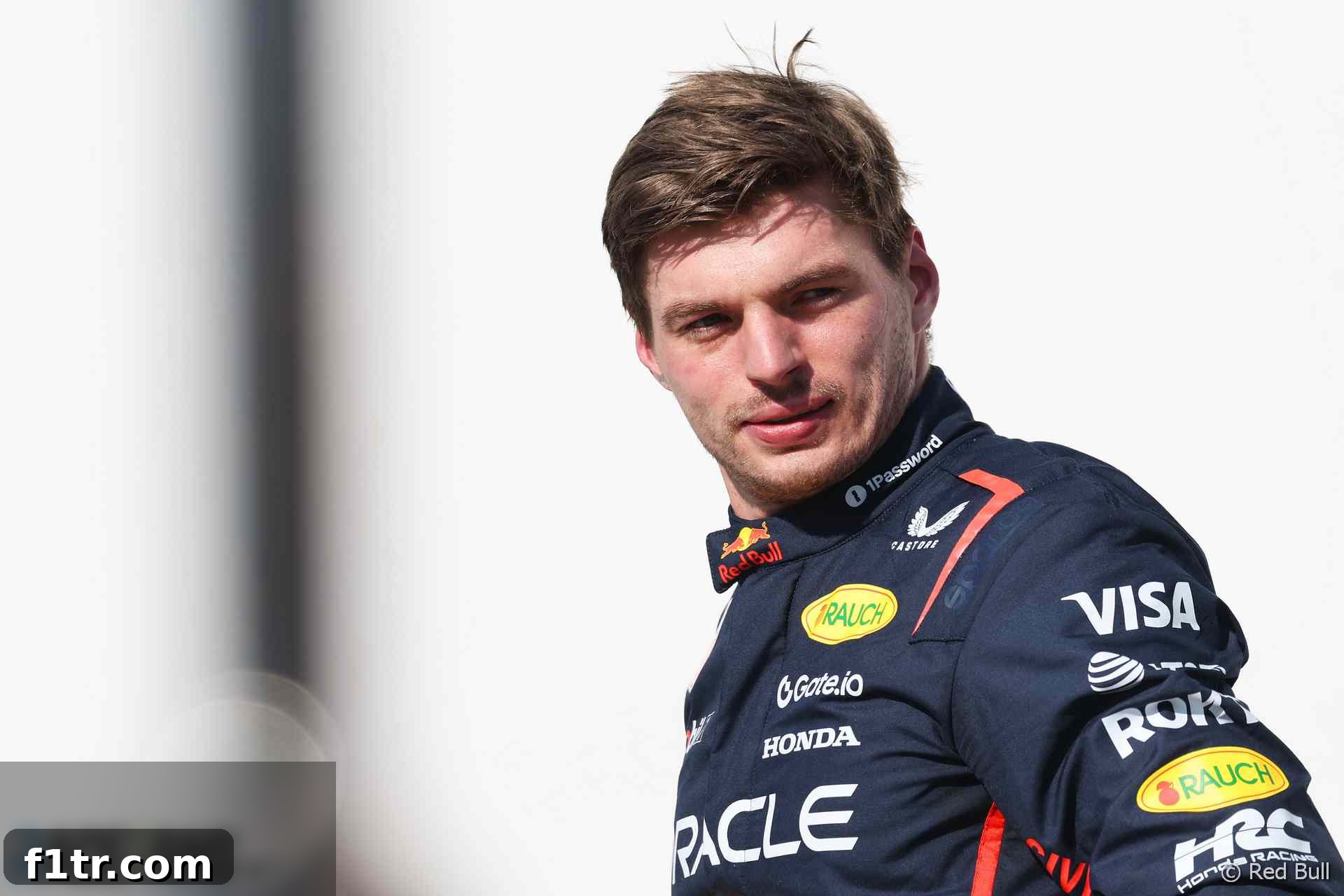
Max Verstappen’s Uphill Battle for a Fourth Consecutive F1 Championship in 2025
The 2025 Formula 1 season has presented an unexpected and formidable challenge for Max Verstappen, the reigning world champion. After an era of dominance, Verstappen now finds himself nearly 100 points adrift of the championship leader, Oscar Piastri, making his bid for a historic fourth consecutive world title appear increasingly improbable. This significant deficit marks a stark contrast to his previous seasons, where he often established an unassailable lead early on.
Max Verstappen’s Performance Snapshot
| Best | Worst | |
|---|---|---|
| GP Start Position | 1 (x4) | 8 |
| GP Finish Position | 1 (x2) | 10 |
| Total Points (Current) | 187 | |
This challenging turn of events cannot be attributed to a lack of effort from Verstappen himself or his Red Bull Racing team. However, the team’s operational strategy has drawn considerable attention, with many observers perceiving it to function increasingly like a one-car outfit centered solely around its star driver. The decision to replace a new 2025 teammate after just two rounds with a driver who has, arguably, delivered only marginal improvements, sent a clear, unequivocal message about Red Bull’s unwavering focus on Max Verstappen’s championship aspirations, even if those aspirations are currently faltering.
Verstappen’s relentless drive and unparalleled talent continue to be the cornerstone justifying Red Bull’s singular approach. Despite the fluctuating performance of the car and the mounting pressure, he has still produced moments of sheer brilliance this year. These include two exceptional Grand Prix victories, triumphs secured “against the run of play” where the car was arguably not the fastest package on track. Yet, his season has also been marred by uncharacteristic lapses in temperament, moments that have proven costly both in terms of points and championship momentum.
Season Highlights and Setbacks: A Race-by-Race Analysis
The season began with a deceptive glimmer of hope. Verstappen’s close second-place finish behind Lando Norris at the season-opener in Melbourne initially suggested that a fifth consecutive championship might still be within reach. However, a closer look at the race revealed that the Red Bull driver simply could not match the blistering pace of the McLaren duo as the track dried. This early race provided a subtle hint of the challenges that lay ahead. In China, the competitive landscape became even clearer, as Verstappen found himself unable to prevent both orange McLarens and George Russell’s Mercedes from finishing ahead of him, highlighting a growing performance gap that Red Bull desperately needed to address.
A true display of “Verstappen magic” at Suzuka temporarily reignited the championship dream. A sublime qualifying lap, executed with surgical precision, secured him pole position by a mere hundredth of a second. Throughout the Grand Prix, he masterfully kept the McLarens at bay, securing a superb and dominant victory that underscored his individual brilliance. But the elation was short-lived. In the very next race, unusually slow Red Bull pit stops blunted his charge and undermined his efforts, forcing him to salvage a sixth-place finish with a desperate last-lap pass on Pierre Gasly. This incident served as a painful reminder that even the most talented driver needs flawless execution from his team.
It would be an oversimplification to exaggerate the deficiencies of Verstappen’s Red Bull car, especially considering his continued ability to extract maximum performance. He impressively took pole position for the subsequent two rounds in Jeddah and Miami, demonstrating the car’s inherent raw speed when circumstances align. In Jeddah, however, he largely lost the lead due to a fractionally slower getaway than Oscar Piastri. In a desperate attempt to stay ahead, Verstappen cut the first corner, a move that the stewards swiftly penalized. Miami presented a different challenge; his Red Bull was plainly not quick enough to contend for the win. Not only did both McLarens overtake him on pace, but Verstappen also lost ground to George Russell during a crucial Safety Car period, further highlighting the car’s fluctuating competitiveness.
Yet, Verstappen’s opportunistic brilliance shone through at the Emilia-Romagna Grand Prix. When Oscar Piastri appeared momentarily preoccupied with George Russell at the start, Verstappen seized the opportunity with lightning-fast reflexes. He masterfully drove around the McLaren at Tamburello and surged into a lead he never looked like relinquishing. It was a classic display of Max Verstappen’s racecraft and his ability to capitalize on even the smallest error from his rivals, marking the second time he had won a race that, on paper, his rivals arguably should have denied him.
The prestigious Monaco Grand Prix proved to be a challenging affair. A sub-par run in the crucial final round of qualifying left Verstappen only fourth on the grid, a position from which he inevitably finished in the narrow, unforgiving streets of the principality. The Spanish Grand Prix offered a renewed sense of optimism. Verstappen matched Russell’s qualifying time to within a thousandth of a second, underscoring his raw pace. An aggressive three-stop strategy appeared to offer him a viable chance to challenge the McLarens for victory, positioning him for a strong result.
However, the aggressive strategy in Spain also left him vulnerable to unforeseen circumstances, particularly the deployment of a late Safety Car. When a Safety Car indeed materialized, and rivals Charles Leclerc and George Russell pounced on the opportunity for fresh tires and a strategic advantage, Verstappen’s composure fractured. Instead of trusting his instinct to disregard his team’s instruction to let Russell pass, he initially backed off, then controversially drove into his rival. This incident was widely perceived as a cynical attempt to at least damage the Mercedes, a move that drew a lenient 10-second penalty from the stewards, coupled with three crucial penalty points. These points pushed him to the brink of a race ban, adding another layer of complexity to an already tumultuous season.
Following this incident, Verstappen’s title hopes, which were already forlorn, quickly began to appear utterly unrealistic. He managed to chip away at Piastri’s lead with a hard-fought second place in Canada, demonstrating his resilience. However, his race at the Red Bull Ring ended prematurely and disastrously when he was taken out by Andrea Kimi Antonelli on the very first lap, a DNF that further damaged his championship aspirations and underscored the unpredictable nature of motorsport.
The British Grand Prix, typically a race where Verstappen excels in rain-affected conditions, presented another strategic misstep. He opted for a slim rear wing setup, optimistically hoping for dry conditions, only to struggle severely when the track became wet. He narrowly avoided spinning off at one stage, highlighting the gamble that backfired spectacularly. At Spa, he encountered the opposite problem: a steeper rear wing choice, which then proved suboptimal as the track dried quickly. Despite these challenges, he had the consolation of a commanding win in the previous day’s sprint race, expertly slipstreaming past Piastri at the start to secure a valuable victory.
Perhaps most worryingly for Verstappen and Red Bull, the Hungarian Grand Prix marked their least competitive showing of the season to date. Few anticipated him qualifying as poorly as eighth, let alone finishing one place lower in the race itself. This performance underscored fundamental issues with the car’s pace and setup, particularly on tracks that demand high downforce and strong cornering ability, further illustrating the shifting competitive landscape of F1 2025.
The Road Ahead: Talent vs. Temperament
As the season progresses, McLaren, with Oscar Piastri and Lando Norris, continues to edge ever further ahead in the Constructors’ and Drivers’ championships. Despite this formidable challenge, Max Verstappen has consistently demonstrated this year that he is still capable of pulling remarkable results out of the bag when the opportunity arises. His raw speed, aggressive racecraft, and unwavering determination remain unmatched by many on the grid. However, the season has also unequivocally shown that his temperament, particularly under immense pressure, can still get the better of him, leading to costly errors and contentious incidents. The balance between his prodigious talent and his sometimes-fiery nature will undoubtedly be a defining narrative for the remainder of his 2025 campaign and potentially for his future championship bids.
Driver Rankings
- 2025 Formula 1 mid-season driver rankings #1: Oscar Piastri
- 2025 Formula 1 mid-season driver rankings #2: George Russell
- 2025 Formula 1 mid-season driver rankings #3: Max Verstappen
- 2025 Formula 1 mid-season driver rankings #4: Charles Leclerc
- 2025 Formula 1 mid-season driver rankings #5: Alexander Albon
Browse all Driver Rankings