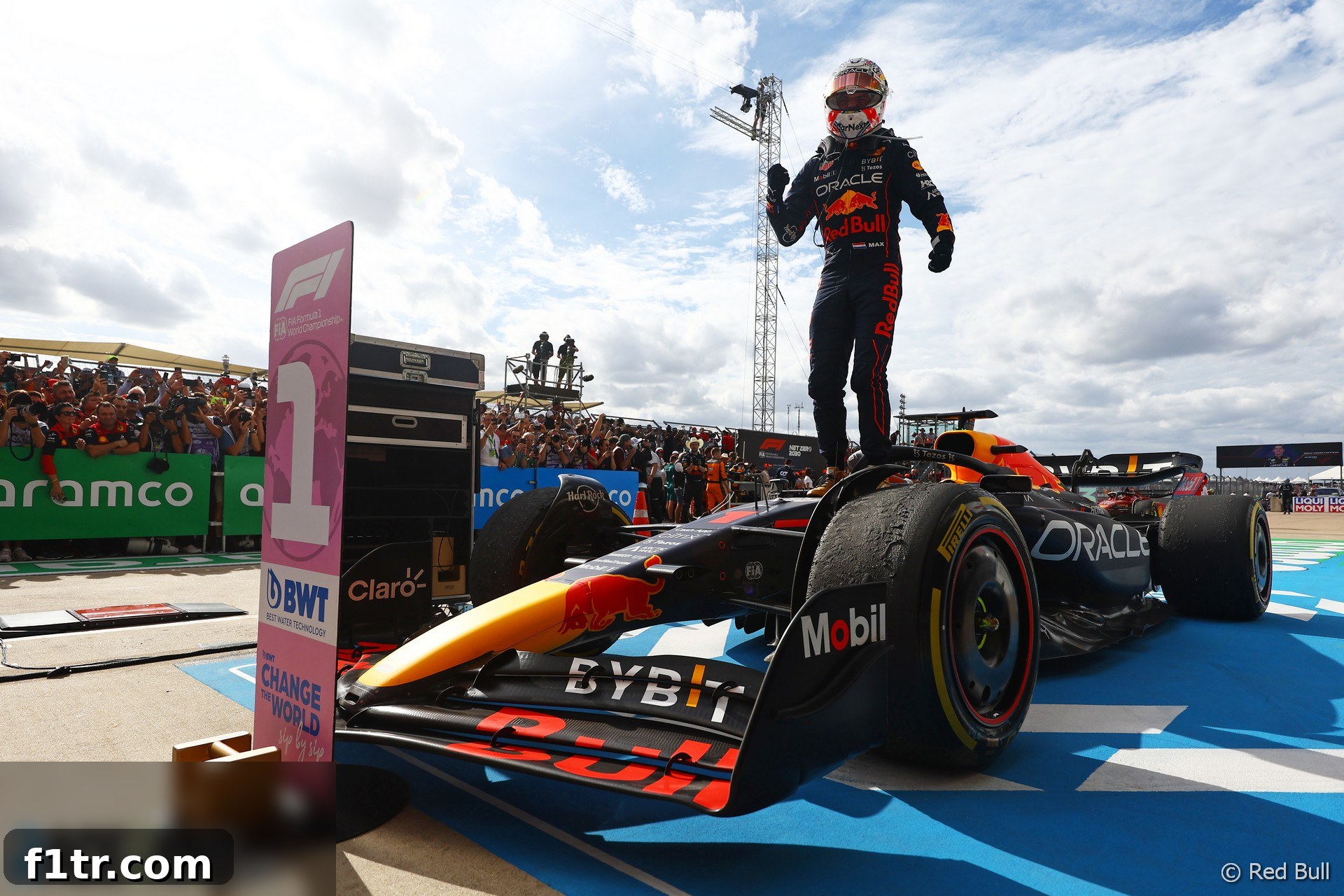
The 2022 Formula 1 season cemented Max Verstappen’s status as a generational talent, as he clinched his second consecutive World Championship title with remarkable authority at Suzuka. This triumph allowed him the privilege of carrying the coveted number one on his car for yet another season, a symbol of his reigning supremacy. Following his championship confirmation, Verstappen continued his relentless march towards history, securing his 33rd career victory at the subsequent United States Grand Prix in Austin. This particular win held a symbolic significance, matching the number he proudly displayed on his car throughout his Formula 1 career before ascending to world champion status. More than just a number, this victory propelled him past legendary driver Fernando Alonso, positioning him firmly in sixth place on the illustrious list of Formula 1’s most successful drivers by race wins.
Max Verstappen’s Historic 2022 Season: A Deep Dive into Record-Equalling Wins and Dominance
The 2022 season was nothing short of extraordinary for Max Verstappen. His commanding performance in Austin not only marked his 33rd career win but also represented his 13th victory of the season. This astonishing feat brought him level with two of Formula 1’s most iconic figures: Michael Schumacher, who set the benchmark with 13 wins in 2004, and Sebastian Vettel, who emulated this achievement in 2013. With three races remaining on the calendar and having dominated by winning seven of the last eight rounds leading up to Austin, the probability of Verstappen surpassing this historic record and etching his name further into the F1 annals was exceptionally high, promising an exhilarating conclusion to an already incredible season.
The Record-Equalling 13-Win Mark: Verstappen, Schumacher, and Vettel Compared
A closer examination of how these three multiple champions achieved their 13-win seasons reveals fascinating differences in their paths to dominance. Sebastian Vettel, Verstappen’s predecessor at Red Bull, secured all 13 of his victories in the 2013 season from either pole position or the front row. This was achieved over a 19-round season, mirroring the number of races held up to that point in Verstappen’s 2022 campaign. Michael Schumacher, nine years prior in 2004, needed only 18 races to rack up his 13 wins. Notably, Schumacher displayed exceptional race craft, with only two of his 13 victories coming from outside the front row, showcasing Ferrari’s supreme package and his unparalleled ability to capitalize on prime starting positions.
Max Verstappen’s journey to 13 wins in 2022, however, presented a stark contrast and highlighted a different facet of his undeniable talent. A remarkable six of his victories came from positions off the front row, demonstrating his car’s raw pace and his skill in navigating through the field. Furthermore, only four of his 13 wins were achieved from pole position, emphasizing his formidable ability to recover and dominate regardless of his grid slot. This is reflected in his average starting position for his 13 wins, which stood at 3.92. This figure is significantly higher than Schumacher’s average of 1.85 and Vettel’s average of 1.38, underscoring Verstappen’s capacity to consistently convert challenging starting points into race victories. This flexibility and relentless pursuit from various grid positions arguably made his 2022 record-equalling season even more compelling, showcasing his adaptability and the sheer competitive edge of the Red Bull package.
The detailed breakdown of their 13-win seasons is presented below, illustrating the different circuits and starting grid positions that led to these historic achievements for each champion. This comparison further emphasizes the unique circumstances and driving styles that characterized their dominant campaigns, offering a rich perspective on F1 history.
| Michael Schumacher, 2004 | Sebastian Vettel, 2013 | Max Verstappen, 2022 | |||||||
|---|---|---|---|---|---|---|---|---|---|
| Win | Round | Track | Grid | Round | Track | Grid | Round | Track | Grid |
| 1 | Australia | Albert Park | 1 | Malaysia | Sepang | 1 | Saudi Arabia | Jeddah Corniche Circuit | 4 |
| 2 | Malaysia | Sepang | 1 | Bahrain | Bahrain IC. | 2 | Emilia Romagna | Imola | 1 |
| 3 | Bahrain | Bahrain IC. | 1 | Canada | Montreal | 1 | Miami | Miami International Autodrome | 3 |
| 4 | San Marino | Imola | 2 | Germany | Nurburgring | 2 | Spain | Circuit de Catalunya | 2 |
| 5 | Spain | Circuit de Catalunya | 1 | Belgium | Spa-Francorchamps | 2 | Azerbaijan | Baku City Circuit | 3 |
| 6 | Europe | Nurburgring | 1 | Italy | Monza | 1 | Canada | Montreal | 1 |
| 7 | Canada | Montreal | 6 | Singapore | Singapore | 1 | France | Paul Ricard | 2 |
| 8 | USA | Indianapolis | 2 | Korea | Korea IC. | 1 | Hungary | Hungaroring | 10 |
| 9 | France | Magny-Cours | 2 | Japan | Suzuka | 2 | Belgium | Spa-Francorchamps | 14 |
| 10 | Great Britain | Silverstone | 4 | India | Buddh IC. | 1 | Netherlands | Zandvoort | 1 |
| 11 | Germany | Hockenheimring | 1 | Abu Dhabi | Yas Marina | 2 | Italy | Monza | 7 |
| 12 | Hungary | Hungaroring | 1 | USA | Circuit of the Americas | 1 | Japan | Suzuka | 1 |
| 13 | Japan | Suzuka | 1 | Brazil | Interlagos | 1 | USA | Circuit of the Americas | 2 |
Red Bull’s Dominance: Constructors’ Championship and Record Streaks
Verstappen’s victory at the United States Grand Prix was not just a personal milestone; it was a crowning moment for the entire Red Bull Racing team. It secured their fifth Constructors’ Championship title, a remarkable achievement and their first since their dominant run in 2013. This championship was particularly significant as it marked a triumph for Red Bull’s power unit operation, which runs rebadged Honda engines. Winning the Constructors’ Championship in their very first attempt under this new power unit configuration was a historic feat, recalling Repco’s similar success in 1966 as the last engine manufacturer to achieve this in their inaugural season. This underscored the engineering prowess and strategic brilliance behind the Red Bull team, demonstrating their ability to adapt and excel even with new technical challenges.
The win in Austin also extended Red Bull’s impressive winning streak to eight consecutive victories, showcasing the car’s unparalleled performance and reliability. With the momentum they had built, the team was on the cusp of equalling their best-ever consecutive win record, a benchmark set by Sebastian Vettel who delivered nine straight victories for Red Bull at the close of the 2013 season. This relentless pursuit of excellence and their consistent performance across various circuits firmly established Red Bull as the team to beat in 2022, reminding many of their past eras of dominance.
United States Grand Prix 2022: Key Moments and Statistics
While Verstappen’s victory was the headline, the United States Grand Prix in Austin delivered several other compelling storylines and notable statistics. Carlos Sainz Jnr secured a historic moment for Ferrari, snatching their first-ever pole position at the Circuit of the Americas. This was Ferrari’s first pole position for the United States Grand Prix since Michael Schumacher achieved it at Indianapolis in 2006. Interestingly, this marked Ferrari’s second pole position on American soil within the same year, with Charles Leclerc having previously taken pole at the inaugural Miami Grand Prix. However, mirroring the outcome in Miami, the ultimate victory in Austin once again belonged to Max Verstappen.
This pole position was the third of Sainz’s career, placing him alongside a distinguished group of drivers with three poles, including Jose Froilan Gonzalez, Tony Brooks, Dan Gurney, Jean-Pierre Jarier, Jody Scheckter, Elio de Angelis, Teo Fabi, and current F1 driver Daniel Ricciardo. Unfortunately for Sainz, his promising start at COTA quickly turned to disappointment. He was involved in an incident at the very first corner, leading to an immediate retirement from the race. This marked his sixth retirement of the year and, shockingly, the second time in the season where he had completed only a single racing lap across two consecutive events, highlighting a challenging period for the Spaniard despite flashes of brilliance.
The driver responsible for the incident that ended Sainz’s race, George Russell, later claimed the fastest lap of the race. He was the only driver to strategically opt for a fresh set of soft tyres during the final two laps, a move that paid off in style. This fastest lap was the third of Russell’s burgeoning career, putting him on par with Sainz, Pierre Gasly, and a host of legendary past drivers such as Brooks, Jarier, Bill Vukovich, Bruce McLaren, Richie Ginther, Jochen Rindt, Chris Amon, and Keke Rosberg, showcasing his growing potential and tactical acumen in F1.
The United States Grand Prix also saw Sebastian Vettel make a return to the front of the pack, albeit briefly. After Fernando Alonso became the seventh different driver to officially lead a race in 2022 at Suzuka, Vettel became the eighth in Austin. It marked the first time he had led a race since the Azerbaijan Grand Prix in the previous year, a testament to his enduring skill and the Aston Martin team’s improvements. This moment was a nostalgic treat for many fans, reminding them of the four-time world champion’s brilliance.
Following a post-race penalty issued to Fernando Alonso – a decision that was subsequently protested – Sebastian Vettel was promoted to an impressive seventh place. He achieved this by making a superb overtake on Kevin Magnussen on the very final lap of the race. Despite being passed, Magnussen’s performance was still significant for the Haas team, as he delivered their second points finish ever in their home race, the first having been secured by Romain Grosjean in 2016. This result was a morale booster for the American team, emphasizing their progress and competitive spirit.
Conclusion: A Season for the History Books
Max Verstappen’s 2022 Formula 1 season was an epic display of dominance, skill, and strategic brilliance. From clinching his second World Championship early to equalling the formidable 13-win record set by Michael Schumacher and Sebastian Vettel, Verstappen re-wrote the record books and carved out his own unique place in motorsport history. His ability to win from diverse grid positions, coupled with Red Bull’s engineering excellence and strategic acumen, made for an almost unstoppable force. Beyond Verstappen’s personal achievements, the season also showcased thrilling battles, notable milestones for teams like Ferrari and Haas, and the continued competitive spirit of seasoned drivers like Sebastian Vettel and Fernando Alonso.
The United States Grand Prix, in particular, encapsulated many of these narratives: the dramatic pole positions, unfortunate retirements, strategic masterstrokes, and hard-fought points finishes. As Verstappen continued his march towards potentially breaking the single-season win record, the 2022 season will undoubtedly be remembered as one of the most dominant individual performances in Formula 1, solidifying his legacy and Red Bull’s return to the pinnacle of the sport. Fans and pundits alike will continue to analyze the depth and breadth of his achievements, comparing them to legends of the past and speculating on what more the Dutch prodigy can accomplish.
Related Articles: 2022 United States Grand Prix
- Steiner annoyed by lack of apology from race director over COTA protest error
- How many victory chances did Hamilton have in his first winless F1 season?
- Income from new title sponsor will bring Haas up to cost cap level – Steiner
- Mexico’s first home win or Verstappen’s record 14th? Six Mexican GP talking points
- Mercedes doubt tyre strategy cost Hamilton chance to beat Verstappen to win
Browse all 2022 United States Grand Prix articles