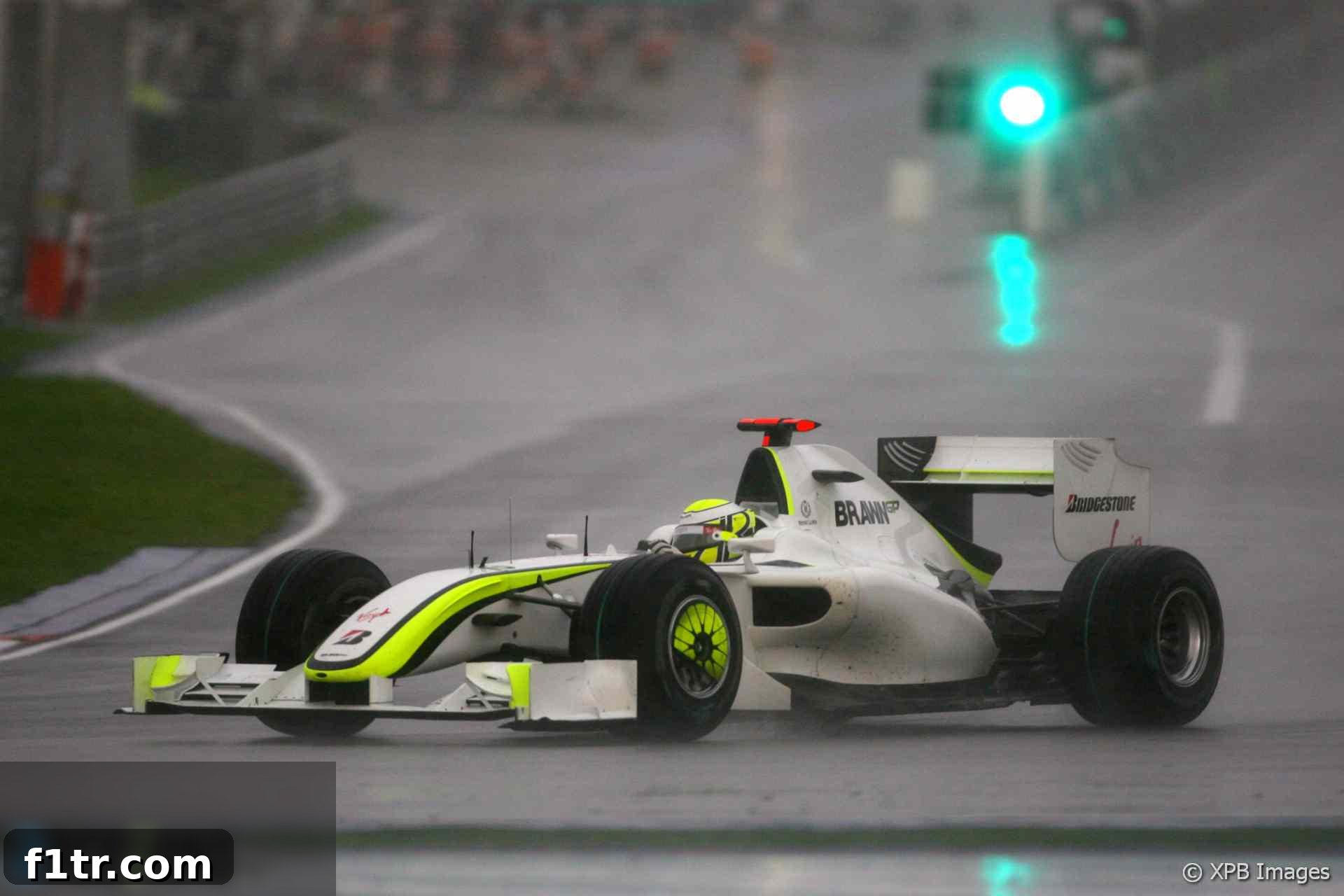
The 2009 Formula 1 season burst into life with an unexpected narrative. Following the dramatic opening round in Australia, Jenson Button and his miraculous Brawn GP team arrived at the Sepang International Circuit in Malaysia riding a wave of unprecedented success. Button, having secured victory from pole in Melbourne, repeated the feat in Sepang, making it two wins in a row for the fairytale outfit. However, this Malaysian Grand Prix would be remembered not just for Button’s driving prowess, but for its dramatic, rain-soaked conclusion that saw the race red-flagged halfway through, resulting in a rare awarding of half-points.
Advert | Become a Supporter & go ad-free
The Sepang circuit, notorious for its challenging layout and unpredictable tropical weather, had been under the constant threat of rain throughout the entire weekend. Between the official Formula 1 sessions, torrential downpours frequently turned the track into a temporary lake, rendering any racing impossible. Yet, defying the meteorological forecasts, the practice and qualifying sessions had miraculously remained dry. As the cars lined up on the grid for Sunday’s race, a palpable tension hung in the humid air – everyone knew a downpour was inevitable; the burning question was, when precisely would the skies open?
A Thrilling Start Amidst Mounting Expectations
With dark clouds gathering ominously on the horizon, the cars commenced the race on dry weather tyres. Jenson Button, once again demonstrating the raw speed of his BGP001, started from pole position, with Jarno Trulli’s Toyota alongside him on the front row. However, in a highly unusual turn of events, neither of the front-row starters managed to hold their advantage into the crucial first corner. Instead, a charging Nico Rosberg, showcasing the early potential of his Williams, executed a brilliant manoeuvre from fourth on the grid, snatching the lead and immediately beginning to pull away from the pack. It was a stunning display of opportunistic driving that caught many off guard.
Further back, Fernando Alonso, despite carrying a significantly heavy fuel load in his KERS-equipped Renault, made an absolutely phenomenal start. The Spaniard’s R29, harnessing the power of its kinetic energy recovery system, scythed through the field with remarkable precision, leaping from ninth place to briefly hold third position behind Trulli. However, Button, ever the strategist, wasted no time in reclaiming his rightful place, pouncing on the Renault at Turn 13 to regain third. The opening lap was a maelstrom of activity, setting the tone for what would be an unforgettable race.
Behind this initial skirmish, Rubens Barrichello navigated his Brawn into third, positioned ahead of a competitive group including Kimi Raikkonen in the Ferrari, Mark Webber in the Red Bull, and Timo Glock in the Toyota – the latter experiencing a difficult start after losing ground from his strong fourth-place grid slot. Lewis Hamilton, starting tenth, quickly found himself under pressure, being swiftly passed by Sebastian Vettel’s lightly-fuelled Red Bull on lap three. The early stages were proving costly for some front-runners, while others capitalized on the chaos.
Adding to the early drama, McLaren found themselves down to a single car after just one lap, echoing their misfortune in Australia. Heikki Kovalainen lost control of his MP4/24 while battling Hamilton on the outside of Turn 5, sending him out of the race. BMW Sauber also encountered significant trouble, with Robert Kubica’s race ending prematurely due to an engine failure, marking a double blow for two prominent teams within the first few minutes of competition.
Advert | Become a RaceFans supporter andgo ad-free
As the race settled, the lead trio – Rosberg, Trulli, and Button – began to establish a significant gap, pulling away from a tight train of cars forming behind Alonso. Barrichello was the first to make a serious challenge, bravely diving down the inside of Alonso’s R29 at the final corner. Although he initially ran wide, allowing Alonso to slip back through, Barrichello’s persistence paid off at the very next corner, where he made the pass stick. By this point, however, Button had already stretched his lead to a considerable 6.5 seconds, demonstrating the Brawn’s superior pace in the dry conditions.
Next to challenge Alonso was Raikkonen, who meticulously stalked the Renault for several laps before finally finding a way past on lap ten. Two laps later, Alonso ran wide at Turn 13, opening the door for Webber to launch an assault for sixth position. The pair engaged in a thrilling, lap-long duel, swapping positions multiple times with fearless aggression, until Alonso ran fractionally wide at Turn 1, finally allowing Webber to seal the deal. With Alonso now losing pace, Glock set about trying to overhaul the struggling Renault, a task made considerably more difficult by the front wing damage he had sustained earlier in contact with Webber. The mid-field battles were intense, a testament to the competitive nature of the 2009 season.
Behind Glock, Sebastian Vettel was making silent but swift progress. The German driver capitalized on an error by Nick Heidfeld, who ran wide at Turn 4 on lap eight, allowing Vettel to snatch a position. Hamilton, too, seized the opportunity to move up to tenth. His position improved further to ninth on lap 13 when Vettel became the first driver among the front-runners to make a scheduled pit stop. Earlier, Sébastien Buemi had made an unscheduled stop on lap one for a new front wing, highlighting the treacherous nature of the Sepang circuit.
The Sky Opens: A Gamble Against the Elements
With dark, brooding clouds threatening, many teams had anticipated the arrival of rain within the first few laps, creating a nervous atmosphere for the lightly-fuelled leaders as they made their pit stops on a still-dry track. Rosberg, maintaining his impressive form, had eked out a three-second lead over Trulli by the time of his first stop on lap 15. Crucially, he managed to stay ahead of the Toyota driver when Trulli pitted two laps later. This strategic timing in the initial pit window was vital, especially with the impending weather front.
Rosberg’s stop released Jenson Button into clear air, and he seized the opportunity with magnificent flair, unleashing a series of blistering laps. He set a fastest lap of 1’36.641 and, against prevailing expectations, extended his first stint by two laps longer than Trulli. This shrewd strategy decisively put the race firmly in his hands. He returned to the track on lap 19 ahead of Rosberg and, following Barrichello’s pit stop on lap 20, assumed the lead of the Malaysian Grand Prix. Button’s combination of raw speed and strategic brilliance was proving formidable.
With an almost mischievous timing, the anticipated rain finally began to fall. However, for Kimi Raikkonen, it came three laps too late. The Ferrari driver had made a bold, high-stakes gamble, switching to full wet-weather tyres on lap 18. Unfortunately, the rain did not intensify quickly enough or hard enough to justify his early decision, leaving him struggling on a still-drying track while others, on slicks, continued to post faster times. This premature tyre change would prove to be a costly miscalculation for the Finn.
Advert | Become a RaceFans supporter andgo ad-free
Glock’s Astute Gamble and the Intensifying Downpour
As the rain began to fall more persistently, over half the field made a frantic dash into the pits on lap 22. Almost universally, drivers switched to full wet tyres, with one crucial exception: Timo Glock. This decision by the German and his Toyota team proved to be a stroke of genius, as the rain initially fell only lightly. Glock, showing incredible composure, coolly picked off his rivals one by one as they nursed their full wet tyres on a track that wasn’t yet wet enough for them. His intermediate tyres allowed him to maintain a crucial performance advantage, elevating him rapidly through the field.
The varying performances of the cars at this transitional stage of the race made for enthralling competition. A particular highlight was the epic duel between Lewis Hamilton and Mark Webber, who exchanged positions lap after lap with aggressive driving. Hamilton effectively utilized his KERS to pass Webber on the straights, but the Red Bull, with its superior aerodynamics, proved vastly stronger under braking into the corners. This back-and-forth battle exemplified the strategic complexity and the raw talent on display.
Webber briefly ran off the track at Turn 6, allowing Hamilton through once more, but the tenacious Australian quickly regained his composure and was soon back ahead, finally making the move stick. Demonstrating impressive bravery, he then drove around the outside of Heidfeld at the final bend, taking fifth position with seemingly effortless grace. Elsewhere, Barrichello was also making rapid progress, successfully passing Trulli and Rosberg on lap 26. However, his charge was short-lived, as he spun on the very next lap, dropping him back down the order in a cruel twist of fate.
At around the same time, Glock’s inspired tyre choice saw him pass Trulli for second place. He was now an astonishing 28 seconds behind Button but was circulating five to ten seconds quicker per lap. The gap was closing at an incredible rate, and suddenly, a victory challenge was very much on the cards for the Toyota driver. Button reacted swiftly to the threat, diving into the pits for intermediate tyres on lap 29. Several other drivers, including Hamilton (who also took on fuel to last until the end of the race) and Rosberg, had already made a similar switch, recognizing the need for more appropriate rubber as the track conditions evolved.
Button emerged from the pits just behind Glock, but the weather had another dramatic twist in store – a fresh, heavy downpour suddenly lashed down on the circuit. Button managed to catch Glock by the end of his out lap, and as the Brawn car dived past at the final turn to retake the lead, Glock calmly peeled off into the pits where full wet tyres, once again, awaited him. It was a masterclass in timing and strategy, proving he had the right tyres at the right time, making him look like a clairvoyant in the chaos.
Advert | Become a RaceFans supporter andgo ad-free
Rain Stops Play: A Controversial Conclusion
With the rain now falling with relentless intensity, creating rivers and lakes on the circuit, everyone who wasn’t already in the pits headed straight for them. Some, like Sebastian Vettel, simply couldn’t make it in time, spinning off into retirement amidst the impossible conditions. The chaos was absolute, with visibility severely compromised and cars aquaplaning uncontrollably. The safety car was deployed on lap 32 in an attempt to manage the situation, but it quickly became painfully obvious that the track conditions were simply too perilous for racing to continue. The race director had no choice but to red-flag the event.
Even when the initial intensity of the rain began to ease, the sheer volume of standing water across huge areas of the circuit, combined with the rapidly diminishing natural light, made any prospect of restarting the race impossible. After a lengthy deliberation, the results were finally declared based on the finishing order on lap 31 – the lap immediately preceding the red flag. This ruling proved particularly unfortunate for Timo Glock, who had spectacularly taken second place from Heidfeld on what was effectively a “phantom” 32nd lap, only for that position to be erased by the count-back. It was a cruel blow for the German, denying him a richly deserved P2 finish.
For the first time in 18 years, a Formula 1 race had failed to complete at least 75% of its intended distance, triggering the regulation that only half points would be awarded to the finishers. This decision, while procedural, left a bitter taste for many, especially considering the fascinating strategic battles and the sheer unpredictability the race had offered up to that point. The 2009 Malaysian Grand Prix will likely be remembered more for the unusual circumstances of its ending – and the fervent debate around whether its late start time could have contributed to the premature conclusion – rather than solely for the captivating racing that characterized its early stages. Many argued that an earlier start would have allowed the race to run its full course before the worst of the weather hit.
Ultimately, two key factors secured the victory for Jenson Button: his remarkable and consistent pace ahead of his first pit stop, which allowed him to build a significant cushion, and that crucial, aggressive pass on Alonso on lap one that solidified his track position. However, a cloud of uncertainty hung over Brawn GP’s remarkable performance. The question remained: would Button enjoy that same kind of performance advantage at the next race in China, especially after the World Motor Sports Council convened to discuss the legality of his BGP001’s controversial double-diffuser? This technical dispute added another layer of intrigue to Brawn’s early season dominance.
While there might have been a touch of luck involved in Nick Heidfeld’s eventual second-place finish, he certainly earned it by expertly keeping his car on the track in the treacherous closing stages, demonstrating superb control and consistency when others faltered. Timo Glock’s race, on the other hand, had the touch of a clairvoyant, his tyre strategy proving exceptional. Had the rain not intensified to such an extreme degree right at the end, he was in an incredibly strong position to genuinely challenge for a win, a testament to his brilliant judgment. The 2009 Malaysian Grand Prix was a race of extreme highs and lows, strategic gambles, and ultimately, an unforgettable ending.
Can Brawn GP sustain their extraordinary winning streak against the growing scrutiny and the ever-present competition? The Formula 1 world eagerly awaited the answer. Teams would make an early return to Shanghai for the Chinese Grand Prix in just two weeks’ time, where the legality of the diffuser would be settled, and the battle for the championship would undoubtedly intensify.
Advert | Become a RaceFans supporter andgo ad-free
2009 Malaysian Grand Prix
- Malaysian Grand Prix results
- Championship standings after Malaysia