FIA Takes Unprecedented Step to Overturn F3 Penalty at Australian Grand Prix
In a rare and significant move that underscores the intricate nature of motorsport officiating, the Fédération Internationale de l’Automobile (FIA) has petitioned its own stewards to review a decision made during a Formula 3 support race at the prestigious Australian Grand Prix. This intervention ultimately led to the retraction of an earlier penalty and a profound discussion about the ‘Right of Review’ process and the clarity of communication within race control.
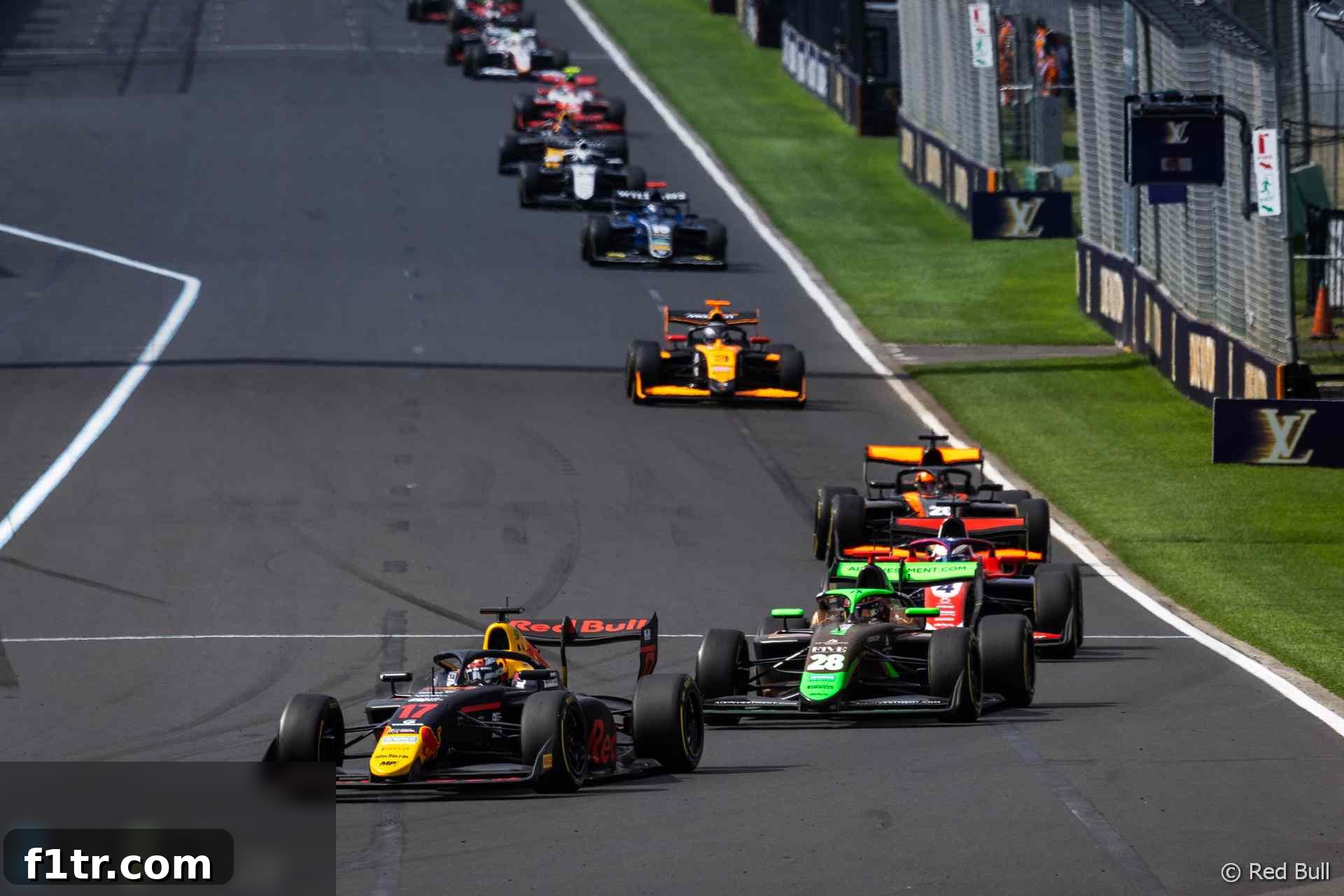
The case in question involved young driver Alessandro Giusti, who was competing in his inaugural Formula 3 race. Giusti had initially been handed a 10-second time penalty and two crucial penalty points by the three-strong F3 stewarding panel. The initial ruling stated that Giusti had improperly overtaken rival Ugo Ugochukwu before the designated control line during a race restart following a Safety Car period. This decision, issued well after the race concluded, cast a shadow over Giusti’s debut.
The Initial Controversy and the Stewards’ Ruling
The incident that sparked the controversy occurred amidst the high-pressure environment of a Safety Car restart. Such periods are notoriously complex, requiring impeccable timing and adherence to stringent rules governing overtaking and track positioning. The stewards’ initial assessment concluded that Giusti had gained an unfair advantage by passing Ugochukwu prematurely. For a rookie driver, such a penalty can be particularly disheartening, potentially impacting championship standings and future prospects.
However, the narrative took an unexpected turn over three hours after the initial penalty was announced. The stewards formally declared that the FIA had requested a review of their decision. This was not a routine request from a competing team but an direct inquiry from the sport’s governing body itself. The review was initiated under the very same ‘Right of Review’ process that is available to teams across various motorsport categories, including Formula 1. Notably, the FIA, in an unusual procedural step, “waived their right to a hearing,” entrusting the stewards with the re-evaluation based on written submissions.
FIA’s Crucial Intervention: Unveiling the ‘New Element’
The FIA’s submission to the stewards proved to be the pivotal factor in this case. In a detailed written argument, the governing body highlighted a fundamental misinterpretation of the timeline by the stewards. The FIA clarified that Giusti’s overtake on Ugochukwu had, in fact, occurred shortly before the Safety Car period *began*, not during its conclusion or the subsequent restart sequence. This temporal distinction was critical, as the rules and their application differ significantly between these two phases of a race.
Furthermore, the FIA’s submission pointed out that Giusti, realizing his potential error, had promptly returned the position to Ugochukwu. This act of sportsmanship and self-correction, often a mitigating factor in stewarding decisions, had seemingly been overlooked or miscontextualized in the initial assessment due to the focus on the incorrect timeframe.
Applying the ‘Right of Review’ Criteria: A Deep Dive into the Process
For a ‘Right of Review’ request to be successful, it must satisfy four stringent tests. These criteria ensure that reviews are not merely appeals for a different outcome but are based on genuinely new and pertinent information. The stewards meticulously applied these tests to the FIA’s submission:
1. Discovery of a “New Element”:
The stewards acknowledged that the core of the FIA’s argument presented a “new element.” This ‘new element’ was defined as the precise clarification of the moment during the Safety Car period at which the video evidence should be evaluated. Initially, the referral from Race Control was understood to pertain to the restart phase. The FIA’s submission, however, redirected attention to the commencement of the Safety Car period – a “completely different and therefore ‘new’ time.” This shift in focus was fundamental, as it altered the entire premise of the alleged infringement.
2. Relevance:
The request to re-evaluate the incident from the beginning of the Safety Car period was deemed highly relevant. The stewards concluded that this clarified timeframe went “to the very heart of the matter,” fundamentally questioning the initial basis of the penalty. The precise timing of an overtake in relation to Safety Car procedures is paramount, and any misinterpretation directly impacts the validity of a ruling.
3. Significance:
The revised temporal framework was also found to be profoundly significant. It “completely changes the framework within which the alleged incident is to be evaluated.” What might constitute an infringement during a restart could be entirely permissible or handled differently if it occurred at the inception of a Safety Car period, especially if the position was promptly relinquished.
4. Unavailability at the Time of Decision:
Perhaps the most crucial criterion for the ‘Right of Review,’ the stewards determined that the proper scope of their inquiry was not, in fact, available at the time of the original decision. They explicitly stated that the fact they evaluated the incident at an “incorrect time within the Safety Car period is clear evidence that proper and correct communication regarding the precise time of the alleged infringement had not occurred between the stewards and Race Control.” This lack of clear, precise communication was identified as the ultimate cause necessitating this right of review, highlighting an internal procedural shortfall rather than a misjudgment of the rules themselves.
The Revised Decision and Its Implications for Motorsport Integrity
Having thoroughly applied the ‘Right of Review’ criteria, the stewards issued a revised decision, which unequivocally corrected their earlier statement. Their updated conclusion noted, “While the driver overtook behind the Safety Car, the position was promptly given back. Under the penalty guidelines no penalty is appropriate.” This revised ruling cleared Alessandro Giusti of any wrongdoing, effectively nullifying the 10-second time penalty and the two penalty points, a significant relief for the young driver.
This incident, though unfolding in a junior category, carries significant implications for the broader landscape of motorsport stewarding and governance. It serves as a powerful reminder of the paramount importance of accurate and unambiguous communication between Race Control and the stewards. Misinformation, even concerning seemingly minor details like timing, can lead to incorrect judgments with profound consequences for drivers’ careers and the perceived fairness of the sport.
Moreover, the FIA’s direct intervention in this manner, rather than simply leaving it to the affected team, reinforces its commitment to upholding the integrity and sporting fairness of its championships. It demonstrates a proactive stance in rectifying errors that might otherwise erode confidence in the officiating process. Such a move, while unusual, underscores a vital mechanism for accountability, ensuring that decisions are based on the fullest and most accurate understanding of events.
For young drivers like Alessandro Giusti, competing in feeder series like Formula 3 is a crucible of talent, where every point and every penalty can significantly influence their trajectory towards higher categories like Formula 1. The overturning of this penalty not only vindicates Giusti but also sends a clear message that justice, even if delayed, will prevail when new and significant information comes to light through established, albeit rarely invoked, procedural mechanisms.
Ultimately, this case will likely become a reference point for discussions on race officiating, communication protocols, and the robust application of the ‘Right of Review’ in motorsport. It highlights the human element in a technologically advanced sport and the continuous need for clarity, precision, and rigorous review to maintain the highest standards of competitive fairness.
Formula 3 Further Reading
- McLaren drop three drivers from junior roster and hire FREC runner-up De Palo
- Lawson: Tsunoda ‘had his time – I beat him in him in the junior series’
- F3 driver’s penalty cancelled after FIA asks stewards to review decision
- Antonelli and Bearman’s F1 graduations show the limitations of its feeder series
- Win-less Fornaroli clinches F3 title with last-lap pass in epic Monza finale
Browse all Formula 3 articles