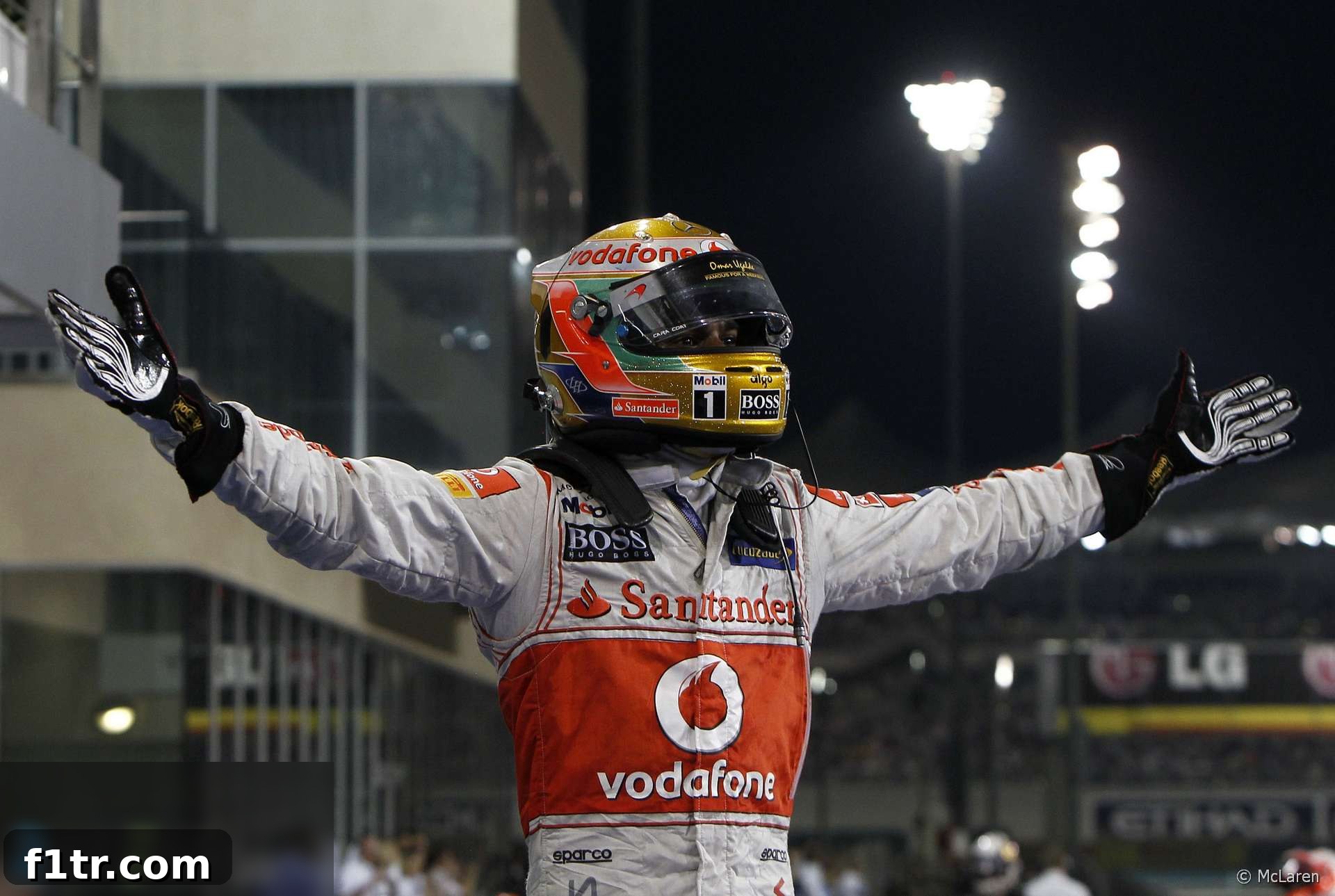
The 2011 Formula 1 season witnessed an unexpected twist at the Abu Dhabi Grand Prix as Lewis Hamilton secured his third victory of the year. The McLaren driver capitalized on a stunning early retirement from then-reigning world champion Sebastian Vettel, who was forced out of the race just moments after the start due to a mysterious puncture. This dramatic turn of events at the Yas Marina Circuit paved the way for Hamilton to lead home a competitive field, ultimately finishing ahead of Fernando Alonso and his McLaren teammate Jenson Button, in what proved to be a thrilling and strategically complex race.
The Abu Dhabi Grand Prix, held under the spectacular lights of the Yas Marina Circuit, was poised for another dominant performance from Sebastian Vettel. Having already clinched the 2011 Drivers’ Championship, the Red Bull ace was expected to continue his relentless winning streak. However, fate had other plans, delivering a shock to the F1 paddock that would redefine the narrative of the race.
Vettel’s Shocking Early Exit
The race began with immediate drama that sent ripples through the paddock. As the lights went out, Sebastian Vettel, starting from pole position, launched off the grid cleanly, maintaining his lead into the challenging Turn 1 without any apparent threats from Lewis Hamilton trailing behind. His start seemed flawless, typical of the commanding performances he had delivered throughout the season.
However, the narrative drastically shifted as Vettel navigated Turn 2. Without warning, the Red Bull RB7 snapped sideways, sending the car into an uncontrolled pirouette. The sight of the championship leader spinning out of contention so early was met with disbelief from fans and commentators alike. As he wrestled his car, it became evident that his right-rear tyre had suffered a sudden and mysterious puncture, instantly derailing his race. The entire field, a blur of colour and speed, hammered past the stranded German as he desperately tried to regain control and nurse his damaged machine back to the pits.
The long, slow lap around the sprawling Yas Marina Circuit on a punctured tyre proved to be a fatal blow to Vettel’s hopes. The incident not only destroyed his tyre but also inflicted significant suspension damage. Upon returning to his garage, the grim reality set in, and Red Bull Racing was forced to confirm his retirement. For a driver who had dominated the season with unwavering reliability, this unexpected DNF (Did Not Finish) was a rare and surprising moment of vulnerability, handing the initiative to his rivals.
Hamilton Takes Command, Alonso and Button Battle On
Vettel’s unexpected retirement instantly handed the lead to Lewis Hamilton, who wasted no time in seizing the opportunity. Behind him, the field erupted into a frantic scramble for positions, which inadvertently bought Hamilton a crucial advantage. By the end of the very first lap, the Briton had already established a comfortable 2.5-second lead, setting the stage for what would become a masterclass in race management.
Meanwhile, the battle for podium places intensified. Fernando Alonso, demonstrating his customary tenacity, made a decisive move on Mark Webber on the outside of Turn 1, a bold maneuver that put him squarely in contention for second. Having dispatched the Red Bull, the Ferrari driver immediately set his sights on Jenson Button, initiating a prolonged and thrilling contest for P2.
Jenson Button Under Intense Pressure
As Lewis Hamilton steadily maintained his lead over Fernando Alonso, Jenson Button found himself embroiled in a tense defensive battle. Initially, the McLaren driver saw his advantage erode, placing him firmly in the clutches of Mark Webber and Felipe Massa. This early phase of the race showcased the competitive nature of the field and the constant pressure drivers faced at Yas Marina.
Button, however, is renowned for his smooth driving style and ability to manage tyres, and he began to steadily pull away from Webber. His race engineer communicated that he was clear of Webber’s DRS threat, offering a brief respite. Yet, this relief was short-lived. A recurring KERS (Kinetic Energy Recovery System) problem developed on his McLaren, intermittently robbing him of crucial power and thrusting him back into the line of fire. The KERS issue proved particularly detrimental in the DRS zones, where Webber could now easily close the gap and launch attacks.
Mark Webber, sensing an opportunity, mounted a fierce challenge in the DRS zone, diving down the inside of Button at Turn 11. It was a bold move, but Button, ever the astute racer, responded with precision. He cleverly positioned his car for Turn 14, reclaiming the inside line and successfully fending off Webber’s assault. This intense wheel-to-wheel combat was a highlight of the early and mid-race stages, showcasing the skill and daring of both drivers.
Shortly after this skirmish, Felipe Massa initiated the first round of pit stops, prompting a chain reaction among the front-runners. Hamilton, Alonso, and Button all followed suit on the very next lap, leading to a crucial test of their respective pit crews. McLaren’s team demonstrated impressive efficiency, managing to pit both their cars on the same lap. Although Button experienced a slightly slower stop due to a minor delay with his right-rear tyre change, it was nothing compared to Webber’s woes. The Red Bull driver endured a significantly prolonged pit stop on the subsequent lap, an unfortunate incident that temporarily dropped him out of the intense battle for third position and gave Button a much-needed buffer.
Strategic Gambles and Midfield Mastery
In the second stint, Lewis Hamilton continued his measured drive, expertly managing a consistent three-second lead over Fernando Alonso. The gap remained stable, a testament to Hamilton’s pace and the McLaren’s strong performance. However, behind this leading duo, the battle for the final podium spot intensified once more. Massa and Webber, having regrouped after their pit stops, gradually closed in on Jenson Button, setting the stage for another thrilling three-way contest.
As Webber began to apply pressure on Massa, the pair started to fall back slightly from Button, who was now beginning to find his rhythm again. While most drivers opted for a conventional two-stop strategy, Red Bull Racing took a high-stakes gamble with Mark Webber. They committed to an aggressive three-stop strategy, hoping to use fresher, softer option tyres to give Webber the crucial speed advantage needed to leapfrog both Massa and Button.
Webber was fitted with a third set of option tyres and tasked with building up a significant gap over his rivals in the closing laps. He pushed his car to its limits, trying to make the audacious strategy work. Towards the end of the race, Felipe Massa suffered a spin at Turn 1, though it likely had little bearing on his final position relative to Webber, who had already managed to gain an advantage. Despite Red Bull’s strategic efforts, Webber ultimately couldn’t build up a sufficient gap over Jenson Button, whose KERS system had now miraculously recovered and was fully operational. This resurgence of power allowed Button to re-establish his pace and comfortably slot back into third position, thwarting Webber’s determined charge.
Fernando Alonso briefly enjoyed the lead for two laps after Hamilton made his final pit stop. The Ferrari team had kept Alonso out longer on the soft tyres, hoping to gain an advantage, while Hamilton switched to the medium compound. However, despite the strategic variation, Alonso was unable to emerge ahead of the McLaren after his own stop, cementing Hamilton’s control of the race.
Midfield Battles and Standout Performances
Away from the podium fight, the midfield delivered its own share of excitement and strategic intrigue. Nico Rosberg briefly ran in third position by postponing his final pit stop, a strategic move that ultimately secured him a commendable sixth place, just ahead of his Mercedes teammate. Rosberg’s race, however, ended with a minor mishap as his car suffered a puncture just after taking the chequered flag, a testament to the demanding nature of the Yas Marina Circuit.
He was closely pursued by Adrian Sutil, who finished an impressive seventh, just over a second behind the Mercedes. Sutil’s Force India teammate, Paul di Resta, secured ninth place after executing a highly unconventional one-stop strategy. Di Resta ran a remarkably long first stint on medium tyres, a bold decision that paid off, demonstrating both his skill in tyre management and the team’s strategic acumen.
Di Resta spent the opening stint engaged in a fascinating cat-and-mouse game with Sebastien Buemi. The Toro Rosso driver repeatedly used the first DRS zone to overtake Di Resta, only for the Force India to reclaim the position in the second DRS zone – a phenomenon observed between several other pairs of drivers as well. This intriguing back-and-forth eventually concluded when Di Resta ran wide at Turn 11, handing the position to Buemi. Unfortunately for the Toro Rosso driver, his race was short-lived. For the second Grand Prix in a row, his STR6 let him down, forcing another retirement.
Kamui Kobayashi, driving for Sauber, claimed the final point of the race, a crucial single point that moved Sauber ahead of Toro Rosso in the fiercely contested battle for seventh in the Constructors’ Championship. Like Di Resta, Kobayashi started the race on the harder tyres but opted for an earlier pit stop, requiring him to skillfully navigate through slower traffic. He even showcased his prowess by overtaking both HRT cars in a single corner, a memorable moment of the race. This point was Kobayashi’s first since the German Grand Prix, making it all the more significant.
His Sauber teammate, Sergio Perez, finished 11th, just outside the points, ahead of veteran Rubens Barrichello, who had impressively climbed his way up from the back row of the grid. Vitaly Petrov finished 13th, followed by Pastor Maldonado, who endured a challenging race marred by two penalties. On both occasions, Maldonado’s driving while being shown blue flags came under scrutiny. He served one drive-through penalty for impeding a faster car and faced an investigation for holding up Mark Webber as the race concluded.
Bruno Senna also incurred a penalty for holding up a car that was in the process of lapping him, ultimately finishing 16th behind Jaime Alguersuari. The Lotuses of Timo Glock and Vitantonio Liuzzi were the remaining finishers, having completed a tough race. Daniel Ricciardo was a late retirement from the race, having spent much of the Grand Prix performing strongly ahead of his teammate.
Hamilton’s Triumphant Third Victory
A visibly joyful Lewis Hamilton celebrated his third victory of the season, dedicating the emotional win to his mother. This triumph marked a significant moment in what had been an often challenging and turbulent year for the British driver. Despite the difficulties and frustrations encountered throughout the 2011 campaign, Hamilton had now matched his McLaren teammate Jenson Button with three wins, showcasing his undeniable talent and resilience.
This impressive performance in Abu Dhabi left McLaren in a strong position heading into the final race of the season in Brazil. The team could now aim to finish the year on a high note, buoyed by this victory and a rare moment of weakness from their biggest rivals, Red Bull Racing. Hamilton’s win not only bolstered his personal morale but also reaffirmed McLaren’s competitive strength, signaling their intent for future seasons.
2011 Abu Dhabi Grand Prix Related Articles and Insights:
- Hamilton voted Abu Dhabi Grand Prix Driver of the Weekend
- Rate the race result: 2011 Abu Dhabi Grand Prix
- Pirelli say tyre failure did not cause Vettel retirement
- Vote for your Abu Dhabi GP driver of the weekend
- McLaren: Relief for Hamilton after return to winning ways
- Ferrari: Slow pit stop costs Alonso shot at victory
- Red Bull: Mystery puncture halts the Vettel steamroller
- Mercedes: Rosberg comes out ahead after first-lap scrap
- Force India: Team tightens grasp on sixth in championship
- Sauber: Kobayashi ends seven-race drought
Browse all 2011 Abu Dhabi Grand Prix articles
Image © Red Bull/Getty images