Austrian Grand Prix: Russell and Gasly Penalized in Turn 4 Collision Controversy
The exhilarating 2022 Austrian Grand Prix at the Red Bull Ring proved to be a weekend of high-stakes racing, thrilling overtakes, and unfortunate collisions, particularly at the challenging Turn 4. Two prominent drivers, George Russell of Mercedes and Pierre Gasly from AlphaTauri, each found themselves on the wrong side of the stewards’ decisions, receiving two superlicence penalty points for incidents that significantly impacted their races and those of their rivals.
Russell’s First-Lap Clash with Perez Shakes Up Championship Battle
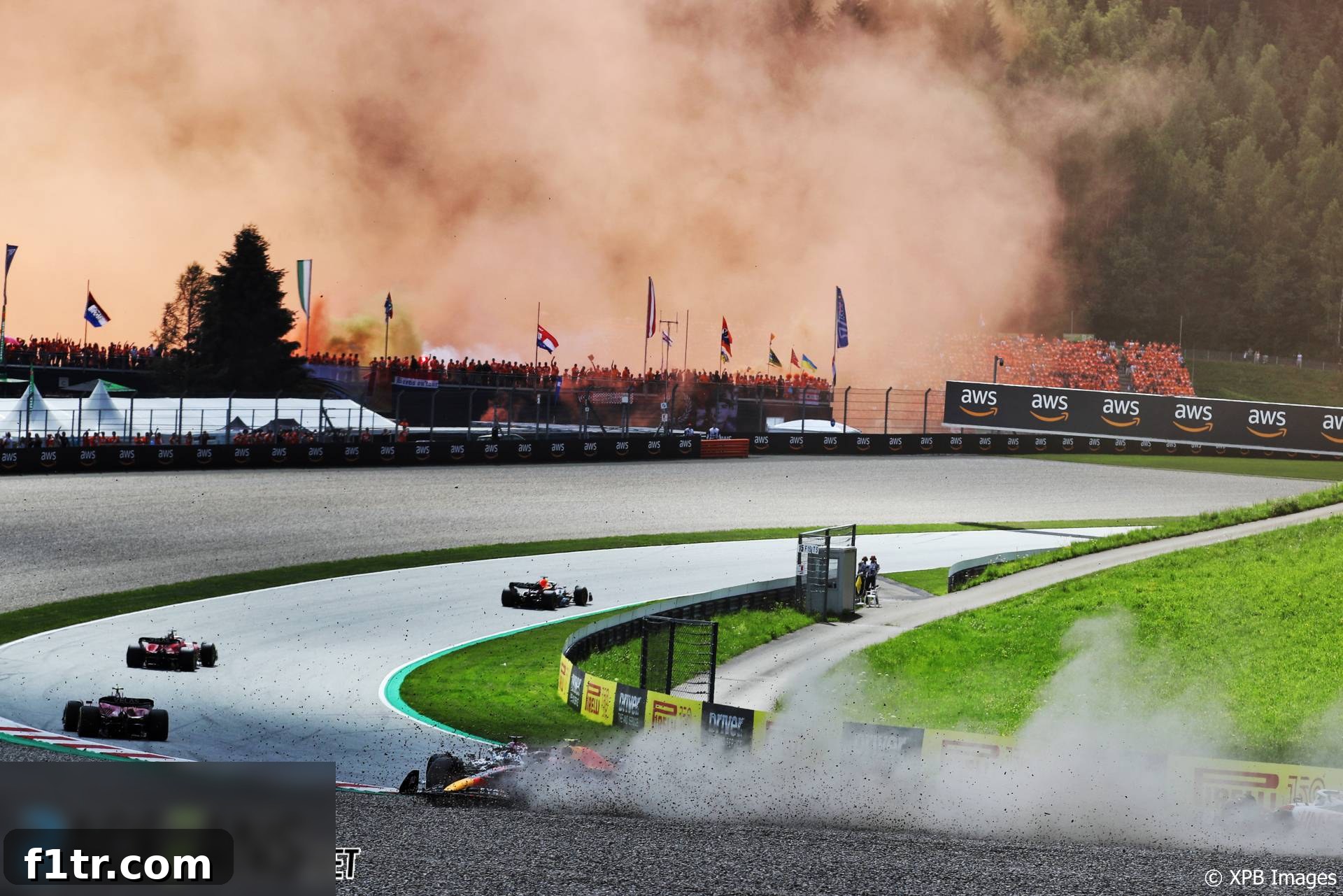
The race had barely begun when the drama unfolded. On the very first lap, a highly anticipated battle between George Russell and Red Bull’s Sergio Perez culminated in a controversial collision at Turn 4. As the cars navigated the tight right-hander, Russell, attempting to hold his position on the inside, made contact with Perez, who was challenging on the outside. The clash sent Perez’s Red Bull car spinning into the gravel trap, severely compromising his race and ultimately leading to his early retirement.
Perez, understandably frustrated by the incident, voiced his strong disapproval of Russell’s manoeuvre. “I was clearly ahead,” Perez stated after the race, highlighting his belief that he had established his position. “It was up to George to really control his car, which he clearly couldn’t, and we ended up making contact. There was nothing else I could have done. I gave him enough room. I was already very close to the gravel to make sure he had enough room and for both of us to make the corner.”
The Mexican driver further emphasized that the drivers had received “clear” guidance from the race director regarding leaving sufficient room for competitors in corners. He expressed particular surprise at Russell’s actions: “For the standards of George, the level, I’m very surprised at that manoeuvre.” The incident was a bitter blow for Perez, who not only lost valuable points but also slipped from second place in the drivers’ championship standings, ceding the position to Charles Leclerc. “It’s very disappointing for me. A very disappointing result for our team because clearly today there were a lot of opportunities. We had too much damage to progress in the race,” he lamented.
Stewards’ Verdict: Russell “Wholly At Fault”
Following a thorough review of video footage and telemetry, the race stewards concluded that Russell was “wholly at fault for the incident.” Their official bulletin detailed their findings: “Car 11 [Perez] was passing on the outside at Turn 4, was at least fully alongside at the entry of the turn and all the way through the manoeuvre, including at the apex of the corner and left sufficient room for car 63, which ultimately struck car 11.”
Crucially, the stewards determined that this was not a typical “first lap incident” that might sometimes be treated with more leniency due to the congestion of the field. Instead, they viewed it as “a battle between the two cars and was not affected by the pack of cars as can happen during the first lap.” This distinction underscored the severity of Russell’s misjudgment, leading to the imposition of a five-second time penalty (though largely academic given his immediate damage) and two penalty points on his superlicence. This incident highlights the intense scrutiny placed on drivers’ conduct, even in the opening moments of a Grand Prix, setting a precedent for responsible racing.
Gasly’s Identical Infringement: A Costly Encounter with Vettel
Later in the race, Turn 4 once again became the focal point of controversy, this time involving Pierre Gasly and four-time world champion Sebastian Vettel. Much like the earlier incident, Gasly, positioned on the inside, collided with Vettel as the Aston Martin driver attempted to overtake on the outside. The contact mirrored the Russell-Perez clash, sending Vettel into the gravel and damaging his car, which also ultimately led to his retirement. While Vettel’s championship aspirations were not as high as Perez’s, the frustration of being taken out of the race due to another driver’s error was palpable.
The stewards’ investigation into the Gasly-Vettel collision yielded an almost identical verdict. After reviewing all available video evidence, they “determined that car five [Vettel] was at least fully alongside throughout his attempt to pass on the outside of car 10 [Gasly] at Turn 4 and gave car 10 sufficient room at the apex. The stewards determine that the collision was wholly the fault of car 10.” Gasly was handed a five-second time penalty, which he served during the race, and crucially, another two penalty points on his superlicence.
The Superlicence Penalty System: A Growing Concern for Drivers
These incidents underscore the critical importance of the FIA’s superlicence penalty point system. Designed to ensure high standards of driving conduct and discourage dangerous racing, the system awards penalty points to drivers for various infringements. Accumulating 12 penalty points within a 12-month period results in an automatic one-race ban, a severe consequence that can dramatically impact a driver’s and team’s championship prospects.
The two points received by George Russell bring his total to three on his superlicence. While this is a relatively low tally, it serves as an early warning for the young Mercedes star. For Pierre Gasly, however, the situation is more precarious. His latest two points push his total to six, putting him halfway towards the dreaded race ban. This tally places significant pressure on Gasly for the remainder of the season, as any further errors could see him sidelined. Drivers constantly walk a tightrope between aggressive, competitive racing and maintaining the required level of discipline to avoid such penalties. The rising number of points for drivers like Gasly can influence their approach in future on-track battles, potentially making them more cautious when pushing the limits.
Turn 4 at Red Bull Ring: A Recurring Flashpoint
The fact that both incidents occurred at Turn 4 is no coincidence. This particular corner at the Red Bull Ring is renowned for being a prime overtaking spot, often leading to close wheel-to-wheel action. Its challenging nature, with a tricky braking zone and a tendency for cars to run wide on exit, frequently tests drivers’ spatial awareness and car control. The stewards’ consistent rulings in both Russell’s and Gasly’s cases highlight a clear interpretation of the regulations concerning overtakes on the outside at this specific corner. The onus is placed on the inside driver to allow sufficient room if the attacking car is alongside, reinforcing the principle of fair racing and avoiding unnecessary contact.
These incidents, and the subsequent penalties, serve as a stark reminder of the fine margins in Formula 1. The difference between a brilliant overtake and a championship-altering collision can be mere inches, and the consequences for misjudgment are severe. The stewards’ consistent application of the rules, despite the differing stages of the race and the drivers involved, reinforces the commitment to maintaining sporting integrity across the grid.
The Ripple Effect: Impact on Teams and Championship Dynamics
Beyond the immediate penalties for the drivers, these collisions had a tangible ripple effect on their respective teams and the broader championship dynamics. For Red Bull Racing, Perez’s retirement was a significant setback in their quest for both the Drivers’ and Constructors’ Championships. While Max Verstappen secured victory, losing Perez’s potential points meant a missed opportunity to further extend their lead over rivals like Ferrari. For AlphaTauri and Aston Martin, these incidents led to double retirements for their involved drivers, frustrating their efforts to score valuable points in the tight midfield battle.
As the Formula 1 season progresses, the pressure on drivers will only intensify. Incidents like those seen at the Austrian Grand Prix’s Turn 4 serve as crucial lessons for all competitors. The pursuit of victory must always be balanced with the responsibility to race cleanly and respect track regulations, especially when championship points, superlicence points, and team pride are all on the line. The 2022 Austrian Grand Prix will be remembered not just for its winner, but also for the critical lessons learned about racing etiquette and the unforgiving nature of the sport’s rules at one of its most challenging corners.
2022 Austrian Grand Prix
- FIA affirms three sprint races on 2023 Formula 1 calendar
- “Oh, so unlucky!” How Alonso’s cursed Austrian Grand Prix unfolded on his radio
- Ferrari believe their performance deficit to Red Bull is now “negligible”
- Another fan’s experience of harassment last weekend – and why F1 must act
- AlphaTauri “desperately” need upgrades after “disaster” weekend, urges Gasly
Browse all 2022 Austrian Grand Prix articles