Carlos Sainz Jnr, the highly regarded Ferrari driver, has openly voiced his profound disagreement and bewilderment regarding a penalty he received during the Miami Grand Prix. His frustration stems from a perceived inconsistency in how race incidents were judged, drawing a stark comparison between his own five-second penalty and a similar on-track infraction by Red Bull’s Sergio Perez, which went unpunished. Sainz’s pointed critique has reignited a long-standing debate within Formula 1 circles about the impartiality and consistency of stewarding decisions, particularly concerning whether the ‘outcome’ of an incident plays an undue role in the final verdict, contrary to official FIA guidelines.
The Miami Grand Prix, a spectacle of speed and strategy, also became a crucible for controversial stewarding calls that left many drivers and fans seeking greater clarity. Sainz’s remarks highlight a critical area of contention in modern motorsport: the challenge of applying rules uniformly across dynamic and unpredictable racing scenarios. This ongoing discussion underscores the immense pressure on race stewards and the perpetual quest for transparent, equitable judgments that uphold the integrity of the sport.
Miami Grand Prix: Two Incidents, Disparate Outcomes
To fully appreciate the crux of Sainz’s argument, it is essential to delve into the specifics of the two incidents in question. Both occurred at high speed during the demanding Miami race, involving top-tier drivers, yet they were adjudicated with remarkably different consequences by the race stewards.
Sergio Perez’s Opening Lap Close Call
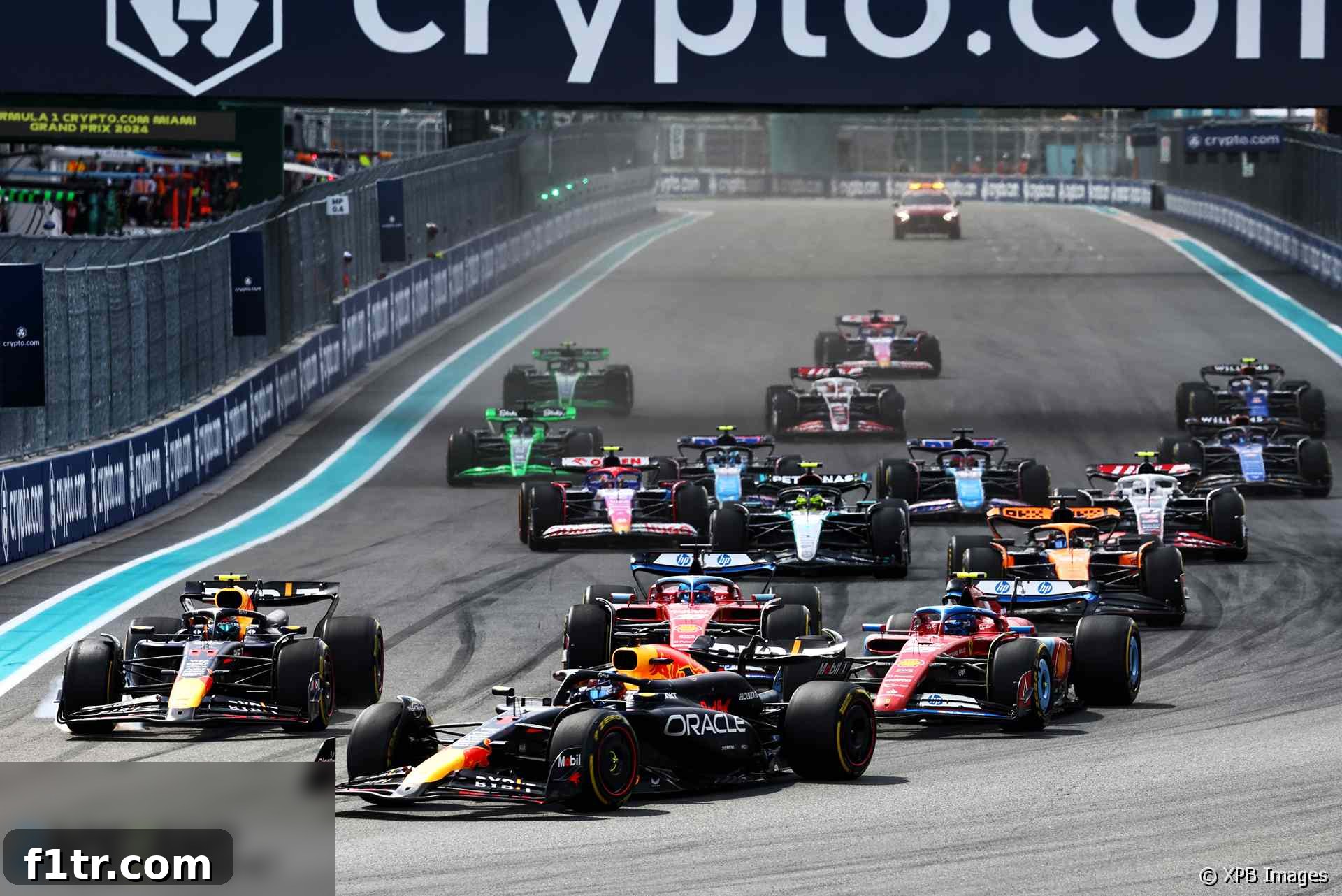
The first flashpoint occurred moments after the start of the Miami Grand Prix. As the twenty-car field aggressively surged into the chaotic Turn 1, a corner renowned for its high potential for contact, Sergio Perez, in his powerful Red Bull, executed an overly ambitious maneuver. Losing significant control of his car, Perez ran wide and slid off the track, creating a perilous situation. In a heart-stopping moment, he narrowly avoided a collision with his own teammate, the championship leader Max Verstappen. The uncontrolled movement also forced several other drivers, including Carlos Sainz and McLaren’s Lando Norris, to take swift evasive action to prevent a multi-car pile-up. This was a clear instance of a driver losing control in a critical section of the track, disrupting the flow of the race for multiple competitors and carrying a high potential for severe consequences.
Despite the undeniable loss of control and the significant jeopardy created for other participants, the race stewards, after reviewing the footage, ultimately concluded that no further action was necessary. Perez was allowed to continue his race without penalty, a decision that, while initially accepted in the heat of the moment, later became a central pillar of Sainz’s post-race protest. The absence of actual contact, and the fact that other drivers successfully avoided collision, appeared to be critical factors in this non-penalty ruling, drawing a subtle yet crucial line between a potentially dangerous action and one that warrants official sanction.
Carlos Sainz’s Collision with Oscar Piastri
Later in the Grand Prix, a separate incident unfolded involving Carlos Sainz and the promising McLaren rookie, Oscar Piastri. The two drivers were locked in an intense wheel-to-wheel battle for position, pushing their cars to the absolute limit. During an overtaking attempt, Sainz’s Ferrari made contact with Piastri’s McLaren. While the collision might not have been deliberate or excessively aggressive, it was sufficient to damage Piastri’s front wing. The damage necessitated an unscheduled pit stop for the Australian driver, effectively derailing his race and dropping him out of contention for valuable points. The impact on Piastri’s race was immediate and substantial.
The race stewards swiftly investigated this contact. Following their review, they determined that Sainz was predominantly responsible for the collision. As a result, a five-second time penalty was imposed on the Ferrari driver, which was applied after the race concluded. This penalty caused Sainz to drop from his finishing position of fourth to fifth in the official results, a direct and measurable consequence of the stewards’ ruling. The key differentiator in this incident, particularly from Sainz’s perspective, was the tangible damage inflicted upon Piastri’s car and the subsequent impact on his race, highlighting the ‘consequence’ aspect in a stark manner.
Sainz’s Stance: The ‘Outcome’ Versus ‘Action’ Dilemma
It is within this context of two similar errors of judgment and car control, yet vastly different outcomes in terms of penalties, that Carlos Sainz articulated his frustration. His central argument critically challenges the FIA’s long-standing assertion that penalties are determined by the ‘action’ of the driver, rather than the ‘outcome’ or ‘consequence’ of the incident.
“I struggle to understand it sometimes,” Sainz admitted with evident perplexity. He meticulously recounted the opening lap incident involving Sergio Perez: “At the start Checo went completely long, lost control of the car, nearly took two guys out. We just were lucky, in a way, to avoid him. He went off the track at the start and there wasn’t a consequence, there was no contact or anything, but it cost [me] a lot [in] my race, it cost a lot [for] other people… and he didn’t get a penalty.” Sainz emphasized the significant disruption Perez caused and the sheer fortune that prevented a larger incident, yet no penalty was levied.
He then drew a direct, unfavorable comparison to his own incident with Oscar Piastri: “I lost minimal control of the car overtaking Oscar, I unfortunately damaged his front wing, he obviously went backwards 15 positions and I got a five-second penalty.” The parallel was clear: both incidents involved a loss of control and created dangerous situations. The pivotal difference, in Sainz’s eyes, was the tangible damage incurred by Piastri, which translated directly into a penalty for him.
Sainz further elaborated on his conviction that the outcome significantly sways the stewards’ judgment, despite official statements to the contrary. “I know we keep thinking we don’t look at the outcome of the [incident],” he stated, directly challenging the prevailing narrative. “In this case I think clearly we’re still looking at the outcome because I’m completely certain that if the front wing of Oscar wouldn’t have had to pit, I would not have got a penalty and everyone would be talking about a good overtake and some good action on a track where it proved to be extremely difficult to overtake and you had to go for a move like that.” This hypothetical scenario powerfully illustrates his belief that a different consequence—no damage—would have led to a completely different interpretation of his maneuver.
Conversely, he reiterated the circumstances of Perez’s incident: “But on the other hand Checo didn’t touch anyone, we all managed to avoid him and there was no penalty. So in my opinion, the consequence is still having a bit of an effect on the penalty that you get, which is something that I don’t fully share or I’m still a bit puzzled about and I struggle with sometimes.” Sainz’s articulate critique reflects a sentiment shared by many within the F1 community: the difficulty in reconciling the stated principles of stewarding with the observed application of penalties.
The Broader Implications: Consistency in Formula 1 Stewarding
Carlos Sainz’s post-Miami comments extend beyond a single race weekend; they resonate with a recurring, foundational debate within Formula 1: the ongoing quest for consistent stewarding. The FIA, as the sport’s governing body, endeavors to ensure fair play and safety through a comprehensive set of sporting regulations. However, the inherent dynamism and often chaotic nature of motor racing mean that no two incidents are ever precisely alike, presenting an almost insurmountable challenge to achieving absolute, unimpeachable consistency.
Race stewards, typically comprised of a rotating panel of experienced officials, including former drivers, face the daunting task of making high-stakes decisions under immense time pressure. They meticulously review incidents from multiple camera angles, analyze telemetry data, and sometimes even consider driver radio communications. Their core mandate is to apply the rulebook impartially, free from any bias towards specific drivers, teams, or championship implications. Yet, the human element of interpretation, combined with the subjective nuances in defining concepts such as “predominantly at fault” or “dangerous driving,” almost inevitably leads to outcomes that are perceived as inconsistent by drivers, teams, and the wider fanbase.
The official position of the FIA has consistently been that the ‘consequence’ of an incident should not be the primary determinant of a penalty. The focus, instead, is meant to be on the ‘action’ itself—whether a driver’s maneuver was reckless, unsafe, or in violation of a specific regulation, irrespective of whether it resulted in a collision, significant damage, or merely an inconvenience. The philosophical underpinning of this approach is to prevent situations where a driver might escape sanction due to a fortunate outcome (a “lucky escape”) or be unduly penalized for an action that was no worse than another, simply because the result was more severe. Sainz’s powerful argument directly challenges the practical application and efficacy of this very principle, suggesting a disconnect between policy and practice.
Impact on Drivers, Teams, and the Sport’s Credibility
Perceived inconsistencies in stewarding decisions carry significant ramifications across various levels of Formula 1. For drivers like Sainz, such experiences can foster deep frustration and subtly influence their approach to aggressive, wheel-to-wheel racing. If a driver internalizes that a robust but fair overtaking maneuver might be penalized solely because a minor contact leads to damage, while a more flagrant loss of control goes unpunished due to sheer luck, it can breed a sense of unfairness. This might inadvertently lead to drivers becoming overly cautious, potentially diminishing the thrilling, close-quarters racing that is a hallmark of Formula 1 and what fans eagerly anticipate. Conversely, it could, in some cases, embolden drivers to push the limits, operating under the assumption that if they avoid actual damage, they might escape official sanction.
For the sport as a whole, consistent and transparent stewarding is absolutely critical for maintaining its integrity, credibility, and appeal. Fans invest emotionally in the races, and when explanations for penalties are vague, contradictory, or absent, it can erode trust and fuel cynicism. Social media platforms frequently become arenas for intense debate following contentious penalties, underscoring the audience’s strong desire for clear, understandable, and uniformly applied rules. The FIA and Formula 1 are continuously striving to enhance this aspect, implementing initiatives such as in-race explanations or more detailed post-race reports to improve transparency. However, the fundamental challenge of balancing the stringent letter of the law with the dynamic spirit of racing remains an intricate and ongoing endeavor.
Looking Ahead: The Ongoing Pursuit of Clarity
Carlos Sainz’s candid and articulate critique following the Miami Grand Prix serves as a timely and important reminder of the complex and often strained relationship between Formula 1 drivers, the rulebook, and the stewards who enforce it. While the underlying intent of the regulations and the dedicated officials is to ensure fair, safe, and exhilarating racing, the high-speed, competitive environment of motorsport frequently presents scenarios that defy straightforward classification and judgment. Sainz’s precise questioning of the ‘consequence’ factor touches upon a fundamental nerve that has long resonated throughout the paddock, among teams, and across the global fanbase.
As the Formula 1 season progresses, the debate surrounding stewarding consistency will undoubtedly resurface, fueled by future on-track incidents. Drivers will continue to push the boundaries of performance and aggression, and stewards will invariably face the challenging task of making difficult, split-second calls under intense scrutiny. The enduring challenge for Formula 1 lies in continuously refining its adjudication processes, significantly enhancing transparency, and cultivating a shared, common understanding among all key stakeholders – including teams, drivers, and the millions of passionate fans – regarding precisely how racing incidents are assessed and judged. Only through such sustained efforts can the perceived inconsistencies be minimized, ensuring that the primary focus of the sport remains firmly fixed on the breathtaking spectacle of racing itself, rather than the controversies that often emerge from the stewards’ room.
2024 Miami Grand Prix Related Content
- 2024 Miami Grand Prix Race Report and Analysis
- Lando Norris’s Maiden Victory: A Turning Point for McLaren
- Understanding F1 Stewarding: Rules, Penalties, and Common Controversies
- Post-Race Driver Reactions and Key Moments from Miami
Browse all 2024 Formula 1 Season articles and analyses